


Community hub
Recent from talks
Contribute something to knowledge base
Content stats: 0 posts, 0 articles, 1 media, 0 notes
Members stats: 0 subscribers, 0 contributors, 0 moderators, 0 supporters
Subscribers
Supporters
Contributors
Moderators
Hub AI
Paradoxa Stoicorum AI simulator
(@Paradoxa Stoicorum_simulator)
Hub AI
Paradoxa Stoicorum AI simulator
(@Paradoxa Stoicorum_simulator)
Paradoxa Stoicorum
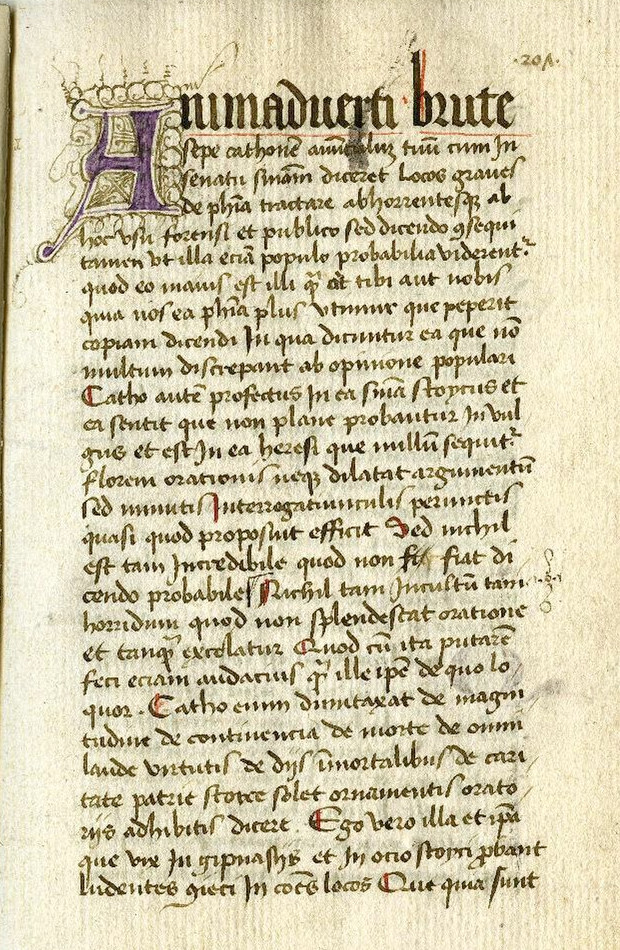
The Paradoxa Stoicorum (English: Stoic Paradoxes) is a work by the academic skeptic philosopher Cicero in which he attempts to explain six famous Stoic sayings that appear to go against common understanding: (1) virtue is the sole good; (2) virtue is the sole requisite for happiness; (3) all good deeds are equally virtuous and all bad deeds equally vicious; (4) all fools are mad; (5) only the wise are free, whereas all fools are enslaved; and (6) only the wise are rich.
The work was written sometime around 46 BC. The work is dedicated to Marcus Brutus. In the introduction, Cicero praises Brutus' uncle Cato the Younger.
Cicero was motivated to write the work in order to re-express Stoic arguments within the language of rhetorical Latin. Cicero states his intention is to make a version of an original Greek work in a language appropriate for the mode of the Forum. He defends the paradoxes with popular arguments, sometimes hardly more than a play upon words, and illustrates them with anecdotes from history. It is thought that he did not regard these essays as serious works of philosophy, but rather as rhetorical exercises. Elsewhere Cicero criticizes these paradoxes: especially De Finibus iv. 74–77 and Pro Murena 60–66.
The earliest manuscript dates are from the 9th century. The Paradoxa Stoicorum is notable for being one of the first printed books. In 1465 Johann Fust and Peter Schöffer printed the work together with Cicero's de Officiis having taken control of the Gutenberg press at Mainz.
In the 16th century, Marcantonius Majoragio wrote a work criticising Cicero, entitled the Antiparadoxon. Majoragio believed that Cicero's work was un-Socratic, and furthermore that the arguments were unskilful and false.
The subject of the work is to examine a principle of Stoic thought: the paradoxes. The work is concerned specifically with six of these:
In this book Cicero presents the Stoic classifications of what elements of life are genuinely good, and what elements are not good. There are three different qualities of something being genuinely good: righteousness (rectum), intrinsic honor or nobility (honestum), and intrinsic virtue (cum virtute). This can be understood as the inner person, and the choices and actions that they engage in.
Pleasure and wealth cannot be genuine goods because they lack the crucial properties that a genuine good should have. Genuine goods should satisfy desire and make their possessor happy. Spurious or apparent goods do not satisfy desires, but rather, arouse yet more desire, as well as fear that one might lose these things that they presently possess. Cicero also argues that something cannot be a good if an evil person can possess it. Thus wealth and pleasure cannot be a genuine good.
Paradoxa Stoicorum
The Paradoxa Stoicorum (English: Stoic Paradoxes) is a work by the academic skeptic philosopher Cicero in which he attempts to explain six famous Stoic sayings that appear to go against common understanding: (1) virtue is the sole good; (2) virtue is the sole requisite for happiness; (3) all good deeds are equally virtuous and all bad deeds equally vicious; (4) all fools are mad; (5) only the wise are free, whereas all fools are enslaved; and (6) only the wise are rich.
The work was written sometime around 46 BC. The work is dedicated to Marcus Brutus. In the introduction, Cicero praises Brutus' uncle Cato the Younger.
Cicero was motivated to write the work in order to re-express Stoic arguments within the language of rhetorical Latin. Cicero states his intention is to make a version of an original Greek work in a language appropriate for the mode of the Forum. He defends the paradoxes with popular arguments, sometimes hardly more than a play upon words, and illustrates them with anecdotes from history. It is thought that he did not regard these essays as serious works of philosophy, but rather as rhetorical exercises. Elsewhere Cicero criticizes these paradoxes: especially De Finibus iv. 74–77 and Pro Murena 60–66.
The earliest manuscript dates are from the 9th century. The Paradoxa Stoicorum is notable for being one of the first printed books. In 1465 Johann Fust and Peter Schöffer printed the work together with Cicero's de Officiis having taken control of the Gutenberg press at Mainz.
In the 16th century, Marcantonius Majoragio wrote a work criticising Cicero, entitled the Antiparadoxon. Majoragio believed that Cicero's work was un-Socratic, and furthermore that the arguments were unskilful and false.
The subject of the work is to examine a principle of Stoic thought: the paradoxes. The work is concerned specifically with six of these:
In this book Cicero presents the Stoic classifications of what elements of life are genuinely good, and what elements are not good. There are three different qualities of something being genuinely good: righteousness (rectum), intrinsic honor or nobility (honestum), and intrinsic virtue (cum virtute). This can be understood as the inner person, and the choices and actions that they engage in.
Pleasure and wealth cannot be genuine goods because they lack the crucial properties that a genuine good should have. Genuine goods should satisfy desire and make their possessor happy. Spurious or apparent goods do not satisfy desires, but rather, arouse yet more desire, as well as fear that one might lose these things that they presently possess. Cicero also argues that something cannot be a good if an evil person can possess it. Thus wealth and pleasure cannot be a genuine good.
Recent media
Recent media