
Recent from talks
Parc Howard Museum
Knowledge base stats:
Talk channels stats:
Members stats:
Parc Howard Museum
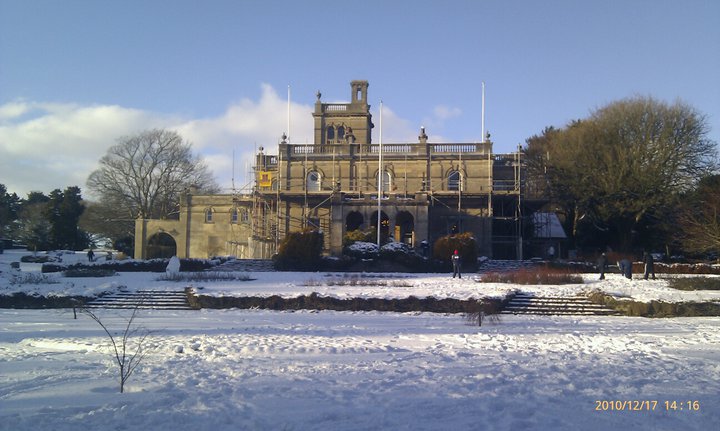
Parc Howard Museum & Art Gallery is a museum in a 19th-century Italianate country house, situated in 24 acres (9.7 ha) of parkland, north of the town centre of Llanelli in Carmarthenshire, Wales. The park is registered on the Cadw/ICOMOS Register of Parks and Gardens of Special Historic Interest in Wales.
The lands originally were home to a far older property, Bryn-y-caerau. In 1559, St Albans lawyer Alban Stepney married into the family of Richard Davies, Bishop of St Davids. On 31 December 1561, the bishop appointed Stepney as receiver-general of the Diocese of St Davids. Stepney also served as its registrar. From this point, Stepney and his descendants built up the Welsh branch of the Stepney family, and their associated estate.
By the early 1800s, part of the original Stepney estate which surrounded Llanelli had been purchased by Mr R. T. Howell, a local business man, Harbour Commissioner, and member of the local Health Board. After Howell's death in 1853, the property passed through his will to James Buckley Wilson, the son of architect James Wilson, and grandson of the Rev. James Buckley. Based in Bath, Somerset, Wilson had no need for such a grand house, and agreed a 99-year lease to his cousin James Buckley (1838–95).
Under the terms of the lease, Buckley commissioned his cousin to design a new large scale addition to the house.[better source needed] However, still wanting more space and to express his money and influence, Buckley recommissioned his cousin in 1882 to undertake a more extensive reconstruction to create the present Italiante style mock-castle in Bath stone, known on opening in 1886 as Brynycaerau Castle.
Originally orientated south-west, Buckley-Wilson reorientated the entrance to the south-east to overlook the earlier structures grounds, the surrounding countryside towards the River Loughor estuary, and onwards towards the sea. He added a central three arched porte cochère (carriage porch) to accommodate the new drive, and the two small symmetrical supporting side extensions with projecting bays. All except the rear elevation are symmetrical, achieved by extending the northwest wing and reconfiguring the out buildings; on all the corners the quoins stand proud. There are square headed windows on the ground floor, and arched windows above. The house is topped by a low pitched slate roof to give a castle-like feel on approach, behind parapets with balustrades and urn finials. There is also a tall belvedere tower rising at the rear. Remodelling the gardens, behind the house sat a kitchen garden with 8 metres (26 ft) pergola and associated small orchard, with access to glasshouses, stables and coachhouse beyond (now converted to council offices and storage). The lodge that was to the south-east of the house has now been demolished. Buckley-Wilson was so proud of the finished structure that it formed part of his application to be admitted as a fellow of the Royal Institute of British Architects.
In 1911, after the deaths of both James Buckley and James Buckley-Wilson, Llanelli Urban Council were looking to secure Parc Howard for development as a civic park and museum. However, the property was in need of extensive renovation and modernisation, and the council budget could not stretch financially to both purchase and renovation. After Sir Arthur Cowell-Stepney died in 1909 in Yuma, Arizona, his daughter, Katherine Meriel Cowell-Stepney, inherited the Stepney estate. In 1911, she became the second wife of the noted Liberal politician Sir Stafford Howard. In January 1912, they offered to fully fund the purchase of the property for £7,750. In February 1912, the parties agreed a 999-year lease, on the conditions that:
These were scoped to allow the property to be opened on the couple's first anniversary, and secondly because Sir Stafford had a belief that local authorities were inclined to be somewhat slow, and this was a way of enforcing progress. As the 1912 Miners' strike was in progress by March, cheap labour was extensively available to complete the project in time at a budget of £4,500. As agreed, the park was opened on 21 September 1912 by Lady Howard on her first wedding anniversary, and included a bandstand and tennis courts.
During the 1930s, the council acquired 5 acres (2.0 ha) of additional land to the north-east, extending today to where Parc Howard Avenue lies. A new entrance was made from Felin Foel Road, and the perimeter path suitably extended.
Hub AI
Parc Howard Museum AI simulator
(@Parc Howard Museum_simulator)
Parc Howard Museum
Parc Howard Museum & Art Gallery is a museum in a 19th-century Italianate country house, situated in 24 acres (9.7 ha) of parkland, north of the town centre of Llanelli in Carmarthenshire, Wales. The park is registered on the Cadw/ICOMOS Register of Parks and Gardens of Special Historic Interest in Wales.
The lands originally were home to a far older property, Bryn-y-caerau. In 1559, St Albans lawyer Alban Stepney married into the family of Richard Davies, Bishop of St Davids. On 31 December 1561, the bishop appointed Stepney as receiver-general of the Diocese of St Davids. Stepney also served as its registrar. From this point, Stepney and his descendants built up the Welsh branch of the Stepney family, and their associated estate.
By the early 1800s, part of the original Stepney estate which surrounded Llanelli had been purchased by Mr R. T. Howell, a local business man, Harbour Commissioner, and member of the local Health Board. After Howell's death in 1853, the property passed through his will to James Buckley Wilson, the son of architect James Wilson, and grandson of the Rev. James Buckley. Based in Bath, Somerset, Wilson had no need for such a grand house, and agreed a 99-year lease to his cousin James Buckley (1838–95).
Under the terms of the lease, Buckley commissioned his cousin to design a new large scale addition to the house.[better source needed] However, still wanting more space and to express his money and influence, Buckley recommissioned his cousin in 1882 to undertake a more extensive reconstruction to create the present Italiante style mock-castle in Bath stone, known on opening in 1886 as Brynycaerau Castle.
Originally orientated south-west, Buckley-Wilson reorientated the entrance to the south-east to overlook the earlier structures grounds, the surrounding countryside towards the River Loughor estuary, and onwards towards the sea. He added a central three arched porte cochère (carriage porch) to accommodate the new drive, and the two small symmetrical supporting side extensions with projecting bays. All except the rear elevation are symmetrical, achieved by extending the northwest wing and reconfiguring the out buildings; on all the corners the quoins stand proud. There are square headed windows on the ground floor, and arched windows above. The house is topped by a low pitched slate roof to give a castle-like feel on approach, behind parapets with balustrades and urn finials. There is also a tall belvedere tower rising at the rear. Remodelling the gardens, behind the house sat a kitchen garden with 8 metres (26 ft) pergola and associated small orchard, with access to glasshouses, stables and coachhouse beyond (now converted to council offices and storage). The lodge that was to the south-east of the house has now been demolished. Buckley-Wilson was so proud of the finished structure that it formed part of his application to be admitted as a fellow of the Royal Institute of British Architects.
In 1911, after the deaths of both James Buckley and James Buckley-Wilson, Llanelli Urban Council were looking to secure Parc Howard for development as a civic park and museum. However, the property was in need of extensive renovation and modernisation, and the council budget could not stretch financially to both purchase and renovation. After Sir Arthur Cowell-Stepney died in 1909 in Yuma, Arizona, his daughter, Katherine Meriel Cowell-Stepney, inherited the Stepney estate. In 1911, she became the second wife of the noted Liberal politician Sir Stafford Howard. In January 1912, they offered to fully fund the purchase of the property for £7,750. In February 1912, the parties agreed a 999-year lease, on the conditions that:
These were scoped to allow the property to be opened on the couple's first anniversary, and secondly because Sir Stafford had a belief that local authorities were inclined to be somewhat slow, and this was a way of enforcing progress. As the 1912 Miners' strike was in progress by March, cheap labour was extensively available to complete the project in time at a budget of £4,500. As agreed, the park was opened on 21 September 1912 by Lady Howard on her first wedding anniversary, and included a bandstand and tennis courts.
During the 1930s, the council acquired 5 acres (2.0 ha) of additional land to the north-east, extending today to where Parc Howard Avenue lies. A new entrance was made from Felin Foel Road, and the perimeter path suitably extended.
Recent media