Hubbry Logo
BandstandBandstandMain
Open search
Bandstand
Community hub
Bandstand
logo
8 pages, 0 posts
0 subscribers
Be the first to start a discussion here.
Bandstand
Bandstand
from Wikipedia
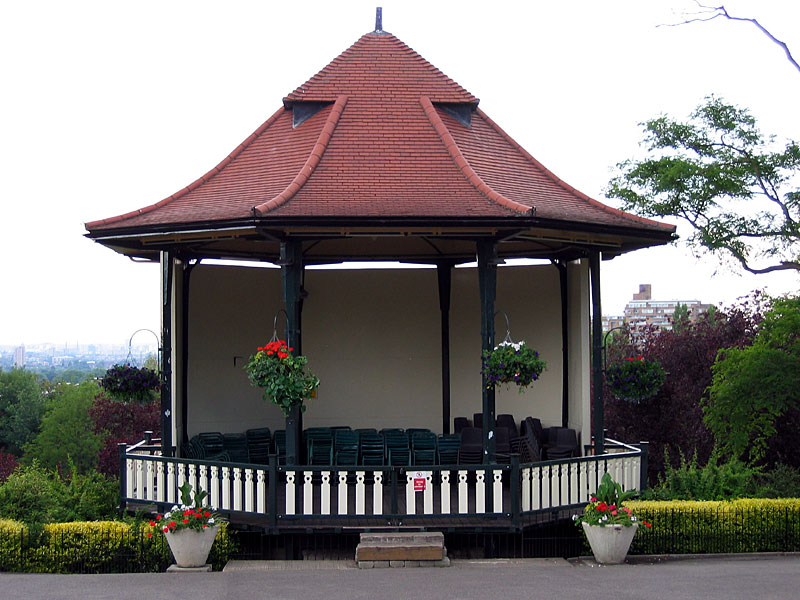
A bandstand built in 1912 stands in the grounds of the Horniman Museum in London
Bandstand at Sefton Park, Liverpool, England
Victorian bandstand in Eastleigh, UK
Ocean Park bandstand, Oak Bluffs, Martha's Vineyard, Massachusetts
The bandstand in Ynysangharad Park, Pontypridd, south Wales.

A bandstand (sometimes music kiosk) is a circular, semicircular or polygonal structure set in a park, garden, pier, or indoor space, designed to accommodate musical bands performing concerts. A simple construction, it both creates an ornamental focal point and also serves acoustic requirements while providing shelter for the changeable weather, if outdoors. In form bandstands resemble ornamental European garden gazebos modeled on outdoor open-sided pavilions found in Asian countries from early times.

Origins

[edit]

During the 18th and 19th centuries this type of performance building was found in the fashionable pleasure gardens of London and Paris where musicians played for guests dining and dancing. They were later built in public spaces in many countries as practical amenities for outdoor entertainment.

Many bandstands in the United Kingdom originated in the Victorian era as the British brass band movement gained popularity. Smaller bandstands are often not much more than gazebos. Much larger bandstands such as that at the Hollywood Bowl may be called bandshells and usually take a shape similar to a quarter sphere. Though many bandstands fell into disuse and disrepair in the post-World War II period, the cultural project the Bandstand Marathon has seen bandstands across the UK utilized for free live concerts since 2008.

History in Britain

[edit]

The parks where most bandstands are found were created in response to the Industrial Revolution, when local authorities realized worsening conditions in urban areas meant there was an increasing need for green, open spaces where the general public could relax. The first bandstands in Britain were built in the Royal Horticultural Society Gardens, South Kensington in 1861. Bandstands quickly became hugely popular and were considered a necessity in parks by the end of the 19th century.

To assist the war effort during World War II, iron fittings were removed from many bandstands to be melted down and transformed into weapons and artillery. Many bandstands fell into disrepair and were boarded up in the late 1940s and 1950s. Other attractions – such as the cinema and television – were becoming increasing popular and traditional recreational parks lost much of their appeal.

Between 1979 and 2001, more than half of the 438 bandstands in historic parks across the country were demolished, vandalized or in a chronic state of disuse. In the late 1990s the National Lottery and Heritage Lottery Fund invested a substantial sum in the restoration and rebuilding of bandstands across the country. As a result of this funding, over eighty bandstands were either fully restored or replaced. Between 1996 and 2010 there was over £500 million worth of investments in parks - a significant chunk of this money was spent on the restoration and building of bandstands.[1]

History in United States

[edit]

Gazebo bandstands appeared in the United States after the Civil War (1861–65) to accommodate the brass and percussion "cornet" bands found in towns of every size. Styles ranged from exotic ″Moorish″ designs to ordinary wood pavilions with mill work trim. They were found in parks, court house squares and fairgrounds. Following the Worlds Columbian Exposition (world's fair) of 1893 in Chicago, amusement parks based on the famous Midway became popular. These were often established by trolley companies to provide a trolley destination on weekends. Bandstands and dance pavilions were an essential feature of these parks. Most are no longer in existence.

After 1900, rectangular pavilions enclosing a stage and acoustical shell providing directional sound appeared in many parks. Styles of acoustical shells took several forms during the 20th century. In 1913 Frank Lloyd Wright designed a freestanding bandshell with edge–supported cantilever roof and no side posts for his Midway Gardens (demolished 1929) in Chicago.[2] Variations on this design were built later in the century.

The 1928 Hollywood Bowl shell in California designed by Wright's son Lloyd Wright was a prototype for the streamlined concrete bandshell of the 1930s. Many of these shells with their distinctive concentric arches survive as landmarks in parks across the US.

Preservation of historic bandstands is by local initiative. Some are on the National Register of Historic Places, usually as part of a historic district. Continuous use as performing venues is a good incentive to keep them maintained. When this is not possible they must be maintained solely as historic landmarks. In many places a succession of bandstands, sometimes as many as three or four, were built on the same site. Because of this practice it is important to preserve postcards and photographs of earlier structures as a historical record.

Notable bandstands

[edit]

England

[edit]

In 1993, the Deal Memorial Bandstand was opened as memorial to the eleven bandsmen killed by 1989 Deal barracks bombing.[3] The bandstand was erected by public subscription and is maintained by volunteers.

Eastbourne bandstand opened in 1935

A good example of a semi-circular bandstand is the Eastbourne Bandstand, built in 1935 to replace a circular bandstand that stood on cast iron stilts.[4] Herne Bay, Kent contains a totally enclosed bandstand with a stage and cafe area, topped with copper-clad domes.[5]

There is a very old bandstand at Horsham's Carfax, built in 1892 by Walter Macfarlane & C at the Saracen Foundry in Glasgow, and another one in its adjacent park. It was moved slightly from its original location, to better accommodate pedestrians and then refurbished in 1978 with funds raised by the Horsham Society and with council funding. In 1992, the original design was rediscovered in museum archives and it was then restored to its original colour scheme.[6]

Cornwall

[edit]

Scotland

[edit]

Scotland's many ironwork foundries and manufacturers built bandstands that were subsequently erected at locations throughout the United Kingdom.[7][8]

Langholm Town Bandstand built in 2008 in the Scottish Borders
A modern Bandstand located in Waterlooville, Hampshire, England. Built in September 2012

Some of the most notable bandstands in Scotland are located at:

Wales

[edit]
Aberystwyth Bandstand, reopened in 2016

United States

[edit]

Worldwide

[edit]
Bandstand at Royal Palace, Sarahan, India
Bandstand in Hanoi, Vietnam

In arts, entertainment, and literature

[edit]

The function of the bandstand inspired the names of:

Movies and cinema:

  • In The Beatles animated film The Yellow Submarine (1968) John, Paul, George and Ringo find a Grand Bandstand with enough stored instruments to recreate Sgt. Pepper's Lonely Hearts Club Band and musically liberate Pepperland from the Blue Meanies. Ringo frees the Pepperland musicians trapped on their bandstand inside a giant bubble.

Musical compositions:

  • "The Bandstand, Hyde Park (La Kiosque de Hyde Park)" movement 3 of "Frescoes (Fresques) Suite" by Haydn Wood. London: Boosey & Hawkes QMB Edition no. 78 (military band)
  • "The Silver Gazebo" (1996) march by James Barnes. San Antonio, Texas: Southern Music Company (Kelly Bandstand in South Park, Lawrence, Kansas)

Works of art and design:

  • Bandstand in Vauxhall Gardens, London, color engraving by Muller (1751)
  • A General Prospect of Vaux Hall Gardens, color engraving drawn by Samuel Wale and engraved by I.S. Muller (c.1751)
  • The Dancing Pavilion at Cremorne Gardens London, oil painting by Phoebus Levin (1864)
  • Le Dimanche, musique à la campagne, painting by Raoul Dufy (1942–43)
  • Chatham, Massachusetts band concert in Kate Gould Park, painting by Grace Chapin
  • ″The Coronation Pavilion also known as the Royal Bandstand″ Honolulu, counted cross stitch design by Frances L. Johnson Designs, Honolulu, Hawaii
  • The Great Bandstand Design Competition: Exhibition, 2 May–5 July 1987, Allen Memorial Art Museum, Oberlin, Ohio (architectural drawings)

See also

[edit]

Citations

[edit]
  1. ^ Rabbitts, Paul A (2011). Bandstands. Oxford: Shire Publications. ISBN 978-0-74780-825-1.
  2. ^ Kruty, Paul (1998). Frank Lloyd Wright and Midway Gardens. Urbana and Chicago: University of Illinois Press. pp.37–39. ISBN 0-252-02366-8
  3. ^ Deal Memorial Bandstand
  4. ^ Eastbourne Bandstand
  5. ^ Herne Bay Central Bandstand, archived from the original on 2006-10-01
  6. ^ Horsham Carfax Bandstand, archived from the original on 2007-01-25
  7. ^ The Bandstand Marathon: Bandstands of Scotland, archived from the original on 2010-06-14, retrieved 2010-07-14
  8. ^ Bandstands on Scotland Iron Work website, archived from the original on 2006-06-21
  9. ^ "Aberystwyth replacement bandstand put on hold after storms". BBC News. 2014-01-17. Retrieved 2025-05-05.
  10. ^ Town Park Bandstand, Etc, archived from the original on 2019-10-29
  11. ^ Warwick, Jane (Spring 2017). "Banding together". Heritage New Zealand. 146: 22–25.

General and cited sources

[edit]
  • Martin, Linda and Kerry Segrove (1983). City Parks of Canada. Oakville, Ontario: Mosaic Press.
  • Mussat, Marie–Claire (1992). La Belle Epoque des Kiosques à Musique. Paris: Du May. ISBN 2-906450-63-4. (International)
  • Starr, S. Frederick, ed. (1987). The Oberlin Book of Bandstands. Washington DC: Preservation Press. ISBN 0-89133-128-X. (United States)
[edit]
Revisions and contributorsEdit on WikipediaRead on Wikipedia
from Grokipedia
![Victorian bandstand in Eastleigh][float-right] A bandstand is a roofed outdoor platform, usually circular, octagonal, or semi-circular in design, constructed in public parks, gardens, promenades, or seaside resorts to serve as a stage for live musical performances by bands, orchestras, and other ensembles. These structures, often elevated and open-sided to allow audiences to gather around, emerged as symbols of cultural refinement and public recreation, particularly in the when municipal parks proliferated to foster health, leisure, and community gatherings. Bandstands trace their origins to 17th- and 18th-century pleasure gardens in , where temporary or simple pavilions hosted orchestras, evolving into purpose-built, domed designs by the mid-19th century—the first such iron-domed "band house" appearing in London's gardens in 1861. Their proliferation accelerated in Britain during the late 19th and early 20th centuries, fueled by the rise of brass bands and an "insatiable appetite" for outdoor music among working-class audiences, leading to approximately 1,500 bandstands across parks, piers, and coastal areas by the . Architecturally, they featured ornate , cast-iron columns, and decorative roofs, reflecting advances and aesthetic tastes of the time, with many now recognized for historic value—over 140 in alone listed for preservation. The cultural zenith of bandstands waned after due to material shortages, shifting entertainment preferences toward amplified music and indoor venues, and , resulting in widespread dereliction and demolition. Recent decades have seen revival efforts, including restorations of notable examples like Eastbourne's Grand Parade bandstand and community-driven projects in places such as , underscoring their enduring role as communal focal points for music and heritage. While controversies are minimal, debates persist over maintenance costs and versus preservation, with some structures repurposed for modern events amid declining traditional activity.

Definition and Characteristics

Architectural Features and Design Principles

Bandstands generally consist of a raised circular, semicircular, or polygonal platform enclosed by an open-sided topped with a , facilitating elevated performances while allowing unobstructed views and projection for audiences seated on surrounding grounds. The platform elevation, typically 1 to 2 meters above ground, provides performers separation from crowds and aids in directing acoustics outward. Access occurs via steps or ramps at one or more entry points, often flanked by decorative railings. Roof designs emphasize acoustic enhancement through curved or bell-cast profiles that reflect sound waves toward listeners, as seen in shell-like canopies or convex rear walls which minimize distortion and amplify projection without electronic aids. Overhanging offer weather protection for musicians while integrating ornamental elements like finials or to harmonize with landscapes. Construction prioritizes durable, lightweight materials such as frameworks for , paired with wooden and zinc or tiled roofs for resistance and ease of assembly. In rustic variants, peeled logs on stone bases evoke natural integration, while polygonal shapes—common in octagonal or dodecagonal forms—optimize space efficiency and aesthetic . These principles balance functionality, with open walls ensuring 360-degree audibility, against elemental exposure, often mitigated by modular for transport and erection in public spaces.

Materials and Construction Methods

Bandstands traditionally employed for columns, railings, and decorative features due to its durability and capacity for intricate molding, particularly in 19th-century designs. Molten cast iron was poured into sand molds formed from wooden patterns, enabling repeatable ornate elements like balustrades and supports, which were then assembled on-site. Wood served as a primary material for flooring, roof framing, and rustic constructions, often in peeled log pavilions elevated on stone or concrete bases to resist weathering. Later examples incorporated structural steel for enhanced strength, sometimes combined with cast iron components and corrugated steel or copper roofing. Construction methods emphasized prefabrication for efficiency, with iron elements bolted or riveted together atop prepared concrete foundations to ensure stability on uneven park terrain. Railings were traditionally fixed using lead set into coping stones, while welding appeared in select repairs or modern adaptations. Foundations prohibited perishable materials like stone or brick in some regulations, favoring portable iron assemblies.

Historical Origins and Development

Early Precursors and Etymology

The term bandstand emerged in the mid-19th century to describe a raised, often roofed outdoor platform designed for musical ensembles, particularly bands, to perform from while providing shelter and acoustic projection to audiences. Its etymology derives straightforwardly from "band," referring to a musical group in the sense established by the , combined with "stand," denoting an elevated structure or platform, with the compound first attested in 1852. The records the earliest printed use in 1859, in Australian author John Lang's writings, reflecting the growing popularity of organized and bands in public spaces during that era. Early precursors to the modern bandstand appeared in the pleasure gardens of 17th- and 18th-century Europe, where temporary wooden stages, gazebos, or open pavilions hosted orchestral and band performances amid landscaped grounds frequented by the public for leisure and entertainment. Venues such as London's Vauxhall Gardens, operational from 1732, featured raised platforms for musicians amid supper boxes and promenades, fostering communal listening experiences that prefigured the dedicated structures of later parks, though these were often ephemeral and integrated into broader garden architecture rather than purpose-built for acoustics or band isolation. Similarly, in continental Europe, seasonal bandstands or music alcoves in public gardens, such as those in Lisbon's Passeio Público from the late 18th century, evolved from festival tents and improvised risers used for military and civilian ensembles during civic events. These arrangements prioritized visibility and weather protection for performers over the ornate, cast-iron designs that characterized Victorian-era bandstands, marking a transition from ad hoc setups to formalized civic amenities as urbanization and band movements expanded.

19th-Century Proliferation in Europe and North America

![Victorian bandstand in Eastleigh][float-right] During the in Britain, bandstands proliferated as integral features of the emerging public parks system, designed to foster moral improvement and physical health among the working classes through structured leisure activities. The construction of purpose-built bandstands accelerated from the mid-19th century, coinciding with the expansion of municipal parks under acts like the Public Health Act of 1875, which encouraged local authorities to provide recreational spaces. The earliest notable example was the iron domed bandstand erected in 1861 at the Royal Horticultural Society's gardens in , , marking a shift from temporary setups to permanent, acoustically optimized structures. By the late 19th century, over 1,500 bandstands dotted British parks, promenades, and seaside resorts, reflecting the era's enthusiasm for brass band music as a form of accessible public entertainment. This architectural trend was driven by the surge in amateur and professional brass bands, which performed regularly to audiences numbering in the thousands, such as the 10,000 attendees at weekly concerts in major urban parks. Bandstands were often elaborately designed with canopies to project sound outward while shielding musicians from weather, and their placement in open spaces enhanced communal gatherings without disrupting formal garden layouts. Seaside towns like saw early adoptions, with structures like the 1884 bandstand on exemplifying the integration of music venues into . The popularity stemmed from brass bands' role in promoting civic pride and social order, as local councils subsidized performances to counter urban vice with wholesome recreation. In , bandstands emerged later in the , influenced by European models but adapted to the rapid urbanization and growth of community bands in the United States and . Brass bands, which proliferated from the 1850s onward with the adoption of saxhorns and cornets, initially performed in ad hoc settings like town squares, but dedicated structures appeared toward the century's end as parks developed in cities. For instance, early bandstands were documented at posts like by 1870, supporting regimental bands that entertained troops and civilians. Municipal adoption accelerated in the 1880s and 1890s, with examples such as the first permanent bandstand in Bronson Park, , installed around 1890 to host local ensembles. By the close of the 19th century, many American towns featured central bandstands for weekly concerts, mirroring European practices but often simpler in design due to resource constraints in growing settlements. These venues hosted diverse events, from political rallies to Fourth of July celebrations, underscoring bands' role in fostering national identity and community cohesion amid industrialization. In , similar developments occurred in urban parks, though documentation remains sparser compared to the U.S. The proliferation reflected a transatlantic exchange, as American band traditions drew directly from British and continental influences, with immigrants bringing and .

20th-Century Adaptations and Global Spread

In the early , bandstand designs adapted to improve acoustics and durability, evolving from open Victorian pavilions to more enclosed bandshells that reflected sound toward audiences. Wright's 1913 freestanding bandshell design exemplified this shift, featuring edge-supported arches for enhanced projection without obstructing views. Such innovations addressed limitations of earlier wooden structures, which were prone to , by incorporating reinforced materials like and for longevity in public parks. Global dissemination accelerated through British colonial networks, with bandstands constructed in dominions and territories to replicate European park traditions. In , early 20th-century examples proliferated as symbols of civic pride, such as the Queen Alexandra Bandstand in , erected in 1908 and named during a royal visit, and the Moore Park Rotunda in , built in 1907 at a of 355 pounds for municipal band performances. The Titanic Memorial Bandstand in , completed in 1915, showcased exotic architectural motifs, blending local craftsmanship with imperial influences. In , colonial authorities installed bandstands in urban green spaces to foster public recreation and displays, continuing into the 20th century. Mumbai's Cooperage Bandstand, established in 1867 but actively used through the early 1900s, hosted regimental performances, while Kolkata's bandstand adjoined grounds for integrated leisure events. received a bandstand in 1930, reflecting ' adoption of British aesthetics. These structures typically featured octagonal forms with domed roofs supported by eight columns, adapted minimally to tropical climates but retaining European ornamentation. Further adaptations emerged mid-century as electrification enabled amplification, reducing reliance on natural acoustics and allowing smaller ensembles in existing pavilions. Post-World War II, while many European bandstands declined due to competing media like radio, colonial legacies persisted, with South Asian examples like Bangalore's Cubbon Park bandstand repurposed for diverse cultural events by the . In Africa, brass band traditions from 19th-century military units influenced informal performances, though dedicated bandstands remained less documented outside settler communities. By the late , restorations in and incorporated modern materials like fibreglass for revival, sustaining bandstands as multifunctional venues amid .

Regional Histories

Bandstands in Britain

Bandstands emerged prominently in Britain during the , coinciding with the expansion of public parks designed to foster physical health, moral improvement, and communal recreation for urban populations. These structures served as dedicated platforms for musical performances, particularly by and military bands, which provided accessible entertainment and reinforced social order through disciplined public gatherings. The earliest purpose-built bandstands trace to the mid-, evolving from temporary setups in pleasure gardens of the 17th and 18th centuries. The first recorded domed bandstand, initially termed a "band house," was constructed in 1861 using iron at the Royal Horticultural Society's gardens in , , marking a shift toward permanent, architecturally distinct pavilions. By the late , their popularity led to widespread installation, with nearly every municipal park and featuring one, totaling over 1,500 across Britain by their zenith before . Concentrated in urban parks and coastal promenades, bandstands exemplified Victorian engineering, often fabricated from by specialized foundries and adorned with ornate canopies, railings, and decorative motifs to enhance aesthetic appeal and acoustic projection. Seaside examples, such as those in and , catered to holidaymakers, hosting regular concerts that drew crowds exceeding 10,000 in major venues during peak seasons. Inland parks like those in and integrated bandstands as central features, promoting outdoor leisure amid industrial cityscapes. Postwar decline stemmed from reduced funding for live music, the rise of radio and recorded entertainment, and , resulting in demolitions or neglect of many structures. Preservation efforts intensified from the late , with over 110 bandstands restored through heritage initiatives, including listings by for their architectural and cultural value; notable survivors include the early 20th-century bandstand in Heaton Park, , and the 1935 structure in . Contemporary uses blend historical concerts with diverse events, sustaining their role in public spaces despite fewer than 200 remaining functional today.

Bandstands in the United States

Bandstands proliferated across the United States in the late 19th and early 20th centuries, driven by the post-Civil War surge in popularity of brass and military-style bands as public entertainment. These structures emerged in parks, town squares, fairgrounds, and resorts to host open-air concerts by community ensembles, reflecting a broader cultural emphasis on accessible music amid urbanization and leisure expansion. Early adoption tied to the growth of domestic band traditions, with hundreds of local groups forming nationwide by the 1880s, supported by advances in affordable brass instruments. Documented examples date to the 1870s, such as provisional bandstands at military installations like in , where maps from 1870 show platforms on parade grounds for regimental performances. Civilian constructions followed, with the first permanent bandstand in Kalamazoo, Michigan's Bronson Park erected in 1899 as a square pavilion under a four-sided gabled roof, catering to the rising demand for outdoor band music. In resort settings, Ocean Park in , featured a bandstand by 1885, integrated into Methodist campgrounds for summer concerts and events like fireworks displays. Regional variations emphasized acoustic functionality and modest grandeur; in , bandstands appeared around the alongside bands, evolving from simple platforms to enclosed polygonal designs with hipped or domed and wooden columns for sound projection. Notable instances include City's Washington Bandstand (1911), a round structure with a domed , and Frankfort's TPA Bandstand (circa 1913), a two-story built for municipal performances. Wooden construction predominated for affordability, often elevated on resonant platforms to amplify tones, symbolizing civic pride and investment in musical heritage akin to libraries or schools. By the early 1900s, bandstands dotted urban greenspaces and national historic sites, such as the reconstructed 1870s-era pavilion at National Historic Site, underscoring their role in and traditions. These venues facilitated regular summer series by volunteer or professional bands, peaking before radio and recorded music shifted entertainment indoors, though many endured as focal points for local identity.

Bandstands in Other Regions

In , bandstands proliferated during the Federation era (1901–1910s), often erected as memorials or civic enhancements in public parks. The Queen Bandstand in , opened in 1908 and named by the and , exemplifies early 20th-century designs honoring royalty and supporting performances. Similarly, the Titanic Memorial Bandstand in , constructed in 1915, featured exotic rural to commemorate the disaster while hosting local ensembles. The Moore Park Rotunda in , built in 1907–1908 at a cost of £355 by the Government Architect, facilitated municipal concerts amid growing urban recreation demands. These structures, frequently octagonal and cast-iron, reflected British influences adapted to colonial contexts, with many preserved as heritage sites despite mid-20th-century declines in live band events. New Zealand adopted similar "band rotundas," with over 100 constructed nationwide by the early to accommodate enthusiasm. The Albert Park Bandstand in , completed in 1901, stands as the region's oldest surviving example, initially hosting military and civilian performances in a cast-iron octagonal form. Structures in , , and other locales, often ornate ironwork pavilions, served community gatherings until automobile culture and recorded music reduced their use post-1930s, though restoration efforts continue for . In , bandstands emerged in western towns and parks from the late , providing elevated platforms for brass bands and civic events. The Bandstand in , erected in 1910 by the town council for $500, supported local performances until relocation to Heritage Park for preservation. The Waskesiu Bandstand in , log-built by relief workers in the 1930s, overlooked lakeside venues for seasonal concerts. Saskatoon's Memorial Bandstand, dedicated post-1917 to honor Canadian forces at Vimy Ridge, underscores wartime commemorative roles, with ongoing use for public music amid broader North American trends. Asian bandstands trace to colonial eras, functioning as open pavilions for Western-style and civic bands. In British India and successors, structures like those in Cubbon Park, Bangalore, hosted regimental performances from the , blending European gazebos with local landscaping. Singapore's Botanic Gardens Bandstand, dating to the 1860s, exemplified Victorian philanthropy for public recreation. In , bandstands built in the late promoted cultural dissemination and through free concerts, often funded jointly by government and donors. introduced brass bands via Western influences by the late 1800s, leading to pavilion-like venues for displays, though indigenous adaptations persisted into the . These relics, now largely ornamental, highlight imported traditions amid regional musical evolutions.

Social and Cultural Significance

Role in Community and Public Life

Bandstands traditionally served as venues for outdoor musical performances that anchored public recreation and social interaction in parks, gardens, and seaside resorts. Emerging prominently in the amid rapid , these structures facilitated free access to live , drawing diverse crowds for concerts, dances, and informal gatherings that promoted physical and communal bonding in purpose-built . In Britain, where over 1,500 bandstands dotted landscapes by their peak in the early , they embodied a deliberate civic effort to counter industrial-era ills through organized leisure, with performances often scheduled weekly to encourage regular attendance. This role extended to reinforcing social norms and patriotism; music at bandstands was promoted as a morally uplifting force, fostering discipline and collective identity without commercial barriers, as evidenced by their integration into municipal park designs emphasizing egalitarian access. In the United States, 19th-century bandstands hosted brass ensembles for civic occasions like Independence Day parades and militia drills, where performances numbered in the thousands annually across towns, serving as non-coercive mechanisms for community solidarity and national pride amid post-Civil War reconstruction. Beyond entertainment, bandstands enabled multifaceted public life by accommodating speeches, ceremonies, and holiday events, functioning as adaptable civic platforms that sustained local traditions and in eras predating widespread . Historical records indicate their causal link to heightened park usage, with attendance spikes during band seasons correlating to broader initiatives, though decline set in post-World War II due to competing amusements. In regions like , they persist as grassroots hubs for ongoing community activities, illustrating enduring utility in non-Western contexts.

Association with Brass Bands and Musical Traditions

Bandstands served as primary venues for brass band performances, accommodating the ensembles' reliance on loud brass and percussion instruments suited to open-air acoustics and large audiences. In 19th-century Britain, where brass bands emerged as a working-class amid industrialization, these structures enabled regular public concerts in parks and resorts, elevating music as a tool for social discipline and community bonding. The proliferation of bandstands—reaching up to 1,500 in Britain by the late 1800s—directly responded to the explosion of bands, with approximately 40,000 active groups and 800,000 players by the end of Queen Victoria's reign in 1901. Sponsored by industrialists and collieries, bands used bandstands for weekly performances that drew massive crowds, such as 50,000 at a single event in , fostering civic pride and moral uplift through accessible entertainment. This association extended musical traditions rooted in standardized all-brass instrumentation—typically 28-30 players including cornets, tenor horns, and euphoniums—performing marches, hymn tunes, and arrangements of classical repertoire by composers like Holst and Vaughan Williams. Competitions, often held outdoors near bandstands, such as the annual Belle Vue contests in attracting 24,000 spectators by the 1890s, reinforced technical precision and communal participation, distinguishing bands from or orchestral forms. In the United States, post-Civil War bandstands similarly hosted town bands for civic events, parades, and parks concerts, adapting British influences to local and community groups with saxhorns and cornets for mellow, projecting tones. This transatlantic link underscored bandstands' role in democratizing traditions, prioritizing volume and endurance over stringed subtlety for proletarian audiences.

Decline and Modern Revival

Factors Contributing to Decline

The decline of bandstands in the mid-20th century was markedly accelerated by the material demands of , during which many iron and steel structures were dismantled and recycled for munitions production as part of broader scrap drives in Britain and other Allied nations. In Britain, this contributed to severe losses: London's pre-war total of nearly 100 bandstands fell to about 50, lost 17 of its 18, and retained just one. Overall, approximately 600 bandstands were lost across the between 1945 and 1980, often due to wartime damage, neglect during , and post-war austerity limiting repairs. Parallel to these physical losses, technological innovations in entertainment eroded the cultural role of bandstands by providing accessible alternatives to live outdoor music. The widespread adoption of radio (referred to as the "" in Britain) from the 1920s onward, followed by cinema's expansion and television's rise after 1945, shifted public leisure toward private, indoor consumption of recorded and broadcast performances, reducing reliance on local brass bands and public concerts. By the late , many bandstands stood idle or were boarded up as audience turnout dwindled amid these changes, with traditional band traditions further undermined by the of music and competition from dance halls and recorded media. Economic and demographic shifts post-World War II compounded the neglect, as urban park budgets prioritized other infrastructure amid suburbanization and rising car ownership, which fragmented community gatherings. In the United States, similar patterns emerged with the decline of professional and military bands after World War I, intensified by post-1945 electrification of rural areas and the boom in home entertainment, though fewer structures were scrapped compared to Britain due to less acute metal shortages. Maintenance costs for aging Victorian and Edwardian designs, often ornate and exposed to weather, became prohibitive without dedicated funding, leading to widespread dereliction by the 1950s.

Preservation Efforts and Contemporary Uses

In the United Kingdom, preservation efforts for historic bandstands have intensified since the late 20th century, often driven by local councils, community groups, and heritage organizations to prevent demolition and restore architectural integrity. For instance, the Grade II-listed bandstand in Sunderland's Roker Park underwent full restoration in a specialist workshop during the winter of 2025, funded by local government initiatives. In Beckenham Recreation Ground, a £245,000 project completed in 2024 refurbished the structure's ironwork and fencing, revitalizing a site linked to early performances by David Bowie. Similar campaigns in Todmorden's Centre Vale Park, where a community group formed in 2019 successfully opposed demolition plans, highlight grassroots involvement in securing funding for repairs to cast-iron elements and foundations. The Birmingham Botanical Gardens bandstand, dating to 1874, was meticulously restored in 2021 over six months, returning it to its original design while addressing decay from weathering. In the United States, restorations emphasize seismic retrofitting, material replacement, and historical fidelity, supported by park districts and preservation societies. Chicago's Garfield Park Bandstand, constructed in 1897, received a $2.2 million overhaul announced in June 2025 to repair decades of neglect, including structural reinforcements for resumed performances. The 1876 Music Stand in Lafayette Park, , began restoration to its Victorian form, focusing on acoustic enhancements and ornamental details through conservancy . In Belmont, , the 1908 Village Bandstand was repainted and reroofed with cedar shakes between 2013 and 2014, enabling continued community events. These projects often incorporate modern utilities like , as seen in , , where post-restoration additions facilitated amplified performances. Contemporary uses of preserved bandstands center on live music, public gatherings, and cultural programming, adapting their acoustic and communal roles to modern contexts without altering core functions. In , the 1884 beachfront bandstand, refurbished in 2009, hosts concerts and is available for private rentals such as weddings. New constructions, like the demountable timber bandstand installed in Fair Green in 2025, support annual festivals with raised stages for local performers. Restored sites in parks continue to feature free summer concerts and community events, fostering social cohesion akin to their Victorian origins, as evidenced by ongoing series in regenerated venues like Handsworth Park, Birmingham, revived since the 1990s. This revival counters mid-20th-century decline from amplified sound shifts, prioritizing open-air, unamplified traditions where feasible.

Notable Bandstands

Exemplary Structures in Britain

The bandstand in South Marine Park, , , represents a well-preserved example of seaside from the late Victorian period, featuring elements and an open-fronted design that facilitated acoustic projection for bands entertaining holidaymakers. Constructed around the turn of the , it hosted regular performances that drew crowds from nearby industrial areas, underscoring the role of such structures in promoting public recreation amid rapid . In Portsmouth's Victoria Park, the bandstand, erected in the 1890s, exemplifies municipal investment in leisure facilities during the , with its polygonal form and decorative railings designed by local engineers to withstand coastal conditions. This structure survived wartime threats and post-war neglect through community-led restoration in the 1980s, preserving its original canopy and seating arrangements for contemporary events. The octagonal bandstand at Morecambe's West End Gardens, built in the early 1900s, served as a focal point for summer visitors from Lancashire's industrial towns, accommodating concerts that attracted thousands weekly during peak seasons. Its elevated platform and ornate ironwork reflect the era's emphasis on aesthetic enhancement of public spaces, and it underwent refurbishment in the to maintain structural integrity against . Eastbourne's bandstand, opened on July 20, 1935, stands as a later interwar example blending influences with traditional forms, positioned along the promenade to optimize sea breezes for performers and audiences alike. Capable of seating 100 musicians, it has hosted continuous summer seasons of military and brass bands, contributing to the town's identity as a destination with over 80 years of uninterrupted use.

Exemplary Structures in the United States

The Iolani Bandstand in Honolulu, Hawaii, constructed in 1883, exemplifies early American bandstand architecture influenced by royal Hawaiian traditions. Originally erected as a pavilion for the coronation of King Kalakaua and Queen Kapiolani on February 12, 1883, in front of Iolani Palace, the structure measures 25 feet across and features a wooden design with ornate detailing suited for ceremonial music performances. It was relocated to its current site near the palace grounds following the event, serving ongoing community concerts by the Royal Hawaiian Band. In Bellville, , the octagonal bandstand designed by Abraham Lash in stands as a preserved Victorian-era structure central to village gatherings. Measuring approximately 12 feet in diameter and 20 feet in height, it features intricate woodwork and was listed on the in 1973 for its architectural merit and role in local band performances since its dedication. The bandstand has hosted continuous summer concerts, maintaining its position in the village square without major alterations. The in , built in 1875, represents Gothic Revival styling in a portable wooden octagonal form originally placed on the county courthouse lawn. Relocated multiple times—to Third Ward in 1891 and later to the county fairgrounds—it was restored and returned to a prominent park setting, earning designation in 1982 for its historical community function and craftsmanship. Its slender columns and elevated platform facilitated events typical of late 19th-century Midwestern parks. Further exemplifying regional adaptations, the Isidore Newman Bandstand in Audubon Park, New Orleans, Louisiana, was dedicated in 1904 following an initial structure and rebuilt in 1921 with a $15,000 donation from the Newman family to honor Isidore Newman's support for free park concerts. Designed in neoclassical style by architect Emile Weil, the pavilion includes arched openings and a domed roof, accommodating amplified music under specific restrictions and continuing as a venue for public events near the Mississippi River levee. The Ocean Park Bandstand in , dating to 1887 amid the area's Methodist origins, underscores bandstands' integration into culture. Rebuilt and renovated over time, the wooden structure crowns a central grassy expanse used for band concerts, , and community picnics, reflecting its evolution from religious assemblies to secular entertainment hubs in the late .

Exemplary Structures Worldwide

The bandstand in Dublin's , , exemplifies Victorian-era design in , constructed circa 1890 as a freestanding octagonal cast-iron structure with a podium, stone base, and lead roof. Originally intended for performances in the park's Hollow near the People's Garden, it reflects the era's emphasis on public musical gatherings in urban green spaces. In , , the kiosque à musique (music kiosk) in the stands as a notable 19th-century example, built in 1888 to designs by architect Charles Garnier, known for the opera house. This ornate gazebo-style bandstand hosts regular free concerts and underscores the French tradition of integrating structured outdoor music venues into formal gardens, accommodating ensembles since its inception amid the park's expansion under . Australia's Titanic Memorial Bandstand in Ballarat, Victoria, erected in 1915, commemorates the eight musicians of the RMS Titanic who continued playing as the ship sank in 1912, funded by subscriptions from Australian bandsmen moved by news reports of their heroism. The rotunda-style structure, dedicated on September 13, 1915, via a ceremony reported in contemporary newspapers, serves as both a musical pavilion and a poignant maritime disaster memorial, highlighting early 20th-century community responses to global tragedies through brass band culture. In , the Cooperage Bandstand in exemplifies British-introduced pavilions for regimental and civilian bands, constructed over 150 years ago as a canopied wooden platform on a solid stone base, facilitating public performances during the Raj era. Similarly, the bandstand in Bengaluru's Lalbagh , dating to the amid the garden's development under British horticulturist John Cameron, features ornamental domes inspired by imperial architecture and hosted concerts, illustrating the adaptation of bandstands for leisure in subtropical climates.

Representations in Arts and Literature

Depictions in Visual Arts and Architecture

Bandstands have been portrayed in primarily through paintings and prints that evoke public recreation and urban , particularly during the late 19th and early 20th centuries when such structures proliferated in parks. British artist Paul Fordyce Maitland captured a contemplative evening scene in his oil on canvas "The Bandstand in Hyde Park—Close of the Day," measuring 10 x 14 inches, which emphasizes the structure's integration into London's green spaces amid fading light. Similarly, Edward Le Bas depicted "The Bandstand at ," highlighting the pavilion's architectural details within a familiar metropolitan landscape, as held in Sheffield Museums' collection. In American art, William James Glackens rendered a vibrant gathering in his 1919 impressionist-style "The Bandstand," portraying musicians performing to an engaged crowd under the canopy, reflecting early 20th-century communal entertainment. Mexican printmaker José Chávez Morado produced a titled "Bandstand" between 1929 and 1944, a 29.7 × 23.3 cm work on paper that abstracts the form through carved linoleum, stored in the Art Institute of Chicago's prints and drawings collection. These depictions often prioritize atmospheric and social elements over the structures' engineering, underscoring bandstands as backdrops for human activity rather than isolated subjects. Architectural representations of bandstands appear in 19th-century technical drawings and engravings, which detail prefabricated iron components for and site assembly. For example, designs from British foundries illustrated fluted columns, Corinthian capitals, and domed roofs in catalogs, facilitating their widespread adoption in public parks by the . Such illustrations, common in journals, emphasized durability and ornamentation using cast and wrought iron, influencing global variants like those in colonial settings. Modern architectural models and digital renderings continue this tradition, adapting historical motifs for preservation projects.

References in Literature and Media

The television program , hosted by and broadcast from 1952 to 1989, prominently featured the term in its title and became a cornerstone of American , showcasing lip-synced performances by emerging rock 'n' roll artists and integrated dancing by teenagers, which influenced fashion, music trends, and social norms despite its studio format diverging from outdoor structures. The show's national debut on August 5, 1957, on ABC reached millions, rating records highly and propelling acts like while maintaining a wholesome image amid efforts post-1964. In cinema, the 1978 musical film Grease depicts high school characters aspiring to perform on a fictional televised event styled as "National Bandstand," parodying Clark's program and capturing 1950s-era dreams of fame through music competitions. The 2017 Broadway musical Bandstand, with book and lyrics by Richard Oberacker and music by Oberacker, portrays veterans assembling a swing band for a national radio contest, employing bandstands as symbolic stages for post-war resilience and performance amid personal trauma. Literature occasionally employs bandstands as evocative settings for leisure, romance, or disruption in early 20th-century narratives, such as Christopher Burns' 1994 novel The Bandstand, where a family's outing to a coastal pavilion exposes a boy's blurred grasp of reality, culminating in violence that shatters the idyllic scene.

References

Add your contribution
Related Hubs
User Avatar
No comments yet.