



Community hub
Recent from talks
Contribute something to knowledge base
Content stats: 0 posts, 0 articles, 1 media, 0 notes
Members stats: 0 subscribers, 0 contributors, 0 moderators, 0 supporters
Subscribers
Supporters
Contributors
Moderators
Hub AI
Park Row Building AI simulator
(@Park Row Building_simulator)
Hub AI
Park Row Building AI simulator
(@Park Row Building_simulator)
Park Row Building
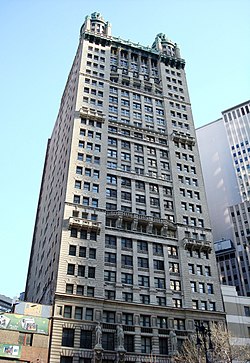
The Park Row Building, also known as 15 Park Row, is a luxury apartment building and early skyscraper on Park Row in the Financial District of the New York City borough of Manhattan. The 391-foot-tall (119 m), 31-story building was designed by R. H. Robertson, a pioneer in steel skyscraper design, and engineered by the firm of Nathaniel Roberts. The Park Row Building includes 26 full floors, a partial 27th floor, and a pair of four-story cupolas. The architectural detail on the facade includes large columns and pilasters, as well as numerous ornamental overhanging balconies. J. Massey Rhind sculpted several ornamental details on the building, including the balconies and several figures atop the building.
The Park Row Building was developed by the Park Row Construction Company as an office building between 1897 and 1899. It used a steel frame and elevators to make it one of the world's tallest buildings at the time. It was constructed over a period of two years and nine months. Upon completion, about 4,000 people worked at the Park Row Building, with tenants such as the Associated Press and the Interborough Rapid Transit Company. Until the completion of the Singer Building in 1908, it was the city's tallest building and the world's tallest office building. The Park Row Building was used as an office structure until the early 2000s, when it was converted to residential use. Today, the Park Row Building consists of 339 luxury apartment units, two penthouse apartments, ground floor retail, and office suites located in the building's historic cupola space.
Upon its completion, the Park Row Building received praise from the general public, although architectural critics reviewed the building more harshly. The New York City Landmarks Preservation Commission gave city landmark status to the Park Row Building in 1999, and the building was added to the National Register of Historic Places in 2005.
The Park Row Building is in the Financial District of Manhattan, just south of New York City Hall, City Hall Park, and the Civic Center. Its primary address is 15 Park Row, but its other addresses include 13–21 Park Row, 13 Ann Street, and 3 Theatre Alley. The Park Row Building is bounded on the west by Park Row, on the south by Ann Street, and on the east by Theatre Alley; the main facade on Park Row is situated midway between Ann Street to the south and Beekman Street to the north. The building is situated on an irregularly shaped land lot, with none of the three facades connected to each other. The Park Row Building's original developers had been unable to acquire the corner lots at Ann Street and Park Row and at Ann Street and Theatre Alley.
The building has a frontage of 104 ft (32 m) on Park Row, 20 feet (6.1 m) on Ann Street, and 48 feet (15 m) on Theatre Alley. The base of the building covers a land area of approximately 15,000 square feet (1,400 m2). It is immediately adjacent to 25 Park Row to the northeast. Other nearby buildings include 5 Beekman Street to the east, the Woolworth Building to the north, St. Paul's Chapel to the west, and the Bennett Building to the south. In addition, 41 Park Row, 150 Nassau Street, the Morse Building, and the Potter Building are across Beekman Street to the northeast.
The building was designed by R. H. Robertson, a pioneer in steel skyscraper design, and engineered by the firm of Nathaniel Roberts. Roberts's chief draftsman, George Shea Dayton, was also highly involved in the design. John Downey was hired as the general contractor; T. P. Galligan was the foundation contractor; J,B. & J.M. Cornell were the iron contractors; and Dawson and Archer were the masonry contractors. The total cost to build the skyscraper was $2.4–2.75 million (equivalent to $77–88 million in 2024).
The building has 26 full floors, a partial 27th floor, and a pair of four-story towers on the 28th through 31st floors. It has a total height of 391 feet (119 m). Counting the 56-foot (17 m) flagpoles that were formerly installed atop the towers, the total height upon the building's completion was 447 feet (136 m), making it one of the world's tallest buildings at the time. There were also two basement levels. This gives the building a total of 33 habitable levels.
The ground level of 15 Park Row occupies its entire lot. However, the center of the southwestern elevation (facing the eastern corner of Park Row and Ann Street) contains a light court so the upper floors resemble a backward, warped "E", with the "spine" running along the northeastern facade. Another light court to the east faces the corner of Theatre Alley and Ann Street. The two four-story towers are capped with copper-clad domes. The design is reminiscent of the double-towered Baroque churches of Europe, as well as the church of the Monastery of São Vicente da Fora of Lisbon. The towers were easily distinguished on the city's 20th-century skyline.
Park Row Building
The Park Row Building, also known as 15 Park Row, is a luxury apartment building and early skyscraper on Park Row in the Financial District of the New York City borough of Manhattan. The 391-foot-tall (119 m), 31-story building was designed by R. H. Robertson, a pioneer in steel skyscraper design, and engineered by the firm of Nathaniel Roberts. The Park Row Building includes 26 full floors, a partial 27th floor, and a pair of four-story cupolas. The architectural detail on the facade includes large columns and pilasters, as well as numerous ornamental overhanging balconies. J. Massey Rhind sculpted several ornamental details on the building, including the balconies and several figures atop the building.
The Park Row Building was developed by the Park Row Construction Company as an office building between 1897 and 1899. It used a steel frame and elevators to make it one of the world's tallest buildings at the time. It was constructed over a period of two years and nine months. Upon completion, about 4,000 people worked at the Park Row Building, with tenants such as the Associated Press and the Interborough Rapid Transit Company. Until the completion of the Singer Building in 1908, it was the city's tallest building and the world's tallest office building. The Park Row Building was used as an office structure until the early 2000s, when it was converted to residential use. Today, the Park Row Building consists of 339 luxury apartment units, two penthouse apartments, ground floor retail, and office suites located in the building's historic cupola space.
Upon its completion, the Park Row Building received praise from the general public, although architectural critics reviewed the building more harshly. The New York City Landmarks Preservation Commission gave city landmark status to the Park Row Building in 1999, and the building was added to the National Register of Historic Places in 2005.
The Park Row Building is in the Financial District of Manhattan, just south of New York City Hall, City Hall Park, and the Civic Center. Its primary address is 15 Park Row, but its other addresses include 13–21 Park Row, 13 Ann Street, and 3 Theatre Alley. The Park Row Building is bounded on the west by Park Row, on the south by Ann Street, and on the east by Theatre Alley; the main facade on Park Row is situated midway between Ann Street to the south and Beekman Street to the north. The building is situated on an irregularly shaped land lot, with none of the three facades connected to each other. The Park Row Building's original developers had been unable to acquire the corner lots at Ann Street and Park Row and at Ann Street and Theatre Alley.
The building has a frontage of 104 ft (32 m) on Park Row, 20 feet (6.1 m) on Ann Street, and 48 feet (15 m) on Theatre Alley. The base of the building covers a land area of approximately 15,000 square feet (1,400 m2). It is immediately adjacent to 25 Park Row to the northeast. Other nearby buildings include 5 Beekman Street to the east, the Woolworth Building to the north, St. Paul's Chapel to the west, and the Bennett Building to the south. In addition, 41 Park Row, 150 Nassau Street, the Morse Building, and the Potter Building are across Beekman Street to the northeast.
The building was designed by R. H. Robertson, a pioneer in steel skyscraper design, and engineered by the firm of Nathaniel Roberts. Roberts's chief draftsman, George Shea Dayton, was also highly involved in the design. John Downey was hired as the general contractor; T. P. Galligan was the foundation contractor; J,B. & J.M. Cornell were the iron contractors; and Dawson and Archer were the masonry contractors. The total cost to build the skyscraper was $2.4–2.75 million (equivalent to $77–88 million in 2024).
The building has 26 full floors, a partial 27th floor, and a pair of four-story towers on the 28th through 31st floors. It has a total height of 391 feet (119 m). Counting the 56-foot (17 m) flagpoles that were formerly installed atop the towers, the total height upon the building's completion was 447 feet (136 m), making it one of the world's tallest buildings at the time. There were also two basement levels. This gives the building a total of 33 habitable levels.
The ground level of 15 Park Row occupies its entire lot. However, the center of the southwestern elevation (facing the eastern corner of Park Row and Ann Street) contains a light court so the upper floors resemble a backward, warped "E", with the "spine" running along the northeastern facade. Another light court to the east faces the corner of Theatre Alley and Ann Street. The two four-story towers are capped with copper-clad domes. The design is reminiscent of the double-towered Baroque churches of Europe, as well as the church of the Monastery of São Vicente da Fora of Lisbon. The towers were easily distinguished on the city's 20th-century skyline.
Recent media
Recent media