


Community hub
Recent from talks
Contribute something to knowledge base
Content stats: 0 posts, 0 articles, 1 media, 0 notes
Members stats: 0 subscribers, 0 contributors, 0 moderators, 0 supporters
Subscribers
Supporters
Contributors
Moderators
Hub AI
Parks Air Lines AI simulator
(@Parks Air Lines_simulator)
Hub AI
Parks Air Lines AI simulator
(@Parks Air Lines_simulator)
Parks Air Lines
Parks Air Lines, named for its founder, Oliver Parks, was a US scheduled airline that initially appeared likely to be one of the most significant carriers of its kind, but in the end, operated only a single route for three months in 1950. In 1946 and 1947 the airline was certificated as a local service carrier (also known at that time as a "feeder airline") by the Civil Aeronautics Board (CAB), the now-defunct federal agency that, at the time, tightly regulated almost all US air transportation. The CAB awarded the airline, then known as Parks Air Transport, a substantial network of routes to mostly smaller cities mostly centered on St Louis. But after lengthy delays in initiating service, the CAB instituted proceedings to strip Parks of its network. Parks started service just in advance of the CAB's decision, but after a brief period of operation and some litigation, merged into Ozark Air Lines, the carrier to which the CAB gave most of Park's route authorities. This marked the start of Ozark's operations.
This was Oliver Parks's second use of the name "Parks Air Lines". He previously used it for his aviation activities prior to the Great Depression, including pilot training and aircraft manufacturing.
See External links for two rare photos of Parks Douglas DC-3s.
Oliver L. Parks was a prominent early aviator, known for his Cahokia, IL-based pilot training school, Parks Air College (PAC), across the Mississippi River from St Louis. Parks started the school in 1927, the first such in the country, and Parks and his school played a key role in training military pilots for World War II.
During World War II, Parks's pilot training expanded to four other locations. After the war Parks converted these other four training companies into fixed base operators (FBOs) that ran and owned various airports under the umbrella of Parks Aircraft Sales and Service (PASS). In August 1944, Parks incorporated Parks Air Transport (PAT) in Nevada to apply to the CAB for certification as a local service carrier. The CAB had created the category of local service (or “feeder”) airlines earlier in the year to bring air transport to previously unserved smaller cities and was seeking to certificate new carriers to fly such routes. PAT had authorized capital of $3.5mm, over $60mm in 2024 dollars. This sounded impressive, but actual available capital (as represented to the CAB) was $650,000 committed by PAC, PASS and the board members of PAT (including Parks).
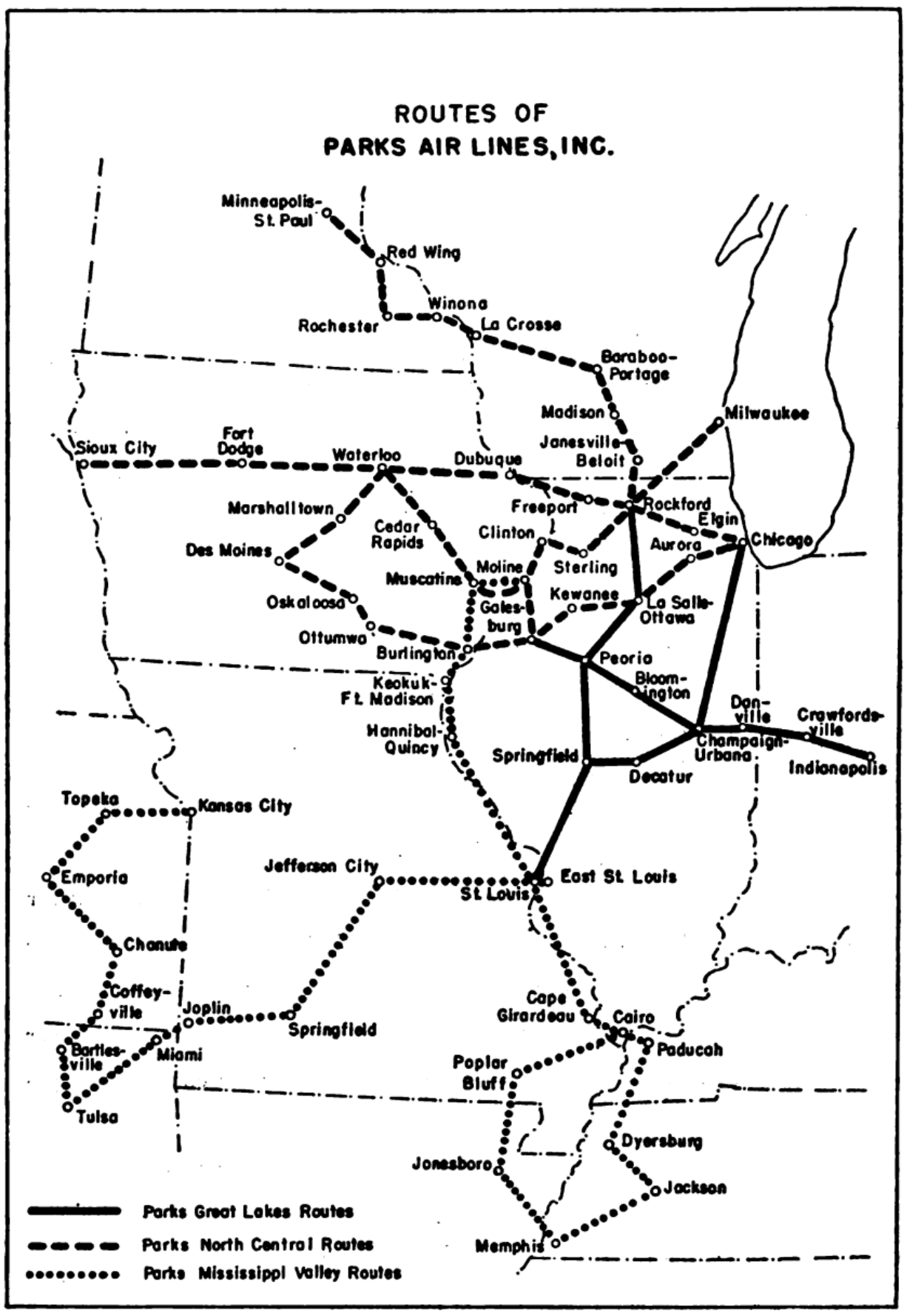
PAT won routes in three CAB cases, most with a St Louis terminus, in Dec 1946 (North Central Case), September 1947 (Great Lakes Area Case) and December 1947 (Mississippi Valley Case). In February 1948, it added another route to Parks's Great Lakes certificate. (see nearby map). The resulting mileage of the routes awarded in these certifications was 50% larger than the next biggest feeder network and over eight times as large as the smallest. PAT was recognized as potentially the “richest feeder network in the U.S.”. The certifications were contingent on a sufficient number of airports on these routes upgrading (radios and other infrastructure) to federal standards required to accept commercial aircraft. In May 1948, the CAB issued Parks a certificate for part of its system, based on a sufficient number of airports being of required standard. In the same month, Parks Air Transport became Parks Air Lines (PAL).
In making these awards to PAT, the CAB cited Parks's extensive experience with PAC and aviation generally. They noted he had airline experience through PAC's long-standing student-run "airline" ("Parks Air College Airlines"), that ran like a real airline (other than carrying passengers) including dispatch, maintenance, operating real flights, etc., learning how to handle real operational issues. The CAB saw public benefit in PAT being able to connect passengers on routes from one of the cases onto routes from the other cases PAT won; in modern terms that PAT would have a hub at St Louis. They liked that Parks was well capitalized.
PAL didn't have the money to start operations. The CAB later determined that of the $650,000 in capital that Parks represented to the CAB, the airline only drew on $81,000 (which, it noted, had been spent mainly on intangible items). In early 1948, Ozark, in appealing to the CAB to reverse the PAT route awards, noted "severe financial losses suffered by Parks and his affiliated companies during the past two years." PASS lost over $148,000 in 1948. Oliver Parks had notable drains on the resources of his enterprises during the period 1944 to 1950:
Parks Air Lines
Parks Air Lines, named for its founder, Oliver Parks, was a US scheduled airline that initially appeared likely to be one of the most significant carriers of its kind, but in the end, operated only a single route for three months in 1950. In 1946 and 1947 the airline was certificated as a local service carrier (also known at that time as a "feeder airline") by the Civil Aeronautics Board (CAB), the now-defunct federal agency that, at the time, tightly regulated almost all US air transportation. The CAB awarded the airline, then known as Parks Air Transport, a substantial network of routes to mostly smaller cities mostly centered on St Louis. But after lengthy delays in initiating service, the CAB instituted proceedings to strip Parks of its network. Parks started service just in advance of the CAB's decision, but after a brief period of operation and some litigation, merged into Ozark Air Lines, the carrier to which the CAB gave most of Park's route authorities. This marked the start of Ozark's operations.
This was Oliver Parks's second use of the name "Parks Air Lines". He previously used it for his aviation activities prior to the Great Depression, including pilot training and aircraft manufacturing.
See External links for two rare photos of Parks Douglas DC-3s.
Oliver L. Parks was a prominent early aviator, known for his Cahokia, IL-based pilot training school, Parks Air College (PAC), across the Mississippi River from St Louis. Parks started the school in 1927, the first such in the country, and Parks and his school played a key role in training military pilots for World War II.
During World War II, Parks's pilot training expanded to four other locations. After the war Parks converted these other four training companies into fixed base operators (FBOs) that ran and owned various airports under the umbrella of Parks Aircraft Sales and Service (PASS). In August 1944, Parks incorporated Parks Air Transport (PAT) in Nevada to apply to the CAB for certification as a local service carrier. The CAB had created the category of local service (or “feeder”) airlines earlier in the year to bring air transport to previously unserved smaller cities and was seeking to certificate new carriers to fly such routes. PAT had authorized capital of $3.5mm, over $60mm in 2024 dollars. This sounded impressive, but actual available capital (as represented to the CAB) was $650,000 committed by PAC, PASS and the board members of PAT (including Parks).
PAT won routes in three CAB cases, most with a St Louis terminus, in Dec 1946 (North Central Case), September 1947 (Great Lakes Area Case) and December 1947 (Mississippi Valley Case). In February 1948, it added another route to Parks's Great Lakes certificate. (see nearby map). The resulting mileage of the routes awarded in these certifications was 50% larger than the next biggest feeder network and over eight times as large as the smallest. PAT was recognized as potentially the “richest feeder network in the U.S.”. The certifications were contingent on a sufficient number of airports on these routes upgrading (radios and other infrastructure) to federal standards required to accept commercial aircraft. In May 1948, the CAB issued Parks a certificate for part of its system, based on a sufficient number of airports being of required standard. In the same month, Parks Air Transport became Parks Air Lines (PAL).
In making these awards to PAT, the CAB cited Parks's extensive experience with PAC and aviation generally. They noted he had airline experience through PAC's long-standing student-run "airline" ("Parks Air College Airlines"), that ran like a real airline (other than carrying passengers) including dispatch, maintenance, operating real flights, etc., learning how to handle real operational issues. The CAB saw public benefit in PAT being able to connect passengers on routes from one of the cases onto routes from the other cases PAT won; in modern terms that PAT would have a hub at St Louis. They liked that Parks was well capitalized.
PAL didn't have the money to start operations. The CAB later determined that of the $650,000 in capital that Parks represented to the CAB, the airline only drew on $81,000 (which, it noted, had been spent mainly on intangible items). In early 1948, Ozark, in appealing to the CAB to reverse the PAT route awards, noted "severe financial losses suffered by Parks and his affiliated companies during the past two years." PASS lost over $148,000 in 1948. Oliver Parks had notable drains on the resources of his enterprises during the period 1944 to 1950:
Recent media
Recent media