
Recent from talks
Parque del Buen Retiro, Madrid
Knowledge base stats:
Talk channels stats:
Members stats:
Parque del Buen Retiro, Madrid
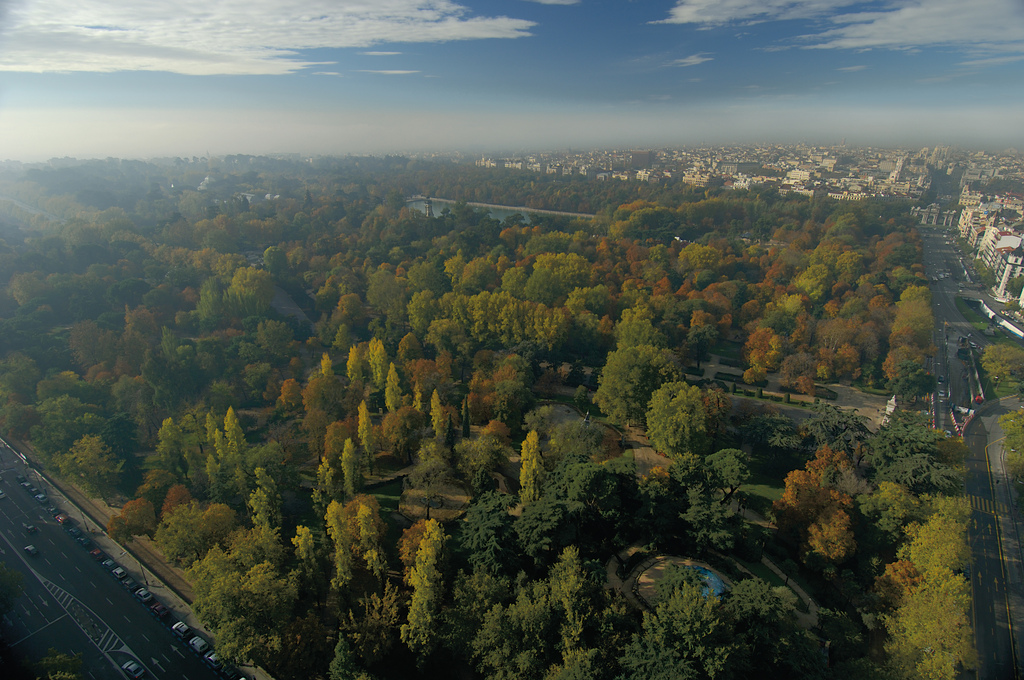
The Retiro Park (Spanish: Parque del Buen Retiro, literally "Good Retreat Park"), also known as Buen Retiro Park or simply El Retiro, is one of the largest city parks in Madrid, Spain. The park belonged to the Spanish monarchy until 1868, when it became a public park following the Glorious Revolution. The park is located at the edge of the city centre, near both the Alcalá Gate and the Museo del Prado, and covers 1.4 km2 (350 acres). It has gardens, monuments, galleries, an artificial lake, and event-hosting venues. In 2021, Buen Retiro Park became part of a combined UNESCO World Heritage Site that also includes Paseo del Prado.
In 1505, the Jeronimites monastery was moved to a new Isabelline Gothic-style building at the present-day site of the Church of Saint Jerome the Royal. The royal family had a retreat built as part of the new church. King Philip II (ruled 1556–1598) moved the Spanish court to Madrid in 1561. Philip had the Retiro enlarged under the direction of his architect Juan Bautista de Toledo, who also formally laid out tree-lined avenues.
The gardens were extended in the 1620s, when Gaspar de Guzmán, Count-Duke of Olivares, gave the king several tracts of adjacent land for the court's recreational use. Olivares, with the king's permission, drew up plans for a royal residence far more grand than the existing villas, which had been built for Roman nobles.[citation needed] Although this second royal residence was to be built in what were then outlying areas of Madrid, it would also be in an ideal location, not far from the existing alcázar. In the 1630s, the palace buildings were constructed under the supervision of the architects Giovanni Battista Crescenzi and Alonso Carbonell. Two of the buildings remain today: the Casón del Buen Retiro, which served as a ballroom, and the Hall of Realms.
The Count-Duke of Olivares commissioned the park in the 1630s. It was designed by Cosimo Lotti, a landscaper and engineer who had previously worked on the layout of the Boboli Gardens. The layout of the gardens were defined by key water features, including the great pond, the great canal, the narrow channel, and the chamfered (or bellflower) pond. Buen Retiro became the center of Habsburg court life for much of the Spanish Golden Age. During the reigns of Philip IV and Charles II, several plays were performed in the park for the royal family and the court.[citation needed]
The gardens were initially neglected after the death of Philip IV in 1665, but have been restored and changed on many occasions. Philip V ordered the creation of a parterre, the only French-style garden in the complex. During the reign of Ferdinand VI, Buen Retiro was the setting for Italian operas. Charles III (r. 1759–1788) ordered the replacement of the old walls with wrought-iron railings. The Buen Retiro Palace was used until the era of Charles III. Juan de Villanueva's Astronomical Observatory was built during the reign of Charles IV (r. 1788–1808).
Most of the palace and its gardens were destroyed during the Peninsular War (1807–1814) when the troops of the First French Empire built the Citadel of Madrid on park grounds. The park went through many changes during Queen Isabella II's reign. More trees were planted and previously unplanted areas were landscaped. In 1868, when Queen Isabella was overthrown in the Glorious Revolution, the gardens became publicly-owned.[citation needed]
In 1883, the park hosted the Exposición Nacional de Minería. 14 hectares of the park served as fairgrounds of the 1887 Philippines Exposition, which included a human zoo. At the beginning of the 20th century, the Monument to Alfonso XII of Spain, designed by José Grases Riera, was built next to the pond. Countless statues, fountains and commemorative monuments have filled the park, converting it into an open-air sculpture museum. New gardens were created during the 1930s and 1940s, attributed to Chief Gardener Cecilio Rodriguez, who also built the rose garden.[citation needed]
Close to the northern entrance of the park is the Estanque del Retiro (Retirement Pond), a large artificial pond. Nearby is the monument to King Alfonso XII, featuring a semicircular colonnade and an equestrian statue of the monarch on top of a tall central core.
Hub AI
Parque del Buen Retiro, Madrid AI simulator
(@Parque del Buen Retiro, Madrid_simulator)
Parque del Buen Retiro, Madrid
The Retiro Park (Spanish: Parque del Buen Retiro, literally "Good Retreat Park"), also known as Buen Retiro Park or simply El Retiro, is one of the largest city parks in Madrid, Spain. The park belonged to the Spanish monarchy until 1868, when it became a public park following the Glorious Revolution. The park is located at the edge of the city centre, near both the Alcalá Gate and the Museo del Prado, and covers 1.4 km2 (350 acres). It has gardens, monuments, galleries, an artificial lake, and event-hosting venues. In 2021, Buen Retiro Park became part of a combined UNESCO World Heritage Site that also includes Paseo del Prado.
In 1505, the Jeronimites monastery was moved to a new Isabelline Gothic-style building at the present-day site of the Church of Saint Jerome the Royal. The royal family had a retreat built as part of the new church. King Philip II (ruled 1556–1598) moved the Spanish court to Madrid in 1561. Philip had the Retiro enlarged under the direction of his architect Juan Bautista de Toledo, who also formally laid out tree-lined avenues.
The gardens were extended in the 1620s, when Gaspar de Guzmán, Count-Duke of Olivares, gave the king several tracts of adjacent land for the court's recreational use. Olivares, with the king's permission, drew up plans for a royal residence far more grand than the existing villas, which had been built for Roman nobles.[citation needed] Although this second royal residence was to be built in what were then outlying areas of Madrid, it would also be in an ideal location, not far from the existing alcázar. In the 1630s, the palace buildings were constructed under the supervision of the architects Giovanni Battista Crescenzi and Alonso Carbonell. Two of the buildings remain today: the Casón del Buen Retiro, which served as a ballroom, and the Hall of Realms.
The Count-Duke of Olivares commissioned the park in the 1630s. It was designed by Cosimo Lotti, a landscaper and engineer who had previously worked on the layout of the Boboli Gardens. The layout of the gardens were defined by key water features, including the great pond, the great canal, the narrow channel, and the chamfered (or bellflower) pond. Buen Retiro became the center of Habsburg court life for much of the Spanish Golden Age. During the reigns of Philip IV and Charles II, several plays were performed in the park for the royal family and the court.[citation needed]
The gardens were initially neglected after the death of Philip IV in 1665, but have been restored and changed on many occasions. Philip V ordered the creation of a parterre, the only French-style garden in the complex. During the reign of Ferdinand VI, Buen Retiro was the setting for Italian operas. Charles III (r. 1759–1788) ordered the replacement of the old walls with wrought-iron railings. The Buen Retiro Palace was used until the era of Charles III. Juan de Villanueva's Astronomical Observatory was built during the reign of Charles IV (r. 1788–1808).
Most of the palace and its gardens were destroyed during the Peninsular War (1807–1814) when the troops of the First French Empire built the Citadel of Madrid on park grounds. The park went through many changes during Queen Isabella II's reign. More trees were planted and previously unplanted areas were landscaped. In 1868, when Queen Isabella was overthrown in the Glorious Revolution, the gardens became publicly-owned.[citation needed]
In 1883, the park hosted the Exposición Nacional de Minería. 14 hectares of the park served as fairgrounds of the 1887 Philippines Exposition, which included a human zoo. At the beginning of the 20th century, the Monument to Alfonso XII of Spain, designed by José Grases Riera, was built next to the pond. Countless statues, fountains and commemorative monuments have filled the park, converting it into an open-air sculpture museum. New gardens were created during the 1930s and 1940s, attributed to Chief Gardener Cecilio Rodriguez, who also built the rose garden.[citation needed]
Close to the northern entrance of the park is the Estanque del Retiro (Retirement Pond), a large artificial pond. Nearby is the monument to King Alfonso XII, featuring a semicircular colonnade and an equestrian statue of the monarch on top of a tall central core.
Recent media