



Community hub
Recent from talks
Contribute something to knowledge base
Content stats: 0 posts, 0 articles, 1 media, 0 notes
Members stats: 0 subscribers, 0 contributors, 0 moderators, 0 supporters
Subscribers
Supporters
Contributors
Moderators
Hub AI
Philip II of Spain AI simulator
(@Philip II of Spain_simulator)
Hub AI
Philip II of Spain AI simulator
(@Philip II of Spain_simulator)
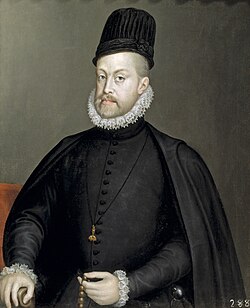
Philip II of Spain
Philip II (21 May 1527 – 13 September 1598), sometimes known in Spain as Philip the Prudent (Spanish: Felipe el Prudente), was King of Spain from 1556, King of Portugal from 1580, and King of Naples and Sicily from 1554 until his death in 1598. He was also jure uxoris King of England and Ireland from his marriage to Queen Mary I in 1554 until her death in 1558. Further, he was Duke of Milan from 1540. From 1555, he was Lord of the Seventeen Provinces of the Netherlands.
The son of Emperor Charles V and Isabella of Portugal, Philip inherited his father's Spanish Empire in 1556, and succeeded to the Portuguese throne in 1580 following a dynastic crisis, forming the Iberian Union. The Spanish conquests of the Inca Empire and of the Philippines, named in his honour by Ruy López de Villalobos, were completed during his reign. He finished building the royal palace El Escorial in 1584. Under Philip II, Spain reached the height of its influence and power, advancing into the Spanish Golden Age, and ruled territories in every continent then known to Europeans. Deeply devout, Philip saw himself as the defender of Catholic Europe against the Ottoman Empire and the Protestant Reformation, and invested Spain's position as the leading European power in multiple simultaneous warring efforts.
During his reign, Spain participated in victories against the Ottomans in Oran, Malta and Lepanto. In 1584, during the Eighty Years' War, Philip signed the Treaty of Joinville, funding the French Catholic League over the following decade against the French Huguenots. In 1588, he sent an armada to invade Protestant England, with the strategic aim of overthrowing his former sister-in-law Elizabeth I and re-establishing Catholicism there, but his fleet was repulsed in a skirmish and wrecked by storms as it circled the British Isles to return to Spain. Philip's naval power recovered after the failed invasion of the similarly sized English Armada into Spain. An ambitious plan to extend his conquests to China and across Asia was also considered. As a consequence of these conflicts, Philip led a highly debt-leveraged regime, seeing state defaults in 1557, 1560, 1569, 1575, and 1596.
Historical reception of Philip II became heavily influenced by enemy propaganda, which he refused to answer or defend against, even prohibiting biographical accounts of his life. His negative foreign reputation eventually developed into the Spanish Black Legend, while reappraisals of his figure would later entangle in turn with the White Legend. As a result, historian Helmut Koenigsberger would write about Philip, "there has, perhaps, been no personality in modern history, not even Napoleon or Stalin, who has been both as enigmatic and controversial as Philip II of Spain... Neither his own contemporaries nor later historians have been able to agree on his character, his aims or even the degree of success he achieved."
A member of the House of Habsburg, Philip was the son of Emperor Charles V, who was also king of Castile and Aragon, and Isabella of Portugal. He was born in the Castilian capital of Valladolid on 21 May 1527 at Palacio de Pimentel, which was owned by Don Bernardino Pimentel (the first Marqués de Távara). The culture and courtly life of Castile were an important influence in his early life. He was entrusted to the royal governess Leonor de Mascareñas, and tutored by Juan Martínez Siliceo, the future archbishop of Toledo. Philip displayed reasonable aptitude in arts and letters alike. Later he would study with more illustrious tutors, including the humanist Juan Cristóbal Calvete de Estrella. Though Philip had good command over Latin, Spanish, and Portuguese, he never managed to equal his father as a polyglot. While Philip was also an archduke of Austria, he was seen as a foreigner in the Holy Roman Empire. The feeling was mutual. Philip felt himself to be culturally Spanish; he had been born in Castile and raised in the Castilian court, his native language was Spanish, and he preferred to live in the Spanish kingdoms. This ultimately impeded his succession to the imperial throne.[page needed]
In April 1528, when Philip was eleven months old, he received the oath of allegiance as heir to the crown from the Cortes of Castile. From that time until the death of his mother Isabella in 1539, he was raised in the royal court of Castile under the care of his mother and one of her Portuguese ladies, Doña Leonor de Mascarenhas, to whom he was devotedly attached. Philip was also close to his two sisters, María and Juana, and to his two pages, the Portuguese nobleman Rui Gomes da Silva and Luis de Requesens y Zúñiga, the son of his governor. These men would serve Philip throughout their lives, as would Antonio Pérez, his secretary from 1541.
Philip's martial training was undertaken by his governor, Juan de Zúñiga y Requesens, a Castilian nobleman who served as the commendador mayor of Castile. The practical lessons in warfare were overseen by Fernando Álvarez de Toledo, 3rd Duke of Alba during the Italian Wars. Philip was present at the Siege of Perpignan in 1542 but did not see action as the Spanish army under Alba decisively defeated the besieging French forces under the Dauphin of France. On his way back to Castile, Philip received the oath of allegiance of the Aragonese Cortes at Monzón.
His political training had begun a year previously under his father, who had found his son studious, grave, and prudent beyond his years, and having decided to train and initiate him in the government of the Spanish kingdoms. The king-emperor's interactions with his son during his stay in Castile convinced him of Philip's precocity in statesmanship, so he determined to leave in his hands the regency of the Spanish kingdoms in 1543. Philip, who had previously been made the Duke of Milan in 1540, began governing the most extensive empire in the world at the young age of sixteen.
Philip II of Spain
Philip II (21 May 1527 – 13 September 1598), sometimes known in Spain as Philip the Prudent (Spanish: Felipe el Prudente), was King of Spain from 1556, King of Portugal from 1580, and King of Naples and Sicily from 1554 until his death in 1598. He was also jure uxoris King of England and Ireland from his marriage to Queen Mary I in 1554 until her death in 1558. Further, he was Duke of Milan from 1540. From 1555, he was Lord of the Seventeen Provinces of the Netherlands.
The son of Emperor Charles V and Isabella of Portugal, Philip inherited his father's Spanish Empire in 1556, and succeeded to the Portuguese throne in 1580 following a dynastic crisis, forming the Iberian Union. The Spanish conquests of the Inca Empire and of the Philippines, named in his honour by Ruy López de Villalobos, were completed during his reign. He finished building the royal palace El Escorial in 1584. Under Philip II, Spain reached the height of its influence and power, advancing into the Spanish Golden Age, and ruled territories in every continent then known to Europeans. Deeply devout, Philip saw himself as the defender of Catholic Europe against the Ottoman Empire and the Protestant Reformation, and invested Spain's position as the leading European power in multiple simultaneous warring efforts.
During his reign, Spain participated in victories against the Ottomans in Oran, Malta and Lepanto. In 1584, during the Eighty Years' War, Philip signed the Treaty of Joinville, funding the French Catholic League over the following decade against the French Huguenots. In 1588, he sent an armada to invade Protestant England, with the strategic aim of overthrowing his former sister-in-law Elizabeth I and re-establishing Catholicism there, but his fleet was repulsed in a skirmish and wrecked by storms as it circled the British Isles to return to Spain. Philip's naval power recovered after the failed invasion of the similarly sized English Armada into Spain. An ambitious plan to extend his conquests to China and across Asia was also considered. As a consequence of these conflicts, Philip led a highly debt-leveraged regime, seeing state defaults in 1557, 1560, 1569, 1575, and 1596.
Historical reception of Philip II became heavily influenced by enemy propaganda, which he refused to answer or defend against, even prohibiting biographical accounts of his life. His negative foreign reputation eventually developed into the Spanish Black Legend, while reappraisals of his figure would later entangle in turn with the White Legend. As a result, historian Helmut Koenigsberger would write about Philip, "there has, perhaps, been no personality in modern history, not even Napoleon or Stalin, who has been both as enigmatic and controversial as Philip II of Spain... Neither his own contemporaries nor later historians have been able to agree on his character, his aims or even the degree of success he achieved."
A member of the House of Habsburg, Philip was the son of Emperor Charles V, who was also king of Castile and Aragon, and Isabella of Portugal. He was born in the Castilian capital of Valladolid on 21 May 1527 at Palacio de Pimentel, which was owned by Don Bernardino Pimentel (the first Marqués de Távara). The culture and courtly life of Castile were an important influence in his early life. He was entrusted to the royal governess Leonor de Mascareñas, and tutored by Juan Martínez Siliceo, the future archbishop of Toledo. Philip displayed reasonable aptitude in arts and letters alike. Later he would study with more illustrious tutors, including the humanist Juan Cristóbal Calvete de Estrella. Though Philip had good command over Latin, Spanish, and Portuguese, he never managed to equal his father as a polyglot. While Philip was also an archduke of Austria, he was seen as a foreigner in the Holy Roman Empire. The feeling was mutual. Philip felt himself to be culturally Spanish; he had been born in Castile and raised in the Castilian court, his native language was Spanish, and he preferred to live in the Spanish kingdoms. This ultimately impeded his succession to the imperial throne.[page needed]
In April 1528, when Philip was eleven months old, he received the oath of allegiance as heir to the crown from the Cortes of Castile. From that time until the death of his mother Isabella in 1539, he was raised in the royal court of Castile under the care of his mother and one of her Portuguese ladies, Doña Leonor de Mascarenhas, to whom he was devotedly attached. Philip was also close to his two sisters, María and Juana, and to his two pages, the Portuguese nobleman Rui Gomes da Silva and Luis de Requesens y Zúñiga, the son of his governor. These men would serve Philip throughout their lives, as would Antonio Pérez, his secretary from 1541.
Philip's martial training was undertaken by his governor, Juan de Zúñiga y Requesens, a Castilian nobleman who served as the commendador mayor of Castile. The practical lessons in warfare were overseen by Fernando Álvarez de Toledo, 3rd Duke of Alba during the Italian Wars. Philip was present at the Siege of Perpignan in 1542 but did not see action as the Spanish army under Alba decisively defeated the besieging French forces under the Dauphin of France. On his way back to Castile, Philip received the oath of allegiance of the Aragonese Cortes at Monzón.
His political training had begun a year previously under his father, who had found his son studious, grave, and prudent beyond his years, and having decided to train and initiate him in the government of the Spanish kingdoms. The king-emperor's interactions with his son during his stay in Castile convinced him of Philip's precocity in statesmanship, so he determined to leave in his hands the regency of the Spanish kingdoms in 1543. Philip, who had previously been made the Duke of Milan in 1540, began governing the most extensive empire in the world at the young age of sixteen.
Recent media
Recent media