

Recent from talks
Particle in a box
Knowledge base stats:
Talk channels stats:
Members stats:
Particle in a box
In quantum mechanics, the particle in a box model (also known as the infinite potential well or the infinite square well) describes the movement of a free particle in a small space surrounded by impenetrable barriers. The model is mainly used as a hypothetical example to illustrate the differences between classical and quantum systems. In classical systems, for example, a particle trapped inside a large box can move at any speed within the box and it is no more likely to be found at one position than another. However, when the well becomes very narrow (on the scale of a few nanometers), quantum effects become important. The particle may only occupy certain positive energy levels. Likewise, it can never have zero energy, meaning that the particle can never "sit still". Additionally, it is more likely to be found at certain positions than at others, depending on its energy level. The particle may never be detected at certain positions, known as spatial nodes.
The particle in a box model is one of the very few problems in quantum mechanics that can be solved analytically, without approximations. Due to its simplicity, the model allows insight into quantum effects without the need for complicated mathematics. It serves as a simple illustration of how energy quantizations (energy levels), which are found in more complicated quantum systems such as atoms and molecules, come about. It is one of the first quantum mechanics problems taught in undergraduate physics courses, and it is commonly used as an approximation for more complicated quantum systems.
The simplest form of the particle in a box model considers a one-dimensional system. Here, the particle may only move backwards and forwards along a straight line with impenetrable barriers at either end. The walls of a one-dimensional box may be seen as regions of space with an infinitely large potential energy. Conversely, the interior of the box has a constant, zero potential energy. This means that no forces act upon the particle inside the box and it can move freely in that region. However, infinitely large forces repel the particle if it touches the walls of the box, preventing it from escaping. The potential energy in this model is given as where L is the length of the box, xc is the location of the center of the box and x is the position of the particle within the box. Simple cases include the centered box (xc = 0) and the shifted box (xc = L/2) (pictured).

In quantum mechanics, the wave function gives the most fundamental description of the behavior of a particle; the measurable properties of the particle (such as its position, momentum and energy) may all be derived from the wave function. The wave function can be found by solving the Schrödinger equation for the system where is the reduced Planck constant, is the mass of the particle, is the imaginary unit and is time.




Inside the box, no forces act upon the particle, which means that the part of the wave function inside the box oscillates through space and time with the same form as a free particle:
where and are arbitrary complex numbers. The frequency of the oscillations through space and time is given by the wave number and the angular frequency respectively. These are both related to the total energy of the particle by the expression


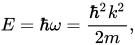
which is known as the dispersion relation for a free particle. However, since the particle is not entirely free but under the influence of a potential, the energy of the particle is where T is the kinetic and V the potential energy. Therefore, the energy of the particle given above is not the same thing as (i.e. the momentum of the particle is not given by ). Thus the wave number k above actually describes the energy states of the particle and is not related to momentum like the "wave number" usually is. The rationale for calling k the wave number is that it enumerates the number of crests that the wave function has inside the box, and in this sense it is a wave number. This discrepancy can be seen more clearly below, when we find out that the energy spectrum of the particle is discrete (only discrete values of energy are allowed) but the momentum spectrum is continuous (momentum can vary continuously), i.e., .


The amplitude of the wave function at a given position is related to the probability of finding a particle there by . The wave function must therefore vanish everywhere beyond the edges of the box. Also, the amplitude of the wave function may not "jump" abruptly from one point to the next. These two conditions are only satisfied by wave functions with the form where and for positive integers . The simplest solutions, or both yield the trivial wave function , which describes a particle that does not exist anywhere in the system. Here one sees that only a discrete set of energy values and wave numbers k are allowed for the particle. Usually in quantum mechanics it is also demanded that the derivative of the wave function in addition to the wave function itself be continuous; here this demand would lead to the only solution being the constant zero function, which is not what we desire, so we give up this demand (as this system with infinite potential can be regarded as a nonphysical abstract limiting case, we can treat it as such and "bend the rules"). Note that giving up this demand means that the wave function is not a differentiable function at the boundary of the box, and thus it can be said that the wave function does not solve the Schrödinger equation at the boundary points and (but does solve it everywhere else).




Hub AI
Particle in a box AI simulator
(@Particle in a box_simulator)
Particle in a box
In quantum mechanics, the particle in a box model (also known as the infinite potential well or the infinite square well) describes the movement of a free particle in a small space surrounded by impenetrable barriers. The model is mainly used as a hypothetical example to illustrate the differences between classical and quantum systems. In classical systems, for example, a particle trapped inside a large box can move at any speed within the box and it is no more likely to be found at one position than another. However, when the well becomes very narrow (on the scale of a few nanometers), quantum effects become important. The particle may only occupy certain positive energy levels. Likewise, it can never have zero energy, meaning that the particle can never "sit still". Additionally, it is more likely to be found at certain positions than at others, depending on its energy level. The particle may never be detected at certain positions, known as spatial nodes.
The particle in a box model is one of the very few problems in quantum mechanics that can be solved analytically, without approximations. Due to its simplicity, the model allows insight into quantum effects without the need for complicated mathematics. It serves as a simple illustration of how energy quantizations (energy levels), which are found in more complicated quantum systems such as atoms and molecules, come about. It is one of the first quantum mechanics problems taught in undergraduate physics courses, and it is commonly used as an approximation for more complicated quantum systems.
The simplest form of the particle in a box model considers a one-dimensional system. Here, the particle may only move backwards and forwards along a straight line with impenetrable barriers at either end. The walls of a one-dimensional box may be seen as regions of space with an infinitely large potential energy. Conversely, the interior of the box has a constant, zero potential energy. This means that no forces act upon the particle inside the box and it can move freely in that region. However, infinitely large forces repel the particle if it touches the walls of the box, preventing it from escaping. The potential energy in this model is given as where L is the length of the box, xc is the location of the center of the box and x is the position of the particle within the box. Simple cases include the centered box (xc = 0) and the shifted box (xc = L/2) (pictured).
In quantum mechanics, the wave function gives the most fundamental description of the behavior of a particle; the measurable properties of the particle (such as its position, momentum and energy) may all be derived from the wave function. The wave function can be found by solving the Schrödinger equation for the system where is the reduced Planck constant, is the mass of the particle, is the imaginary unit and is time.
Inside the box, no forces act upon the particle, which means that the part of the wave function inside the box oscillates through space and time with the same form as a free particle:
where and are arbitrary complex numbers. The frequency of the oscillations through space and time is given by the wave number and the angular frequency respectively. These are both related to the total energy of the particle by the expression
which is known as the dispersion relation for a free particle. However, since the particle is not entirely free but under the influence of a potential, the energy of the particle is where T is the kinetic and V the potential energy. Therefore, the energy of the particle given above is not the same thing as (i.e. the momentum of the particle is not given by ). Thus the wave number k above actually describes the energy states of the particle and is not related to momentum like the "wave number" usually is. The rationale for calling k the wave number is that it enumerates the number of crests that the wave function has inside the box, and in this sense it is a wave number. This discrepancy can be seen more clearly below, when we find out that the energy spectrum of the particle is discrete (only discrete values of energy are allowed) but the momentum spectrum is continuous (momentum can vary continuously), i.e., .
The amplitude of the wave function at a given position is related to the probability of finding a particle there by . The wave function must therefore vanish everywhere beyond the edges of the box. Also, the amplitude of the wave function may not "jump" abruptly from one point to the next. These two conditions are only satisfied by wave functions with the form where and for positive integers . The simplest solutions, or both yield the trivial wave function , which describes a particle that does not exist anywhere in the system. Here one sees that only a discrete set of energy values and wave numbers k are allowed for the particle. Usually in quantum mechanics it is also demanded that the derivative of the wave function in addition to the wave function itself be continuous; here this demand would lead to the only solution being the constant zero function, which is not what we desire, so we give up this demand (as this system with infinite potential can be regarded as a nonphysical abstract limiting case, we can treat it as such and "bend the rules"). Note that giving up this demand means that the wave function is not a differentiable function at the boundary of the box, and thus it can be said that the wave function does not solve the Schrödinger equation at the boundary points and (but does solve it everywhere else).
Recent media