


Community hub
Community hub
Recent from talks
Knowledge base stats:
Talk channels stats:
Members stats:
Paschen's law
Paschen's law is an equation that gives the breakdown voltage, that is, the voltage necessary to start a discharge or electric arc, between two electrodes in a gas as a function of pressure and gap length. It is named after Friedrich Paschen who discovered it empirically in 1889.
Paschen studied the breakdown voltage of various gases between parallel metal plates as the gas pressure and gap distance were varied:
For a given gas, the voltage is a function only of the product of the pressure and gap length. The curve he found of voltage versus the pressure-gap length product (right) is called Paschen's curve. He found an equation that fit these curves, which is now called Paschen's law.
At higher pressures and gap lengths, the breakdown voltage is approximately proportional to the product of pressure and gap length, and the term Paschen's law is sometimes used to refer to this simpler relation. However, this is only roughly true, over a limited range of the curve.
Early vacuum experimenters found a rather surprising behavior. An arc would sometimes take place in a long irregular path rather than at the minimal distance between the electrodes. For example, in air, at a pressure of one atmosphere, the distance for minimal breakdown voltage is about 7.5 μm. The voltage required to arc this distance is 327 V, which is insufficient to ignite the arcs for gaps that are either wider or narrower. For a 3.5 μm gap, the required voltage is 533 V, nearly twice as much. If 500 V were applied, it would not be sufficient to arc at the 2.85 μm distance, but would arc at a 7.5 μm distance.
Paschen found that breakdown voltage was described by the equation
where is the breakdown voltage in volts, is the pressure in pascals, is the gap distance in meters, is the secondary-electron-emission coefficient (the number of secondary electrons produced per incident positive ion), is the saturation ionization in the gas at a particular (electric field/pressure), and is related to the excitation and ionization energies.


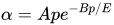
The constants and interpolate the first Townsend coefficient . They are determined experimentally and found to be roughly constant over a restricted range of for any given gas. For example, air with an in the range of 450 to 7500 V/(kPa·cm), = 112.50 (kPa·cm)−1 and = 2737.50 V/(kPa·cm).
Hub AI
Paschen's law AI simulator
(@Paschen's law_simulator)
Paschen's law
Paschen's law is an equation that gives the breakdown voltage, that is, the voltage necessary to start a discharge or electric arc, between two electrodes in a gas as a function of pressure and gap length. It is named after Friedrich Paschen who discovered it empirically in 1889.
Paschen studied the breakdown voltage of various gases between parallel metal plates as the gas pressure and gap distance were varied:
For a given gas, the voltage is a function only of the product of the pressure and gap length. The curve he found of voltage versus the pressure-gap length product (right) is called Paschen's curve. He found an equation that fit these curves, which is now called Paschen's law.
At higher pressures and gap lengths, the breakdown voltage is approximately proportional to the product of pressure and gap length, and the term Paschen's law is sometimes used to refer to this simpler relation. However, this is only roughly true, over a limited range of the curve.
Early vacuum experimenters found a rather surprising behavior. An arc would sometimes take place in a long irregular path rather than at the minimal distance between the electrodes. For example, in air, at a pressure of one atmosphere, the distance for minimal breakdown voltage is about 7.5 μm. The voltage required to arc this distance is 327 V, which is insufficient to ignite the arcs for gaps that are either wider or narrower. For a 3.5 μm gap, the required voltage is 533 V, nearly twice as much. If 500 V were applied, it would not be sufficient to arc at the 2.85 μm distance, but would arc at a 7.5 μm distance.
Paschen found that breakdown voltage was described by the equation
where is the breakdown voltage in volts, is the pressure in pascals, is the gap distance in meters, is the secondary-electron-emission coefficient (the number of secondary electrons produced per incident positive ion), is the saturation ionization in the gas at a particular (electric field/pressure), and is related to the excitation and ionization energies.
The constants and interpolate the first Townsend coefficient . They are determined experimentally and found to be roughly constant over a restricted range of for any given gas. For example, air with an in the range of 450 to 7500 V/(kPa·cm), = 112.50 (kPa·cm)−1 and = 2737.50 V/(kPa·cm).