
Recent from talks
Electric arc
Knowledge base stats:
Talk channels stats:
Members stats:
Electric arc
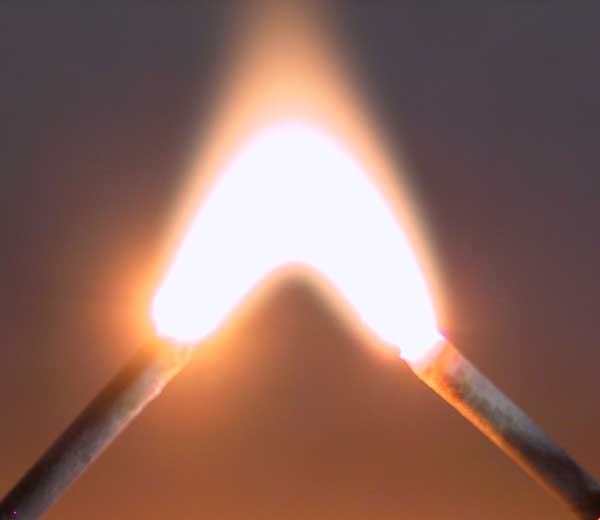
An electric arc (or arc discharge) is an electrical breakdown of a gas that produces a prolonged electrical discharge. The current through a normally nonconductive medium such as air produces a plasma, which may produce visible light. An arc discharge is initiated either by thermionic emission or by field emission. After initiation, the arc relies on thermionic emission of electrons from the electrodes supporting the arc. An arc discharge is characterized by a lower voltage than a glow discharge. An archaic term is voltaic arc, as used in the phrase "voltaic arc lamp".
Techniques for arc suppression can be used to reduce the duration or likelihood of arc formation.
In the late 19th century, electric arc lighting was in wide use for public lighting. Some low-pressure electric arcs are used in many applications. For example, fluorescent tubes, mercury, sodium, and metal-halide lamps are used for lighting; xenon arc lamps have been used for movie projectors. Electric arcs can be utilized for manufacturing processes, such as electric arc welding, plasma cutting and electric arc furnaces for steel recycling.
Sir Humphry Davy discovered the short-pulse electrical arc in 1800. In 1801, he described the phenomenon in a paper published in William Nicholson's Journal of Natural Philosophy, Chemistry and the Arts. According to modern science, Davy's description was a spark rather than an arc. In the same year Davy publicly demonstrated the effect, before the Royal Society, by transmitting an electric current through two carbon rods that touched, and then pulling them a short distance apart. The demonstration produced a "feeble" arc, not readily distinguished from a sustained spark, between charcoal points. The Society subscribed for a more powerful battery of 1,000 plates, and in 1808 he demonstrated the large-scale arc. He is credited with naming the arc. He called it an arc because it assumes the shape of an upward bow when the distance between the electrodes is not small. This is due to the buoyant force on the hot gas.
The first continuous arc was discovered independently in 1802 and described in 1803 as a "special fluid with electrical properties", by Vasily V. Petrov, a Russian scientist experimenting with a copper-zinc battery consisting of 4200 discs.
In the late nineteenth century, electric arc lighting was in wide use for public lighting. The tendency of electric arcs to flicker and hiss was a major problem. In 1895, Hertha Marks Ayrton wrote a series of articles for the Electrician, explaining that these phenomena were the result of oxygen coming into contact with the carbon rods used to create the arc. In 1899, she was the first woman ever to read her own paper before the Institution of Electrical Engineers (IEE). Her paper was entitled "The Hissing of the Electric Arc". Shortly thereafter, Ayrton was elected the first female member of the IEE; the next woman to be admitted to the IEE was in 1958. She petitioned to present a paper before the Royal Society, but she was not allowed because of her gender, and "The Mechanism of the Electric Arc" was read by John Perry in her stead in 1901.
An electric arc is the form of electric discharge with the highest current density. The maximum current through an arc is limited only by the external circuit, not by the arc itself.
An arc between two electrodes can be initiated by ionization and glow discharge, when the current through the electrodes is increased. The breakdown voltage of the electrode gap is a combined function of the pressure, distance between electrodes and type of gas surrounding the electrodes. When an arc starts, its terminal voltage is much less than a glow discharge, and current is higher. An arc in gases near atmospheric pressure is characterized by visible light emission, high current density, and high temperature. An arc is distinguished from a glow discharge partly by the similar temperatures of the electrons and the positive ions; in a glow discharge, the ions are much colder than the electrons.
Hub AI
Electric arc AI simulator
(@Electric arc_simulator)
Electric arc
An electric arc (or arc discharge) is an electrical breakdown of a gas that produces a prolonged electrical discharge. The current through a normally nonconductive medium such as air produces a plasma, which may produce visible light. An arc discharge is initiated either by thermionic emission or by field emission. After initiation, the arc relies on thermionic emission of electrons from the electrodes supporting the arc. An arc discharge is characterized by a lower voltage than a glow discharge. An archaic term is voltaic arc, as used in the phrase "voltaic arc lamp".
Techniques for arc suppression can be used to reduce the duration or likelihood of arc formation.
In the late 19th century, electric arc lighting was in wide use for public lighting. Some low-pressure electric arcs are used in many applications. For example, fluorescent tubes, mercury, sodium, and metal-halide lamps are used for lighting; xenon arc lamps have been used for movie projectors. Electric arcs can be utilized for manufacturing processes, such as electric arc welding, plasma cutting and electric arc furnaces for steel recycling.
Sir Humphry Davy discovered the short-pulse electrical arc in 1800. In 1801, he described the phenomenon in a paper published in William Nicholson's Journal of Natural Philosophy, Chemistry and the Arts. According to modern science, Davy's description was a spark rather than an arc. In the same year Davy publicly demonstrated the effect, before the Royal Society, by transmitting an electric current through two carbon rods that touched, and then pulling them a short distance apart. The demonstration produced a "feeble" arc, not readily distinguished from a sustained spark, between charcoal points. The Society subscribed for a more powerful battery of 1,000 plates, and in 1808 he demonstrated the large-scale arc. He is credited with naming the arc. He called it an arc because it assumes the shape of an upward bow when the distance between the electrodes is not small. This is due to the buoyant force on the hot gas.
The first continuous arc was discovered independently in 1802 and described in 1803 as a "special fluid with electrical properties", by Vasily V. Petrov, a Russian scientist experimenting with a copper-zinc battery consisting of 4200 discs.
In the late nineteenth century, electric arc lighting was in wide use for public lighting. The tendency of electric arcs to flicker and hiss was a major problem. In 1895, Hertha Marks Ayrton wrote a series of articles for the Electrician, explaining that these phenomena were the result of oxygen coming into contact with the carbon rods used to create the arc. In 1899, she was the first woman ever to read her own paper before the Institution of Electrical Engineers (IEE). Her paper was entitled "The Hissing of the Electric Arc". Shortly thereafter, Ayrton was elected the first female member of the IEE; the next woman to be admitted to the IEE was in 1958. She petitioned to present a paper before the Royal Society, but she was not allowed because of her gender, and "The Mechanism of the Electric Arc" was read by John Perry in her stead in 1901.
An electric arc is the form of electric discharge with the highest current density. The maximum current through an arc is limited only by the external circuit, not by the arc itself.
An arc between two electrodes can be initiated by ionization and glow discharge, when the current through the electrodes is increased. The breakdown voltage of the electrode gap is a combined function of the pressure, distance between electrodes and type of gas surrounding the electrodes. When an arc starts, its terminal voltage is much less than a glow discharge, and current is higher. An arc in gases near atmospheric pressure is characterized by visible light emission, high current density, and high temperature. An arc is distinguished from a glow discharge partly by the similar temperatures of the electrons and the positive ions; in a glow discharge, the ions are much colder than the electrons.
Recent media