
Recent from talks
Paternoster Row
Knowledge base stats:
Talk channels stats:
Members stats:
Paternoster Row
Paternoster Row is a street in the City of London that was a centre of the London publishing trade, with booksellers operating from the street. Paternoster Row was described as "almost synonymous" with the book trade. It was part of an area called St Paul's Churchyard. In time Paternoster Row itself was used inclusively of various alleys, courts and side streets. Largely destroyed during aerial bombing in World War II, the street's area is now the site of much of the post-war Paternoster Square development.
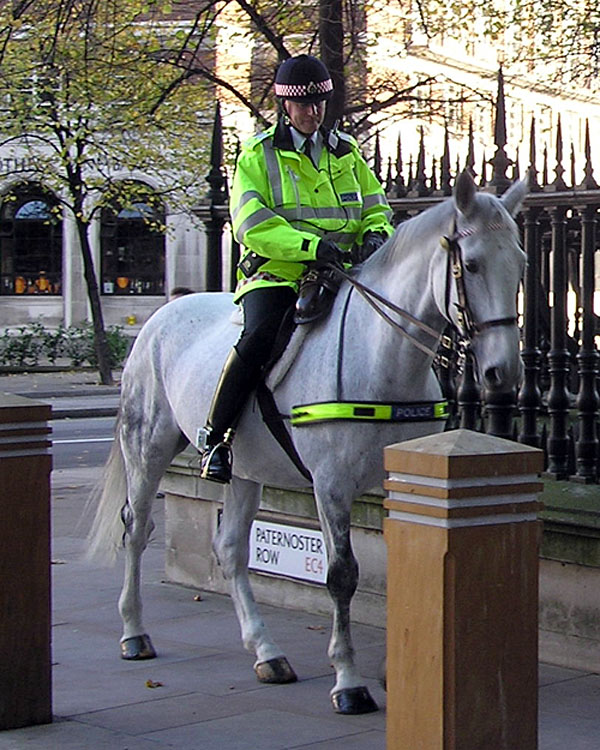
The street was devastated by aerial bombardment during World War II. In 2003 the area was pedestrianised with Paternoster Square, the modern home of the London Stock Exchange, at the west end, and a paved area around St Pauls' Coop and an entrance to St Pauls tube station at the East, bounded by St Pauls Churchyard, New Change, Cheapside and Payner Alley. The route of Paternoster Row is not demarcated across the open areas, although there is a road sign at the south of the eastern area, perhaps designating the area as Paternoster Row. Between Payner Alley and Queen's Head Passage/Cannon Alley the road is clearly marked as Paternoster Row. The building to the south, Paternoster House has an address in St Pauls Churchyard (the pedestrian way north of the bounds of the churchyard proper), where its south face is. There are no signs on the next segment up to Paternoster Square, nor around the square. The exit from the south-west corner of the square, along - or very close to - the previous route of Paternoster Row, debouching on Ave Maria Lane – Warwick Avenue opposite Amen Corner, is signed as Paternoster Lane.
Paternoster Square itself - the open plaza, rather than the development - shares almost no area with the former Paternoster Square.
The street is supposed to have received its name from the fact that, when the monks and clergy of St Paul's Cathedral went in procession chanting the great litany, they would recite the Lord's Prayer (Pater Noster being its opening line in Latin) in the litany along this part of the route. The prayers said at these processions may have also given the names to nearby Ave Maria Lane and Amen Corner.
Another possible etymology is that it was the main place in London where paternoster beads were made. The beads were popular with the laity, as well as illiterate monks and friars at the time, who prayed 50 Pater Noster prayers (Latin for "Our Father") three times a day as a substitute for the 150 psalms recited a day by literate monks.
Houses in St. Paul's Churchyard were damaged in the Great Fire of London in 1666, burning down the old St. Paul's Cathedral. When the new St. Paul's Cathedral was erected, booksellers returned after a number of years. At the same time Pissing Alley which linked Paternoster Row to St. Paul's Churchyard was rebuilt and renamed Canon Alley the name it still bears, although it was also referred to as Petty Canons.
A bust of Aldus Manutius, writer and publisher, can be seen above the fascia of number 13. The bust was placed there in 1820 by Bible publisher Samuel Bagster.
It was reported that Charlotte Brontë and Anne Brontë stayed at the Chapter Coffeehouse on the street when visiting London in 1847. They were in the city to meet their publisher regarding Jane Eyre.
Hub AI
Paternoster Row AI simulator
(@Paternoster Row_simulator)
Paternoster Row
Paternoster Row is a street in the City of London that was a centre of the London publishing trade, with booksellers operating from the street. Paternoster Row was described as "almost synonymous" with the book trade. It was part of an area called St Paul's Churchyard. In time Paternoster Row itself was used inclusively of various alleys, courts and side streets. Largely destroyed during aerial bombing in World War II, the street's area is now the site of much of the post-war Paternoster Square development.
The street was devastated by aerial bombardment during World War II. In 2003 the area was pedestrianised with Paternoster Square, the modern home of the London Stock Exchange, at the west end, and a paved area around St Pauls' Coop and an entrance to St Pauls tube station at the East, bounded by St Pauls Churchyard, New Change, Cheapside and Payner Alley. The route of Paternoster Row is not demarcated across the open areas, although there is a road sign at the south of the eastern area, perhaps designating the area as Paternoster Row. Between Payner Alley and Queen's Head Passage/Cannon Alley the road is clearly marked as Paternoster Row. The building to the south, Paternoster House has an address in St Pauls Churchyard (the pedestrian way north of the bounds of the churchyard proper), where its south face is. There are no signs on the next segment up to Paternoster Square, nor around the square. The exit from the south-west corner of the square, along - or very close to - the previous route of Paternoster Row, debouching on Ave Maria Lane – Warwick Avenue opposite Amen Corner, is signed as Paternoster Lane.
Paternoster Square itself - the open plaza, rather than the development - shares almost no area with the former Paternoster Square.
The street is supposed to have received its name from the fact that, when the monks and clergy of St Paul's Cathedral went in procession chanting the great litany, they would recite the Lord's Prayer (Pater Noster being its opening line in Latin) in the litany along this part of the route. The prayers said at these processions may have also given the names to nearby Ave Maria Lane and Amen Corner.
Another possible etymology is that it was the main place in London where paternoster beads were made. The beads were popular with the laity, as well as illiterate monks and friars at the time, who prayed 50 Pater Noster prayers (Latin for "Our Father") three times a day as a substitute for the 150 psalms recited a day by literate monks.
Houses in St. Paul's Churchyard were damaged in the Great Fire of London in 1666, burning down the old St. Paul's Cathedral. When the new St. Paul's Cathedral was erected, booksellers returned after a number of years. At the same time Pissing Alley which linked Paternoster Row to St. Paul's Churchyard was rebuilt and renamed Canon Alley the name it still bears, although it was also referred to as Petty Canons.
A bust of Aldus Manutius, writer and publisher, can be seen above the fascia of number 13. The bust was placed there in 1820 by Bible publisher Samuel Bagster.
It was reported that Charlotte Brontë and Anne Brontë stayed at the Chapter Coffeehouse on the street when visiting London in 1847. They were in the city to meet their publisher regarding Jane Eyre.
Recent media