

Recent from talks
Pathfinding
Knowledge base stats:
Talk channels stats:
Members stats:
Pathfinding
Pathfinding or pathing is the search, by a computer application, for the shortest route between two points. It is a more practical variant on solving mazes. This field of research is based heavily on Dijkstra's algorithm for finding the shortest path on a weighted graph.
Pathfinding is closely related to the shortest path problem, within graph theory, which examines how to identify the path that best meets some criteria (shortest, cheapest, fastest, etc) between two points in a large network.
At its core, a pathfinding method searches a graph by starting at one vertex and exploring adjacent nodes until the destination node is reached, generally with the intent of finding the cheapest route. Although graph searching methods such as a breadth-first search would find a route if given enough time, other methods, which "explore" the graph, would tend to reach the destination sooner. An analogy would be a person walking across a room; rather than examining every possible route in advance, the person would generally walk in the direction of the destination and only deviate from the path to avoid an obstruction, and make deviations as minor as possible.
Two primary problems of pathfinding are (1) to find a path between two nodes in a graph; and (2) the shortest path problem—to find the optimal shortest path. Basic algorithms such as breadth-first and depth-first search address the first problem by exhausting all possibilities; starting from the given node, they iterate over all potential paths until they reach the destination node. These algorithms run in , or linear time, where V is the number of vertices, and E is the number of edges between vertices.
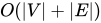
The more complicated problem is finding the optimal path. The exhaustive approach in this case is known as the Bellman–Ford algorithm, which yields a time complexity of , or quadratic time. However, it is not necessary to examine all possible paths to find the optimal one. Algorithms such as A* and Dijkstra's algorithm strategically eliminate paths, either through heuristics or through dynamic programming. By eliminating impossible paths, these algorithms can achieve time complexities as low as .


The above algorithms are among the best general algorithms which operate on a graph without preprocessing. However, in practical travel-routing systems, even better time complexities can be attained by algorithms which can pre-process the graph to attain better performance. One such algorithm is contraction hierarchies.
A common example of a graph-based pathfinding algorithm is Dijkstra's algorithm. This algorithm begins with a start node and an "open set" of candidate nodes. At each step, the node in the open set with the lowest distance from the start is examined. The node is marked "closed", and all nodes adjacent to it are added to the open set if they have not already been examined. This process repeats until a path to the destination has been found. Since the lowest distance nodes are examined first, the first time the destination is found, the path to it will be the shortest path.
Dijkstra's algorithm fails if there is a negative edge weight. In the hypothetical situation where Nodes A, B, and C form a connected undirected graph with edges AB = 3, AC = 4, and BC = −2, the optimal path from A to C costs 1, and the optimal path from A to B costs 2. Dijkstra's Algorithm starting from A will first examine B, as that is the closest. It will assign a cost of 3 to it, and mark it closed, meaning that its cost will never be reevaluated. Therefore, Dijkstra's cannot evaluate negative edge weights. However, since for many practical purposes there will never be a negative edgeweight, Dijkstra's algorithm is largely suitable for the purpose of pathfinding.
Hub AI
Pathfinding AI simulator
(@Pathfinding_simulator)
Pathfinding
Pathfinding or pathing is the search, by a computer application, for the shortest route between two points. It is a more practical variant on solving mazes. This field of research is based heavily on Dijkstra's algorithm for finding the shortest path on a weighted graph.
Pathfinding is closely related to the shortest path problem, within graph theory, which examines how to identify the path that best meets some criteria (shortest, cheapest, fastest, etc) between two points in a large network.
At its core, a pathfinding method searches a graph by starting at one vertex and exploring adjacent nodes until the destination node is reached, generally with the intent of finding the cheapest route. Although graph searching methods such as a breadth-first search would find a route if given enough time, other methods, which "explore" the graph, would tend to reach the destination sooner. An analogy would be a person walking across a room; rather than examining every possible route in advance, the person would generally walk in the direction of the destination and only deviate from the path to avoid an obstruction, and make deviations as minor as possible.
Two primary problems of pathfinding are (1) to find a path between two nodes in a graph; and (2) the shortest path problem—to find the optimal shortest path. Basic algorithms such as breadth-first and depth-first search address the first problem by exhausting all possibilities; starting from the given node, they iterate over all potential paths until they reach the destination node. These algorithms run in , or linear time, where V is the number of vertices, and E is the number of edges between vertices.
The more complicated problem is finding the optimal path. The exhaustive approach in this case is known as the Bellman–Ford algorithm, which yields a time complexity of , or quadratic time. However, it is not necessary to examine all possible paths to find the optimal one. Algorithms such as A* and Dijkstra's algorithm strategically eliminate paths, either through heuristics or through dynamic programming. By eliminating impossible paths, these algorithms can achieve time complexities as low as .
The above algorithms are among the best general algorithms which operate on a graph without preprocessing. However, in practical travel-routing systems, even better time complexities can be attained by algorithms which can pre-process the graph to attain better performance. One such algorithm is contraction hierarchies.
A common example of a graph-based pathfinding algorithm is Dijkstra's algorithm. This algorithm begins with a start node and an "open set" of candidate nodes. At each step, the node in the open set with the lowest distance from the start is examined. The node is marked "closed", and all nodes adjacent to it are added to the open set if they have not already been examined. This process repeats until a path to the destination has been found. Since the lowest distance nodes are examined first, the first time the destination is found, the path to it will be the shortest path.
Dijkstra's algorithm fails if there is a negative edge weight. In the hypothetical situation where Nodes A, B, and C form a connected undirected graph with edges AB = 3, AC = 4, and BC = −2, the optimal path from A to C costs 1, and the optimal path from A to B costs 2. Dijkstra's Algorithm starting from A will first examine B, as that is the closest. It will assign a cost of 3 to it, and mark it closed, meaning that its cost will never be reevaluated. Therefore, Dijkstra's cannot evaluate negative edge weights. However, since for many practical purposes there will never be a negative edgeweight, Dijkstra's algorithm is largely suitable for the purpose of pathfinding.
Recent media