



Community hub
Community hub
Recent from talks
Knowledge base stats:
Talk channels stats:
Members stats:
Dijkstra's algorithm
Dijkstra's algorithm (/ˈdaɪkstrəz/ DYKE-strəz) is an algorithm for finding the shortest paths between nodes in a weighted graph, which may represent, for example, a road network. It was conceived by computer scientist Edsger W. Dijkstra in 1956 and published three years later.
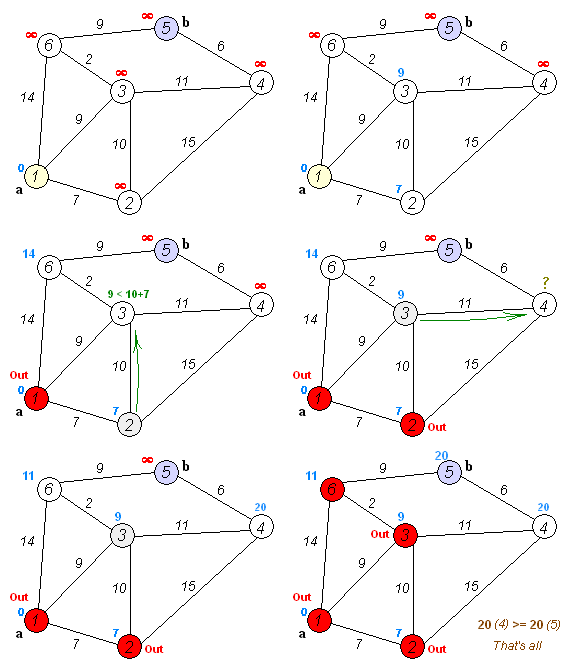
Dijkstra's algorithm finds the shortest path from a given source node to every other node. It can be used to find the shortest path to a specific destination node, by terminating the algorithm after determining the shortest path to the destination node. For example, if the nodes of the graph represent cities, and the costs of edges represent the distances between pairs of cities connected by a direct road, then Dijkstra's algorithm can be used to find the shortest route between one city and all other cities. A common application of shortest path algorithms is network routing protocols, most notably IS-IS (Intermediate System to Intermediate System) and OSPF (Open Shortest Path First). It is also employed as a subroutine in algorithms such as Johnson's algorithm.
The algorithm uses a min-priority queue data structure for selecting the shortest paths known so far. Before more advanced priority queue structures were discovered, Dijkstra's original algorithm ran in time, where is the number of nodes. Fredman & Tarjan 1984 proposed a Fibonacci heap priority queue to optimize the running time complexity to . This is asymptotically the fastest known single-source shortest-path algorithm for arbitrary directed graphs with unbounded non-negative weights. However, specialized cases (such as bounded/integer weights, directed acyclic graphs etc.) can be improved further. If preprocessing is allowed, algorithms such as contraction hierarchies can be up to seven orders of magnitude faster.



Dijkstra's algorithm is commonly used on graphs where the edge weights are positive integers or real numbers. It can be generalized to any graph where the edge weights are partially ordered, provided the subsequent labels (a subsequent label is produced when traversing an edge) are monotonically non-decreasing.
In many fields, particularly artificial intelligence, Dijkstra's algorithm or a variant offers a uniform cost search and is formulated as an instance of the more general idea of best-first search.
What is the shortest way to travel from Rotterdam to Groningen, in general: from given city to given city. It is the algorithm for the shortest path, which I designed in about twenty minutes. One morning I was shopping in Amsterdam with my young fiancée, and tired, we sat down on the café terrace to drink a cup of coffee and I was just thinking about whether I could do this, and I then designed the algorithm for the shortest path. As I said, it was a twenty-minute invention. In fact, it was published in '59, three years later. The publication is still readable, it is, in fact, quite nice. One of the reasons that it is so nice was that I designed it without pencil and paper. I learned later that one of the advantages of designing without pencil and paper is that you are almost forced to avoid all avoidable complexities. Eventually, that algorithm became to my great amazement, one of the cornerstones of my fame.
— Edsger Dijkstra, in an interview with Philip L. Frana, Communications of the ACM, 2001
Dijkstra thought about the shortest path problem while working as a programmer at the Mathematical Center in Amsterdam in 1956. He wanted to demonstrate the capabilities of the new ARMAC computer. His objective was to choose a problem and a computer solution that non-computing people could understand. He designed the shortest path algorithm and later implemented it for ARMAC for a slightly simplified transportation map of 64 cities in the Netherlands (he limited it to 64, so that 6 bits would be sufficient to encode the city number). A year later, he came across another problem advanced by hardware engineers working on the institute's next computer: minimize the amount of wire needed to connect the pins on the machine's back panel. As a solution, he re-discovered Prim's minimal spanning tree algorithm (known earlier to Jarník, and also rediscovered by Prim). Dijkstra published the algorithm in 1959, two years after Prim and 29 years after Jarník.
Hub AI
Dijkstra's algorithm AI simulator
(@Dijkstra's algorithm_simulator)
Dijkstra's algorithm
Dijkstra's algorithm (/ˈdaɪkstrəz/ DYKE-strəz) is an algorithm for finding the shortest paths between nodes in a weighted graph, which may represent, for example, a road network. It was conceived by computer scientist Edsger W. Dijkstra in 1956 and published three years later.
Dijkstra's algorithm finds the shortest path from a given source node to every other node. It can be used to find the shortest path to a specific destination node, by terminating the algorithm after determining the shortest path to the destination node. For example, if the nodes of the graph represent cities, and the costs of edges represent the distances between pairs of cities connected by a direct road, then Dijkstra's algorithm can be used to find the shortest route between one city and all other cities. A common application of shortest path algorithms is network routing protocols, most notably IS-IS (Intermediate System to Intermediate System) and OSPF (Open Shortest Path First). It is also employed as a subroutine in algorithms such as Johnson's algorithm.
The algorithm uses a min-priority queue data structure for selecting the shortest paths known so far. Before more advanced priority queue structures were discovered, Dijkstra's original algorithm ran in time, where is the number of nodes. Fredman & Tarjan 1984 proposed a Fibonacci heap priority queue to optimize the running time complexity to . This is asymptotically the fastest known single-source shortest-path algorithm for arbitrary directed graphs with unbounded non-negative weights. However, specialized cases (such as bounded/integer weights, directed acyclic graphs etc.) can be improved further. If preprocessing is allowed, algorithms such as contraction hierarchies can be up to seven orders of magnitude faster.
Dijkstra's algorithm is commonly used on graphs where the edge weights are positive integers or real numbers. It can be generalized to any graph where the edge weights are partially ordered, provided the subsequent labels (a subsequent label is produced when traversing an edge) are monotonically non-decreasing.
In many fields, particularly artificial intelligence, Dijkstra's algorithm or a variant offers a uniform cost search and is formulated as an instance of the more general idea of best-first search.
What is the shortest way to travel from Rotterdam to Groningen, in general: from given city to given city. It is the algorithm for the shortest path, which I designed in about twenty minutes. One morning I was shopping in Amsterdam with my young fiancée, and tired, we sat down on the café terrace to drink a cup of coffee and I was just thinking about whether I could do this, and I then designed the algorithm for the shortest path. As I said, it was a twenty-minute invention. In fact, it was published in '59, three years later. The publication is still readable, it is, in fact, quite nice. One of the reasons that it is so nice was that I designed it without pencil and paper. I learned later that one of the advantages of designing without pencil and paper is that you are almost forced to avoid all avoidable complexities. Eventually, that algorithm became to my great amazement, one of the cornerstones of my fame.
— Edsger Dijkstra, in an interview with Philip L. Frana, Communications of the ACM, 2001
Dijkstra thought about the shortest path problem while working as a programmer at the Mathematical Center in Amsterdam in 1956. He wanted to demonstrate the capabilities of the new ARMAC computer. His objective was to choose a problem and a computer solution that non-computing people could understand. He designed the shortest path algorithm and later implemented it for ARMAC for a slightly simplified transportation map of 64 cities in the Netherlands (he limited it to 64, so that 6 bits would be sufficient to encode the city number). A year later, he came across another problem advanced by hardware engineers working on the institute's next computer: minimize the amount of wire needed to connect the pins on the machine's back panel. As a solution, he re-discovered Prim's minimal spanning tree algorithm (known earlier to Jarník, and also rediscovered by Prim). Dijkstra published the algorithm in 1959, two years after Prim and 29 years after Jarník.