Hubbry Logo
Patrick KinnaPatrick KinnaMain
Open search
Patrick Kinna
Community hub
Patrick Kinna
logo
8 pages, 0 posts
0 subscribers
Be the first to start a discussion here.
Patrick Kinna
Patrick Kinna
from Wikipedia

Patrick Francis Kinna MBE (September 5, 1913 – March 14, 2009) was Winston Churchill's stenographer during World War II.[1]

Key Information

Kinna was born in 1913, the eighth child of Captain Thomas Kinna, who as a boy had met Napoleon III when serving as an acolyte in the Catholic Church at Eltham. Thomas Kinna was subsequently decorated for his part in the relief of Ladysmith.[2][3]

Patrick Kinna was the Duke of Windsor's confidential clerk during the Duke's service to the British military mission to France, and was recommended by the Duke's staff to Churchill.[4] He met most of the key Allied figures, from Franklin D. Roosevelt to Joseph Stalin. In addition to his Pitman shorthand speed of 150 words per minute, Kinna could take dictation straight on to a manual typewriter at 50 words per minute. In the rather cramped bathroom at Chartwell, Churchill would dictate to him from his bath, while Kinna typed in the only other place there was to sit, on top of the lavatory seat, with the typewriter on his knee. The typescript would be ready for the Prime Minister by the time his valet had towelled him dry. [2][3]

At a Washington, D.C. meeting, Kinna told the BBC, "Churchill was in the bath and began dictating. He would submerge himself under the water every now and again and come up and carry on with the dictation. He was very absorbed in his work that morning and would not keep still for the valet to help dress him; he kept walking around the room speaking aloud. There was a rat-a-tat-tat on the door, and Churchill swung the door open to President Roosevelt! Churchill simply said that he had nothing to hide from Mr. President!"[5]

Kinna turned down the opportunity to stay with Churchill after the war. He remained in government service, working for Foreign Secretary Ernest Bevin.[6] Kinna died, aged 95, in 2009.[7]

References

[edit]

Sources

[edit]
  • Stelzer, Cita (2019). Working With Winston: The Unsung Women Behind Britain's Greatest Statesman. London: Head of Zeus. ISBN 978-1-786-69587-1.
[edit]
Revisions and contributorsEdit on WikipediaRead on Wikipedia
from Grokipedia
Patrick Kinna is a British stenographer and confidential secretary best known for serving as Winston Churchill's personal secretary during World War II. Born on September 5, 1913, in London, he joined Churchill's staff in 1941 shortly after the Atlantic Conference with President Roosevelt and remained in the role until 1945, accompanying the Prime Minister on demanding overseas trips to major wartime conferences including Tehran and Yalta. Kinna handled shorthand dictation under intense conditions, often working long hours with no holidays, and was present for pivotal historical moments such as Churchill's reaction to the Pearl Harbor attack and the famous 1941 White House incident where Churchill, emerging naked from his bath, famously remarked to Roosevelt that he had "nothing to conceal." His loyal wartime service earned him the MBE on Churchill's personal recommendation after the Prime Minister's 1945 election defeat, though Kinna declined an offer to continue in Opposition due to exhaustion. Postwar, he served as stenographer to Labour Foreign Secretary Ernest Bevin until 1951, then transitioned to the private sector as a personnel director at timber company Montague Meyer, retiring at age 60. Never married, Kinna lived quietly in Brighton with his sister until her death and remained there alone, recognized in his later years as the last surviving member of Churchill’s wartime private office secretariat before his own death on March 14, 2009, at age 95.

Early life and early career

Family background

Patrick Kinna was born on 5 September 1913 in London, England. He was the eighth child of Captain Thomas Kinna, a Boer War veteran who received decorations for his part in the relief of Ladysmith, and grew up in a family with a multi-generational military tradition. His father had met Napoleon III as a boy while serving as an acolyte in the Catholic Church at Eltham. Unlike his brothers, Kinna's slight stature rendered him unsuited to a military career. This circumstance directed his early interests toward non-military pursuits.

Secretarial training and early work

Patrick Kinna attended a local secretarial college after leaving school, where he acquired skills in shorthand and typing and won the All England Championship for secretarial speeds. He achieved proficiency at 150 words per minute in shorthand and 90 words per minute in typing. He joined Barclays Bank as a clerk while deliberating whether to pursue a career as a journalist or as a skating instructor. In parallel with his secretarial work, he trained in ice skating with Belita Jepson-Turner and achieved British gold medal status in ice dancing. These exceptional secretarial skills later contributed to his selection for wartime postings, including service with the Duke of Windsor.

Service with the Duke of Windsor

In September 1939, shortly after the outbreak of World War II, Patrick Kinna was posted to Paris as confidential clerk and secretary to the Duke of Windsor (formerly King Edward VIII), who was attached to the British military mission to France. His appointment leveraged his prior secretarial training and shorthand skills. Officially serving in the Anglo-French Liaison Secretariat, Kinna's primary but covert responsibility was to monitor the Duke and prevent him from removing official documents to his residence, amid broader security concerns about the Duke's activities and contacts. As German forces advanced and the fall of France unfolded in May-June 1940, Kinna assisted in the destruction of sensitive secret documents at the British mission to safeguard them from capture. Following the evacuation of British personnel, Kinna made his way to the coast by hitch-hiking and successfully returned to England. Staff associated with the Duke of Windsor subsequently recommended Kinna to Winston Churchill, leading to his later wartime appointment.

World War II service with Winston Churchill

Recruitment and appointment

Patrick Kinna was recruited to Winston Churchill's staff in 1941, shortly before the Prime Minister's first meeting with President Franklin D. Roosevelt at the Atlantic Charter conference in Newfoundland in August 1941. His prior service as confidential clerk to the Duke of Windsor during the British military mission in Paris led to his recommendation by the Duke's staff. Kinna received a telephone call from 10 Downing Street requesting him to join Churchill as a clerk for the transatlantic voyage aboard HMS Prince of Wales. He initially declined the offer but was told that complying was as close to a royal command as he was likely to receive, leading him to accept and begin his duties shortly thereafter. After impressing Churchill during the Newfoundland meeting, he was invited to join the staff permanently. Kinna served as shorthand typist, confidential assistant, and secretary to Churchill from 1941 until the general election of 1945. Due to security concerns that excluded women from accompanying the Prime Minister on overseas journeys, particularly aboard naval vessels, Kinna was the staff member who traveled with Churchill on all such wartime trips.

Duties and working conditions

Patrick Kinna's primary duties as one of Winston Churchill's confidential secretaries during World War II centered on stenographic work, which involved taking rapid dictation and producing typed transcripts, often under demanding circumstances. He frequently took dictation directly onto a typewriter due to his high typing speed, which allowed him to produce finished typescripts quickly after dictation sessions. Working conditions were highly irregular and intense, with Kinna and other secretaries operating on shifts around the clock in the Cabinet War Rooms bunker in London to accommodate Churchill's habit of dictating telegrams and memoranda in the middle of the night. A typical day often ran from 8 a.m. to midnight, leaving little opportunity for rest or personal life. Dictation sometimes occurred in unconventional settings, such as while Churchill bathed at Chartwell, where Kinna balanced his portable typewriter on his knees while seated on the lavatory in the small bathroom. To manage the challenges of rapid typing, Kinna used a specially modified portable typewriter with shaved keys to prevent jamming; this machine accompanied him on all overseas trips. On hazardous wartime flights, Kinna occasionally had to sleep in bomb racks, a precarious arrangement that required him to hope the pilot would not activate the wrong mechanism. His pre-war training enabled exceptionally high shorthand and typing speeds that proved essential for these exacting duties.

Notable anecdotes

During Winston Churchill's wartime visit to the White House over Christmas 1941, Patrick Kinna was summoned to take dictation while the Prime Minister was bathing. As Kinna recorded Churchill's words, President Franklin D. Roosevelt unexpectedly entered the bathroom without warning. Churchill rose naked from the tub and quipped, "The Prime Minister of Great Britain has nothing to hide from the President of the United States." The incident, witnessed by Kinna, became one of the most recounted personal moments from Churchill's American stay. On another occasion in Washington, Kinna continued taking dictation after Churchill emerged naked from the bath, illustrating the informal and unpredictable nature of such sessions. A lighter moment occurred during a turbulent flight aboard a Dakota aircraft, when strong winds prompted Churchill to tease Kinna about his small build, remarking, "No use throwing you out – there's not enough of you to make a ham sandwich!" One of Kinna's most poignant memories came after Churchill's defeat in the 1945 general election, when the two men shared an emotional farewell in the Cabinet Room, both reduced to tears as they reflected on their years together.

Wartime travels and conferences

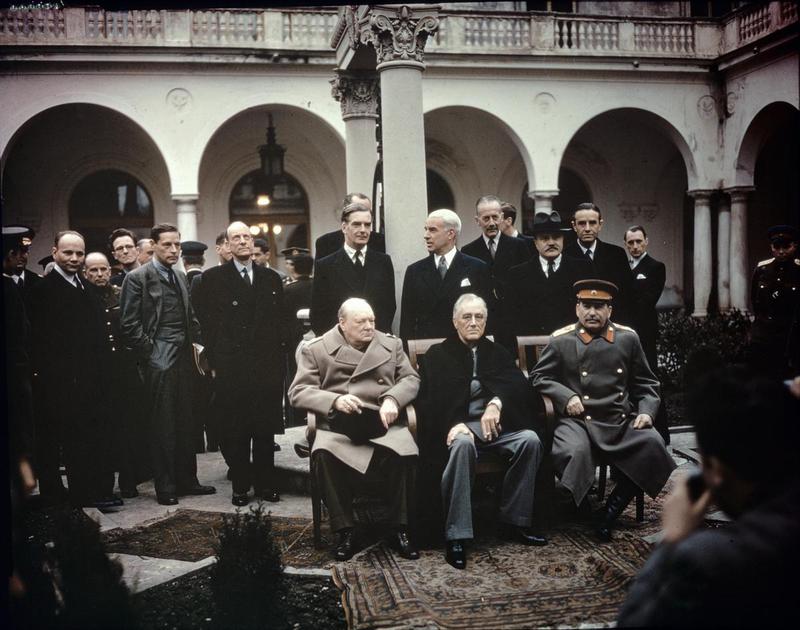
Patrick Kinna accompanied Winston Churchill on numerous overseas journeys and major international conferences during World War II, serving as the Prime Minister's confidential shorthand writer and assistant. These travels brought him into direct contact with key Allied leaders, including U.S. President Franklin D. Roosevelt and Soviet Premier Joseph Stalin. His first major trip occurred in August 1941 aboard HMS Prince of Wales for the Atlantic Charter meeting with Roosevelt in the mid-Atlantic, where Kinna spent days typing extensive messages and documents from Churchill's dictation. In December 1941, he traveled with Churchill to Washington, D.C., for further discussions and stayed at the White House during the Christmas period. Kinna was present at Churchill's visit to Moscow in August 1942, during the first direct meeting with Stalin, and later attended the Tehran Conference in 1943, where the three Allied leaders coordinated war strategy. He also participated in the Yalta Conference in Crimea in February 1945, recording the Yalta Agreement in shorthand. In addition to overseas conferences, Kinna attended meetings of the Defence Chiefs in the Cabinet War Rooms in London. Travel conditions on these wartime missions were frequently hazardous, with Kinna occasionally sleeping in bomb racks aboard aircraft to manage risks during flights.

Post-war career

Service to Ernest Bevin

After the Conservative Party's defeat in the 1945 general election, Patrick Kinna declined Winston Churchill's invitation to continue serving him in opposition due to exhaustion from his wartime duties. He subsequently accepted a position serving Labour Foreign Secretary Ernest Bevin in the Foreign Office, where he worked until Bevin's death in April 1951. In this role as stenographer, Kinna assisted with Bevin's duties, including social arrangements for official entertaining; one notable responsibility was selecting wines for dinners and receptions, where he always chose Bevin's preferred Nuits St Georges.

Business career and retirement

After his tenure serving Foreign Secretary Ernest Bevin ended with Bevin's death in 1951, Patrick Kinna transitioned to the private sector. In the early 1950s, he joined the timber firm Montague Meyer, where he rose to the position of personnel director. This role marked a significant shift from his wartime and immediate postwar governmental service, though it was described as less glamorous by comparison. Kinna retired at the age of 60 in 1973 and moved to Brighton, where he lived in a retirement apartment with his sister Gladys.

Later life and historical contributions

Assistance to historians and public speaking

After retiring in Brighton, Patrick Kinna provided considerable assistance to historians researching the Second World War. He offered great assistance to many writers of wartime books, in particular to Martin Gilbert, Churchill's official biographer, and to the archivist of Churchill College, Cambridge. Kinna also contributed to the preparation of the Cabinet War Rooms for public opening by accurately recalling and indicating the exact seating positions of all key participants around the table during a BBC interview at the site, enabling museum staff and the television crew to reposition the name cards correctly. He gave a number of public talks on his wartime experiences into his eighties that raised several thousand pounds for local charities. In these talks he consistently stated that he had never seen Churchill the worse for drink. Kinna further campaigned for and successfully obtained a grant to replace the railings around Sussex Square Gardens in Brighton that had been removed for the war effort.

Media appearances

Television documentaries and interviews

Patrick Kinna made several appearances in television documentaries about Winston Churchill, providing firsthand recollections of his service as the prime minister's shorthand writer during the Second World War. He featured as himself in the 1992 TV mini-series Churchill, appearing in three episodes credited as Churchill's shorthand writer from 1941 to 1945. The series offered a detailed biography of Churchill presented by historian Martin Gilbert. He later appeared in two episodes of the 1996 TV mini-series The Churchills and in one episode of the 2003 TV mini-series Churchill, again as himself sharing insights from his wartime role. Kinna also participated in television interviews recounting anecdotes from his time with Churchill, including a 1994 C-SPAN discussion of his experiences as personal assistant around D-Day. He occasionally declined invitations to appear on certain programs, such as a television programme on the Duke of Windsor produced by a company headed by Prince Edward, citing obligations under the Official Secrets Act. A tribute to his life and contributions aired on BBC Radio 4's Last Word following his death in 2009.

Personal life

Family and interests

Patrick Kinna did not marry and had no children. Following his retirement at age sixty, he lived with his sister Gladys in Brighton, where he had long enjoyed visiting for the sea, town, and restaurants. He became active in the local community there, including successfully obtaining a grant to replace railings in Sussex Square Gardens that had been removed during the war. Among his personal interests, Kinna pursued ice skating in his youth, training with the star Belita Jepson-Turner and achieving British gold medal status in ice dancing while considering a career as a skating instructor. In retirement he engaged in charity work, delivering talks about his wartime experiences that raised several thousand pounds for local charities and donating lecture fees to charitable causes. Known for his discreet and loyal character, he led a private personal life focused on these activities and community involvement.

Honours and death

Honours

Patrick Kinna was appointed a Member of the Order of the British Empire (MBE) in the Civil Division in 1945, in recognition of his wartime service as Senior Temporary Assistant in the Prime Minister's Private Office. This honour appeared in Winston Churchill's Resignation Honours list, announced following the Prime Minister's defeat in the July 1945 general election and the end of World War II in Europe. The award acknowledged Kinna's contributions as confidential assistant and stenographer to Churchill throughout the conflict.

Death

Patrick Kinna died on 14 March 2009 in Brighton, East Sussex, England, at the age of 95. His death was noted in obituaries published by several major publications, including The Daily Telegraph, The Guardian, The Independent, and the Los Angeles Times, which reflected on his discreet wartime service and long career in public life.

References

Add your contribution
Related Hubs
User Avatar
No comments yet.