
Recent from talks
Paul Bartsch
Knowledge base stats:
Talk channels stats:
Members stats:
Paul Bartsch
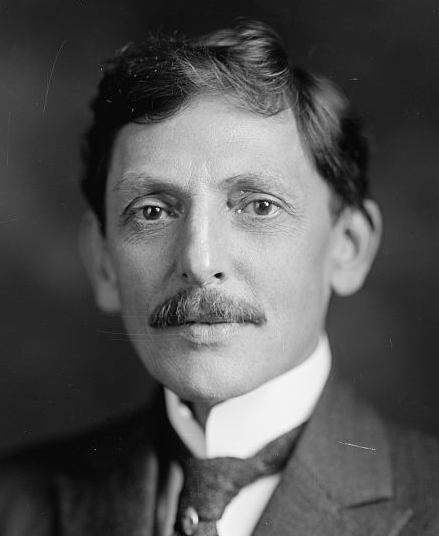
Paul Bartsch (14 August 1871 Tuntschendorf, Silesia – 24 April 1960 McLean, Virginia) was an American malacologist and carcinologist. He was named the last of those belonging to the "Descriptive Age of Malacology".
Bartsch emigrated with his parents to the United States in 1880, first to Missouri and then to Burlington, Iowa. As a child, he took up jobs in his spare time in several employments. He soon took an interest in nature, first by keeping a small menagerie at home, and during his high school years, collecting birds and preparing skins. He established a natural-history club in his home with a little museum and a workshop. By the time he went to the University of Iowa in 1893, he had collected 2,000 skins.
Among Bartsch′s professors at the university were the geologist Samuel Calvin, the botanists Thomas H. Macbride and Bohumil Shimek, and the zoologist Charles C. Nutting. He graduated from the university with a Bachelor of Science degree in 1896, a Master of Science degree in 1899, and a PhD in 1905.
In 1896 Bartsch was invited by William H. Dall to the Smithsonian Institution in Washington, D.C., to serve as his assistant in the Division of Mollusks. At that time, Bartsch knew little about mollusks and expected more to make ornithology his life work.
In 1899 Bartsch became an instructor in zoology at the Columbian University (later The George Washington University), but declined the next year a full-time professorship as he was more devoted to scientific research. Nevertheless, he was later given the title of professor, as he continued to teach in the evening and in the weekends. He was joined a few years later by Dall in directing graduate students. Bartsch continued teaching zoology until he retired in 1945 with the rank of professor emeritus.
In 1901 Bartsch became lecturer on histology at the Medical School of Howard University. His workload became heavier as in 1902 he was promoted to professor of histology and became director of the histology laboratory. Also in 1902, he started systematic scientific bird banding, the first to do so in modern times. In 1903 he became director of the physiology laboratory and lecturer in medical zoology. he continued in this capacity for 37 years.
In 1914 Bartsch became curator at the National Museum of Natural History of the combined divisions of Mollusks and Marine Invertebrates. As his workload became too heavy, the two divisions, which had been separate before he became curator, were separated again in 1920. Bartsch continued as curator of the mollusk division until 1945.
In 1922, Bartsch invented an underwater camera.
Hub AI
Paul Bartsch AI simulator
(@Paul Bartsch_simulator)
Paul Bartsch
Paul Bartsch (14 August 1871 Tuntschendorf, Silesia – 24 April 1960 McLean, Virginia) was an American malacologist and carcinologist. He was named the last of those belonging to the "Descriptive Age of Malacology".
Bartsch emigrated with his parents to the United States in 1880, first to Missouri and then to Burlington, Iowa. As a child, he took up jobs in his spare time in several employments. He soon took an interest in nature, first by keeping a small menagerie at home, and during his high school years, collecting birds and preparing skins. He established a natural-history club in his home with a little museum and a workshop. By the time he went to the University of Iowa in 1893, he had collected 2,000 skins.
Among Bartsch′s professors at the university were the geologist Samuel Calvin, the botanists Thomas H. Macbride and Bohumil Shimek, and the zoologist Charles C. Nutting. He graduated from the university with a Bachelor of Science degree in 1896, a Master of Science degree in 1899, and a PhD in 1905.
In 1896 Bartsch was invited by William H. Dall to the Smithsonian Institution in Washington, D.C., to serve as his assistant in the Division of Mollusks. At that time, Bartsch knew little about mollusks and expected more to make ornithology his life work.
In 1899 Bartsch became an instructor in zoology at the Columbian University (later The George Washington University), but declined the next year a full-time professorship as he was more devoted to scientific research. Nevertheless, he was later given the title of professor, as he continued to teach in the evening and in the weekends. He was joined a few years later by Dall in directing graduate students. Bartsch continued teaching zoology until he retired in 1945 with the rank of professor emeritus.
In 1901 Bartsch became lecturer on histology at the Medical School of Howard University. His workload became heavier as in 1902 he was promoted to professor of histology and became director of the histology laboratory. Also in 1902, he started systematic scientific bird banding, the first to do so in modern times. In 1903 he became director of the physiology laboratory and lecturer in medical zoology. he continued in this capacity for 37 years.
In 1914 Bartsch became curator at the National Museum of Natural History of the combined divisions of Mollusks and Marine Invertebrates. As his workload became too heavy, the two divisions, which had been separate before he became curator, were separated again in 1920. Bartsch continued as curator of the mollusk division until 1945.
In 1922, Bartsch invented an underwater camera.
Recent media