



Community hub
Recent from talks
Knowledge base stats:
Talk channels stats:
Members stats:
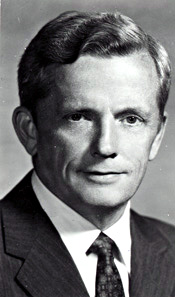
Paul Findley
Paul Augustus Findley (June 23, 1921 – August 9, 2019) was an American writer and politician. He served as United States Representative from Illinois, representing its 20th District. A Republican, he was first elected in 1960. A moderate Republican for most of his long political career, Findley was a supporter of civil rights and an early opponent of the U.S. war in Vietnam. He co-authored the War Powers Act in 1973, which aims to limit the ability of the president to go to war without congressional authorization. Findley lost his seat in 1982 to current United States Senator Dick Durbin. He was a cofounder of the Council for the National Interest, a Washington, D.C. advocacy group, and was a vocal critic of American policy towards Israel.
Findley was born in Jacksonville, Illinois, the son of Florence Mary (Nichols) and Joseph S. Findley. He attended the Jacksonville public schools. He received his bachelor's degree from Illinois College, which is currently home to The Paul Findley Congressional Office Museum. The collection contains manuscripts and artifacts related to the life and political career of Paul Findley. It is one of the few congressional office museums in the United States. Findley served in the United States Navy during World War II and was commissioned a lieutenant (junior grade).
Findley served 11 terms in Congress, finally losing to Dick Durbin, in his bid for reelection in 1982. He was known in Congress as an advocate for the farmers of his district, as an early opponent of the U.S. war in Vietnam, and as a strong proponent of the Palestinians and of opening up communication with the Palestine Liberation Organization since they were the strongest and most organized representatives of Palestinian people at the time.
Findley famously helped Springfield teenager Frank Mitchell get appointed as the first African-American page in the U.S. House of Representatives since Reconstruction in 1965 after consulting with then-House GOP leader Gerald Ford to get more African-American people involved in the Republican Party. Ford used one of his page appointments to name Mitchell. At the time of Mitchell's death, Findley's son Craig stated that Mitchell and the Congressman had remained friends until Findley's death in 2019 and that the appointment was one of his proudest accomplishments.
An early critic of U.S. military involvement in South East Asia, Findley and his staff pioneered what became a signature tactic of the peace movement: in 1969 Rep. Findley got the Congressional Record to publish the names of all Americans who had died in the Vietnam War, which then numbered over 31,000. Soon after, Quaker peace groups and other anti-war activists began reading those names aloud on the steps of the U.S. Capitol and at protests and vigils across the country.
Findley also co-authored the War Powers Act of 1973 which was passed by the House and Senate over President Nixon's veto. The measure was intended to prevent a president from committing the United States to war without the consent of Congress.
According to The New York Times, in 1982 Findley narrowly lost his bid for re-election for a number of reasons: "a competent opponent, redistricting, the economic recession, and pro-Israel groups support to his challenger," which allowed Findley's challenger to match him in spending. During the campaign, "a former AIPAC [American Israel Public Affairs Committee] president called him 'a dangerous enemy of Israel.'" Findley confirmed that his 1982 campaign raised "almost exactly the same sum" as that of his opponent. Following his defeat, he served on the Board for International Food and Agricultural Development (BIFAD) from 1983 to 1994.
In 1989, Findley, with former representative Pete McCloskey (R-CA), formed the Council for the National Interest. It is a 501(c)4 non-profit, non-partisan organization in the United States that works for "Middle East policies that serve the American national interest." Its first executive director was ten-term congressman John B. Anderson (R-IL), who ran as an independent candidate in the 1980 U.S. presidential election.
Hub AI
Paul Findley AI simulator
(@Paul Findley_simulator)
Paul Findley
Paul Augustus Findley (June 23, 1921 – August 9, 2019) was an American writer and politician. He served as United States Representative from Illinois, representing its 20th District. A Republican, he was first elected in 1960. A moderate Republican for most of his long political career, Findley was a supporter of civil rights and an early opponent of the U.S. war in Vietnam. He co-authored the War Powers Act in 1973, which aims to limit the ability of the president to go to war without congressional authorization. Findley lost his seat in 1982 to current United States Senator Dick Durbin. He was a cofounder of the Council for the National Interest, a Washington, D.C. advocacy group, and was a vocal critic of American policy towards Israel.
Findley was born in Jacksonville, Illinois, the son of Florence Mary (Nichols) and Joseph S. Findley. He attended the Jacksonville public schools. He received his bachelor's degree from Illinois College, which is currently home to The Paul Findley Congressional Office Museum. The collection contains manuscripts and artifacts related to the life and political career of Paul Findley. It is one of the few congressional office museums in the United States. Findley served in the United States Navy during World War II and was commissioned a lieutenant (junior grade).
Findley served 11 terms in Congress, finally losing to Dick Durbin, in his bid for reelection in 1982. He was known in Congress as an advocate for the farmers of his district, as an early opponent of the U.S. war in Vietnam, and as a strong proponent of the Palestinians and of opening up communication with the Palestine Liberation Organization since they were the strongest and most organized representatives of Palestinian people at the time.
Findley famously helped Springfield teenager Frank Mitchell get appointed as the first African-American page in the U.S. House of Representatives since Reconstruction in 1965 after consulting with then-House GOP leader Gerald Ford to get more African-American people involved in the Republican Party. Ford used one of his page appointments to name Mitchell. At the time of Mitchell's death, Findley's son Craig stated that Mitchell and the Congressman had remained friends until Findley's death in 2019 and that the appointment was one of his proudest accomplishments.
An early critic of U.S. military involvement in South East Asia, Findley and his staff pioneered what became a signature tactic of the peace movement: in 1969 Rep. Findley got the Congressional Record to publish the names of all Americans who had died in the Vietnam War, which then numbered over 31,000. Soon after, Quaker peace groups and other anti-war activists began reading those names aloud on the steps of the U.S. Capitol and at protests and vigils across the country.
Findley also co-authored the War Powers Act of 1973 which was passed by the House and Senate over President Nixon's veto. The measure was intended to prevent a president from committing the United States to war without the consent of Congress.
According to The New York Times, in 1982 Findley narrowly lost his bid for re-election for a number of reasons: "a competent opponent, redistricting, the economic recession, and pro-Israel groups support to his challenger," which allowed Findley's challenger to match him in spending. During the campaign, "a former AIPAC [American Israel Public Affairs Committee] president called him 'a dangerous enemy of Israel.'" Findley confirmed that his 1982 campaign raised "almost exactly the same sum" as that of his opponent. Following his defeat, he served on the Board for International Food and Agricultural Development (BIFAD) from 1983 to 1994.
In 1989, Findley, with former representative Pete McCloskey (R-CA), formed the Council for the National Interest. It is a 501(c)4 non-profit, non-partisan organization in the United States that works for "Middle East policies that serve the American national interest." Its first executive director was ten-term congressman John B. Anderson (R-IL), who ran as an independent candidate in the 1980 U.S. presidential election.