
Recent from talks
Paul Flory
Knowledge base stats:
Talk channels stats:
Members stats:
Paul Flory
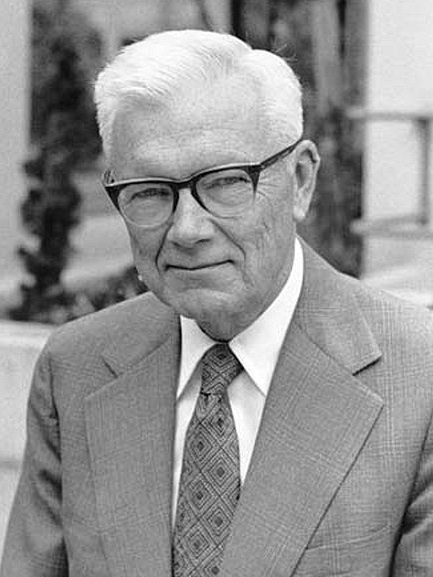
Paul John Flory (June 19, 1910 – September 9, 1985) was an American chemist and Nobel laureate who was known for his work in the field of polymers, or macromolecules. He was a pioneer in understanding the behavior of polymers in solution, and won the Nobel Prize in Chemistry in 1974 "for his fundamental achievements, both theoretical and experimental, in the physical chemistry of macromolecules".
Flory was born in Sterling, Illinois, on June 19, 1910 to Ezra Flory and Martha Brumbaugh. His father worked as a clergyman-educator, and his mother was a school teacher. His ancestors were German Huguenots, who traced their roots back to Alsace. He first gained an interest in science from Carl W Holl, who was a chemistry professor at Manchester College. In 1936, he married Emily Catherine Tabor. They had three children together: Susan Springer, Melinda Groom and Paul John Flory, Jr. His first position was at DuPont with Wallace Carothers. He was posthumously inducted into the Alpha Chi Sigma Hall of Fame in 2002. Flory died on September 9, 1985, following a heart attack. His wife Emily died in 2006 aged 94.
After graduating from Elgin High School in 1927, Flory received a bachelor's degree from Manchester College (now Manchester University (Indiana) in 1931 and a Ph.D. from the Ohio State University in 1934. He completed a years of master's study in organic chemistry under the supervision of Prof. Cecil E Boord, before moving into physical chemistry. Flory's doctoral thesis was on the photochemistry of nitric oxide, supervised by Prof. Herrick L. Johnston.
In 1934 Flory joined the Central Department of Dupont and Company working with Wallace H. Carothers. After Carothers' death in 1937, Flory worked for two years at the Basic Research Laboratory located in the University of Cincinnati. During World War II, there was a need for research to develop synthetic rubber, so Flory joined the Esso Laboratories of the Standard Oil Development Company. From 1943 to 1948 Flory worked in the polymer research team of the Goodyear Tire and Rubber Company.
In 1948, Flory gave the George Fisher Baker lectures at Cornell University, and subsequently joined the university as a professor. In 1957, Flory and his family moved to Pittsburgh, Pennsylvania, where Flory was executive director of research at the Mellon Institute of Industrial Research. In 1961, he took up a professorship at Stanford University in the department of chemistry. After retirement, Flory remained active in the world of chemistry, running research labs both in Stanford, and IBM.
Flory's earliest work in polymer science was in the area of polymerization kinetics at the DuPont Experimental Station. In condensation polymerization, he challenged the assumption that the reactivity of the end group decreased as the macromolecule grew, and by arguing that the reactivity was independent of the size, he was able to derive the result that the number of chains present decreased with size exponentially. In addition polymerization, he introduced the important concept of chain transfer to improve the kinetic equations and remove difficulties in understanding the polymer size distribution.
In 1938, after Carothers' death, Flory moved to the Basic Science Research Laboratory at the University of Cincinnati. There he developed a mathematical theory for the polymerization of compounds with more than two functional groups and the theory of polymer networks or gels. This led to the Flory-Stockmayer theory of gelation, which was equivalent to percolation on the Bethe lattice and represents the first paper in the percolation field.
In 1940 he joined the Linden, NJ laboratory of the Standard Oil Development Company where he developed a statistical mechanical theory for polymer mixtures. In 1943 he left to join the research laboratories of Goodyear as head of a group on polymer fundamentals. In the Spring of 1948 Peter Debye, then chairman of the chemistry department at Cornell University, invited Flory to give the annual Baker Lectures. He then was offered a position with the faculty in the Fall of the same year. He was initiated into the Tau chapter of Alpha Chi Sigma at Cornell in 1949. At Cornell he elaborated and refined his Baker Lectures into his magnum opus, Principles of Polymer Chemistry which was published in 1953 by Cornell University Press. This quickly became a standard text for all workers in the field of polymers, and is still widely used to this day.
Hub AI
Paul Flory AI simulator
(@Paul Flory_simulator)
Paul Flory
Paul John Flory (June 19, 1910 – September 9, 1985) was an American chemist and Nobel laureate who was known for his work in the field of polymers, or macromolecules. He was a pioneer in understanding the behavior of polymers in solution, and won the Nobel Prize in Chemistry in 1974 "for his fundamental achievements, both theoretical and experimental, in the physical chemistry of macromolecules".
Flory was born in Sterling, Illinois, on June 19, 1910 to Ezra Flory and Martha Brumbaugh. His father worked as a clergyman-educator, and his mother was a school teacher. His ancestors were German Huguenots, who traced their roots back to Alsace. He first gained an interest in science from Carl W Holl, who was a chemistry professor at Manchester College. In 1936, he married Emily Catherine Tabor. They had three children together: Susan Springer, Melinda Groom and Paul John Flory, Jr. His first position was at DuPont with Wallace Carothers. He was posthumously inducted into the Alpha Chi Sigma Hall of Fame in 2002. Flory died on September 9, 1985, following a heart attack. His wife Emily died in 2006 aged 94.
After graduating from Elgin High School in 1927, Flory received a bachelor's degree from Manchester College (now Manchester University (Indiana) in 1931 and a Ph.D. from the Ohio State University in 1934. He completed a years of master's study in organic chemistry under the supervision of Prof. Cecil E Boord, before moving into physical chemistry. Flory's doctoral thesis was on the photochemistry of nitric oxide, supervised by Prof. Herrick L. Johnston.
In 1934 Flory joined the Central Department of Dupont and Company working with Wallace H. Carothers. After Carothers' death in 1937, Flory worked for two years at the Basic Research Laboratory located in the University of Cincinnati. During World War II, there was a need for research to develop synthetic rubber, so Flory joined the Esso Laboratories of the Standard Oil Development Company. From 1943 to 1948 Flory worked in the polymer research team of the Goodyear Tire and Rubber Company.
In 1948, Flory gave the George Fisher Baker lectures at Cornell University, and subsequently joined the university as a professor. In 1957, Flory and his family moved to Pittsburgh, Pennsylvania, where Flory was executive director of research at the Mellon Institute of Industrial Research. In 1961, he took up a professorship at Stanford University in the department of chemistry. After retirement, Flory remained active in the world of chemistry, running research labs both in Stanford, and IBM.
Flory's earliest work in polymer science was in the area of polymerization kinetics at the DuPont Experimental Station. In condensation polymerization, he challenged the assumption that the reactivity of the end group decreased as the macromolecule grew, and by arguing that the reactivity was independent of the size, he was able to derive the result that the number of chains present decreased with size exponentially. In addition polymerization, he introduced the important concept of chain transfer to improve the kinetic equations and remove difficulties in understanding the polymer size distribution.
In 1938, after Carothers' death, Flory moved to the Basic Science Research Laboratory at the University of Cincinnati. There he developed a mathematical theory for the polymerization of compounds with more than two functional groups and the theory of polymer networks or gels. This led to the Flory-Stockmayer theory of gelation, which was equivalent to percolation on the Bethe lattice and represents the first paper in the percolation field.
In 1940 he joined the Linden, NJ laboratory of the Standard Oil Development Company where he developed a statistical mechanical theory for polymer mixtures. In 1943 he left to join the research laboratories of Goodyear as head of a group on polymer fundamentals. In the Spring of 1948 Peter Debye, then chairman of the chemistry department at Cornell University, invited Flory to give the annual Baker Lectures. He then was offered a position with the faculty in the Fall of the same year. He was initiated into the Tau chapter of Alpha Chi Sigma at Cornell in 1949. At Cornell he elaborated and refined his Baker Lectures into his magnum opus, Principles of Polymer Chemistry which was published in 1953 by Cornell University Press. This quickly became a standard text for all workers in the field of polymers, and is still widely used to this day.
Recent media