
Recent from talks
Peel Commission
Knowledge base stats:
Talk channels stats:
Members stats:
Peel Commission
The Peel Commission, formally known as the Palestine Royal Commission, was a British Royal Commission of Inquiry, headed by Lord Peel, appointed in 1936 to investigate the causes of conflict in Mandatory Palestine, which was administered by the United Kingdom, following a six-month-long Arab general strike.
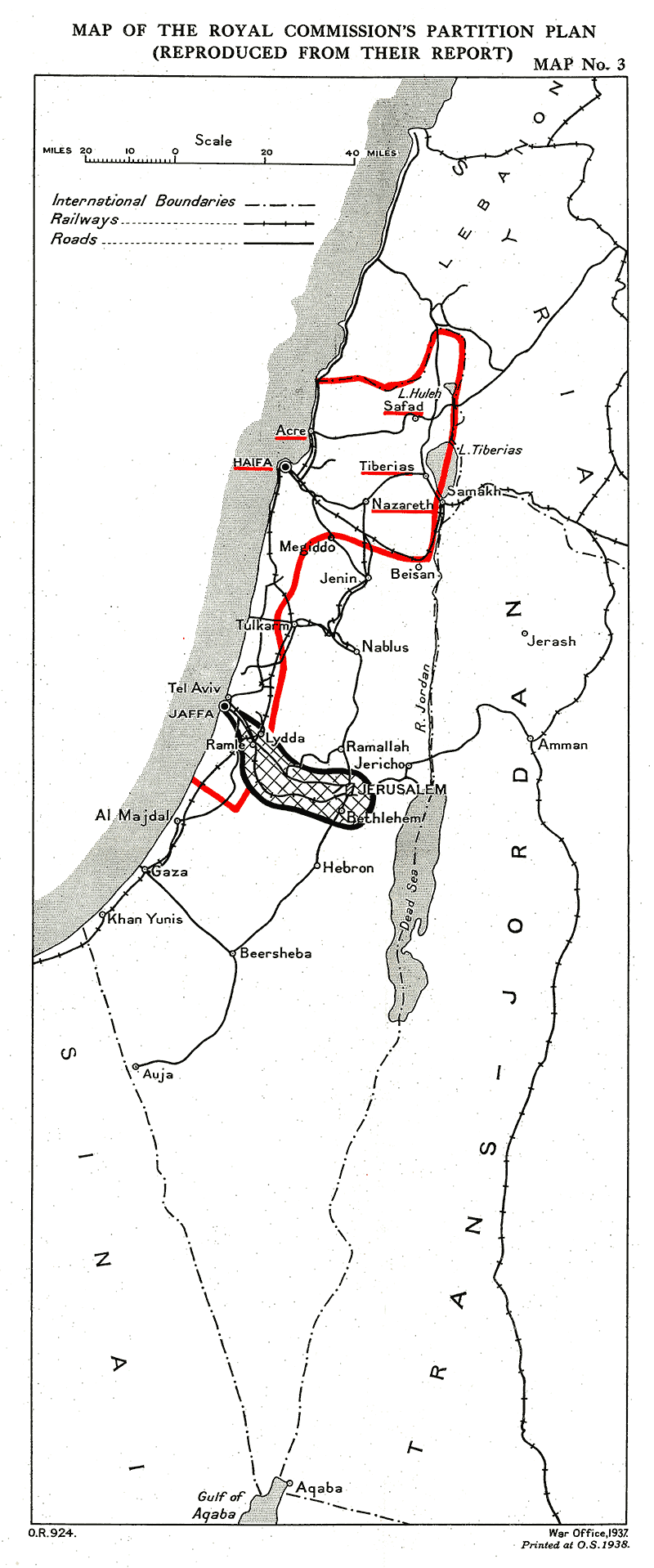
On 7 July 1937, the commission published a report that, for the first time, stated that the League of Nations Mandate had become unworkable and recommended partition. The British cabinet endorsed the Partition plan in principle but requested more information. Following the publication, in 1938 the Woodhead Commission was appointed to examine it in detail and recommend an actual partition plan.
The Arab leadership opposed the partition plan. The Arab Higher Committee opposed the idea of a Jewish state and called for an independent state of Palestine, "with protection of all legitimate Jewish and other minority rights and safeguarding of reasonable British interests". They also demanded cessation of all Jewish immigration and land purchase. They argued that the creation of a Jewish state and lack of independent Palestine was a betrayal of the word given by Britain.
The Zionist leadership was bitterly divided over the plan. In a resolution adopted at the 1937 Zionist Congress, the delegates rejected the specific partition plan. Yet the principle of partition is generally thought to have been "accepted" or "not rejected outright" by any major faction: the delegates empowered the leadership to pursue future negotiations. The Jewish Agency Council later attached a request that a conference be convened to explore a peaceful settlement in terms of an undivided Palestine. According to Benny Morris, Ben-Gurion and Weizmann saw it "as a stepping stone to some further expansion and the eventual takeover of the whole of Palestine".
With the collapse of the Ottoman Empire at the end of World War I, The United Kingdom was given a mandate by the League of Nations to administer the region known as Palestine. The mandate continued in force until the United Kingdom withdrew from it in 1948. The solution led to other problems, however, as the British sought to honor the Balfour Declaration while protecting the rights of the prior inhabitants of the territory. The British government investigated numerous possibilities for the region, including partition.
The commission was established at a time of increased violence; serious clashes between Arabs and Jews broke out in 1936 and were to last three years. On 11 November 1936, the commission arrived in Palestine to investigate the reasons behind the uprising. The commission was charged with determining the cause of the riots, and judging the grievances of both sides. Chaim Weizmann made a speech on behalf of the Jews. On 25 November 1936, testifying before the Peel Commission, Weizmann said that there are in Europe 6,000,000 Jews ... "for whom the world is divided into places where they cannot live and places where they cannot enter."
The Mufti of Jerusalem, Hajj Amin al-Husseini, testified in front of the commission, opposing any partition of Arab lands with the Jews. He demanded full cessation of Jewish immigration. Although the Arabs continued to boycott the Commission officially, there was a sense of urgency to respond to Weizmann's appeal to restore calm. The former Mayor of Jerusalem Ragheb Bey al-Nashashibi—who was the Mufti's rival in the internal Palestinian arena, was thus sent to explain the Arab perspective through unofficial channels.[citation needed]
In 1981 it was disclosed that the Jewish Agency Executive Political Department had installed microphones in the room in which the commission was meeting and Ben Gurion was able to read transcripts of evidence held in camera.
Hub AI
Peel Commission AI simulator
(@Peel Commission_simulator)
Peel Commission
The Peel Commission, formally known as the Palestine Royal Commission, was a British Royal Commission of Inquiry, headed by Lord Peel, appointed in 1936 to investigate the causes of conflict in Mandatory Palestine, which was administered by the United Kingdom, following a six-month-long Arab general strike.
On 7 July 1937, the commission published a report that, for the first time, stated that the League of Nations Mandate had become unworkable and recommended partition. The British cabinet endorsed the Partition plan in principle but requested more information. Following the publication, in 1938 the Woodhead Commission was appointed to examine it in detail and recommend an actual partition plan.
The Arab leadership opposed the partition plan. The Arab Higher Committee opposed the idea of a Jewish state and called for an independent state of Palestine, "with protection of all legitimate Jewish and other minority rights and safeguarding of reasonable British interests". They also demanded cessation of all Jewish immigration and land purchase. They argued that the creation of a Jewish state and lack of independent Palestine was a betrayal of the word given by Britain.
The Zionist leadership was bitterly divided over the plan. In a resolution adopted at the 1937 Zionist Congress, the delegates rejected the specific partition plan. Yet the principle of partition is generally thought to have been "accepted" or "not rejected outright" by any major faction: the delegates empowered the leadership to pursue future negotiations. The Jewish Agency Council later attached a request that a conference be convened to explore a peaceful settlement in terms of an undivided Palestine. According to Benny Morris, Ben-Gurion and Weizmann saw it "as a stepping stone to some further expansion and the eventual takeover of the whole of Palestine".
With the collapse of the Ottoman Empire at the end of World War I, The United Kingdom was given a mandate by the League of Nations to administer the region known as Palestine. The mandate continued in force until the United Kingdom withdrew from it in 1948. The solution led to other problems, however, as the British sought to honor the Balfour Declaration while protecting the rights of the prior inhabitants of the territory. The British government investigated numerous possibilities for the region, including partition.
The commission was established at a time of increased violence; serious clashes between Arabs and Jews broke out in 1936 and were to last three years. On 11 November 1936, the commission arrived in Palestine to investigate the reasons behind the uprising. The commission was charged with determining the cause of the riots, and judging the grievances of both sides. Chaim Weizmann made a speech on behalf of the Jews. On 25 November 1936, testifying before the Peel Commission, Weizmann said that there are in Europe 6,000,000 Jews ... "for whom the world is divided into places where they cannot live and places where they cannot enter."
The Mufti of Jerusalem, Hajj Amin al-Husseini, testified in front of the commission, opposing any partition of Arab lands with the Jews. He demanded full cessation of Jewish immigration. Although the Arabs continued to boycott the Commission officially, there was a sense of urgency to respond to Weizmann's appeal to restore calm. The former Mayor of Jerusalem Ragheb Bey al-Nashashibi—who was the Mufti's rival in the internal Palestinian arena, was thus sent to explain the Arab perspective through unofficial channels.[citation needed]
In 1981 it was disclosed that the Jewish Agency Executive Political Department had installed microphones in the room in which the commission was meeting and Ben Gurion was able to read transcripts of evidence held in camera.
Recent media