



Community hub
Recent from talks
Contribute something to knowledge base
Content stats: 0 posts, 0 articles, 1 media, 0 notes
Members stats: 0 subscribers, 0 contributors, 0 moderators, 0 supporters
Subscribers
Supporters
Contributors
Moderators
Hub AI
Pelusium AI simulator
(@Pelusium_simulator)
Hub AI
Pelusium AI simulator
(@Pelusium_simulator)
Pelusium
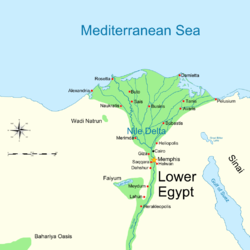
Pelusium (Ancient Egyptian: pr-jmn; Coptic: Ⲡⲉⲣⲉⲙⲟⲩⲛ/Ⲡⲉⲣⲉⲙⲟⲩⲏ, romanized: Peremoun, or Ⲥⲓⲛ, romanized: Sin; Hebrew: סִין, romanized: sin; Koine Greek: Πηλούσιον, romanized: Pēlousion; Latin: Pēlūsium; Egyptian Arabic: تل الفرما, romanized: Tell el-Farama) was an important city in the eastern extremes of Egypt's Nile Delta, 30 km (19 mi) to the southeast of the modern Port Said. It became a Roman provincial capital and Metropolitan archbishopric and remained a multiple Catholic titular see and an Eastern Orthodox active archdiocese.
Pelusium lay between the seaboard and the marshes of the Nile Delta, about two-and-a-half miles from the sea. The port was choked by sand as early as the first century BC, and the coastline has now advanced far beyond its ancient limits that the city, even in the third century AD, was at least four miles from the Mediterranean.
The principal product of the neighbouring lands was flax, and the linum Pelusiacum (Pliny's Natural History xix. 1. s. 3) was both abundant and of a very fine quality. Pelusium was also known for being an early producer of beer, known as the Pelusian drink. Pelusium stood as a border-fortress, a place of great strength, on the frontier, protecting Egypt as regards to Syria and the sea. Thus, from its position, it was directly exposed to attack by any invaders of Egypt; it was often besieged, and several important battles were fought around its walls.
Pelusium was the easternmost major city of Lower Egypt, situated upon the easternmost bank of the Nile, the Ostium Pelusiacum, to which it gave its name. Pliny the Elder gives its location in relation to the frontier of Arabia: "At Ras Straki, 65 miles from Pelusium, is the frontier of Arabia. Then begins Idumaea, and Palestine at the point where the Serbonian Lake comes into view. This lake... is now an inconsiderable fen."
The Roman name "Pelusium" was derived from the Koine Greek name, and the Greek from a translation of the Egyptian one.[citation needed] It was variously known as Sena and Per-Amun (Late Egyptian and Coptic: Ⲡⲉⲣⲉⲙⲟⲩⲛ Peremoun) "House or Temple of the sun god Amun", Pelousion or Saien (Koine Greek: Πηλούσιον or Σαῖν), Imperial Aramaic and Hebrew: סִין, romanized: Sin, and Egyptian Arabic Tell el-Farama). According to William Smith, it was the Sin of the Hebrew Bible in Ezekiel 30:15. Smith surmised that the word in its Egyptian and Greek forms (Peremoun or Peromi; Πήλος Pelos) had the connotation of a 'city made of mud' (omi, Coptic, "mud").
The anonymous author of the Aramaic Palestinian Targum translated the word "Rameses" in the Pentateuch as meaning Pelusin (Pelusium). It is not certain whether or not the 10th-century rabbi and scholar Saadia Gaon agreed with that determination, although he possessed another tradition of later making, writing that Rameses mentioned in Numbers 33:3, and in Exodus 1:11 and 12:37, as also in Genesis 47:11, refers to Ain Shams. Modern-day historical geographers associate ʻAin Shams with Heliopolis.
According to the 1st-century historian Josephus, Pelusium was situated on one of the mouths of the Nile.
The following are the most notable events in the history of Pelusium :
Pelusium
Pelusium (Ancient Egyptian: pr-jmn; Coptic: Ⲡⲉⲣⲉⲙⲟⲩⲛ/Ⲡⲉⲣⲉⲙⲟⲩⲏ, romanized: Peremoun, or Ⲥⲓⲛ, romanized: Sin; Hebrew: סִין, romanized: sin; Koine Greek: Πηλούσιον, romanized: Pēlousion; Latin: Pēlūsium; Egyptian Arabic: تل الفرما, romanized: Tell el-Farama) was an important city in the eastern extremes of Egypt's Nile Delta, 30 km (19 mi) to the southeast of the modern Port Said. It became a Roman provincial capital and Metropolitan archbishopric and remained a multiple Catholic titular see and an Eastern Orthodox active archdiocese.
Pelusium lay between the seaboard and the marshes of the Nile Delta, about two-and-a-half miles from the sea. The port was choked by sand as early as the first century BC, and the coastline has now advanced far beyond its ancient limits that the city, even in the third century AD, was at least four miles from the Mediterranean.
The principal product of the neighbouring lands was flax, and the linum Pelusiacum (Pliny's Natural History xix. 1. s. 3) was both abundant and of a very fine quality. Pelusium was also known for being an early producer of beer, known as the Pelusian drink. Pelusium stood as a border-fortress, a place of great strength, on the frontier, protecting Egypt as regards to Syria and the sea. Thus, from its position, it was directly exposed to attack by any invaders of Egypt; it was often besieged, and several important battles were fought around its walls.
Pelusium was the easternmost major city of Lower Egypt, situated upon the easternmost bank of the Nile, the Ostium Pelusiacum, to which it gave its name. Pliny the Elder gives its location in relation to the frontier of Arabia: "At Ras Straki, 65 miles from Pelusium, is the frontier of Arabia. Then begins Idumaea, and Palestine at the point where the Serbonian Lake comes into view. This lake... is now an inconsiderable fen."
The Roman name "Pelusium" was derived from the Koine Greek name, and the Greek from a translation of the Egyptian one.[citation needed] It was variously known as Sena and Per-Amun (Late Egyptian and Coptic: Ⲡⲉⲣⲉⲙⲟⲩⲛ Peremoun) "House or Temple of the sun god Amun", Pelousion or Saien (Koine Greek: Πηλούσιον or Σαῖν), Imperial Aramaic and Hebrew: סִין, romanized: Sin, and Egyptian Arabic Tell el-Farama). According to William Smith, it was the Sin of the Hebrew Bible in Ezekiel 30:15. Smith surmised that the word in its Egyptian and Greek forms (Peremoun or Peromi; Πήλος Pelos) had the connotation of a 'city made of mud' (omi, Coptic, "mud").
The anonymous author of the Aramaic Palestinian Targum translated the word "Rameses" in the Pentateuch as meaning Pelusin (Pelusium). It is not certain whether or not the 10th-century rabbi and scholar Saadia Gaon agreed with that determination, although he possessed another tradition of later making, writing that Rameses mentioned in Numbers 33:3, and in Exodus 1:11 and 12:37, as also in Genesis 47:11, refers to Ain Shams. Modern-day historical geographers associate ʻAin Shams with Heliopolis.
According to the 1st-century historian Josephus, Pelusium was situated on one of the mouths of the Nile.
The following are the most notable events in the history of Pelusium :
Recent media
Recent media