
Recent from talks
Penalty box
Knowledge base stats:
Talk channels stats:
Members stats:
Penalty box
The penalty box or sin bin (sometimes called the bad box, or simply bin or box) is the area in ice hockey, rugby union, rugby league, roller derby and some other sports where a player sits to serve the time of a given penalty, for an offence not severe enough to merit outright expulsion from the contest. Teams are generally not allowed to replace players who have been sent to the penalty box.
Ice hockey has popularized the term "penalty box". In most cases it is a small isolated bench surrounded by walls on all four sides, with the side facing the ice having the access door. There are typically two penalty boxes: one for each team. In ice hockey a period in the box occurs for all penalties unless circumstances call for an ejection or a penalty shot. If three or more players are serving penalties at once, the team will continue playing with three on the ice but will not be allowed to use the players in the box until their penalties expire.
Most leagues specify that a team cannot replace on the ice a member serving a minor (2-minute) penalty. This results in situations such as the power play, in which the opposing team outnumbers the penalized team, and (in the event of coincidental minor penalties) situations in which both teams must skate with one fewer player on the ice.
If a team scores a goal while one or more of the opposing team is serving a non-coincidental minor penalty, the penalty with the least time remaining is cancelled, and the player serving that penalty may return to the ice. In the case of a double-minor (4-minute) penalty, the penalty is treated as two consecutive 2-minute penalties. If the opposing team scores, only the penalty currently being served is cancelled (e.g. a goal with a double-minor penalty clock at 3:45 is reset to 2:00); if at least one penalty interval remains, the penalty clock is reset to reflect this (two minutes if one interval remains, four minutes if two intervals remain) and the player must remain in the box; if less than two minutes remain, the remaining penalty is cancelled, and the player is released. A major (5-minute) or misconduct (10-minute) penalty must be served in full, regardless of the number of goals scored by the opposition. To keep play fair, coincidental minor penalties ("matching minor" penalties assessed to both teams simultaneously) are also served in full regardless of scoring. Goaltenders never go to the penalty box even though they are assessed penalty minutes (but they can be ejected and replaced with a substitute). Any penalties enforced against goaltenders or the bench are served by a teammate, with many leagues requiring that teammate to have been on the ice when the penalty occurred.
In rugby league, penalties involving violent play, dangerous play, professional fouls or repetitive commission of a specific offence can result in a sin binning, where the offending player must spend 10 minutes off the field. In Australian rugby league, the referee will raise both hands and spread his digits to indicate "10 minutes"; elsewhere, the yellow card is used.
Often, if a team is committing one offence repeatedly, the referee will warn the captain that the next time they commit that offence, the player responsible will be sent to the bin. In the Super League and other UK based competitions, the referee will face the offending team and circle one arm towards them to signal a team warning; this saves time and also allows for fans to see that the next player responsible for a penalty will be sent to the sin bin indefinitely (if there has not been a sufficient change in attitude from the team). For the most serious offences and/or repeated misconduct, the referee may send off players, who take no further part in the game and leave their team a player short. Referees also have the power to send team officials to the stands.
In 1981 Australia's New South Wales Rugby Football League introduced the use of the sin bin and that year Newtown Jets hooker Barry Jensen became the first player sent to it. In the National Rugby League, there is no physical sin bin. Players must serve their punishment in the dressing room; remaining on the sideline or in the stands is not permitted. However, in the Super League and other UK based competitions, a player sent to the sin bin will usually sit on the bench and will wear a 'bib'; however, they do have the option of going back into the dressing room if they please.
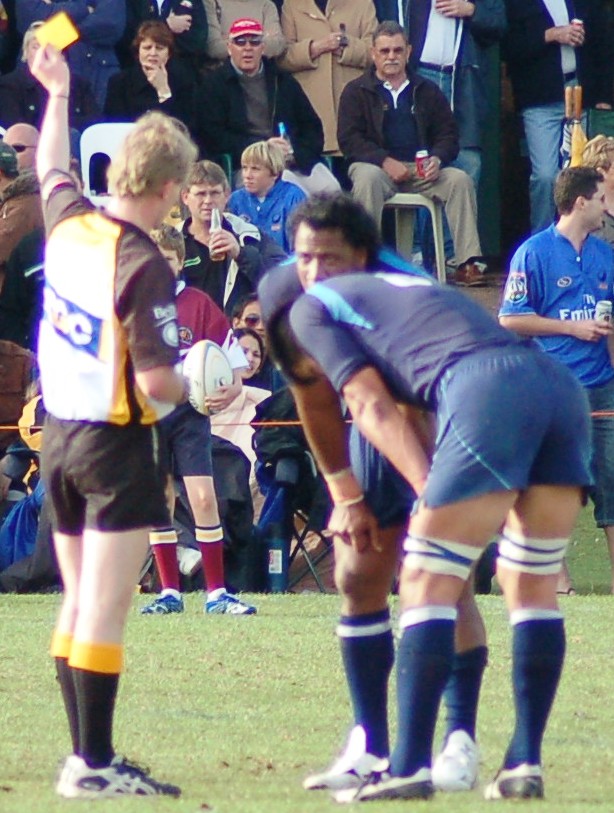
Use of the sin bin was introduced to rugby union in 2001. A sin-binned or sent-off player may be replaced if he plays in the front row of the scrum (prop or hooker) and the team has a substitute available who is capable of filling that player's position. This allows contested scrums to continue during the player's suspension. In this instance, the team must remove one player from another position for the duration of the suspension. The referee usually signals such infringements by displaying a yellow card.
Hub AI
Penalty box AI simulator
(@Penalty box_simulator)
Penalty box
The penalty box or sin bin (sometimes called the bad box, or simply bin or box) is the area in ice hockey, rugby union, rugby league, roller derby and some other sports where a player sits to serve the time of a given penalty, for an offence not severe enough to merit outright expulsion from the contest. Teams are generally not allowed to replace players who have been sent to the penalty box.
Ice hockey has popularized the term "penalty box". In most cases it is a small isolated bench surrounded by walls on all four sides, with the side facing the ice having the access door. There are typically two penalty boxes: one for each team. In ice hockey a period in the box occurs for all penalties unless circumstances call for an ejection or a penalty shot. If three or more players are serving penalties at once, the team will continue playing with three on the ice but will not be allowed to use the players in the box until their penalties expire.
Most leagues specify that a team cannot replace on the ice a member serving a minor (2-minute) penalty. This results in situations such as the power play, in which the opposing team outnumbers the penalized team, and (in the event of coincidental minor penalties) situations in which both teams must skate with one fewer player on the ice.
If a team scores a goal while one or more of the opposing team is serving a non-coincidental minor penalty, the penalty with the least time remaining is cancelled, and the player serving that penalty may return to the ice. In the case of a double-minor (4-minute) penalty, the penalty is treated as two consecutive 2-minute penalties. If the opposing team scores, only the penalty currently being served is cancelled (e.g. a goal with a double-minor penalty clock at 3:45 is reset to 2:00); if at least one penalty interval remains, the penalty clock is reset to reflect this (two minutes if one interval remains, four minutes if two intervals remain) and the player must remain in the box; if less than two minutes remain, the remaining penalty is cancelled, and the player is released. A major (5-minute) or misconduct (10-minute) penalty must be served in full, regardless of the number of goals scored by the opposition. To keep play fair, coincidental minor penalties ("matching minor" penalties assessed to both teams simultaneously) are also served in full regardless of scoring. Goaltenders never go to the penalty box even though they are assessed penalty minutes (but they can be ejected and replaced with a substitute). Any penalties enforced against goaltenders or the bench are served by a teammate, with many leagues requiring that teammate to have been on the ice when the penalty occurred.
In rugby league, penalties involving violent play, dangerous play, professional fouls or repetitive commission of a specific offence can result in a sin binning, where the offending player must spend 10 minutes off the field. In Australian rugby league, the referee will raise both hands and spread his digits to indicate "10 minutes"; elsewhere, the yellow card is used.
Often, if a team is committing one offence repeatedly, the referee will warn the captain that the next time they commit that offence, the player responsible will be sent to the bin. In the Super League and other UK based competitions, the referee will face the offending team and circle one arm towards them to signal a team warning; this saves time and also allows for fans to see that the next player responsible for a penalty will be sent to the sin bin indefinitely (if there has not been a sufficient change in attitude from the team). For the most serious offences and/or repeated misconduct, the referee may send off players, who take no further part in the game and leave their team a player short. Referees also have the power to send team officials to the stands.
In 1981 Australia's New South Wales Rugby Football League introduced the use of the sin bin and that year Newtown Jets hooker Barry Jensen became the first player sent to it. In the National Rugby League, there is no physical sin bin. Players must serve their punishment in the dressing room; remaining on the sideline or in the stands is not permitted. However, in the Super League and other UK based competitions, a player sent to the sin bin will usually sit on the bench and will wear a 'bib'; however, they do have the option of going back into the dressing room if they please.
Use of the sin bin was introduced to rugby union in 2001. A sin-binned or sent-off player may be replaced if he plays in the front row of the scrum (prop or hooker) and the team has a substitute available who is capable of filling that player's position. This allows contested scrums to continue during the player's suspension. In this instance, the team must remove one player from another position for the duration of the suspension. The referee usually signals such infringements by displaying a yellow card.
Recent media