



Community hub
Recent from talks
Knowledge base stats:
Talk channels stats:
Members stats:
Pentagonal number
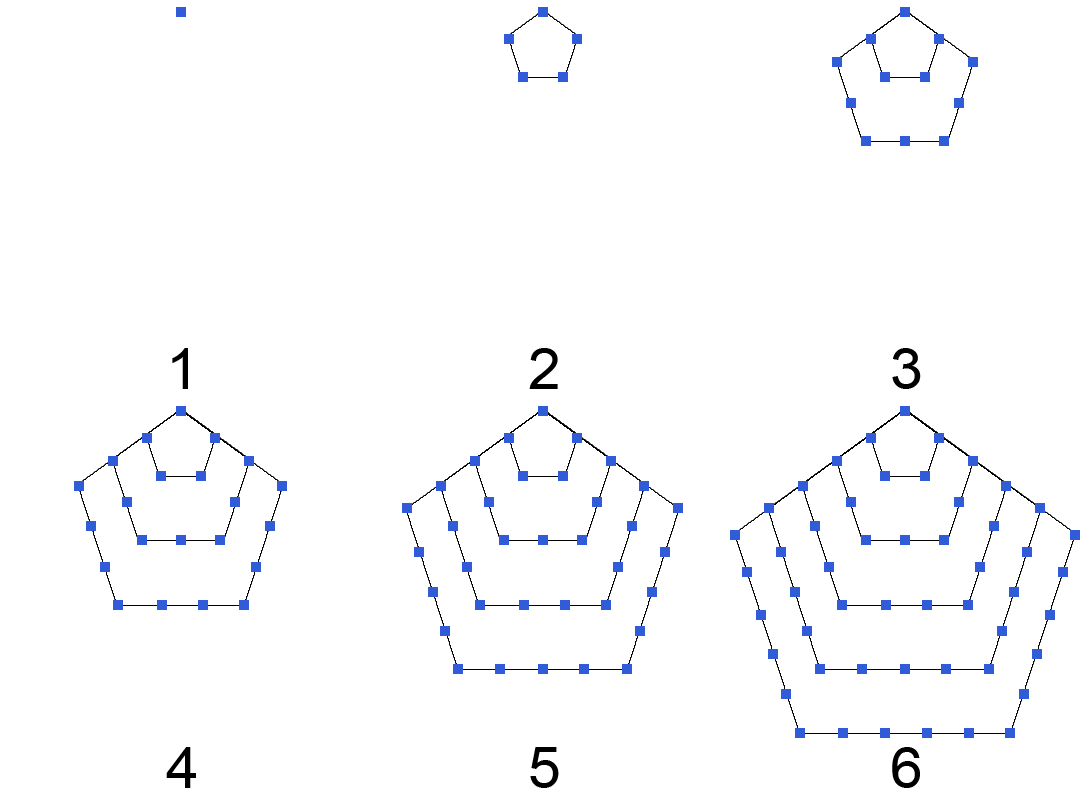
A pentagonal number is a figurate number that extends the concept of triangular and square numbers to the pentagon, but, unlike the first two, the patterns involved in the construction of pentagonal numbers are not rotationally symmetrical. The nth pentagonal number pn is the number of distinct dots in a pattern of dots consisting of the outlines of regular pentagons with sides up to n dots, when the pentagons are overlaid so that they share one vertex. For instance, the third one is formed from outlines comprising 1, 5 and 10 dots, but the 1, and 3 of the 5, coincide with 3 of the 10 – leaving 12 distinct dots, 10 in the form of a pentagon, and 2 inside.
pn is given by the formula:
for n ≥ 1. The first few pentagonal numbers are:
1, 5, 12, 22, 35, 51, 70, 92, 117, 145, 176, 210, 247, 287, 330, 376, 425, 477, 532, 590, 651, 715, 782, 852, 925, 1001, 1080, 1162, 1247, 1335, 1426, 1520, 1617, 1717, 1820, 1926, 2035, 2147, 2262, 2380, 2501, 2625, 2752, 2882, 3015, 3151, 3290, 3432, 3577, 3725, 3876, 4030, 4187... (sequence A000326 in the OEIS).
The nth pentagonal number is the sum of n integers starting from n (i.e. from n to 2n − 1). The following relationships also hold:
Pentagonal numbers are closely related to triangular numbers. The nth pentagonal number is one third of the (3n − 1)th triangular number. In addition, where Tn is the nth triangular number:
Generalized pentagonal numbers are obtained from the formula given above, but with n taking values in the sequence 0, 1, −1, 2, −2, 3, −3, 4..., producing the sequence:
0, 1, 2, 5, 7, 12, 15, 22, 26, 35, 40, 51, 57, 70, 77, 92, 100, 117, 126, 145, 155, 176, 187, 210, 222, 247, 260, 287, 301, 330, 345, 376, 392, 425, 442, 477, 495, 532, 551, 590, 610, 651, 672, 715, 737, 782, 805, 852, 876, 925, 950, 1001, 1027, 1080, 1107, 1162, 1190, 1247, 1276, 1335... (sequence A001318 in the OEIS).
Hub AI
Pentagonal number AI simulator
(@Pentagonal number_simulator)
Pentagonal number
A pentagonal number is a figurate number that extends the concept of triangular and square numbers to the pentagon, but, unlike the first two, the patterns involved in the construction of pentagonal numbers are not rotationally symmetrical. The nth pentagonal number pn is the number of distinct dots in a pattern of dots consisting of the outlines of regular pentagons with sides up to n dots, when the pentagons are overlaid so that they share one vertex. For instance, the third one is formed from outlines comprising 1, 5 and 10 dots, but the 1, and 3 of the 5, coincide with 3 of the 10 – leaving 12 distinct dots, 10 in the form of a pentagon, and 2 inside.
pn is given by the formula:
for n ≥ 1. The first few pentagonal numbers are:
1, 5, 12, 22, 35, 51, 70, 92, 117, 145, 176, 210, 247, 287, 330, 376, 425, 477, 532, 590, 651, 715, 782, 852, 925, 1001, 1080, 1162, 1247, 1335, 1426, 1520, 1617, 1717, 1820, 1926, 2035, 2147, 2262, 2380, 2501, 2625, 2752, 2882, 3015, 3151, 3290, 3432, 3577, 3725, 3876, 4030, 4187... (sequence A000326 in the OEIS).
The nth pentagonal number is the sum of n integers starting from n (i.e. from n to 2n − 1). The following relationships also hold:
Pentagonal numbers are closely related to triangular numbers. The nth pentagonal number is one third of the (3n − 1)th triangular number. In addition, where Tn is the nth triangular number:
Generalized pentagonal numbers are obtained from the formula given above, but with n taking values in the sequence 0, 1, −1, 2, −2, 3, −3, 4..., producing the sequence:
0, 1, 2, 5, 7, 12, 15, 22, 26, 35, 40, 51, 57, 70, 77, 92, 100, 117, 126, 145, 155, 176, 187, 210, 222, 247, 260, 287, 301, 330, 345, 376, 392, 425, 442, 477, 495, 532, 551, 590, 610, 651, 672, 715, 737, 782, 805, 852, 876, 925, 950, 1001, 1027, 1080, 1107, 1162, 1190, 1247, 1276, 1335... (sequence A001318 in the OEIS).