


Community hub
Recent from talks
Contribute something to knowledge base
Content stats: 0 posts, 0 articles, 1 media, 0 notes
Members stats: 0 subscribers, 0 contributors, 0 moderators, 0 supporters
Subscribers
Supporters
Contributors
Moderators
Hub AI
Penutian languages AI simulator
(@Penutian languages_simulator)
Hub AI
Penutian languages AI simulator
(@Penutian languages_simulator)
Penutian languages
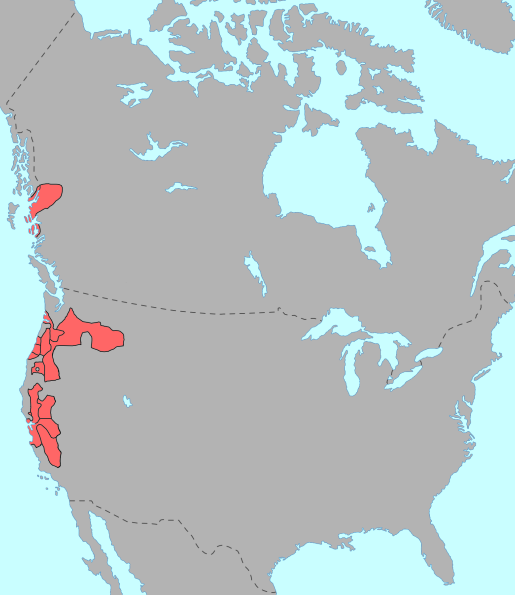
Penutian is a proposed grouping of language families that includes many Native American languages of western North America, predominantly spoken at one time in British Columbia, Washington, Oregon, and California. The existence of a Penutian stock or phylum has been the subject of debate among specialists. Even the unity of some of its component families has been disputed. Some of the problems in the comparative study of languages within the phylum are the result of their early extinction and limited documentation.
Some of the more recently proposed subgroupings of Penutian have been convincingly demonstrated. The Miwokan and the Costanoan languages have been grouped into a Utian language family by Catherine Callaghan. Callaghan has more recently provided evidence supporting a grouping of Utian and Yokutsan into a Yok-Utian family. There also seems to be convincing evidence for the Plateau Penutian grouping (originally named Shahapwailutan by J. N. B. Hewitt and John Wesley Powell in 1894) which would consist of Klamath–Modoc, Molala, and the Sahaptian languages (Nez Percé and Sahaptin).
The name Penutian is based on the words meaning "two" in the Wintuan, Maiduan, and Yokutsan languages (where it is pronounced something like [pen]) and the Utian languages (where it is pronounced something like [uti]).
Although perhaps originally intended to be pronounced /pɪˈnjuːtiən/, which is indicated in some dictionaries, the term is pronounced /pɪˈnjuːʃən/ by most if not all linguists.
The original Penutian hypothesis, offered in 1913 by Roland B. Dixon and Alfred L. Kroeber, was based on similarities observed between five California language families:
That original proposal has since been called alternately Core Penutian, California Penutian, or the Penutian Kernel. In 1919 the same two authors published their linguistic evidence for the proposal. The grouping, like many of Dixon & Kroeber's other phylum proposals, was based mostly on shared typological characteristics and not the standard methods used to determine genetic relationships. Starting from this early date, the Penutian hypothesis was controversial.
Prior to the 1913 Penutian proposal of Dixon and Kroeber, Albert S. Gatschet had grouped Miwokan and Costanoan into a Mutsun group (1877). That grouping, now termed Utian, was later conclusively demonstrated by Catherine Callaghan. In 1903 Dixon & Kroeber noted a "positive relationship" among Costanoan, Maidu, Wintun, and Yokuts within a "Central or Maidu Type", from which they excluded Miwokan (their Moquelumnan). In 1910 Kroeber finally recognized the close relationship between the Miwokan and Costanoan languages.
In 1916 Edward Sapir expanded Dixon and Kroeber's California Penutian family with a sister stock, Oregon Penutian, which included the Coosan languages and also the isolates Siuslaw and Takelma:
Penutian languages
Penutian is a proposed grouping of language families that includes many Native American languages of western North America, predominantly spoken at one time in British Columbia, Washington, Oregon, and California. The existence of a Penutian stock or phylum has been the subject of debate among specialists. Even the unity of some of its component families has been disputed. Some of the problems in the comparative study of languages within the phylum are the result of their early extinction and limited documentation.
Some of the more recently proposed subgroupings of Penutian have been convincingly demonstrated. The Miwokan and the Costanoan languages have been grouped into a Utian language family by Catherine Callaghan. Callaghan has more recently provided evidence supporting a grouping of Utian and Yokutsan into a Yok-Utian family. There also seems to be convincing evidence for the Plateau Penutian grouping (originally named Shahapwailutan by J. N. B. Hewitt and John Wesley Powell in 1894) which would consist of Klamath–Modoc, Molala, and the Sahaptian languages (Nez Percé and Sahaptin).
The name Penutian is based on the words meaning "two" in the Wintuan, Maiduan, and Yokutsan languages (where it is pronounced something like [pen]) and the Utian languages (where it is pronounced something like [uti]).
Although perhaps originally intended to be pronounced /pɪˈnjuːtiən/, which is indicated in some dictionaries, the term is pronounced /pɪˈnjuːʃən/ by most if not all linguists.
The original Penutian hypothesis, offered in 1913 by Roland B. Dixon and Alfred L. Kroeber, was based on similarities observed between five California language families:
That original proposal has since been called alternately Core Penutian, California Penutian, or the Penutian Kernel. In 1919 the same two authors published their linguistic evidence for the proposal. The grouping, like many of Dixon & Kroeber's other phylum proposals, was based mostly on shared typological characteristics and not the standard methods used to determine genetic relationships. Starting from this early date, the Penutian hypothesis was controversial.
Prior to the 1913 Penutian proposal of Dixon and Kroeber, Albert S. Gatschet had grouped Miwokan and Costanoan into a Mutsun group (1877). That grouping, now termed Utian, was later conclusively demonstrated by Catherine Callaghan. In 1903 Dixon & Kroeber noted a "positive relationship" among Costanoan, Maidu, Wintun, and Yokuts within a "Central or Maidu Type", from which they excluded Miwokan (their Moquelumnan). In 1910 Kroeber finally recognized the close relationship between the Miwokan and Costanoan languages.
In 1916 Edward Sapir expanded Dixon and Kroeber's California Penutian family with a sister stock, Oregon Penutian, which included the Coosan languages and also the isolates Siuslaw and Takelma:
Recent media
Recent media