



Community hub
Community hub
Recent from talks
Knowledge base stats:
Talk channels stats:
Members stats:
People's Crusade
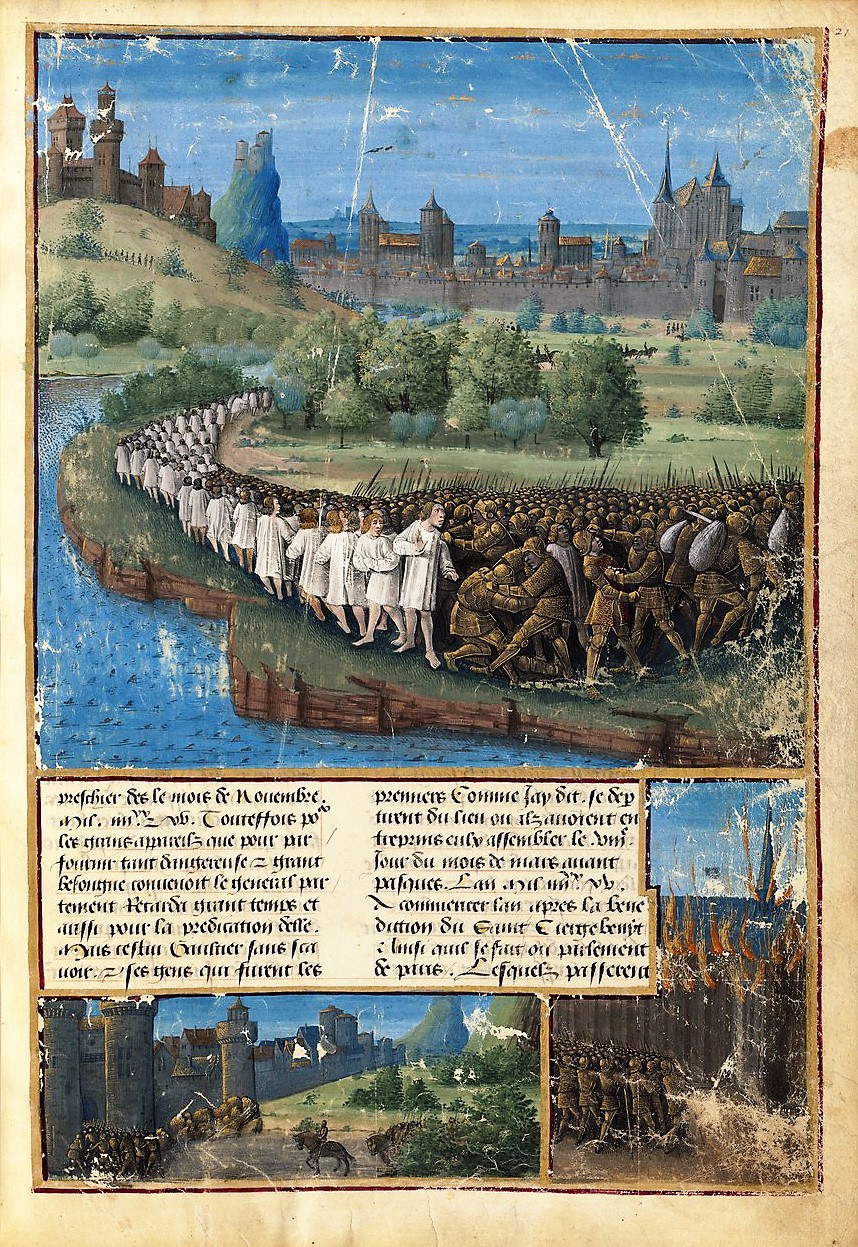
The People's Crusade was the beginning phase of the First Crusade whose objective was to retake the Holy Land, and Jerusalem in particular, from Islamic rule. In 1095, after the head of the Roman Catholic Church Pope Urban II started to urge faithful Christians to undertake an armed pilgrimage to Jerusalem, the People's Crusade was conducted for roughly six months from April to October 1096. It is also known as the Peasants' Crusade, Paupers' Crusade or the Popular Crusade as it was executed by a mainly untrained peasant army prior to the main church-organized crusade. It was led primarily by Peter the Hermit with forces of Walter Sans Avoir. The peasant army of this crusade was largely destroyed by the forces of the Seljuk Turks under Kilij Arslan at the Battle of Civetot in northwestern Anatolia, though some survivors joined the armies of the Prince's Crusade in Constantinople.
The People's Crusade was the first, largest, and best documented of the popular crusades. The start of the more official and fully church-backed crusade, called the "Princes' Crusade", occurred a few months later and was better organized, better armed, and better funded; it was also successful.
Calling for a crusade at the Council of Clermont in 1095, Pope Urban II planned the departure of the crusade for 15 August 1096. Nevertheless, a number of unexpected bands of peasants and low-ranking knights organized and set off for Jerusalem on their own. The peasant population had been afflicted by drought, famine, and disease for many years before 1096, and some of them seem to have envisioned the crusade as an escape from these hardships. Spurring them on had been a number of meteorological occurrences beginning in 1095 that seemed to be a divine blessing for the movement: a meteor shower, aurorae, a lunar eclipse, and a comet, among other events. An outbreak of ergotism had also occurred just before the Council of Clermont. Millenarianism, the belief that the end of the world was imminent, popular in the early 11th century, experienced a resurgence in popularity. The response was beyond expectations: while Urban might have expected a few thousand knights, he ended up with a migration numbering up to 100,000 Crusaders of mostly unskilled fighters, including women and children.
A charismatic monk and powerful orator named Peter the Hermit of Amiens was the spiritual leader of the movement. He was known for riding a donkey and dressing in simple clothing. He had vigorously preached the crusade throughout northern France and Flanders. He claimed to have been appointed to preach by Christ himself (and supposedly had a divine letter to prove it), and it is likely that some of his followers thought he, not Urban, was the true originator of the crusading idea. It is often believed that Peter's army was a band of illiterate, incompetent peasants who had no idea where they were going, and who believed that every city of any size they encountered on their way was Jerusalem itself; this may have been true for some, but the long tradition of pilgrimages to Jerusalem ensured that the location and distance of the city were well known. While the majority were unskilled in fighting, there were some well-trained minor knights leading them, such as Walter Sans-Avoir (also mistakenly known as Walter the Penniless), who was experienced in warfare.
In the late spring and summer of 1096, crusaders destroyed most of the Jewish communities along the Rhine in a series of unprecedentedly large pogroms in France and Germany in which thousands of Jews were massacred, driven to suicide, or forced to convert to Christianity. Twelve Jews were murdered in Speyer, where the Bishop saved the rest of the Jews, but in the Worms massacre some 800 were murdered. In Mainz, over 1,000 Jews were murdered, as well as more in Trier, Metz, Cologne, and elsewhere. Others were subjected to forced baptism and conversion. The preacher Folkmar and Emicho of Flonheim were the main inciters and leaders of the massacre. The major chroniclers of the 1096 killings are Solomon bar Simson and Albert of Aachen. In Prague, the army of Volkmar slaughtered the city's Jewish citizens and were subsequently defeated by the Kingdom of Hungary for their violence.
Estimates of the number of Jewish men, women, and children murdered or driven to suicide by crusaders vary, ranging from 2,000 to 12,000. Norman Cohn puts the number at between 4,000 and 8,000 from May to June 1096. Gedaliah ibn Yahya estimated that some 5,000 Jews were killed from April to June 1096. Edward H. Flannery's estimate is that 10,000 were murdered over the longer January-to-July period, "probably one-fourth to one-third of the Jewish population of Germany and Northern France at that time." The clergy and nobility of Europe condemned the killing of Jews, and forbade it on subsequent crusades.
Peter gathered his army at Cologne on 12 April 1096, planning to stop there and preach to the Germans and gather more crusaders.
The French, however, were not willing to wait for Peter and the Germans and under the leadership of Walter Sans Avoir, a few thousand French crusaders left before Peter and reached Hungary on 8 May, passing through Hungary without incident and arriving at the river Sava at the border of the Byzantine territory at Belgrade. The Belgrade commander was taken by surprise, having no orders on what to do with them, and refused entry, forcing the crusaders to pillage the countryside for food.
Hub AI
People's Crusade AI simulator
(@People's Crusade_simulator)
People's Crusade
The People's Crusade was the beginning phase of the First Crusade whose objective was to retake the Holy Land, and Jerusalem in particular, from Islamic rule. In 1095, after the head of the Roman Catholic Church Pope Urban II started to urge faithful Christians to undertake an armed pilgrimage to Jerusalem, the People's Crusade was conducted for roughly six months from April to October 1096. It is also known as the Peasants' Crusade, Paupers' Crusade or the Popular Crusade as it was executed by a mainly untrained peasant army prior to the main church-organized crusade. It was led primarily by Peter the Hermit with forces of Walter Sans Avoir. The peasant army of this crusade was largely destroyed by the forces of the Seljuk Turks under Kilij Arslan at the Battle of Civetot in northwestern Anatolia, though some survivors joined the armies of the Prince's Crusade in Constantinople.
The People's Crusade was the first, largest, and best documented of the popular crusades. The start of the more official and fully church-backed crusade, called the "Princes' Crusade", occurred a few months later and was better organized, better armed, and better funded; it was also successful.
Calling for a crusade at the Council of Clermont in 1095, Pope Urban II planned the departure of the crusade for 15 August 1096. Nevertheless, a number of unexpected bands of peasants and low-ranking knights organized and set off for Jerusalem on their own. The peasant population had been afflicted by drought, famine, and disease for many years before 1096, and some of them seem to have envisioned the crusade as an escape from these hardships. Spurring them on had been a number of meteorological occurrences beginning in 1095 that seemed to be a divine blessing for the movement: a meteor shower, aurorae, a lunar eclipse, and a comet, among other events. An outbreak of ergotism had also occurred just before the Council of Clermont. Millenarianism, the belief that the end of the world was imminent, popular in the early 11th century, experienced a resurgence in popularity. The response was beyond expectations: while Urban might have expected a few thousand knights, he ended up with a migration numbering up to 100,000 Crusaders of mostly unskilled fighters, including women and children.
A charismatic monk and powerful orator named Peter the Hermit of Amiens was the spiritual leader of the movement. He was known for riding a donkey and dressing in simple clothing. He had vigorously preached the crusade throughout northern France and Flanders. He claimed to have been appointed to preach by Christ himself (and supposedly had a divine letter to prove it), and it is likely that some of his followers thought he, not Urban, was the true originator of the crusading idea. It is often believed that Peter's army was a band of illiterate, incompetent peasants who had no idea where they were going, and who believed that every city of any size they encountered on their way was Jerusalem itself; this may have been true for some, but the long tradition of pilgrimages to Jerusalem ensured that the location and distance of the city were well known. While the majority were unskilled in fighting, there were some well-trained minor knights leading them, such as Walter Sans-Avoir (also mistakenly known as Walter the Penniless), who was experienced in warfare.
In the late spring and summer of 1096, crusaders destroyed most of the Jewish communities along the Rhine in a series of unprecedentedly large pogroms in France and Germany in which thousands of Jews were massacred, driven to suicide, or forced to convert to Christianity. Twelve Jews were murdered in Speyer, where the Bishop saved the rest of the Jews, but in the Worms massacre some 800 were murdered. In Mainz, over 1,000 Jews were murdered, as well as more in Trier, Metz, Cologne, and elsewhere. Others were subjected to forced baptism and conversion. The preacher Folkmar and Emicho of Flonheim were the main inciters and leaders of the massacre. The major chroniclers of the 1096 killings are Solomon bar Simson and Albert of Aachen. In Prague, the army of Volkmar slaughtered the city's Jewish citizens and were subsequently defeated by the Kingdom of Hungary for their violence.
Estimates of the number of Jewish men, women, and children murdered or driven to suicide by crusaders vary, ranging from 2,000 to 12,000. Norman Cohn puts the number at between 4,000 and 8,000 from May to June 1096. Gedaliah ibn Yahya estimated that some 5,000 Jews were killed from April to June 1096. Edward H. Flannery's estimate is that 10,000 were murdered over the longer January-to-July period, "probably one-fourth to one-third of the Jewish population of Germany and Northern France at that time." The clergy and nobility of Europe condemned the killing of Jews, and forbade it on subsequent crusades.
Peter gathered his army at Cologne on 12 April 1096, planning to stop there and preach to the Germans and gather more crusaders.
The French, however, were not willing to wait for Peter and the Germans and under the leadership of Walter Sans Avoir, a few thousand French crusaders left before Peter and reached Hungary on 8 May, passing through Hungary without incident and arriving at the river Sava at the border of the Byzantine territory at Belgrade. The Belgrade commander was taken by surprise, having no orders on what to do with them, and refused entry, forcing the crusaders to pillage the countryside for food.