Hubbry Logo
search
logo
1633742

Pera Museum

logo
Community Hub0 Subscribers
Read side by side
from Wikipedia

Pera Museum (Turkish: Pera Müzesi) is an art museum in the Tepebaşı quarter of the Beyoğlu (formerly called Pera) district in Istanbul, Turkey, at Meşrutiyet Avenue No. 65, adjacent to İstiklal Avenue and in close proximity to Taksim Square.[1] It has a particular focus on Orientalism in 19th-century art.

Key Information

History

[edit]

The Pera Museum was founded by the Suna and İnan Kıraç Foundation in 2005.[2][3] The museum is located in the historic building of the former Bristol Hotel, which was designed by architect Achille Manoussos and built in 1893.[2] It was renovated between 2003 and 2005 by architect Sinan Genim, who preserved the facade of the building and transformed the interior into a modern and fully equipped museum.[2]

Collection

[edit]

Pera Museum hosts regular, international loan exhibitions, in addition to holding permanent collections of Orientalist Paintings, Anatolian Weights and Measures, and Kütahya Tiles and Ceramics.

Orientalist Painting Collection

[edit]

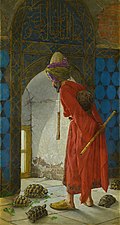
The museum's Orientalist Painting Collection consists of works by European and Ottoman and Turkish artists, including works by Osman Hamdi Bey and his most famous painting, The Tortoise Trainer.

Anatolian Weights and Measures Collection

[edit]

The Anatolian Weights and Measures Collection comprises over ten thousand pieces and consists of objects dating from prehistory to those used in present-day Anatolia. These comprise the main types of scales and measuring instruments, used for measuring weight, length, and volume in every field, from land measurement to commerce, architecture to jewelry making, shipping to pharmacy.

Kütahya Tiles and Ceramics Collection

[edit]

The beginnings of the Suna and İnan Kıraç Foundation's Kütahya Tiles and Ceramics Collection date back to 1980s. Today the collection consists of over 800 pieces representing various periods, especially the 18th to 20th centuries. The limited number of pieces on display have been chosen to give a general idea of the collection and the craftsmanship of Kütahya ceramics.

Temporary exhibitions

[edit]

Having organized joint projects with leading international museums, collections, and foundations including Tate Britain, Centre Pompidou, Victoria and Albert Museum, St. Petersburg Russian State Museum, JP Morgan Chase Collection, New York School of Visual Arts, and the Maeght Foundation, Pera Museum has introduced Turkish audiences to countless internationally acclaimed artists, among them Alberto Giacometti, Jean Dubuffet, Henri Cartier-Bresson, Rembrandt, Niko Pirosmani, Josef Koudelka, Joan Miró, Akira Kurosawa, Marc Chagall, Pablo Picasso, Fernando Botero, Frida Kahlo, Etel Adnan, Diego Rivera, and Goya.[4][5][6]

Since its inauguration, Pera Museum collaborates annually with national and international institutions of art and education to hold exhibitions that support young artists.

Other functions

[edit]

All of the museum's exhibitions are accompanied by books, catalogues, concerts, audio-visual events, and education programs. Through seasonal programs and events, Pera Film offers visitors and film buffs a wide range of screenings that extend from classics and independent movies to animated films and documentaries, as well as special shows paralleling the temporary exhibitions’ themes.[2]

See also

[edit]

References

[edit]

Literature

[edit]
  • Pera Museum (ed.). Portraits from the Empire. Pera Museum Publications, 2005. 155 p. ISBN 975 9123 -02 - 9
  • Pera Museum (ed.). Young Expansion. Pera Museum Publications, 2005. 163 p. ISBN 975 9123 -00-2
[edit]
Revisions and contributorsEdit on WikipediaRead on Wikipedia
from Grokipedia
The Pera Museum is a private art museum in Istanbul, Turkey, founded by the Suna and İnan Kıraç Foundation and inaugurated on June 8, 2005, with the mission of providing high-quality cultural and artistic services to foster public dialogue on aesthetic values.[1] Located at Meşrutiyet Caddesi No. 65 in the Tepebaşı quarter of the Beyoğlu district, the museum occupies a renovated neoclassical building originally constructed in 1893 as the Bristol Hotel by Greek architect Achille Manoussos, with preservation-led restorations conducted from 2003 to 2005 by Turkish architect Sinan Genim.[2][3] The museum's permanent collections, comprising works from the Suna and İnan Kıraç Foundation, include the Orientalist Paintings Collection featuring European depictions of the Ottoman world; the Anatolian Weights and Measures Collection with approximately 10,000 artifacts spanning from prehistoric times to the early Turkish Republic; and the Kütahya Tiles and Ceramics Collection showcasing around 5,000 pieces of traditional Turkish pottery from the 14th to 20th centuries.[1][4][5] In addition to these, the Pera Museum hosts rotating temporary exhibitions that have featured international artists such as Pablo Picasso, Andy Warhol, and Frida Kahlo, often in collaboration with prestigious institutions like Tate Britain and the Victoria and Albert Museum.[1] Beyond exhibitions, the museum supports educational programs through Pera Learning, which offers workshops, lectures, and activities for diverse audiences including youth and families, while Pera Film provides a platform for cinema screenings and audiovisual events focused on contemporary themes.[1] As a leading cultural center in Istanbul, it also publishes catalogs and supports emerging artists, contributing to the city's vibrant arts scene in the historic Pera neighborhood.[1] The museum operates Tuesday through Sunday with varying hours (closed Mondays), and offers free admission for students on Wednesdays.[6]

History and Founding

Establishment of the Foundation

The Suna and İnan Kıraç Foundation was established on October 27, 2003, by Suna Kıraç (June 3, 1941 – September 15, 2020), İnan Kıraç (born 1937), and their daughter İpek Kıraç as a private initiative dedicated to cultural preservation.[7][8][9] This non-profit organization emerged from the founders' shared vision to safeguard Turkey's vanishing cultural assets, particularly Ottoman and Anatolian artifacts, through targeted philanthropy.[7] The foundation's broader mission encompasses promoting Turkish cultural heritage via museums, research endeavors, and arts programs, while also supporting education and health initiatives to foster empowered citizens.[10][11] Suna Kıraç, the youngest daughter of industrialist Vehbi Koç, was a prominent philanthropist and business leader within the Koç Holding conglomerate, where she held key executive roles after studying banking and finance at Boğaziçi University.[12][13] Her earlier efforts included leading the founding of the Turkish Education Volunteers Foundation in 1995 to advance educational access.[14] İnan Kıraç is an industrialist who joined Koç Group in 1961 after studying economics in London, rising to senior management before establishing Kiraca Holding to focus on automotive and industrial sectors.[15][16] Together, the couple's commitment to cultural stewardship stemmed from their recognition of the need to protect historical artifacts amid modernization pressures in Turkey.[7] From its inception, the foundation prioritized the creation of a museum in Istanbul as its inaugural major project, initiating acquisitions for permanent collections in the early 2000s to highlight Turkish artistic and historical legacies.[17] These efforts laid the groundwork for institutionalizing the preservation of Ottoman-era paintings, Anatolian measurement tools, and Kütahya ceramics, aligning with the founders' goal of public engagement through accessible cultural institutions.[17] The foundation's activities also included early renovations of a historic site in Istanbul's Pera district to house these initiatives.[17]

Opening and Early Development

The Pera Museum was officially inaugurated on June 8, 2005, as the flagship cultural institution of the Suna and İnan Kıraç Foundation in Istanbul's Beyoğlu district.[18] Founded in 2003 to promote arts and culture, the foundation selected this site to establish a modern venue for public engagement with art and history.[10] The opening featured the debut of three permanent collections—Orientalist Paintings, Anatolian Weights and Measures, and Kütahya Tiles and Ceramics—alongside dedicated spaces for temporary exhibitions and educational programs, marking the museum's role in bridging local heritage with global perspectives.[18] From its launch, the museum received positive public reception for its accessible approach to high-quality cultural programming, drawing diverse audiences to explore international and Turkish art.[18] It played a key part in revitalizing the cultural scene of the Tepebaşı area in Beyoğlu, a historic quarter undergoing renewal, by attracting visitors to the neighborhood and fostering community interactions through free events and guided tours.[18] This early momentum positioned the Pera Museum as a vibrant hub, enhancing Beyoğlu's reputation as a center for contemporary cultural activity amid Istanbul's evolving urban landscape.[18] A significant milestone came in 2006 with the museum's first major international temporary exhibition, "Henri Cartier-Bresson," showcasing over 100 photographs by the renowned 20th-century artist from January 31 to April 9, which highlighted the venue's capacity for global collaborations.[19] By 2008, the museum integrated with the foundation's newly opened İstanbul Research Institute, adjacent to the building, enabling joint initiatives in scholarly research, publications, and interdisciplinary events that enriched its programming.[20][21] In its first decade, the museum underwent early expansions to bolster educational and exhibition components, including the establishment of Pera Learning by 2010, which offered workshops and school programs. The Suna and İnan Kıraç Foundation provided scholarships supporting over 300 disadvantaged students since its establishment in 2003.[18] The addition of Pera Film, a dedicated cinema space for exhibition-related screenings and independent films, further diversified offerings and solidified the institution's multifaceted role in cultural education.[18] These developments, coupled with partnerships like those with Tate Britain and the Victoria and Albert Museum, expanded the museum's reach and affirmed its evolution into a leading private cultural center.[18]

Building and Location

Historical Background of the Building

The Bristol Hotel was constructed in 1893 in the Tepebaşı quarter of Beyoğlu, then known as Pera, during the late Ottoman era, as a prominent accommodation for international visitors to Istanbul. Originally owned by the Armenian Catholic Patriarchate, the building was designed by the Greek architect Achille Manoussos and exemplified neoclassical architecture with European influences, featuring brick masonry construction, a grand lobby, marble staircases, an early elevator, luxurious suites, assembly halls, and a spacious dining area.[18] These elements reflected Pera's role as the cosmopolitan European enclave of the Ottoman capital, a district that had evolved into a hub of commerce, diplomacy, and cultural exchange by the late 19th century.[22] The hotel opened to guests around 1896 and operated successfully for decades, managed by figures such as Logothetti, Adampoulos, Djiras, Hadjira, and later Ömer Lütfi Bengü from the early 1930s, attracting high-ranking international dignitaries and travelers.[18][23] It remained in active use as a hotel until the early 1980s, embodying the grandeur of Pera's Belle Époque hospitality amid the city's shifting socio-political landscape.[18] Following the hotel's closure, after the death of Ömer Lütfi Bengü in 1983, the property was sold to Yıldız Lastikçilik and subsequently acquired by Esbank (Eskişehir Bank), which demolished the interior while preserving the original facade and had it modified by architect Doğan Hasol to serve as its Istanbul headquarters with offices.[18] Esbank used the building until vacating the premises in 2002. In the early 2000s, the Suna and İnan Kıraç Foundation acquired the building for cultural reuse, leading to a comprehensive renovation overseen by architect Sinan Genim that restored its historical integrity; this project also combined the lots with an adjacent five-storey residential building while preserving their façades facing Meşrutiyet Caddesi.[18]

Architectural Features and Facilities

The Pera Museum building underwent a comprehensive renovation project between 2003 and 2005, led by architect and restorer Sinan Genim, who preserved the original neoclassical facade while completely modernizing the interiors to serve as a contemporary museum space.[18] This adaptive reuse transformed the former Hôtel de Bristol, originally constructed in 1893, into a fully equipped facility optimized for art display and visitor experience.[18] The structure spans six levels, from a basement to the fifth floor, with exhibition spaces distributed across multiple floors to accommodate both permanent and temporary displays. The ground floor houses the reception desk, an art shop offering museum publications and merchandise, and the Pera Café, providing a space for visitors to rest and socialize. Permanent collections are featured on the first and second floors, while the third, fourth, and fifth floors are dedicated to temporary exhibitions, allowing for flexible gallery configurations. The basement level includes an auditorium for film screenings through Pera Film and workshops for educational programs via Pera Learning.[24] Accessibility is enhanced throughout the building with elevators on every level and wheelchair-accessible restrooms, ensuring inclusive navigation for all visitors. The museum is closely connected to the adjacent Istanbul Research Institute, located just 50 meters away, facilitating shared cultural initiatives and resources such as the institute's art library.[24][18]

Permanent Collections

Orientalist Painting Collection

The Orientalist Painting Collection at Pera Museum forms a significant repository of over 300 works by European, Ottoman, and Turkish artists, capturing the visual and cultural essence of the Ottoman Empire during its final two centuries, from the late 18th to the early 20th century.[25] Assembled by Suna and İnan Kıraç since the 1990s through targeted purchases, and donated to the Suna and İnan Kıraç Foundation established in 2003, the collection reflects a deliberate effort to preserve artistic depictions of Ottoman society amid modernization and the empire's decline. These paintings, primarily oils on canvas, offer a panoramic view of daily life, customs, and landscapes, distinguishing the collection as one of Turkey's most comprehensive assemblages of Orientalist art.[26] Key European Orientalists represented include Jean-Léon Gérôme, whose academic precision influenced the genre's focus on exoticism and historical accuracy, alongside figures like Rudolf Ernst and Amadeo Preziosi, who portrayed intricate scenes of Ottoman urbanity.[27] Turkish pioneers, notably Osman Hamdi Bey—a prominent Ottoman painter, archaeologist, and founder of the Imperial Ottoman Museum—bridge Eastern and Western styles, with his works emphasizing cultural introspection and reform. Other Turkish artists such as Şeker Ahmet Paşa contribute to the collection's dual perspective, blending local motifs with European techniques learned abroad.[26] The collection's themes revolve around intimate and public facets of Ottoman existence, including harem scenes that evoke mystery and seclusion, bustling bazaars symbolizing commerce and diversity, and archaeological motifs reflecting the empire's antiquarian revival.[28] Harem depictions, such as Antoine de Favray's A Scene from the Turkish Harem (second half of the 18th century), highlight gendered spaces and domestic rituals, often idealized through a European lens. Bazaar scenes, like those by Preziosi, capture the vibrancy of markets in Istanbul and beyond, with detailed renderings of merchants, textiles, and architecture. Archaeological themes appear prominently in Osman Hamdi Bey's oeuvre, underscoring his excavations at sites like Nemrut and his advocacy for heritage preservation. A standout example is Hamdi Bey's The Tortoise Trainer (1906, oil on canvas), which portrays an elderly dervish in the Yeşil Cami of Bursa, training tortoises amid Islamic inscriptions, symbolizing patience, spiritual synthesis, and a critique of modernization's haste—inspired by a 1869 travelogue and exhibited at the 1906 Paris Salon.[29][30] Cataloging efforts include a comprehensive digital archive launched in 2025, encompassing high-resolution scans and metadata for research, with 88 works detailed in dedicated publications as of 2024.[31] Conservation practices involve regular condition assessments and restoration by the foundation's experts, ensuring the longevity of these fragile canvases, particularly those vulnerable to environmental fluctuations in Istanbul's climate.[32] The collection is displayed in the Sevgi and Erdoğan Gönül Gallery, where thematic rotations integrate select pieces with adjacent exhibits for contextual depth.[26]

Anatolian Weights and Measures Collection

The Anatolian Weights and Measures Collection at the Pera Museum comprises nearly 10,000 objects spanning from prehistoric times to the early years of the Turkish Republic, encompassing a wide array of tools used for measuring weight, length, and volume.[33] These artifacts include steelyards, balances, rulers, and volumetric measures employed in diverse fields such as commerce, architecture, jewelry making, shipping, and pharmacy, reflecting the evolution of measurement practices across Anatolia's civilizations.[34] The collection stands as the most comprehensive of its kind in Turkey, offering a tangible record of how standardization facilitated trade and shaped daily interactions over millennia.[35] Organized chronologically, the collection traces measurement tools from the Bronze Age through Hellenistic, Roman, Byzantine, Islamic, and Ottoman periods to 19th-century innovations influenced by European standards.[34] Early examples include Bronze Age weights unearthed from sites like Kültepe-Kanesh, which demonstrate rudimentary trade standardization in ancient Assyrian colonies around the second millennium BC.[34] Ottoman-era items feature finely crafted brass steelyards and scales, often inscribed with official seals to ensure accuracy in marketplaces, while 19th-century devices incorporate metric influences, such as imported balances adapted for local use in apothecaries and merchants' shops.[33] Notable among the Islamic holdings are dirhem weights, standardized silver units that underpinned economic transactions from the Seljuk to Ottoman eras, exemplifying the continuity of metrological traditions.[34] The collection's significance lies in its illumination of technological and economic evolution, particularly how measurement tools enforced fair trade and influenced everyday life across Anatolia's regions.[35] Folkloric inscribed tools, such as apothecary scales etched with proverbs or protective symbols from rural Anatolian communities, highlight cultural dimensions beyond mere utility, revealing social norms and artisanal ingenuity.[34] These artifacts underscore regional diversity, with pieces sourced from coastal trade hubs, inland caravanserais, and provincial workshops, illustrating Anatolia's role as a crossroads of measurement systems from Mesopotamia to the Mediterranean.[33] The Ottoman instruments, for instance, provide brief contextual ties to the economic scenes depicted in the museum's Orientalist Painting Collection. The collection's formation began in the 1980s through the personal efforts of Suna and İnan Kıraç, who acquired items via donations, purchases from private collectors, and acquisitions from both Turkey and international markets, emphasizing Anatolia's historical breadth.[35] Donated to the Suna and İnan Kıraç Foundation, it has since expanded rapidly, with ongoing efforts to include underrepresented regional variants, ensuring a representative survey of Anatolian metrology up to the early Republican period.[33] As of March 2025, 1,358 objects from this collection are digitally accessible online.[31]

Kütahya Tiles and Ceramics Collection

The Kütahya Tiles and Ceramics Collection at Pera Museum comprises over 800 pieces, primarily from the 18th to 20th centuries, encompassing tiles, plates, vases, and other objects that exemplify Ottoman decorative traditions.[36] These works feature intricate floral and figural motifs, often rendered in vibrant colors on white or turquoise grounds, highlighting the region's enduring craftsmanship in pottery production.[36] Kütahya emerged as a major Ottoman ceramic center following the decline of İznik in the 18th century, building on a production history that traces back to Phrygian times and includes early Islamic examples such as tiles from the 1377 Kurşunlu Mosque and the 1428 Tomb of Yakup II.[36] The city's abundant local clay resources supported traditional techniques like underglaze painting, where designs were applied to unfired clay before glazing and firing, allowing for durable and colorful results that persisted into the modern era.[37] This revival in the late 19th and 20th centuries, bolstered by state initiatives, positioned Kütahya ceramics as a key export commodity, particularly household pottery that blended Islamic art influences with everyday functionality.[36] Among the collection's notable items are 19th-century mosque tiles depicting cypress trees and tulips, which reflect stylized Islamic geometric and natural motifs used in religious architecture, alongside practical household ceramics like dishes and ewers that circulated through trade networks across the Ottoman Empire and beyond.[36] The collection was assembled by the Suna and İnan Kıraç Foundation starting in the 1980s, growing through targeted acquisitions to emphasize historical significance and material integrity.[37] These pieces are integrated into the museum's architectural displays to evoke Ottoman interior aesthetics.[36] As of March 2025, all 584 objects from this collection are digitally accessible online.[31]

Exhibitions and Displays

Temporary Exhibitions

Since its opening in 2005, the Pera Museum has maintained a robust program of temporary exhibitions, drawing on international loans as well as selections from the Suna and İnan Kıraç Foundation's holdings to present typically three to four shows annually across its dedicated gallery spaces.[18][38] These rotating displays emphasize thematic depth, often integrating historical artifacts with modern analytical perspectives to illuminate Istanbul's layered multicultural heritage and its place in global art history.[1] The curatorial approach prioritizes interdisciplinary narratives that connect past and present, fostering dialogue on cultural evolution. A notable example is the 2015 exhibition "Life is Short, Art Long: The Art of Healing in Byzantium," which traced Byzantine medical traditions from Roman antiquity through the late Middle Ages using manuscripts, icons, surgical tools, and herbal illustrations sourced from international collections.[39] Similarly, "On the Spot" (2023–2024) examined 19th-century panoramic representations of Istanbul, blending Ottoman-era paintings, photographs, and archival documents with loans from the British Library to critique urbanization and visual documentation practices.[40] More recently, as part of its 20th anniversary celebrations, the museum presented "Feelings in Common," featuring works from the British Council Collection by 29 contemporary artists exploring shared emotions amid global uncertainties, and "Åsa Jungnelius," showcasing the Swedish artist's glass and stone installations that pay tribute to elemental creative processes; both ran from September 16, 2025, to January 18, 2026.[41] Retrospectives of modern Turkish artists further exemplify this strategy, as seen in "Dreams, Realities, Images" (2013), which surveyed 20th-century Turkish painting to contextualize national identity and historical shifts through over 100 works.[42] Such exhibitions underscore the museum's role in bridging local and global discourses, with thematic catalogs published for each to provide scholarly accompaniment.[43] These temporary shows have bolstered the museum's cultural influence, drawing more than 200,000 visitors each year through ticketed entry and contributing to Istanbul's vibrant art scene.

Digital and Special Initiatives

The Pera Museum launched its digital collections initiative in partnership with Google Arts & Culture, beginning with the Google Art Project in 2012 and expanding significantly thereafter.[44] By March 2025, this platform provided access to 2,510 works from the museum's permanent collections, encompassing high-resolution images of Orientalist paintings, Anatolian weights and measures, and Kütahya tiles and ceramics.[4][45] These digital resources feature interactive virtual tours of exhibition spaces, allowing users to explore the collections in 3D format, such as the Kütahya Tiles and Ceramics Collection.[46] In 2018, the online archive was enriched with engravings from the Orientalist Painting Collection, drawing from Ottoman-era visual records to offer deeper historical context.[47] The platform also includes curated stories and exhibits, like "Portraits from the Empire" and "Coffee Break," highlighting thematic selections from the museum's holdings.[48] Special initiatives include Pera Film, the museum's cinema program established alongside its 2005 opening, which presents thematic screenings of classics, independent films, and artist-focused works to complement exhibitions.[49] Recent programs, such as "All That Art" from October 2025 to January 2026, explore intersections between cinema and other artistic disciplines, marking the program's 20th anniversary.[50] During the COVID-19 pandemic in 2020, Pera Museum adapted by uploading full collections and exhibition catalogues online via Google Arts & Culture, enabling virtual access to shows like those featuring Kütahya ceramics through slideshows and high-resolution views.[51][52][53] Technological enhancements encompass augmented reality applications, such as the 2016 Blippar integration that allowed visitors to interact with paintings by virtually transforming into depicted figures.[54] Post-2020, the museum introduced online escape games like "Save the Legacy," incorporating artificial intelligence scenarios set in 2105 to engage users with collection themes, alongside workshops on AI-driven video creation tied to prehistoric and technological motifs.[55][56] These efforts emphasize hybrid formats that extend the museum's reach beyond physical visits, fostering global interaction with its cultural heritage.[57]

Programs and Cultural Role

Educational Programs

The Pera Learning program, initiated alongside the museum's opening in 2005 by the Suna and İnan Kıraç Foundation, provides structured educational initiatives designed to engage visitors with the museum's collections and exhibitions through interactive and age-appropriate activities.[18] These programs primarily target school groups and youth aged 5 to 18, featuring guided tours, workshops, and tailored school sessions that foster an understanding of art history and cultural heritage.[58] By integrating museum visits into educational curricula, Pera Learning emphasizes hands-on experiences using replicas and materials inspired by the permanent collections, such as tile-making workshops drawing from the Kütahya Tiles and Ceramics Collection and weight-measuring activities based on the Anatolian Weights and Measures Collection.[59][60] Annual events enhance accessibility for young learners, including Young Wednesday, which offers free admission to students every Wednesday to encourage regular engagement with the museum's offerings.[6] Complementing these are specialized teacher training sessions, such as workshops and guided tours focused on Ottoman art history, equipping educators with resources to incorporate museum content into classroom instruction.[61] Some sessions utilize the museum's auditorium for group discussions, further enriching the learning environment.[58] Pera Learning reaches thousands of participants annually, with programs available in Turkish and English to accommodate diverse audiences, and dedicated initiatives like Pera Enabled ensuring inclusivity for visitors with disabilities through adapted tours and activities.[62] In 2023, the program served 6,488 individuals across online and in-person formats, and in 2024, 6,554 participants.[62][31] As of 2025, programs include workshops tied to exhibitions such as "Feelings in Common" and well-being activities through January 2026.[58]

Public Events and Outreach

The Pera Museum engages in outreach efforts through strategic partnerships with local schools and non-governmental organizations (NGOs), facilitating free access days and collaborative programs to broaden community access to its collections and exhibitions. For instance, the museum offers complimentary entry for students on Wednesdays, enabling thousands of young visitors from public schools to participate in guided tours and workshops without cost. These initiatives are supported by collaborations with educational institutions and NGOs, such as joint projects aimed at supporting young artists and disadvantaged students through scholarships and inclusive programming.[6][18] On the international front, the museum participates in biennials and forms partnerships with global institutions, including the Tate Britain, Victoria and Albert Museum, and the St. Petersburg Russian State Museum, to co-develop exhibitions and cultural exchanges that extend its reach beyond Turkey. These collaborations, such as its role as a venue for the Istanbul Biennial organized by the Istanbul Foundation for Culture and Arts, promote cross-cultural dialogue and attract diverse audiences.[18][63] Inclusivity forms a core aspect of the museum's outreach, with targeted programs for refugees, migrants, and low-income groups to foster social integration and cultural participation. The "Immigrant Artists Looking at Istanbul" project, for example, involves interdisciplinary activities that strengthen connections between migrant and refugee communities and broader society, including performances and exhibitions highlighting immigrant perspectives. Additionally, scholarships for disadvantaged students ensure access for low-income youth, aligning with broader efforts to make cultural resources available to underserved populations.[64][18] The museum significantly contributes to Beyoğlu's tourism landscape as a leading cultural hub in the Tepebaşı quarter, drawing visitors who explore its offerings alongside the district's historic sites. In 2023, it welcomed 217,433 visitors, and in 2024, 206,032 visitors, underscoring its role in boosting local tourism and economic vitality. The Pera Museum has also received recognition for its contributions, including the Gold Award in the Museums category at the 2025 Brandverse Awards for excellence in branding and audience engagement.[18][65][66][67][62][31] Looking ahead, the museum is expanding its digital outreach through enhanced online programming and virtual tours to increase global accessibility, while integrating sustainability practices such as eco-friendly materials in exhibitions to align with environmental goals. These efforts build on its existing ties to educational programs, aiming for greater societal impact by 2026.[68][18]

References

User Avatar
No comments yet.