


Community hub
Recent from talks
Contribute something
Nothing was collected or created yet.
Perry Groves
View on Wikipedia
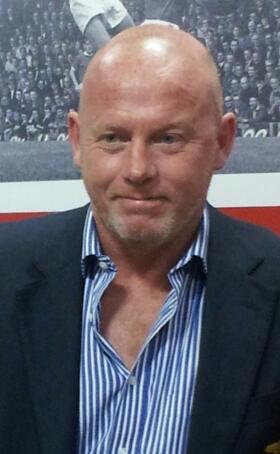
Perry Groves (born 19 April 1965)[1] is an English former professional footballer, best known for his time at Arsenal. A fast-paced player who usually played as a left winger and occasionally a striker, Groves also played professionally for Colchester United and Southampton, also briefly playing for both Dagenham & Redbridge and Canvey Island in non-league football towards the end of his career. He currently works as a media pundit.[2][3]
Key Information


Playing career
[edit]Colchester United
[edit]Groves was born in Bow, London, but as a boy he played for Cornard Dynamos in the village of Great Cornard on the Suffolk – Essex border. Groves then had a trial with Wolves as a schoolboy before signing as an apprentice for Colchester United in 1981. He turned professional a year later and over the next four seasons he played 142 league games for the U's, scoring 26 goals.
Arsenal
[edit]In September 1986, he signed for Arsenal for £50,000, becoming the first signing by new manager George Graham. His debut came in a goalless draw against Luton Town that same month.
In his first season at the club he helped set up Charlie Nicholas for the winner in the 1987 League Cup final, dribbling past three Liverpool players before laying the ball off.
Noted for his enthusiasm, pace and hard work, he started most of Arsenal's games in the 1987–88 season, ousting Charlie Nicholas as strike partner to Alan Smith, and helping the Gunners reach a second League Cup final the following season by scoring the only goal of the away leg of the semi-final against Everton; Arsenal however lost the final to Luton Town. Although Groves made 46 appearances in all competitions that season, the arrival of Brian Marwood reduced his opportunities to play, and he was mainly used as a substitute in Arsenal's title-winning 1988–89 season, coming off the bench 15 times during the league campaign, on top of six starts. He was on the pitch as a substitute in the final game of the season and helped create the space when Michael Thomas famously scored the title clinching goal at Anfield.
Although an injury to Marwood opened the door for him again in 1989–90, Groves returned to the bench after Marwood recovered. This did not however stop him from winning a second league title winners' medal in 1990–91, again with most of his appearances coming as a sub, as Graham usually favoured Kevin Campbell to play alongside Alan Smith. After making only 13 league appearances in 1991–92, Groves was sold to Southampton just at the start of the inaugural Premier League season.[4]
Southampton
[edit]He moved to Southampton in August 1992 for £750,000 but only played 15 times in two years before retiring from professional football at the age of 28, following two serious Achilles tendon injuries.[1][5]
Dagenham and Redbridge
[edit]He then played four games in the Conference for Dagenham & Redbridge before ending his playing career with a solitary appearance for Canvey Island.
Post-retirement
[edit]Groves has appeared for Arsenal in several Masters footballing tournaments.[3] He is now a well established sports pundit and has worked for a wide variety of media firms including Sky Sports, BBC Radio 5 Live, BT Sport, Absolute Radio as well as Talksport.[6] Groves was previously part of Absolute Radio's Sony Award winning Rock 'N' Roll Football show, fronted by former Arsenal teammate, Ian Wright, which airs on a Saturday.
In 2010, Groves signed as a non-playing substitute for new club Chester after Colin Murray, then of BBC Radio 5 Live, offered the new club £2,000 if they named Groves and Pat Nevin as unused substitutes at every game in the 2010–11 season.[7]
Legacy
[edit]Groves became a cult player among Arsenal fans, who commemorate him with the chant "We all live in a Perry Groves World", which listed Perry in every position from 1 to 12 (except 7, which is instead taken by Liam Brady), to the tune of The Beatles' "Yellow Submarine".[3]
In October 2006, Groves published his autobiography, entitled We All Live in a Perry Groves World (ISBN 1-84454-319-6). With it came an Arsenal fans' campaign on the web to purchase the book, in an attempt to outsell former Arsenal defender Ashley Cole's autobiography, My Defence, which was out at the same time.[8][better source needed]
Family
[edit]His great uncle, Vic Groves, having previously featured for Tottenham Hotspur, played for and captained Arsenal. He played as a forward making 203 appearances and scoring 37 goals.[2][9]
Career statistics
[edit]| Club | Season | League | FA Cup | League Cup | Other | Total | ||||||
|---|---|---|---|---|---|---|---|---|---|---|---|---|
| Division | Apps | Goals | Apps | Goals | Apps | Goals | Apps | Goals | Apps | Goals | ||
| Colchester United | ||||||||||||
| 1981–82[10] | Fourth Division | 9 | 0 | 0 | 0 | 0 | 0 | — | 9 | 0 | ||
| 1982–83[11] | Fourth Division | 17 | 2 | 0 | 0 | 2 | 1 | 3[a] | 0 | 22 | 3 | |
| 1983–84[12] | Fourth Division | 42 | 2 | 2 | 0 | 5 | 0 | 1[b] | 0 | 50 | 2 | |
| 1984–85[13] | Fourth Division | 44 | 10 | 3 | 1 | 2 | 0 | 3[b] | 1 | 52 | 12 | |
| 1985–86[14] | Fourth Division | 43 | 12 | 1 | 0 | 1 | 0 | 2[b] | 3 | 47 | 15 | |
| 1986–87[15] | Fourth Division | 1 | 0 | 0 | 0 | 0 | 0 | — | 1 | 0 | ||
| Total | 156 | 26 | 6 | 1 | 10 | 1 | 9 | 4 | 181 | 32 | ||
| Arsenal | ||||||||||||
| 1986–87[16] | First Division | 25 | 3 | 3 | 0 | 6 | 0 | — | 34 | 3 | ||
| 1987–88[16] | First Division | 34 | 6 | 4 | 1 | 8 | 2 | — | 46 | 9 | ||
| 1988–89[16] | First Division | 21 | 4 | 2 | 0 | 2 | 0 | 2[c] | 1 | 27 | 5 | |
| 1989–90[16] | First Division | 30 | 4 | 3 | 0 | 3 | 1 | — | 36 | 5 | ||
| 1990–91[16] | First Division | 32 | 3 | 4 | 0 | 4 | 3 | — | 40 | 6 | ||
| 1991–92[16] | First Division | 13 | 1 | 1 | 0 | 3 | 0 | 4[d] | 0 | 21 | 1 | |
| 1992–93[16] | Premier League | 1 | 0 | 0 | 0 | 0 | 0 | — | 1 | 0 | ||
| Total | 156 | 21 | 17 | 1 | 26 | 6 | 6 | 1 | 205 | 29 | ||
| Southampton | 1992–93[17] | Premier League | 15 | 2 | 1 | 0 | 2 | 0 | — | 18 | 2 | |
| Career total | 327 | 49 | 24 | 2 | 38 | 7 | 15 | 5 | 404 | 63 | ||
- ^ Appearances in Group Cup
- ^ a b c Appearances in Associate Members' Cup
- ^ Appearances in Centenary Trophy
- ^ Appearances in European Cup
Honours
[edit]Arsenal
References
[edit]- ^ a b c Chalk, Gary; Holley, Duncan; Bull, David (2013). All the Saints: A Complete Players' Who's Who of Southampton FC. Southampton: Hagiology Publishing. p. 336. ISBN 978-0-9926-8640-6.
- ^ a b Perry Groves (2007). We all live in a Perry Groves World. London: John Blake Publishing. p. 2.
- ^ a b c "Perry Groves: Interview". Planet Football.com. 13 March 2017.
- ^ "arsenal historic players". 15 January 2023.
- ^ "saintsplayers". 7 January 2023.
- ^ "Play with a legend". Nights Out in Newcastle.co.uk.
- ^ "Club not live". Archived from the original on 21 April 2014.
- ^ "Let's make Perry Groves better than Ashley Cole". oleole.com. Archived from the original on 19 May 2009. Retrieved 13 January 2022.
- ^ "Vic Groves". Arsenal.com.
- ^ "Games played by Perry Groves in 1981/1982". coludata.co.uk. Retrieved 25 November 2022.
- ^ "Games played by Perry Groves in 1982/1983". coludata.co.uk. Retrieved 25 November 2022.
- ^ "Games played by Perry Groves in 1983/1984". coludata.co.uk. Retrieved 25 November 2022.
- ^ "Games played by Perry Groves in 1984/1985". coludata.co.uk. Retrieved 25 November 2022.
- ^ "Games played by Perry Groves in 1985/1986". coludata.co.uk. Retrieved 25 November 2022.
- ^ "Games played by Perry Groves in 1986/1987". coludata.co.uk. Retrieved 25 November 2022.
- ^ a b c d e f g "Player search: Groves, P (Perry)". English National Football Archive. Retrieved 26 November 2022.
- ^ "Games played by Perry Groves in 1992/1993". saintsplayers.co.uk. Retrieved 25 November 2022.
- ^ "Premier League (Tier One) Honours". Coludaybyday.co.uk. Retrieved 27 February 2017.
- ^ "1972/73 Terry Anderson". Coludaybyday.co.uk. Retrieved 27 February 2017.
External links
[edit]
- Perry Groves on arseblog.com's "arsecast" on 10 November 2006 (MP3, 17 MB)
- Interview with Perry Groves in The Guardian
- Perry Groves at Soccerbase
| International | |
|---|---|
| National | |

Perry Groves
View on GrokipediaClub career
Colchester United
Born on 19 April 1965 in Bow, London, Perry Groves developed an early passion for football influenced by his family's strong Arsenal connections, including his great-uncle Vic Groves, a former Arsenal captain who inspired his interest in the sport.[4] Growing up in the East End, he honed his skills through local schoolboy trials, including one with Wolverhampton Wanderers, before being scouted for professional opportunities.[5] At age 16, Groves joined Colchester United as an apprentice on 1 August 1981, marking the start of his professional development at the club in the Fourth Division.[6] He turned professional in 1982 and made his senior debut on 10 April that year in a 1-2 home league defeat to AFC Bournemouth, coming on as a substitute.[6] Over the next four seasons, Groves established himself as a key player, making 181 appearances and scoring 32 goals across all competitions, with his first goal coming on 31 August 1982 in a 2-0 home win over Aldershot.[6] His standout 1984-85 season saw him feature in 52 matches and net 12 goals, contributing significantly to Colchester's campaigns in the lower tiers.[6] Known for his pace and direct style as a left winger, Groves provided dynamism on the flank, often delivering crosses and goals that helped drive the team's attacking play during their Fourth Division efforts.[7] In the 1985-86 season, he reached a personal best with 15 goals in 47 appearances, showcasing his growth into a reliable forward option.[6] Groves departed Colchester in September 1986, transferring to Arsenal for a fee of £50,000, ending his formative spell at Layer Road.[2]Arsenal
Perry Groves joined Arsenal from Colchester United in September 1986 for a transfer fee of £50,000, becoming the first signing of new manager George Graham and quickly integrating into the first team as a versatile left winger known for his pace and work ethic.[2][8] During his six-year stint at Highbury, Groves made 155 league appearances and scored 21 goals, contributing to a total of 196 appearances and 27 goals across all competitions, with notable strikes including the decisive goal in the 1987-88 Littlewoods Cup semi-final against Everton and a brace in a 4-0 league win over Manchester City in 1989-90.[2] His energetic style, characterized by tireless runs and precise crosses, earned him a regular role early on, starting the majority of matches in the 1987-88 season under Graham's emerging tactical setup.[9] Groves played a key part in Arsenal's 1988-89 First Division title triumph, appearing in 24 league games that season and providing vital energy from the wing during the dramatic final-day victory at Anfield, where he entered as a substitute and helped shift the team to a more attacking 4-4-2 formation that created space for Michael Thomas's winner.[10][11] The following year, injuries limited his involvement, but he still contributed to the 1990-91 league title with his speed and crossing ability, notably assisting goals for striker Alan Smith through overlapping runs that stretched defenses.[2][12] These successes, alongside his ginger-haired appearance and relentless enthusiasm, cemented his cult status among fans, who originated the chant "We all live in a Perry Groves world"—an adaptation of a Manchester United song for George Best—to celebrate his impact.[13][14] By 1991-92, Groves had fallen out of favor amid increased competition and a shift toward a more defensive style, managing only 13 league appearances with two goals before departing for Southampton in August 1992 in a £750,000 transfer that marked the end of his Arsenal career.[2][15] Despite the reduced role in his final season, his contributions to back-to-back titles and memorable moments like the Anfield drama left a lasting legacy as a fan favorite during Arsenal's resurgence under Graham.[10]Southampton
Perry Groves transferred to Southampton from Arsenal in August 1992 for a fee of £750,000, arriving with expectations of revitalizing the team's attacking options after a prominent role in Arsenal's title-winning campaigns.[16] However, under manager Ian Branfoot, Groves encountered limited playing time, often relegated to the substitutes' bench amid stiff competition on the flanks.[17] In the 1992–93 Premier League season, his sole year at the club, Groves recorded 15 league appearances and 2 goals, with the majority of his outings coming as a substitute; he also featured once in the FA Cup and twice in the League Cup without scoring.[6] Persistent injuries, particularly an Achilles issue that had troubled him upon arrival, further restricted his contributions and exacerbated frustrations over his diminished prominence compared to his Arsenal days.[17] Groves departed Southampton in May 1993 following the expiry of his contract, marking the end of his top-flight career and a shift toward non-league football.[18]Dagenham and Redbridge
After leaving Southampton in 1993, Perry Groves joined Dagenham & Redbridge on a free transfer ahead of the 1993–94 season in the Conference.[19] During his time with the club, he made four appearances but did not score any goals, functioning mainly as a squad player with limited involvement.[20] In 1995, Groves moved to Canvey Island for a brief spell, appearing in just one match before retiring from competitive play at age 30.[6] This non-league phase represented the end of his professional playing career, following a decline from top-flight opportunities.Post-playing career
Media career
After retiring from professional football in 1995, Perry Groves entered the media industry, initially contributing to local radio broadcasts before advancing to prominent national platforms.[21] His early work included appearances on BBC London, where he provided football commentary and analysis drawing on his playing experience at Arsenal.[21] Over time, Groves established himself as a regular pundit across major outlets such as Sky Sports, BBC Radio 5 Live, BT Sport, and Talksport, focusing primarily on Arsenal matches and Premier League coverage.[22] Throughout the 2000s and 2010s, Groves became a familiar voice in football broadcasting, offering post-match analysis and insights during key Arsenal campaigns, including title challenges and European fixtures.[23] His contributions extended to live radio shows on Talksport, where he discussed team tactics and player performances with a direct style informed by his time as a winger under George Graham.[24] Known for his humorous and candid delivery, Groves often injects personal anecdotes from his career to critique modern strategies, such as set-piece execution.[25] In recent years, Groves has continued his active role in punditry, particularly amid Arsenal's resurgence. In June 2025, he urged Arsenal to invest heavily in a striker, recommending Viktor Gyökeres over Benjamin Šeško due to the former's advanced development. Following Arsenal's 4-0 Champions League victory over Atletico Madrid in October 2025, he highlighted perceived "snobbery" in the team's set-piece approach during a Talksport segment.[25] These appearances underscore his ongoing influence as an Arsenal specialist, blending expertise with engaging, no-nonsense commentary.[24]Public engagements
In 2006, Perry Groves published his autobiography, We All Live in a Perry Groves World: My Story, co-authored with John McShane, which offers a humorous and candid account of his football career, including anecdotes from his time at Arsenal and insights into the drinking culture within the sport.[26] The book gained significant attention through an Arsenal fans' online campaign aimed at boosting its sales to surpass that of Ashley Cole's My Defence, a goal it achieved, highlighting Groves' enduring cult status among supporters.[27] Following his retirement, Groves represented Arsenal in various Masters football tournaments during the 2000s, participating in exhibition matches for over-35s teams that showcased former players in competitive yet nostalgic settings.[28] These appearances, such as the 2000 London Masters event against Tottenham, allowed him to engage directly with fans and relive club rivalries in a light-hearted format.[29] Groves has established himself as a motivational speaker, drawing on his experiences in professional football to discuss themes of discipline, resilience, and personal growth.[22] In September 2024, he visited HMP Brixton to speak with National Prison Radio presenter 'T' about his struggles with alcoholism and subsequent recovery, emphasizing the importance of seeking help through facilities like Tony Adams' Sporting Chance clinic.[30] Beyond these, Groves frequently participates in football nostalgia events, such as "An Evening with Arsenal Legends" tours alongside figures like Ray Parlour and Paul Merson, where he shares stories from his playing days and interacts with fans celebrating Arsenal's history.[31] These engagements underscore his role as a beloved cult figure, often tied to the iconic fan chant "We All Live in a Perry Groves World," which originated during his Arsenal tenure and continues to foster lively supporter connections.[13]Personal life
Family
Perry Groves was born in Bow, East London, in 1965, into a family with strong roots in the East End, where football played a central role in their heritage and shaped his early passion for the sport.[32] His family's deep affinity for Arsenal, described by Groves as a "religion," stemmed from this local football culture and influenced his development as a player from a young age.[4] Groves is the nephew of Vic Groves, who played as a forward for Arsenal from 1955 to 1964, making 203 appearances and captaining the side during that period.[33] This familial tie, with Vic being his father's uncle according to Groves' autobiography, provided direct inspiration for Perry's career and facilitated his connection to Arsenal, beginning in his youth and leading to his professional debut nearby at Colchester United.[32][2] Little public information exists on other family members, with the emphasis remaining on this influential Arsenal lineage.Alcoholism recovery
Following his retirement from professional football in 1994 due to injury, Perry Groves struggled with the void left by the sport, which exacerbated his alcohol dependency rooted in the heavy drinking culture prevalent among players during his career. He described post-match rituals as normalized binge drinking sessions that extended into midweek, contributing to a pattern of denial where he did not recognize his beer and lager consumption as problematic, despite not drinking daily. This culture, which he later reflected on as making heavy alcohol use seem ordinary, persisted into his post-playing life, leading to escalating mental health challenges.[30] In January 2023, Groves experienced a severe mental and physical breakdown, with his body and brain shutting down completely after a talkSPORT appearance, prompting him to cancel subsequent commitments and seek immediate professional help. He entered a 28-day rehabilitation program at Sporting Chance Clinic, founded by his former Arsenal teammate Tony Adams, and received additional support from the NHS. This intervention marked the turning point in his journey, with Groves crediting the clinic for saving his life and emphasizing the importance of support systems like Alcoholics Anonymous meetings in maintaining sobriety. He has remained sober since completing the program, viewing his recovery as his greatest personal achievement.[34][35][36] Groves publicly disclosed his experiences in September 2023 during interviews on talkSPORT's White and Jordan show and with The Mirror, revealing he was seven months sober at the time and openly admitting, "I am an alcoholic and I'm not ashamed to admit it." In these candid discussions, he highlighted his years of denial and the breakdown's role in forcing recognition of alcoholism as a brain disease, aiming to destigmatize the issue. By September 2024, he extended his advocacy by visiting HMP Brixton for an interview on National Prison Radio, where he encouraged inmates to discuss mental health and seek help without shame, stating, "The best thing you’ve done is you’re talking about it." Through these efforts, Groves promotes resources like the Samaritans and AA, urging others in similar situations to reach out for support. As of November 2025, Groves remains sober and continues to work as a football pundit.[35][34][30][36][37]Professional record
Career statistics
Perry Groves amassed 327 appearances and 49 goals in league matches across his professional career spanning from 1982 to 1994.[2][6] His playing record includes significant contributions at Colchester United in the lower divisions, followed by stints in the top flight with Arsenal and Southampton, and a brief return in non-league with Dagenham & Redbridge. Detailed breakdowns by club and competition are presented below, drawn from club records and statistical databases up to his retirement in 1995. These figures cover major domestic competitions only; additional appearances occurred in European and minor cup competitions.[38][17]| Club | League Apps (Goals) | FA Cup Apps (Goals) | League Cup Apps (Goals) | Total Apps (Goals) |
|---|---|---|---|---|
| Colchester United | 156 (26) | 6 (1) | 10 (1) | 172 (28) |
| Arsenal | 156 (21) | 17 (1) | 26 (6) | 199 (28) |
| Southampton | 15 (2) | 1 (0) | 2 (0) | 18 (2) |
| Dagenham & Redbridge | 4 (0) | 0 (0) | 0 (0) | 4 (0) |
| Career Total | 327 (49) | 24 (2) | 38 (8) | 393 (58) |