
Recent from talks
Persecution of Jews during the Black Death
Knowledge base stats:
Talk channels stats:
Members stats:
Persecution of Jews during the Black Death
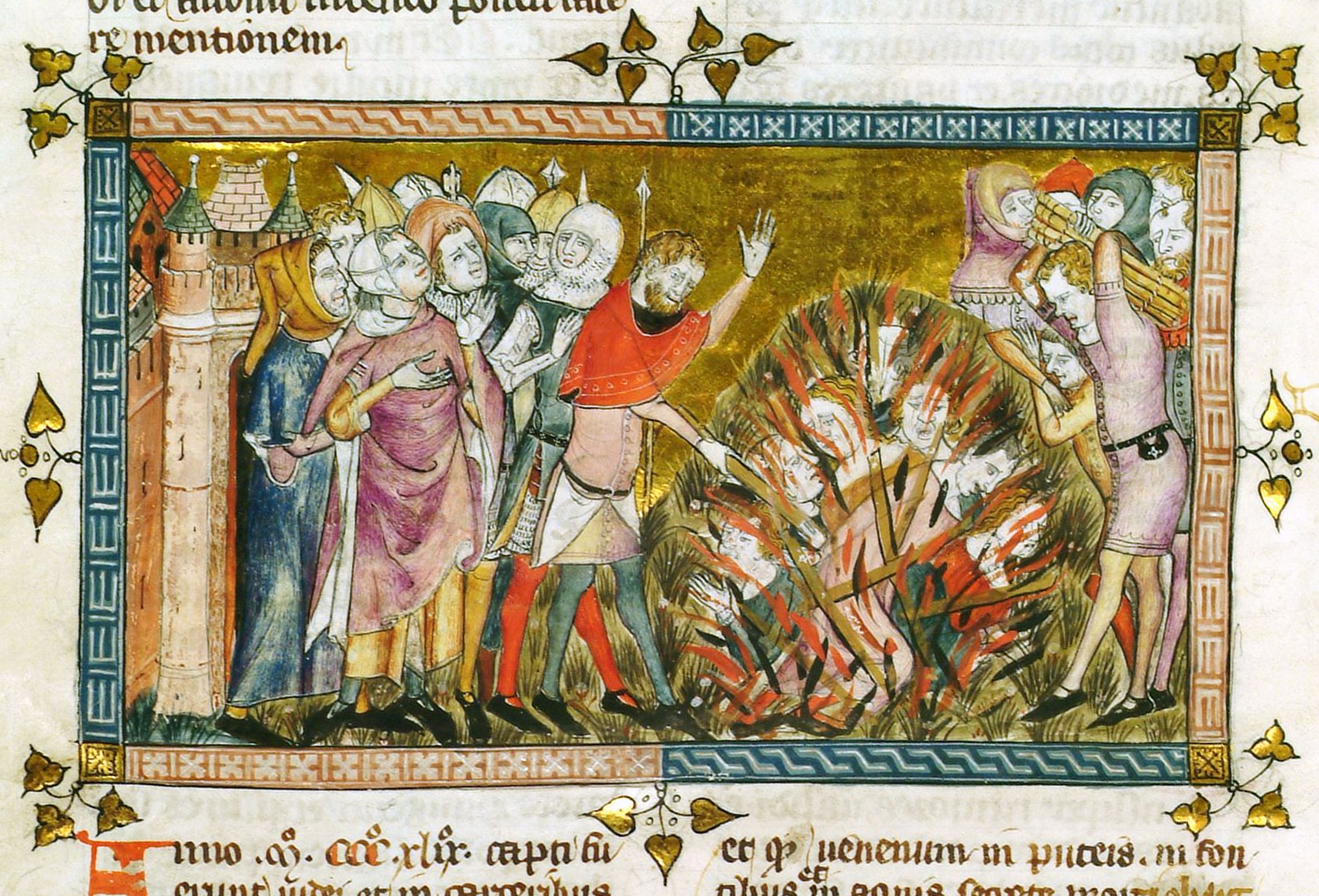
The persecution of Jews during the Black Death consisted of a series of violent mass attacks and massacres. Jewish communities were often blamed for outbreaks of the Black Death in Europe. From 1348 to 1351, acts of violence were committed in Toulon, Barcelona, Erfurt, Basel, Frankfurt, Strasbourg and elsewhere. The persecutions led to a large migration of Jews to Jagiellonian Poland and the Grand Duchy of Lithuania. There are very few Jewish sources on Jewish massacres during the Plague.
The official policy of the Church, which was reasoned in part because Jesus was Jewish, was to protect Jews. In practice, however, Jews were frequently the targets of Christian loathing. As the plague swept across Europe in the mid-14th century and annihilated nearly half the population, people had little scientific understanding of disease and were looking for an explanation. Unlike in Western Europe, Muscovite Russia did not have a Jewish population, and so as the Black Death swept into Russia, popular opinion sometimes blamed the Tatars instead.
Jews were frequently used as scapegoats and false accusations, which stated that they had caused the disease by deliberately poisoning wells, were circulated. That is likely because they were less affected than the other people since many Jews chose not to use the common wells which were located in towns and cities. Additionally, Jews were sometimes coerced to confess to poisoning wells through torture.
The first massacre directly related to the plague took place in April 1348 in Toulon, where the Jewish quarter was sacked, and forty Jews were murdered in their homes. Shortly afterward, violence broke out in Barcelona and other Catalan cities. Other pogroms took place in France during the height of the Black Death in April and May 1348. In 1349, massacres and persecutions spread across Europe, including the Erfurt massacre, the Zürich massacre, the Basel massacre, and massacres in Aragon, Fulda and Flanders. Around 2,000 Jews were burnt alive on 14 February 1349 in the "Valentine's Day" Strasbourg massacre, where the plague had not yet affected the city. While the ashes smouldered, Christian residents of Strasbourg sifted through and collected the valuable possessions of Jews that were not burnt by the fires. The following September, 330 Jews were burned alive in the Kyburg Castle, east of Zürich. Many hundreds of Jewish communities were destroyed in this period. Within the 510 Jewish communities destroyed in this period, some members killed themselves to avoid the persecutions.
In the spring of 1349, the Jewish community in Frankfurt am Main was annihilated. That was followed by the destruction of Jewish communities in Mainz and Cologne. The 3,000-strong Jewish population of Mainz initially defended themselves and managed to hold off the Christian attackers. However, the Christians managed to overwhelm the Jewish ghetto in the end and killed all of its Jews.
On 1 March 1349, the Jewish community of Worms suffered a devastating pogrom. Accused of causing the plague, the Jews were attacked, when much of the Judengasse and the synagogue quarter were set ablaze. Contemporary sources report that over 400 members of the community were killed, many of them setting fire to their own homes to avoid forced baptism.
At Speyer, Jewish corpses were disposed in wine casks and cast into the Rhine. By late 1349, the worst of the pogroms had ended in Rhineland. However, the massacres of Jews was starting to rise near the Hansa townships of the Baltic coast and in Eastern Europe. By 1351, there had been 350 incidents of anti-Jewish pogroms, and 60 major and 150 minor Jewish communities had been exterminated.[citation needed]
There are many possible reasons why Jews were accused to be the cause of the plague. Antisemitism was widespread in the 14th century, and in some locales, the plague was stated to be the work of Jews as retribution for the dying's wicked ways. Harbouring "enemies of Christ" was also given as a reason. Some commentators have argued that Jews who were not killed actually stood a better chance of surviving the plague because of greater cleanliness, sanitation and observance of the laws of kashrut. David Nirenberg, dean of the University of Chicago Divinity School and a specialist in medieval Jewish history, doubted whether there is credible evidence for that assertion. Another reason to discount that theory is that the plague was spread by flea bites, which would have been unaffected by handwashing. Communities that valued the work of Jews in the city more, saw less persecution, and those that did not value it saw more.
Hub AI
Persecution of Jews during the Black Death AI simulator
(@Persecution of Jews during the Black Death_simulator)
Persecution of Jews during the Black Death
The persecution of Jews during the Black Death consisted of a series of violent mass attacks and massacres. Jewish communities were often blamed for outbreaks of the Black Death in Europe. From 1348 to 1351, acts of violence were committed in Toulon, Barcelona, Erfurt, Basel, Frankfurt, Strasbourg and elsewhere. The persecutions led to a large migration of Jews to Jagiellonian Poland and the Grand Duchy of Lithuania. There are very few Jewish sources on Jewish massacres during the Plague.
The official policy of the Church, which was reasoned in part because Jesus was Jewish, was to protect Jews. In practice, however, Jews were frequently the targets of Christian loathing. As the plague swept across Europe in the mid-14th century and annihilated nearly half the population, people had little scientific understanding of disease and were looking for an explanation. Unlike in Western Europe, Muscovite Russia did not have a Jewish population, and so as the Black Death swept into Russia, popular opinion sometimes blamed the Tatars instead.
Jews were frequently used as scapegoats and false accusations, which stated that they had caused the disease by deliberately poisoning wells, were circulated. That is likely because they were less affected than the other people since many Jews chose not to use the common wells which were located in towns and cities. Additionally, Jews were sometimes coerced to confess to poisoning wells through torture.
The first massacre directly related to the plague took place in April 1348 in Toulon, where the Jewish quarter was sacked, and forty Jews were murdered in their homes. Shortly afterward, violence broke out in Barcelona and other Catalan cities. Other pogroms took place in France during the height of the Black Death in April and May 1348. In 1349, massacres and persecutions spread across Europe, including the Erfurt massacre, the Zürich massacre, the Basel massacre, and massacres in Aragon, Fulda and Flanders. Around 2,000 Jews were burnt alive on 14 February 1349 in the "Valentine's Day" Strasbourg massacre, where the plague had not yet affected the city. While the ashes smouldered, Christian residents of Strasbourg sifted through and collected the valuable possessions of Jews that were not burnt by the fires. The following September, 330 Jews were burned alive in the Kyburg Castle, east of Zürich. Many hundreds of Jewish communities were destroyed in this period. Within the 510 Jewish communities destroyed in this period, some members killed themselves to avoid the persecutions.
In the spring of 1349, the Jewish community in Frankfurt am Main was annihilated. That was followed by the destruction of Jewish communities in Mainz and Cologne. The 3,000-strong Jewish population of Mainz initially defended themselves and managed to hold off the Christian attackers. However, the Christians managed to overwhelm the Jewish ghetto in the end and killed all of its Jews.
On 1 March 1349, the Jewish community of Worms suffered a devastating pogrom. Accused of causing the plague, the Jews were attacked, when much of the Judengasse and the synagogue quarter were set ablaze. Contemporary sources report that over 400 members of the community were killed, many of them setting fire to their own homes to avoid forced baptism.
At Speyer, Jewish corpses were disposed in wine casks and cast into the Rhine. By late 1349, the worst of the pogroms had ended in Rhineland. However, the massacres of Jews was starting to rise near the Hansa townships of the Baltic coast and in Eastern Europe. By 1351, there had been 350 incidents of anti-Jewish pogroms, and 60 major and 150 minor Jewish communities had been exterminated.[citation needed]
There are many possible reasons why Jews were accused to be the cause of the plague. Antisemitism was widespread in the 14th century, and in some locales, the plague was stated to be the work of Jews as retribution for the dying's wicked ways. Harbouring "enemies of Christ" was also given as a reason. Some commentators have argued that Jews who were not killed actually stood a better chance of surviving the plague because of greater cleanliness, sanitation and observance of the laws of kashrut. David Nirenberg, dean of the University of Chicago Divinity School and a specialist in medieval Jewish history, doubted whether there is credible evidence for that assertion. Another reason to discount that theory is that the plague was spread by flea bites, which would have been unaffected by handwashing. Communities that valued the work of Jews in the city more, saw less persecution, and those that did not value it saw more.
Recent media