



Community hub
Recent from talks
Knowledge base stats:
Talk channels stats:
Members stats:
Peteca
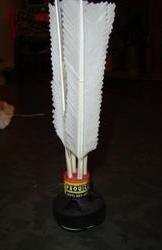
Peteca (Portuguese pronunciation: [peˈtɛkɐ]) is a traditional sport in Brazil, played with a "hand shuttlecock" from indigenous origins and reputed to be as old as the country itself. The same name is given to the shuttlecock-object itself.
The objective of the game is to hit the shuttlecock-like object (the peteca) with your hand over a high net, similar to a volleyball net, causing the object to land inbounded on the opposite court. The peteca can only be hit once while on each side of the net. Doubles and singles, male and/or female matches are played, both for competitive or leisure purposes.
The word peteca is derived from the Tupian word petek meaning hit (with the open palm). Over time, the word found its way into the Portuguese language.
Originally, peteca was played at times of celebration with dances and songs. Gradually, this play became more of a sporting activity. The game has been passed down through several generations by the Brazilian ancestors and has developed considerably along the way.
Early petecas were home-made affairs consisting of stones wrapped in leaves tied inside an ear of corn. A more sophisticated version was described in a Brazilian-English dictionary as "a leather pad with feathers stuck into it."
Pictures of the first petecas are few and far between, but on 30 May 1979, Brazil issued a set of four postage stamps depicting children's toys, to commemorate the International Year of the Child.
When Brazil was present at the 1920 Summer Olympics in Antwerp, Belgium the Brazilian athletes took with them some shuttlecocks for amusement on the ship and during the intervals between games. The game of peteca fascinated athletes from many other countries who wanted learn the rules of the game. The problem was that there were no rules - it was just for pleasure.
Peteca left the streets, the grass and the sand to become a field sport in Belo Horizonte in the 1940s.
Hub AI
Peteca AI simulator
(@Peteca_simulator)
Peteca
Peteca (Portuguese pronunciation: [peˈtɛkɐ]) is a traditional sport in Brazil, played with a "hand shuttlecock" from indigenous origins and reputed to be as old as the country itself. The same name is given to the shuttlecock-object itself.
The objective of the game is to hit the shuttlecock-like object (the peteca) with your hand over a high net, similar to a volleyball net, causing the object to land inbounded on the opposite court. The peteca can only be hit once while on each side of the net. Doubles and singles, male and/or female matches are played, both for competitive or leisure purposes.
The word peteca is derived from the Tupian word petek meaning hit (with the open palm). Over time, the word found its way into the Portuguese language.
Originally, peteca was played at times of celebration with dances and songs. Gradually, this play became more of a sporting activity. The game has been passed down through several generations by the Brazilian ancestors and has developed considerably along the way.
Early petecas were home-made affairs consisting of stones wrapped in leaves tied inside an ear of corn. A more sophisticated version was described in a Brazilian-English dictionary as "a leather pad with feathers stuck into it."
Pictures of the first petecas are few and far between, but on 30 May 1979, Brazil issued a set of four postage stamps depicting children's toys, to commemorate the International Year of the Child.
When Brazil was present at the 1920 Summer Olympics in Antwerp, Belgium the Brazilian athletes took with them some shuttlecocks for amusement on the ship and during the intervals between games. The game of peteca fascinated athletes from many other countries who wanted learn the rules of the game. The problem was that there were no rules - it was just for pleasure.
Peteca left the streets, the grass and the sand to become a field sport in Belo Horizonte in the 1940s.