


Community hub
Recent from talks
Contribute something
Nothing was collected or created yet.
Shuttlecock
View on Wikipedia

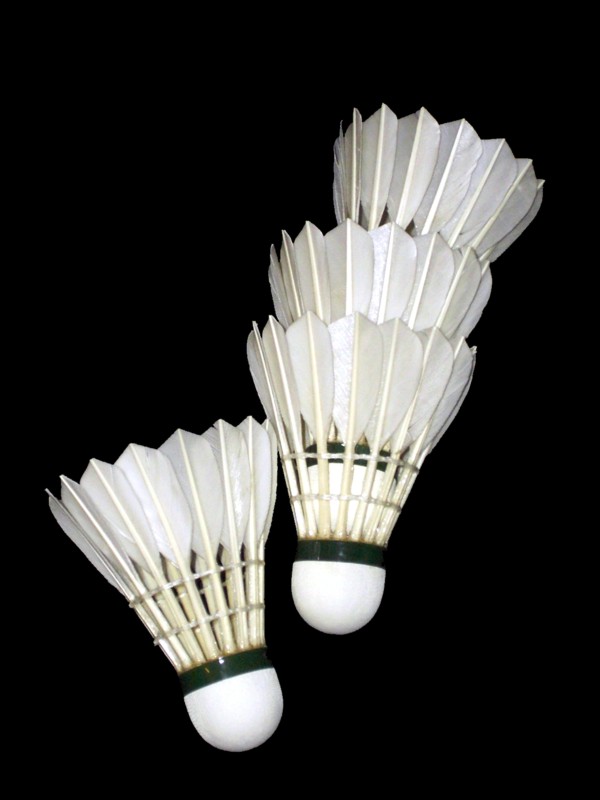
A shuttlecock (also called a birdie or shuttle, or ball) is a high-drag projectile used in multiple sports, most notably badminton. It has an open conical shape formed by feathers or a synthetic material, such as plastic, embedded into a rounded cork (or rubber) base. The shuttlecock's shape makes it extremely aerodynamically stable. Regardless of initial orientation, it will turn to fly cork first, and remain in the cork-first orientation.
Origins
[edit]The object resembles a hawk's lure, used from ancient times in the training of hunting birds.[citation needed] It is frequently shortened to shuttle. The "shuttle" part of the name is derived from its back-and-forth motion during the game, resembling the shuttle of a 14th-century loom, while the "cock" part of the name is derived from the resemblance of the feathers to those on a rooster.[1]
Specifications
[edit]A regulation standard shuttlecock weighs around 4.75 to 5.50 g (0.168 to 0.194 oz). It has 16 feathers with each feather 62 to 70 mm (2.4 to 2.8 in) in length, and the diameter of the cork is 25 to 28 mm (0.98 to 1.10 in).[2] The diameter of the circle that the feathers make is around 58 to 68 mm (2.3 to 2.7 in).[1][3]
Construction and materials
[edit]A shuttlecock is formed from 16 or so overlapping feathers, usually goose or duck, embedded into a rounded cork base. Feathers are plucked from the wings of a live goose or duck, a method which has been deemed cruel by animal rights activists in recent years.[4] The cork is covered with thin leather.[5] To ensure satisfactory flight properties, it is considered preferable to use feathers from right or left wings only in each shuttlecock, and not mix feathers from different wings, as the feathers from different wings are shaped differently. Badminton companies make shuttlecock corks by sandwiching polyurethane between corks and/or using a whole piece of natural cork. With the first method, the cork becomes misshaped after use, while the cork in the latter method changes very little after use. This is because the structure of the shuttlecock is more durable when made with a single piece of natural cork.[6][7]
Feather or synthetic shuttlecocks
[edit]The feathers are brittle; shuttlecocks break easily and often need to be replaced several times during a game. For this reason, synthetic shuttlecocks have been developed that replace the feathers with a plastic skirt. Players often refer to synthetic shuttlecocks as plastics and feathered shuttlecocks as feathers. Feather shuttles need to be properly humidified for at least 4 hours prior to play in order to fly the correct distance at the proper speed and to last longer. Properly humidified feathers flex during play, enhancing the shuttle's speed change and durability. Dry feathers are brittle and break easily, causing the shuttle to wobble. Saturated feathers are 'mushy', making the feather cone narrow too much when strongly hit, which causes the shuttle to fly overly far and fast. Typically a humidification box is used, or a small moist sponge is inserted in the feather end of the closed shuttle tube container, avoiding any water contact with the cork of the shuttle. Shuttles are tested prior to play to make sure they fly true and at the proper speed, and cover the proper distance. Different weights of shuttles are used to compensate for local atmospheric conditions. Both humidity and height above sea level affect shuttle flight. World Badminton Federation Rules say the shuttle should reach the far doubles service line plus or minus half the width of the tram. According to manufacturers proper shuttles will generally travel from the back line of the court to just short of the long doubles service line on the opposite side of the net, with a full underhand hit from an average player.[8]

The cost of good quality feathers is similar to that of good quality plastics, but plastics are far more durable, typically lasting many matches without any impairment to their flight. Feather shuttles are easily damaged and should be replaced every three or four games or sooner if they are damaged and do not fly straight. Damaged shuttles interfere with play as any impairment may misdirect the flight of the shuttlecock.
Most experienced and skillful players greatly prefer feathers, and serious tournaments or leagues are always played using feather shuttlecocks of the highest quality.[9]
The playing characteristics of plastics and feathers are substantially different. Plastics fly more slowly on initial impact, but slow down less towards the end of their flight. Feathers, however, tend to drop straight down on a clear shot, plastics never quite return to a straight drop, falling more on a diagonal. Feather shuttles may come off the strings at speeds in excess of 565 km/h (351 mph) but slow down faster as they drop.[10][11] Furthermore, feathered shuttlecocks are recorded as having a constant drag coefficient. Contrarily, championship-grade synthetic shuttlecocks show less consistency with this factor. This shows that feathered shuttlecocks have a capacity for a higher standard speed range at which the game is typically played that synthetics cannot quite reach. This impacts the feel of the bird during the game for players, especially in the case of deformation of the shuttlecock. A feathered shuttlecock will still feel dull and heavy while in play because of the feathers, but a synthetic cannot maintain energy in flight in the same manner.[12]
Shuttlecock sports
[edit]- Air Badminton
- Badminton
- Battledore and shuttlecock – an ancient game similar to that of modern badminton
- Crossminton
- Hanetsuki
- Tambourelli
See also
[edit]- Jianzi – a traditional Asian game in which players aim to keep a heavily weighted shuttlecock (Jian) from touching the ground
- The Corsican Shuttlecock – a satirical cartoon from 1814 featuring Napoleon as a shuttlecock
- Shuttlecock at the 2009 Asian Indoor Games
References
[edit]- ^ a b "Shuttlecock Trivia". www.xdcbadminton.co.uk. 2019-10-09. Retrieved 2021-01-05.
- ^ Whittemore, Frank. "Badminton Equipment Regulations". SportsRec. Retrieved 20 June 2020.
- ^ "Badminton Shuttle - All You Need to Know About the Badminton Projectile". The Badminton Guide. 2020-01-05. Retrieved 2022-04-08.
- ^ Lee, David (20 January 2020). "Badminton: World body to allow synthetic shuttles from 2021, Singapore's Loh Kean Yew says move towards sustainability is good". The Straits Times.
- ^ "Making Birdies: How Shuttlecocks Are Made". Official Badminton. Archived from the original on 8 December 2015. Retrieved 24 February 2015.
- ^ Kiley, Brendan (July 24, 2013). "The Rise of the Shuttlecock". The Stranger. Archived from the original on July 27, 2019. Retrieved August 13, 2016.
- ^ "Yonex Shuttle News" (PDF). yonex.ch. Yonex. Archived (PDF) from the original on July 22, 2019. Retrieved July 14, 2017.
- ^ Adapted from various Shuttlecock Manufacturer's recommendations – RSL, Yonex, Carleton, among others by J. Wigglesworth. May 2015
- ^ "BWF's tournament sanctioned shuttlecocks". Badminton World Federation site. Archived from the original on 2013-04-28. Retrieved 2011-11-01.
- ^ "Satwiksairaj Rankireddy 'smashes' Guinness world record with fastest badminton hits". The Indian Express. 2023-07-18. Retrieved 2025-04-24.
- ^ "Satwiksairaj Rankireddy creates Guinness world record with fastest badminton hit by a male player - CNBC TV18". CNBCTV18. 2023-07-18. Retrieved 2025-04-24.
- ^ Alam, Firoz; Chowdhury, Harun; Theppadungporn, Chavaporn; Subic, Aleksandar (2010). "Measurements of aerodynamic properties of badminton shuttlecocks". Procedia Engineering. 2 (2): S. 2487–2492. doi:10.1016/j.proeng.2010.04.020.
External links
[edit] Media related to Shuttlecocks at Wikimedia Commons
 The dictionary definition of shuttlecock at Wiktionary


Shuttlecock
View on GrokipediaHistory
Ancient Origins and Early Games
The shuttlecock, a feathered projectile designed for controlled flight, traces its earliest documented use to ancient China in the sport of jianzi (also known as ti jianzi or shuttlecock kicking), where players propelled it into the air using feet and other body parts excluding hands. This game emerged as an evolution from cuju, an ancient football-like activity used for military training, with the first known version of jianzi appearing around the 5th century BCE and becoming established during the Han Dynasty (206 BCE–220 CE).[8] It gained popularity across social classes during the subsequent Six Dynasties (220–589 CE), Sui (581–618 CE), and Tang (618–907 CE) dynasties, serving both recreational and skill-building purposes; by the Song Dynasty (960–1279 CE), it was formalized as jianqiu.[8] The jianzi shuttlecock typically consisted of a weighted base covered in feathers, enabling unpredictable aerial trajectories that demanded precise control.[9] Variants of shuttlecock-kicking games proliferated across Asia, reflecting cultural adaptations of the core mechanic. In Japan, influences from Chinese jianzi contributed to kemari by the 7th century CE, though this emphasized foot-based ball-keeping for militia training and leisure among nobility and commoners.[8] Vietnam's historical annals record organized kickball tournaments involving shuttlecock-like objects as early as the 11th century CE, with 17th-century temple wood carvings depicting players in action.[8] In India, precursors involving hand- or foot-propelled feathered objects predate 1500 BCE, though direct links to modern shuttlecock forms remain less precisely documented than Chinese examples.[8] These games prioritized endurance and accuracy, often without nets or boundaries, fostering physical agility over competition. The transition to racket-based play, ancestral to modern badminton, occurred later in Europe with battledore and shuttlecock, where flat wooden paddles (battledores) struck the shuttlecock to sustain volleys. While speculative accounts invoke ancient Greek origins around 2000 years ago based on unverified drawings of similar activities, concrete evidence points to medieval dissemination among English peasants and formalized European adoption by the late 16th century, with terms like "battledore" and "shuttlecock" entering records in 1598 and 1599, respectively.[10] Played by individuals or pairs aiming to maximize consecutive hits without dropping the shuttlecock—early records note a 1830 achievement of 2117 volleys by the Somerset family—this game spread as a children's pastime and upper-class diversion, known in France as jeu de volant.[10] Its shuttlecocks mirrored Asian designs in feather construction for spin and descent, but lacked standardized rules until the 19th century.[10]Evolution into Modern Badminton
The game of battledore and shuttlecock, which used wooden paddles to volley a feathered projectile without a net, transitioned into a netted version known as poona in India during the 1860s, as British army officers introduced a mesh net strung across a marked court to contain play.[11] This adaptation emphasized controlled rallies and territorial boundaries, distinguishing it from unstructured hitting games.[11] Poona reached England around 1873, demonstrated at Badminton House in Gloucestershire by the Duke of Beaufort's guests, who refined the rules for indoor play on a lawn tennis-style court divided by a net raised to 5 feet at the center.[11] The Bath Badminton Club formalized initial regulations in 1877, specifying court dimensions of 44 by 20 feet for doubles, a 15-point scoring system favoring the server, and the use of a shuttlecock with a cork tip and overlapping feathers for predictable descent.[11] These rules prioritized the shuttlecock's inherent drag, which causes rapid deceleration and forces precise overhead shots, shaping tactical play around its physics rather than speed.[12] The Badminton Association of England, founded in 1893, standardized the sport nationwide by codifying 13 core rules, including shuttlecock specifications—a 5-gram assembly of a cork hemisphere base and 16 goose feathers inserted at precise angles for stability—and prohibiting synthetic alternatives to maintain flight consistency.[11][12] This era marked the shift to competitive formats, with the first All England Championships in 1899 establishing singles and doubles as primary disciplines.[11] By 1934, the International Badminton Federation (now Badminton World Federation) unified global standards, while 20th-century refinements like the 2001 adoption of 21-point rally scoring enhanced accessibility without altering the shuttlecock's role.[13] The sport's Olympic debut in 1992 affirmed its modern structure, centered on the feather shuttlecock's demanding aerodynamics that reward skill in control over power.[13][12]Design and Specifications
Physical Dimensions and Regulatory Standards
The Badminton World Federation (BWF) prescribes precise physical dimensions for shuttlecocks to maintain uniformity in international competition. Feathered shuttles require exactly 16 feathers affixed to a cork base, with each feather measuring uniformly between 62 mm and 70 mm from the tip of the base to its uppermost point. The feather tips must form a circle of 58 mm to 68 mm in diameter, positioned on a horizontal plane perpendicular to the shuttle's axis when held horizontally. The base itself has a diameter of 25 mm to 28 mm and features a rounded bottom surface. Overall, the shuttle weighs 4.74 grams to 5.50 grams.[14]| Component | Specification |
|---|---|
| Number of feathers | 16 |
| Feather length | 62–70 mm |
| Feather tip circle diameter | 58–68 mm |
| Base diameter | 25–28 mm |
| Weight | 4.74–5.50 g |
Aerodynamic Design Principles
The shuttlecock's aerodynamic design features a hemispherical cork nose attached to a conical skirt composed of 16 overlapping goose feathers, forming a structure approximately 115 mm long with a skirt diameter of 65-70 mm. This geometry creates a bluff body that promotes early flow separation, generating high drag forces essential for its characteristic flight.[16] The skirt's semi-porous nature, with gaps between feathers, enhances turbulence in the wake, contributing to a drag coefficient of around 0.65 that varies minimally with Reynolds numbers typical in play (10^4 to 10^5), unlike streamlined bodies.[17] Drag dominates the shuttlecock's motion, resulting in a pure drag trajectory where gravitational descent is steep and predictable, with the object losing roughly half its initial velocity (often 40-60 m/s from racket impact) by the flight's turnaround point.[18][16] Aerodynamic stability arises from the forward position of the center of mass relative to the center of pressure; perturbations cause the skirt's high drag to generate a restoring torque, self-aligning the shuttlecock nose-first without significant lift or Magnus effects at standard spins.[19] This inherent stability ensures consistent orientation, minimizing erratic deviations during flight. The design's conical profile also facilitates rapid reorientation post-impact, flipping from back-to-front in milliseconds due to transient pressure differences, enabling the shuttlecock to transition quickly from launch to stabilized flight.[18] Variations in feather overlap and stiffness influence boundary layer behavior and drag onset, with tighter overlaps reducing permeability and slightly altering deceleration rates, as observed in wind tunnel tests.[12] Synthetic skirts, while mimicking feather drag profiles, often deform more under load, leading to higher variability in flow attachment and trajectory consistency compared to natural feathers.[20]Materials and Construction
Natural Feather Components
Natural feather shuttlecocks primarily utilize goose or duck feathers for the skirt, with high-quality models favoring goose feathers sourced from the wings of mature birds. Goose feathers are preferred over duck feathers for their straighter quills, greater elasticity, and enhanced durability, which contribute to more consistent flight trajectories and reduced breakage during play.[21][22] Each shuttlecock incorporates exactly 16 overlapping feathers, typically harvested from the left wing to ensure uniform curvature for stable aerodynamics.[23][24] Feathers are rigorously selected based on criteria including whiteness, uniformity, length (approximately 70 mm), and weight (1.7 to 2.1 grams per feather), with premium grades classified as A or A+ for minimal defects and optimal flexibility.[25][26] The BWF Equipment Approval Scheme mandates that approved feather shuttles meet standards for trajectory, flight deviation, and stability, indirectly enforcing high-quality feather selection through performance testing.[7] Duck feathers, while more affordable and used in mid-tier shuttlecocks, exhibit greater natural curvature and lower resilience, leading to faster wear and less precise control compared to goose variants.[21][5] Processing involves trimming feathers to precise angles and attaching them to a cork base with adhesive, ensuring the skirt forms a conical shape that generates the shuttlecock's characteristic drag and spin. Goose feathers from breeds like white geese provide superior rebound properties, allowing better response to racket impact, whereas duck feathers from species such as Pekin ducks offer enhanced initial durability but compromise on long-rally consistency.[21][27] Limited usable feathers per bird—often only six per wing—necessitate efficient sourcing, with ethical concerns over live plucking noted in industry discussions, though feathers are byproducts of poultry farming.[28]Synthetic Alternatives
Synthetic shuttlecocks utilize man-made materials to replicate the skirt of natural feather models, typically employing nylon or plastic filaments molded into vane-like structures, paired with a cork or polyurethane base. Advanced variants incorporate high-performance polymers such as polyamide 12 (PA12) and polyether block amide (PEBA) for enhanced flexibility and impact resistance, or carbon fiber-foamed plastics for improved rigidity and weight distribution.[29][30] The widespread adoption of synthetic designs began with affordable plastic models introduced in 1952, which broadened the sport's accessibility beyond elite circles reliant on fragile feathers.[31] Modern iterations, such as Victor's New Carbonsonic series launched in 2024, aim to mimic feather shuttlecock trajectories through composite cork bases and foamed synthetic skirts, achieving comparable weight (around 5 grams) and stability for training purposes.[30] These alternatives offer superior durability, often lasting through hundreds of hits without breakage, and lower production costs—typically under $5 per unit versus $20–30 for premium feathers—making them suitable for recreational play and outdoor conditions where wind or moisture degrades natural materials.[32][33] However, synthetics exhibit flatter flight paths with reduced deceleration on slower shots and less precise aerodynamic response due to inferior elasticity and vane flexibility, resulting in inconsistent spin and lift compared to goose feathers.[29][33] Consequently, international governing bodies like the Badminton World Federation mandate feather shuttlecocks for official tournaments, reserving synthetics primarily for beginner training and casual use.[32][33]Performance Characteristics
Flight Dynamics and Physics
The flight dynamics of a badminton shuttlecock are dominated by aerodynamic drag and gravitational forces, with the cork head providing mass and the skirt inducing high drag through flow separation and turbulence. The drag force follows the quadratic relation , where (drag coefficient) ranges from 0.55 to 0.65 for feather shuttlecocks at velocities of 25–50 m/s, is air density, is the effective cross-sectional area (approximately 0.004 m²), and is velocity.[16] [34] This results in rapid deceleration, with the shuttlecock typically losing about half its initial velocity—often exceeding 50 m/s in smashes—by the trajectory turnaround point, contrasting with low-drag objects like tennis balls that maintain speed longer.[16] [19] Aerodynamic stability arises from the shuttlecock's inverted cone geometry, where the forward center of gravity (near the cork) and rearward center of pressure (due to skirt drag) create a restoring moment that aligns it nose-first against perturbations, minimizing tumbling.[35] In steady flight, it rotates about its longitudinal axis at rates reaching steady-state values (typically 1000–2000 rpm, depending on launch conditions), which dampens oscillations and maintains axial symmetry without inducing significant Magnus effect under non-spinning serves.[12] [34] The skirt's porosity and gaps further amplify drag by promoting vortex shedding, with turbulent flow dominating above Reynolds numbers of approximately , ensuring the shuttlecock orients stably at zero angle of attack.[36] Trajectory paths deviate from parabolic due to velocity-dependent drag, yielding initial near-linear descent followed by steep drop; for example, launch angles of 20–30° and speeds of 40 m/s produce ranges of 5–7 m under standard conditions, governed by .[19] Spin serves introduce precession and lateral drift via unsteady skirt interactions, altering paths by up to 10–20% through torque-induced wobble, though inherent stability limits extreme deviations.[37] [38] These dynamics prioritize precision over distance, as drag ensures quick slowdown, reducing net-crossing speeds to 10–20 m/s.[16]Comparative Analysis: Feather vs. Synthetic
Feather shuttlecocks exhibit lower drag coefficients at low speeds, approximately 0.49 at 60 km/h, compared to synthetic shuttlecocks at 0.54, facilitating initial acceleration and lift.[39] At higher speeds exceeding 100 km/h, feather drag increases to around 0.62, while synthetic drag decreases to 0.59, resulting from skirt deformation in synthetics that streamlines airflow.[39] This inverse drag behavior contributes to feathers' more parabolic trajectory with rapid deceleration and sharper descent, mimicking natural flight decay, whereas synthetics maintain a straighter, more linear path with gradual speed loss.[40]| Speed Range | Feather Drag Coefficient (C_D) | Synthetic Drag Coefficient (C_D) |
|---|---|---|
| Low (e.g., 60 km/h) | ~0.49 | ~0.54 |
| High (>100 km/h) | ~0.62 | ~0.59 |
Usage in Competition and Training
Standards and Speed Ratings
In international badminton competitions governed by the Badminton World Federation (BWF), shuttlecocks must comply with specifications outlined in the Laws of Badminton and the BWF Equipment Certification Programme to ensure consistent performance. Approved shuttlecocks exhibit flight characteristics akin to those of a natural-feathered shuttle with a cork base, including minimal wobbling, even balance, and uniform quality throughout. The total weight ranges from 4.74 to 5.50 grams, with the base (cork or synthetic) having a diameter of 25 to 28 mm and feathers (or skirt) forming a circular arrangement with an overall diameter of 58 to 68 mm, typically using 16 feathers for feathered models.[2][43] Speed ratings classify shuttlecocks by their flight trajectory under standardized conditions, denoted by numbers from 75 (slowest) to 79 (fastest), reflecting subtle variations in weight, feather stiffness, or construction that affect distance traveled when struck with controlled force. Manufacturers like Yonex calibrate these ratings to account for environmental factors, as higher temperatures and altitudes reduce air density, causing faster shuttles to overshoot; thus, slower ratings compensate for such conditions to maintain optimal play.[44][45][46] The BWF defines correct speed via a prescribed test: from behind the back boundary line, a player executes a full underhand stroke with the racket head below the hand, projecting the shuttle over the net to land in the opponent's receiving court; an acceptable shuttle falls 530 to 990 mm short of the opponent's back boundary line. This test, performed during tournament setup, determines suitability for the venue's temperature and altitude, with referees selecting from certified tubes (e.g., Yonex Aerosensa models rated 76-78 for most events).[47][15][48]| Speed Rating | Typical Conditions (Temperature/Altitude) |
|---|---|
| 75 | Very slow; high altitude, very hot (>30°C)[46] |
| 76 | Slow; sea level, hot (28-30°C)[5] |
| 77 | Medium; sea level, moderate (23-28°C)[44] |
| 78 | Fast; sea level, cool (16-23°C) or low altitude[5] |
| 79 | Very fast; low altitude, cold (<16°C)[45] |