Recent from talks
Nothing was collected or created yet.
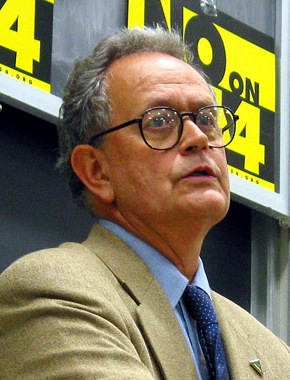
Peter Camejo
View on Wikipedia
Peter Miguel Camejo Guanche (December 31, 1939 – September 13, 2008) was a Venezuelan American author, activist, politician and Sailing Olympian. In the 2004 United States presidential election, he was selected by independent candidate Ralph Nader as his vice-presidential running mate on a ticket which had the endorsement of the Reform Party.[1][2]
Key Information
Camejo was a three-time Green Party gubernatorial candidate in California, most recently in 2006, when he received 2.3 percent of the vote. Camejo also ran in the 2003 California gubernatorial recall election finishing fourth in a field of 135 candidates (2.8%), and in 2002, finishing third with 5.3%. In the 1976 presidential election he ran for the Socialist Workers Party, receiving 90,310 votes.
Early life
[edit]Camejo was a first-generation American of Venezuelan descent. At the time of his birth, his mother was residing in the Queens borough of New York City. Although Camejo spent most of his early childhood in Venezuela, he was a "natural born citizen" of the United States and therefore constitutionally eligible for the U.S. Presidency later in life.
His parents, Elvia Guanche and Dr. Daniel Camejo Octavio,[3] divorced when their son was seven. Camejo then resided with his mother in the United States and returned to Venezuela during summer holidays to visit family. In later youth Camejo showed talent as a yachtsman, competing in 1960 for Venezuela at the Rome Olympics with his father in the Star class, where they took 21st place.[4]
Camejo entered the Massachusetts Institute of Technology, involving himself in soccer and, increasingly, left-wing politics. Later he studied history at the University of California, Berkeley, where he won election to student council. His participation in a protest of the Vietnam War in 1967 led to his suspension from the university for "using an unauthorized microphone." Then-governor Ronald Reagan deemed Camejo one of California's ten most dangerous citizens due to his presence at anti-war protests.[5] He also participated in one of the Selma civil rights marches.[5]
Politics
[edit]Initially, Camejo was a member of the Socialist Workers Party (SWP), a Trotskyist party. As a branch organizer, he sought to reorient the SWP towards the student movement.[6]

Camejo's first political campaign on behalf of the SWP came in 1967 when as a 27-year old he ran for mayor Berkeley, California.[7] He was the SWP's nominee for President in 1976 and won 90,986 votes, or 0.1%.
While a member of the Socialist Workers Party, Camejo wrote Racism, Revolution, Reaction, 1861-1877. The Rise and Fall of Radical Reconstruction, published by the party's publishing house, Pathfinder Press.[8] He also met with J. Posadas.[9]
The SWP's policy was to turn its members into "proletarians" by having them take jobs in factories and advocate for a worker-based class struggle. By 1980, Camejo came to disagree with this policy in favor of democratic socialism, and the SWP expelled him. He led the third dissident group of the SWP and formed North Star Network in 1983.[10][11]
In 1992 Camejo committed $20,000 of his own money toward establishing the Progressive Alliance of Alameda County, an organizational effort that did not sustain itself.[12]
Camejo was quoted in 2002 as claiming that he was a watermelon—green on the outside but red on the inside.[13]
However, in January 2004 Camejo initiated the Avocado Declaration which compares Greens, to avocados. "An avocado is Green on the outside and Green on the inside."[14]
Just over a month after the 2004 election, Camejo was elected as one of California's delegates to the National Committee of the Green Party and established the GDI, "Greens for Democracy and Independence,"[15] a cadre group within the larger Green Party of California that ran candidates for local Green County Councils.[16] At the 2005 Green Party National Convention, Camejo stated that he would not be a candidate for President in 2008.
Camejo wrote a number of articles concerning the divisions evident in the Green Party in the aftermath of the turbulent 2004 national convention, continuing the themes of the Avocado Declaration in opposing attempts to "cozy up" to the newly formed Progressive Democrats of America.
In August 2008 he attended the convention of the Peace and Freedom Party in order to personally endorse Nader's presidential candidacy.[5]
Gubernatorial campaigns
[edit]
Camejo ran for Governor of California three times, against incumbent governors Gray Davis and Arnold Schwarzenegger in 2002 and 2006, and in the 2003 recall election in which Schwarzenegger replaced Davis as governor.
2002 gubernatorial election
[edit]In 2002, Camejo ran uncontested in the California Green Party gubernatorial primary. In the general election, he ran as part of the first full slate of Green candidates for all seven of California's partisan constitutional offices. Camejo lost the election to Governor Gray Davis, but he polled 393,036 votes, for 5.3% of the vote, the largest vote total for a third-party in the California governor's race since 1946, when Henry R. Schmidt of the Prohibition Party polled 7.1%. Because the San Francisco Green Party endorsed him, Camejo earned more votes in San Francisco than Republican gubernatorial nominee Bill Simon, a rarity in third-party politics.
2003 gubernatorial recall election
[edit]In 2003, he was the endorsed Green Party candidate for governor (although several other Greens appeared on the ballot) in an unprecedented California recall election against Gray Davis, in which he polled 242,247 votes for 2.8%, coming in fourth in a field of 135 certified candidates. In a strange preview of the divisions about to erupt on the left in the following year, Camejo first cooperated with, and then competed with, fellow recall candidate Arianna Huffington.
2006 gubernatorial election
[edit]
In 2006, Camejo made his third bid for Governor of California against incumbent Arnold Schwarzenegger and Democratic Party nominee Phil Angelides. Camejo received 193,553 votes, or 2.3% of the popular vote.
Peter Daniels criticized Camejo for "lending his support to the right-wing effort to depose California governor Gray Davis" by recall in 2004.[17] However, the Green Party state convention easily voted to endorse Camejo as a recall replacement candidate.
2004 vice-presidential campaign
[edit]Camejo was submitted as a candidate in the Green Party of California's March 2, 2004, Presidential Preference Primary. Before the primary, he made it known that he was not planning to run for president and that any delegates pledged to him would not be committed to vote for him after the first round. The former gubernatorial candidate received 33,753 votes (75.9%) of the Green Party membership's support in California,[18] and 72.7% of the votes in all Green Party primary elections.[citation needed]
In June 2004, Camejo campaigned for the vice-presidential spot beside two-time Green Party presidential candidate Ralph Nader as independents (i.e. Nader never actually joined the Green Party), running against whoever the Green Party nominee might be. They received the endorsement of the Reform Party, which gave them ballot access in several states they would not otherwise have. With votes for Nader added in, the Nader/Camejo ticket had what appeared to be an insurmountable 83% of Green voters behind their candidacies going into the Green Party National Convention in Milwaukee.[citation needed] However many delegates were alienated by non-Green Party member Ralph Nader's wanting the party's hard-won ballot lines, and by Camejo's maneuver serving as a proxy for Nader in California. After an extremely contentious proceeding the convention nominated Green Party members David Cobb and Pat LaMarche for the Green Party ticket instead.[19] Rejected by the Greens, Nader and Camejo continued their campaign as independent candidates.
Both Nader and Camejo asserted that one of the main reason they ran in the 2004 election was because there were no other national candidates demanding an immediate withdrawal of American troops from what they believe is an immoral and unconstitutionally pursued War in Iraq (though minor party national candidates Green David Cobb, Libertarian Michael Badnarik, Constitution Party candidate Michael Peroutka, Socialist Party USA candidate Walt Brown and Socialist Workers Party candidate Róger Calero all strongly opposed the war). The Nader/Camejo were the only candidates who had a regular voice in the mainstream media arguing for withdrawal, since Ralph Nader was regularly invited to appear on mainstream news, and none of the other candidates received mainstream media coverage.
The Nader/Camejo ticket came in a very distant third in the election, polling approximately 460,000 votes, or 0.4% of the vote. Camejo's supporters claimed this result vindicated the Nader/Camejo team seeking the Green Party's endorsement (of them as non-Green Party candidates) since Cobb/LaMarche received less than one third that many votes with a total of 119,859 votes (0.1%). This was a drop of 95% compared to the Green Party's 2000 national ticket of Nader and his running mate Winona LaDuke. Camejo supporter's claimed that the difference between these outcomes was made up by Nader/Camejo having four-to-one support compared to Cobb/LaMarche within the Green Party. Camejo's experiences on the 2004 campaign are chronicled in Jurgen Vsych's book, "What Was Ralph Nader Thinking?"[20]
The Nader/Camejo Campaign cooperated loosely with an effort by the Green Party Cobb/LaMarche and Libertarian Party Badnarik/Campagna campaigns to do hand recounts across the country in states where vulnerable electronic voting machines had been used and anomalous results were questioned. Nader/Camejo undertook a challenge to the results in New Hampshire.[21]
Writings
[edit]Camejo is the author of The SRI Advantage: Why Socially Responsible Investing Has Outperformed Financially.
At the time of his death, Camejo was engaged in writing North Star: A Memoir, published in May 2010 by Haymarket Books.[22]
Conflict within the Green Party
[edit]In the run-up to the June 6, 2006, primary elections in California, Camejo helped create a cadre group within the larger Green Party of California, the Green IDEA (later known as IDEA PAC), a California political action committee espousing "Independence, Democracy, Empowerment, and Accountability," to support candidates for county councils, the locally elected leadership bodies of the Green Party of California. The IDEA PAC was not raising or spending money as of 2010.
Personal life
[edit]
Camejo died of lymphoma on September 13, 2008, at his home in Folsom, California.[23] He was survived by his wife, Morella Camejo; stepdaughter Alexandra Baquero, stepson Victor Baquero, and brothers Antonio and Daniel Camejo and Danny Ratner.[24] He last worked as the Chief Executive Officer of Progressive Asset Management,[25] a financial investment firm that encourages socially responsible projects.
Footnotes
[edit]- ^ "Nader For President 2004". www.votenader.org. Archived from the original on October 9, 2007.
- ^ Seelye, Katharine Q. (May 13, 2004). "THE 2004 CAMPAIGN: THE INDEPENDENT; Reform Party Backs Nader, Offering Line On Ballots". New York Times. Mississippi; Kansas; Michigan; Colorado; Montana; Florida; South Carolina. Retrieved January 1, 2011.
- ^ "Ancestry of Peter Camejo". Wargs.com. Retrieved January 1, 2011.
- ^ "Peter Camejo". Olympedia. Retrieved June 4, 2020.
- ^ a b c "Peter Camejo, 68, Dies; '04 Nader Pick" AP, September 13, 2008, 9:46 p.m. ET, in the New York Times [1]
- ^ "The Cochranite Legacy". Marxists.org. Retrieved January 1, 2011.
- ^ "SWP Slate Files in California Contest," The Militant, vol. 31, no. 3 (Jan. 16, 1967), pg. 1.
- ^ "Racism, Revolution, Reaction, 1861-1877". Pathfinderpress.com. Retrieved January 1, 2011.
- ^ Wenz, John (November 2017). "UFOs, dolphins, nuclear war and communism: the stranger than sci-fi political party". Syfy Wire. Syfy. Archived from the original on February 7, 2019. Retrieved February 4, 2019.
- ^ John Kelly (October 28, 2022). The Twilight of World Trotskyism. Taylor & Francis. ISBN 978-1000816457.
- ^ Robert Jackson Alexander (1991). International Trotskyism, 1929-1985 | A Documented Analysis of the Movement. Duke University Press. p. 893. ISBN 0822309750.
- ^ "Progressive Alliance of Alameda County - KeyWiki". keywiki.org. Retrieved February 12, 2016.
- ^ Herel, Suzanne. "Multimedia (image)". SF Gate. Archived from the original on November 15, 2005. Retrieved January 1, 2011.
- ^ "The Avocado Declaration, a statement by Peter Camejo and the Avocado Education Project". www.cagreens.org. Retrieved February 12, 2016.
- ^ "S/R 39: Call for a Green Committee for Democracy and Independence". www.greens.org. Retrieved February 12, 2016.
- ^ "Greens for Democracy and Independence". December 5, 2006. Archived from the original on December 5, 2006. Retrieved February 12, 2016.
- ^ "Peter Camejo and the Greens bid for "respectability" in California recall campaign". Wsws.org. September 30, 2003. Retrieved January 1, 2011.
- ^ "sov_summary_pres.xls" (PDF). Archived from the original (PDF) on October 22, 2004. Retrieved January 1, 2011.
- ^ Martin, Patrick (June 28, 2004). "Green Party convention rejects Nader-Camejo ticket - World Socialist Web Site". www.wsws.org. Retrieved February 12, 2016.
- ^ "Domain name - Under Construction". www.thewomandirector.com. Archived from the original on September 14, 2012.
- ^ "Recount New Hampshire". The Nation. ISSN 0027-8378. Retrieved February 12, 2016.
- ^ Camejo, Peter. "North Star: A Memoir". Haymarket Books. Retrieved January 1, 2011.
- ^ Judy Lin, Peter Camejo; Nader's Running Mate in 2004, Associated Press (September 15, 2008).
- ^ Gordon, Rachel. "Peter Camejo Dies - Helped Found Green Party". CommonDreams.org. Archived from the original on June 5, 2011. Retrieved January 1, 2011.
- ^ Created by WJDesigns. "Progressive Asset Management - Specializing in Socially Responsible Investing". Progressive-asset.com. Archived from the original on January 11, 2010. Retrieved January 1, 2011.
External links
[edit]- Peter Camejo at World Sailing (archive)
- Peter Camejo at Olympics.com
- CNN Factsheet On Peter Camejo, 2004.
- San Francisco Chronicle campaign profile, 2002
- California election results
- Peter Camejo Papers Catalogue entry at Special Collections Dept., University Library, University of California, Davis
- Appearances on C-SPAN
Peter Camejo
View on GrokipediaPeter Miguel Camejo (December 31, 1939 – September 13, 2008) was an American political activist, investment manager, and multiple-time candidate for public office, noted for his transitions from Trotskyist socialism to Green Party leadership.[1][2] Born in New York City to parents of Venezuelan descent, Camejo participated in civil rights marches, including Selma with Martin Luther King Jr., and led anti-Vietnam War protests at the University of California, Berkeley, from which he was suspended in 1967.[1][3] Camejo joined the Socialist Workers Party in his youth, rising to become its presidential nominee in 1976, before departing in the early 1980s amid internal disputes.[2][1] He later entered finance, working as a broker for Merrill Lynch and pioneering socially responsible investing through his firm.[4] In 1991, he co-founded the California Green Party and ran as its nominee for governor in 2002, the 2003 recall election, and 2006, emphasizing opposition to corporate influence and electoral reform.[2][3] Nationally, he served as independent candidate Ralph Nader's vice-presidential running mate in 2004, critiquing the two-party system and the Iraq War.[1][3] Camejo died of lymphoma in Folsom, California, leaving a legacy of challenging dominant political structures despite limited electoral success.[1][2]
Early Life and Education
Childhood and Family Background in Venezuela
Peter Camejo, born Pedro Miguel Camejo Guanche on December 31, 1939, in New York City, was the son of Venezuelan parents Dr. Daniel Camejo Octavio and Elvia Guanche Camejo.[5][6] His birth occurred in the United States because his mother sought the higher standards of American healthcare available at the time.[7] Dr. Camejo, born on April 23, 1914, in Barquisimeto, Lara state, served as head of tourism under the Venezuelan government and amassed wealth as a landowner and real estate developer.[8][6] The family descended from Venezuelan elites; Camejo's parents had earlier been deported from Venezuela for publicly criticizing the dictator Juan Vicente Gómez during his regime in the 1920s and 1930s.[6] Camejo spent his early childhood primarily in Venezuela, returning there shortly after birth to join his affluent family's life amid the country's oil-booming economy of the era.[9] This period, lasting until approximately age seven around 1946 or 1947, exposed him to the privileges of wealth in a nation marked by stark class divides, though specific daily experiences remain sparsely documented beyond his later recollections.[9][6] His parents' divorce prompted his mother to relocate with him to Long Island, New York, ending his initial Venezuelan residency, though he maintained ties through subsequent visits.[9] In his memoir North Star, Camejo recounted a formative encounter during a later childhood stay in Barquisimeto at age thirteen, around 1952 or 1953, where discussions with his aunt Milagro highlighted Venezuela's poverty as stemming from U.S. economic control and backing of local dictators, fostering his early awareness of imperialism and inequality.[10] He also had a younger brother, Antonio, born in 1942 in Texas to the same parents, underscoring the family's transnational movements.[6] These Venezuelan roots, blending privilege with exposure to underdevelopment, informed Camejo's lifelong internationalist outlook, though his direct childhood there was curtailed by family upheaval.[10]Immigration to the United States and Initial Exposure to Politics
Peter Miguel Camejo was born on December 31, 1939, in Queens, New York, to Venezuelan parents Elvia Guanche and Dr. Daniel Camejo Octavio, members of a wealthy family involved in real estate development.[1][11][4] His mother had traveled to the United States specifically for the birth to access advanced medical care unavailable in Venezuela at the time, granting Camejo dual U.S.-Venezuelan citizenship from birth.[7][12] Camejo spent the majority of his childhood in Venezuela following his early years, though he maintained ties to the United States through family connections and periodic visits.[13][10] In 1958, at age 18, he returned to the United States to pursue higher education, enrolling as a freshman at the Massachusetts Institute of Technology (MIT) in Cambridge, Massachusetts.[14] This relocation marked his primary immigration-like transition from Venezuela to full-time residence in the U.S., where he would remain for the rest of his life despite retaining Venezuelan citizenship. During his initial months in the U.S. as a college student, Camejo encountered socialist ideas amid the intellectual ferment of the late 1950s, joining the Young Socialist Alliance (YSA)—the youth affiliate of the Trotskyist Socialist Workers Party (SWP)—in New York shortly before or upon arriving at MIT.[10][14] This affiliation introduced him to revolutionary Marxist theory, including critiques of capitalism and imperialism drawn from Leon Trotsky's writings, which resonated with his observations of social inequalities experienced across his binational upbringing.[10] His early involvement in YSA activities laid the groundwork for deeper engagement in leftist organizing, though his studies at MIT focused on mathematics and provided a platform for initial political discussions among peers.[14]Trotskyist Activism and Early Political Career
Membership and Leadership in the Socialist Workers Party
Peter Camejo joined the Young Socialist Alliance, the youth organization affiliated with the Socialist Workers Party (SWP), in 1958 while studying at the Massachusetts Institute of Technology. He became a full member of the SWP the following year and rapidly emerged as a leader within the organization.[15] His early involvement included participation in civil rights pickets and student movements during the early 1960s.[15] Camejo served as a branch and district organizer for the SWP, helping to build its presence in key areas such as Berkeley, California, where he relocated in the mid-1960s.[16] He played a prominent role in the party's anti-war efforts and student organizing, often acting as a main speaker and strategist for the SWP and its youth wing.[17] By the 1970s, he had ascended to national leadership positions, contributing to the SWP's orientation toward mass movements and Trotskyist principles.[18] In 1976, Camejo was selected as the SWP's presidential candidate, representing the party's commitment to revolutionary socialism amid the post-Vietnam era.[4] His campaign emphasized building independent working-class politics, though it garnered limited electoral support.[19] Camejo's tenure in the SWP ended in 1981 amid internal disagreements over the party's strategic shifts toward greater emphasis on the Cuban model and away from traditional Trotskyist united-front tactics.[20] He requested a leave of absence that summer, traveling to Venezuela, and subsequently departed the organization after critiquing its increasing sectarianism in writings such as "Against Sectarianism."[21][20] This exit aligned him with a faction of dissidents advocating for renewed focus on democratic internal processes and broader alliances.[20]
Anti-War Activism and SWP Presidential Candidacies
Camejo emerged as a key organizer in the Socialist Workers Party's (SWP) anti-Vietnam War efforts during the mid-1960s, leveraging his role as a leader in the party's youth organization, the Young Socialist Alliance, to mobilize students and workers against U.S. imperialism.[19] He advocated for building a broad, multi-issue mass movement centered on immediate U.S. withdrawal from Vietnam, critiquing both liberal reformism—which he saw as diluting anti-war demands through electoral ties to the Democratic Party—and ultraleft isolationism that rejected alliances with broader forces.[22] Through public speaking and SWP-led initiatives, Camejo helped integrate anti-war activism with civil rights and labor struggles, positioning the party as a consistent voice for revolutionary socialism amid escalating U.S. troop deployments that peaked at over 543,000 in 1969.[23] The SWP's anti-war stance informed Camejo's 1976 presidential candidacy, where he ran on a platform demanding an end to U.S. interventions abroad, including support for self-determination in Vietnam and opposition to CIA-backed operations.[24] Nominated by the SWP at its August 1975 convention, Camejo campaigned alongside vice-presidential candidate Willie Mae Reid, securing ballot access in 28 states and focusing on uniting anti-war veterans, feminists, and union activists against capitalist exploitation.[25] The effort emphasized entryism into mass movements rather than sectarian isolation, drawing endorsements from some independent left groups and achieving the SWP's highest vote total since 1948 with approximately 90,000 votes nationwide, though it represented less than 0.1% of the popular vote.[26] This campaign highlighted tensions within the Trotskyist left, as Camejo's outward-oriented approach contrasted with more insular SWP factions, foreshadowing internal debates over the party's future direction.[27]Business Career and Financial Philosophy
Entry into Finance and Development of Socially Responsible Investing
In 1985, following his departure from the Socialist Workers Party, Camejo entered the financial industry as a stockbroker.[3] He initially worked at major firms including Prudential Financial and Merrill Lynch, where he developed an interest in aligning investments with ethical and environmental criteria.[28] At Merrill Lynch, Camejo created the Eco-Logical Trust, one of the early investment vehicles focused on socially responsible criteria such as avoiding tobacco, alcohol, and defense-related companies while prioritizing environmental sustainability.[29] By 1987, seeking greater autonomy to promote these principles, Camejo co-founded Progressive Asset Management (PAM), an Oakland-based broker-dealer firm dedicated to channeling client funds into socially responsible mutual funds and stocks.[30] PAM emphasized screening investments for social and environmental impacts, such as excluding firms involved in weapons production or labor exploitation, and directing capital toward renewable energy and community development projects.[31] Under Camejo's leadership as chair, the firm grew to manage billions in assets by the early 2000s, serving individual investors, pension funds, and institutions interested in ethical alternatives to conventional Wall Street practices.[32] Camejo advanced the field of socially responsible investing (SRI) by arguing that such strategies not only mitigated moral risks but also delivered superior financial returns due to long-term sustainability advantages and avoidance of volatile or scandal-prone sectors.[33] This thesis formed the basis of his 2002 book, The SRI Advantage: Why Socially Responsible Investing Has Outperformed Financially, which cited empirical data showing SRI funds outperforming broader indices over multi-year periods, attributing gains to factors like innovation in green technologies and reduced exposure to externalities such as regulatory fines.[34] Through PAM and public advocacy, Camejo helped institutionalize SRI, influencing the growth of the sector from niche offerings in the 1980s to a multi-trillion-dollar market by the 2000s, though critics questioned whether performance edges stemmed from SRI criteria or mere market selection biases.[35]Founding and Success of Progressive Asset Management
In 1987, Peter Camejo co-founded Progressive Asset Management, Inc. (PAM), an Oakland, California-based broker-dealer firm dedicated to socially responsible investing (SRI).[30][13] The firm emerged from Camejo's prior experience as a stockbroker starting in 1985, where he identified a market gap for investments aligned with progressive values, steering client funds toward companies and mutual funds avoiding industries like tobacco, alcohol, and military contracting while favoring those with strong environmental, labor, and diversity practices.[36][32] As co-founder and chairman, Camejo positioned PAM to fill demand for ethical brokerage services amid growing investor interest in SRI during the late 1980s.[37] PAM's model emphasized broker-dealers promoting SRI products, including mutual funds and unit investment trusts screened for social criteria, which Camejo argued could yield competitive returns based on historical data showing SRI portfolios outperforming broader markets over periods like 1975–2001.[32] This claim, detailed in Camejo's 2002 book The SRI Advantage, drew on analyses of funds like the Domini Social Index, though subsequent studies have debated the persistence of any SRI "alpha" after accounting for risk factors and fees.[32] The firm supported innovative SRI initiatives, such as community development funds and proxy voting for corporate governance reforms, establishing itself as a pioneer in channeling institutional and retail capital toward sustainable practices.[38] By 2013, PAM marked 25 years of operation, reflecting sustained viability in a niche that grew from under $1 billion in SRI assets in 1987 to trillions globally by the 2010s, with the firm retaining a focus on ethical screening amid broader industry adoption of environmental, social, and governance (ESG) metrics.[30] Camejo remained actively involved as CEO until his death in 2008, during which PAM expanded its offerings to include international SRI options and educational resources for clients.[4][39] Its longevity and role in normalizing SRI contrasted with critiques that such investing sometimes prioritizes ideological screens over pure financial optimization, potentially underperforming in certain market cycles.[13]Shift to Green Party Politics
Motivations for Leaving Trotskyism and Joining the Greens
Camejo departed from the Socialist Workers Party (SWP) amid its sharp turn toward sectarianism in the late 1970s and early 1980s, a shift he detailed in his 1983 pamphlet Against Sectarianism. He criticized the SWP leadership under Jack Barnes for withdrawing from mass movements, such as solidarity campaigns for El Salvador and the nuclear freeze initiative, in favor of propagandistic abstentionism that isolated the organization from broader social struggles.[21] This included an overemphasis on recruiting industrial workers through a rigid "turn to industry" that devolved into organizational purging rather than strategic engagement, resulting in the expulsion of hundreds of members—including Camejo himself around 1980–1981—and a rejection of radicals from the 1960s era as unreliable.[21] [20] Camejo argued this betrayed core Leninist principles of democratic centralism and rooted intervention in living class conflicts, fostering instead a "bunker mentality" that prioritized internal factional control over building alliances.[21] In his 1995 essay Return to Materialism, Camejo extended this critique to Trotskyism more broadly, identifying an idealist deviation where the pursuit of a singular "correct program" supplanted empirical analysis of mass dynamics, leading to recurrent sectarian cults and isolation across groups like the SWP, Posadists, and Healyites.[40] He contended that Trotskyist dogma confused programmatic purity with actual revolutionary potential, neglecting adaptations to emerging realities such as environmental degradation and the limitations of vanguardist structures in democratic contexts.[40] This realization prompted Camejo to found the North Star Network in 1983 as an attempt at non-sectarian left coordination, but ultimate disillusionment with Trotskyism's "trap" of perpetual minority status drove him toward formations emphasizing ecological imperatives and electoral independence.[41] Camejo's turn to the Green Party, culminating in co-founding the California branch in 1991, stemmed from its prioritization of ecology as a causal driver of systemic crisis—issues like global warming and resource depletion that traditional Trotskyism had marginalized in favor of class-reductionist analyses.[42] He viewed the Greens as a viable vehicle for constructing a mass-based, independent left alternative to the Democratic Party, integrating social justice with environmental realism without the ultraleft abstentionism that had hamstrung the SWP.[4] This alignment allowed engagement in concrete struggles, such as renewable energy advocacy and anti-corporate reforms, reflecting Camejo's empirical reassessment that sustainable politics required broad coalitions over dogmatic purity.[4] [40]Advocacy for Party Independence and Internal Reforms
Camejo consistently advocated for the Green Party to uphold strict independence from the Democratic Party, viewing alignment with Democrats as a capitulation that would demobilize progressive movements and perpetuate corporate influence in politics. In the "Avocado Declaration" published on June 3, 2004, he rejected the "lesser evil" rationale for supporting Democratic candidates, arguing that the party's role required confronting both major parties on issues like the Iraq War, the Patriot Act, and economic inequality to build a viable third option.[43] He positioned independent campaigns, exemplified by Ralph Nader's 2000 effort that garnered 2.7 million votes, as essential for exposing Democratic complicity in right-wing policies and fostering grassroots mobilization.[43] Camejo opposed internal strategies that diluted this independence, such as the "safe states" tactic promoted by 2004 Green presidential nominee David Cobb, which restricted aggressive campaigning in swing states to prevent perceived "spoilage" for Democrats. He contended that such approaches subordinated Green principles to Democratic electoral success, undermining the party's anti-corporate and anti-war platform. In writings following the 2004 election, Camejo warned that Democratic ties, including through groups like Progressive Democrats of America, risked co-opting Green activists and fragmenting the party along factional lines between "lesser evil" proponents and independence advocates.[44] On internal reforms, Camejo pushed for greater democratic accountability, proposing a shift to "one Green, one vote" systems based on verified state memberships to supplant delegate conventions prone to stacking and manipulation. He highlighted the 2004 Milwaukee convention, where Cobb secured the nomination despite Nader winning primaries by a roughly 6:1 ratio, as evidence of undemocratic practices that ignored rank-and-file preferences.[45] Camejo advocated pluralism within the party, urging acceptance of diverse strategic currents unified around core values like the Ten Key Values, while calling for structural changes—starting in strongholds like California and New York—to enable national primaries and prevent factional dominance. These reforms, he argued, would enhance unity, transparency, and long-term viability against pressures from the two-party duopoly.[44][45]Major Electoral Campaigns
2002 California Gubernatorial Campaign
Peter Camejo, the Green Party candidate, entered the 2002 California gubernatorial race amid widespread dissatisfaction with incumbent Democratic Governor Gray Davis and Republican challenger Bill Simon, positioning himself as an alternative focused on environmental protection, social justice, and opposition to corporate influence in politics.[46] The election occurred on November 5, 2002, following a March 5 primary where major-party nominees were selected under California's nonpartisan primary system, while Camejo secured the Green Party nomination through party processes.[4] His campaign emphasized independence from special interests, drawing on his background in socially responsible investing to argue for policies untainted by donor money.[47] Camejo's platform critiqued the state's recent energy crisis as a corporate-manipulated scheme with no genuine shortage, claiming it eroded California's budget surplus through deregulation favoring energy companies.[48] He advocated for reforms including living-wage laws, universal healthcare access, stricter environmental regulations, and campaign finance changes to reduce corporate sway over government decisions.[49] These positions targeted progressive voters disillusioned with Davis's handling of the energy issues and budget woes, while appealing to Latino communities feeling overlooked by Democratic policies.[46] Throughout the campaign, Camejo conducted grassroots efforts and media appearances to highlight Green Party principles, though he was excluded from major debates dominated by the two leading candidates. His strategy prioritized policy differentiation over attacking opponents directly, aiming to build long-term party infrastructure rather than immediate victory.[32] Funding came partly from his personal wealth and small donations, aligning with his critique of moneyed politics.[47] Camejo finished third with 393,036 votes, capturing 5.3% of the total, outperforming other third-party contenders and serving as a protest vote against the major parties' perceived failures.[4] [50] Davis narrowly won re-election with 47.3% against Simon's 42.4%, but Camejo's share drew votes primarily from Democrats, amplifying Green Party visibility and foreshadowing future third-party challenges in California.[46] The result boosted Green registration and local wins elsewhere in the state, though it did not alter the gubernatorial outcome.[4]2003 California Gubernatorial Recall Election
Peter Camejo served as the Green Party of California's nominee to replace Governor Gray Davis in the special recall election held on October 7, 2003. The recall effort, driven by dissatisfaction with Davis's handling of the state's budget deficit and energy crisis, qualified for the ballot after collecting over 1.6 million signatures by July 23, 2003.[51] Camejo, building on his 5.3% showing in the 2002 gubernatorial election, positioned his campaign as an alternative to the major-party candidates, emphasizing independence from corporate influence and Democratic Party politics.[52] In his official candidate statement, Camejo pledged to halt proposed cutbacks in education and health care funding, advocating for budget balance through a progressive tax structure targeting high-income earners and corporations, alongside reductions in government waste and corporate subsidies.[53] His platform highlighted environmental protection, campaign finance reform to curb special-interest money, and opposition to the Iraq War, aligning with Green Party principles of grassroots democracy and social justice. During the campaign, Camejo participated in multiple televised debates, including a September 3, 2003, forum on C-SPAN and a September 4 debate covered by CNN, where he critiqued the economic policies of frontrunners Arnold Schwarzenegger and Cruz Bustamante for favoring wealthy interests over working families.[54][55] Camejo garnered 242,247 votes, approximately 2.7% of the total cast for replacement candidates, finishing behind Schwarzenegger (48.6%), Bustamante (31.5%), Tom McClintock (13.0%), and Arianna Huffington (4.6%).[51] This performance marked a decline from his 2002 result amid a field of 134 candidates, which diluted third-party support, though it represented a notable presence for the Greens in a high-profile contest. Post-election analyses attributed the recall's outcome to voter frustration with Davis, whom 55.4% voted to remove, enabling Schwarzenegger's victory, while Camejo's campaign underscored the Green Party's push for ballot access and visibility in California politics.[51][52]2004 Vice-Presidential Campaign with Ralph Nader
On June 21, 2004, independent presidential candidate Ralph Nader announced Peter Camejo as his vice-presidential running mate, selecting the California-based Green Party activist to bolster third-party outreach and address ballot access hurdles.[56][57] Camejo, who had previously run unsuccessfully for California governor in 2002 and 2003 on the Green Party ticket, accepted the nomination to promote an anti-corporate, progressive agenda independent of the Democratic Party.[58] The Nader-Camejo ticket campaigned on opposition to the Iraq War, calling for immediate U.S. troop withdrawal and criticizing both major parties for enabling military adventurism.[59] Key platform elements included reducing corporate influence in government, advocating for single-payer healthcare, environmental protections, and campaign finance reform to diminish the two-party duopoly's control over elections.[60] Camejo emphasized voter disenfranchisement through restricted ballot access and argued that third-party candidacies pressured Democrats toward bolder positions on social justice and peace issues.[61] Ballot access proved contentious, with Democratic-aligned groups filing lawsuits in multiple states to exclude Nader-Camejo, alleging procedural violations to prevent vote splitting similar to the 2000 election.[62] Courts upheld their inclusion in Florida on September 18, 2004, via the Reform Party line, but rejected it in Pennsylvania due to nomination paper defects.[63][64] The ticket secured spots on ballots in at least 27 states through independent, Reform, or Populist nominations, though exact counts varied amid ongoing litigation.[65] In the November 2, 2004, general election, Nader and Camejo garnered 465,647 popular votes nationwide, representing 0.38% of the total, with no electoral votes; state-level results included 4,053 votes in New Mexico and 15,626 in New York.[65][66][67] The campaign raised over $4 million but faced fundraising limits and media blackouts, underscoring challenges for independent runs against the Republican-Democratic dominance.[68]2006 California Gubernatorial Campaign
Peter Camejo served as the Green Party nominee for Governor of California in the 2006 election, marking his third such bid following campaigns in 2002 and the 2003 recall.[11] He secured the nomination in the party's primary on June 6, 2006, facing no opponents.[69] Camejo's platform centered on environmental sustainability, opposition to the Iraq War, and economic reforms to address inequality. In his official candidate statement, he attributed California's budget shortfalls to tax reductions benefiting the wealthy and corporations, observing that the effective tax rate for the state's poorest residents exceeded that of the richest by 57%. He proposed restoring progressive taxation, implementing single-payer healthcare, investing in clean energy, reforming criminal justice toward treatment over punishment, and reducing corporate influence in politics.[70] The campaign advocated solar power as an alternative to fossil fuels, expanded workers' rights, and non-violent foreign policy, aligning with Green Party tenets of ecological wisdom, social justice, and grassroots democracy.[71] Lacking access to major televised debates dominated by the Republican incumbent Arnold Schwarzenegger and Democratic challenger Phil Angelides, Camejo engaged voters through alternative forums, including a October 30, 2006, discussion hosted by the Commonwealth Club featuring third-party candidates.[72] His effort highlighted critiques of the two-party system's ties to corporate interests and military interventions. On November 7, 2006, Schwarzenegger won re-election with 4,850,380 votes (55.9%), defeating Angelides who received 3,376,732 (38.9%). Camejo garnered 232,996 votes (2.7%), placing third amid a field that included other minor candidates.[73] This outcome reflected a lower share than his approximately 5% in the 2003 recall, coinciding with Schwarzenegger's bolstered approval after navigating state fiscal challenges and special election propositions.[73]
