Hubbry Logo
Peter GreenawayPeter GreenawayMain
Open search
Peter Greenaway
Community hub
Peter Greenaway
logo
8 pages, 0 posts
0 subscribers
Be the first to start a discussion here.
Peter Greenaway
Peter Greenaway
from Wikipedia

Peter Greenaway, CBE (born 5 April 1942[1]) is a Welsh film director, screenwriter and artist. His films are noted for the distinct influence of Renaissance and Baroque painting, and Mannerist painting in particular. Common traits in his films are the scenic composition and illumination and the contrasts of costume and nudity, nature and architecture, furniture and people, sexual pleasure and painful death.

Key Information

Early life

[edit]

Greenaway was born in Newport, Monmouthshire, Wales,[2] to a teacher mother and a builder's merchant father.[3] Greenaway's family had relocated to Wales prior to his birth to escape the Blitz. They returned to the London area at the end of World War II and settled in Woodford, then part of Essex. He attended Churchfields Junior School [4] and later Forest School in nearby Walthamstow.[5]

At an early age Greenaway decided on becoming a painter. He became interested in European cinema, focusing first on the films of Ingmar Bergman, and then on the French Nouvelle Vague filmmakers such as Jean-Luc Godard and, most especially, Alain Resnais. Greenaway has said that Resnais's Last Year in Marienbad (1961) had been the most important influence upon his own filmmaking (and he himself established a close working relationship with that film's cinematographer Sacha Vierny).[6] He now lives in Amsterdam.[7]

Career

[edit]

1962–1999

[edit]
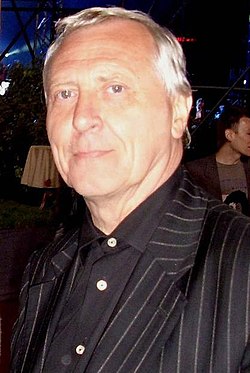
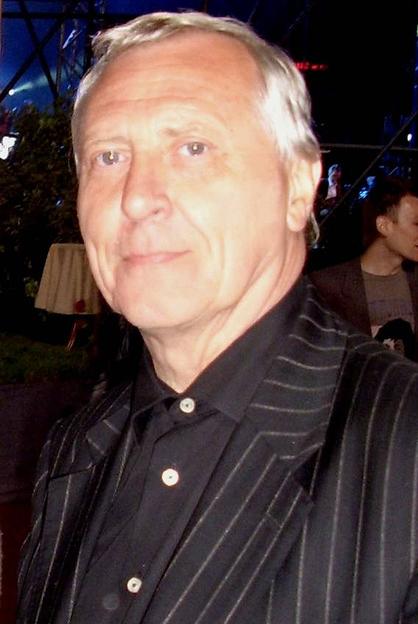
Greenaway at the 44th Venice Film Festival (1987)

In 1962, Greenaway began studies at Walthamstow College of Art, where a fellow student was musician Ian Dury (later cast in The Cook, the Thief, His Wife & Her Lover). Greenaway trained as a muralist for three years; he made his first film, Death of Sentiment, a churchyard furniture essay filmed in four large London cemeteries. In 1965, he joined the Central Office of Information (COI), where he went on to work for fifteen years as a film editor and director. In that time he made a series of experimental films, starting with Train (1966), footage of the last steam trains at Waterloo station (situated behind the COI), edited to a musique concrète composition. Tree (1966) is a homage to the embattled tree growing in concrete outside the Royal Festival Hall on the South Bank in London. In the late 1970s, he made Vertical Features Remake and A Walk Through H.[8] The former is an examination of various arithmetical editing structures, and the latter is a journey through the maps of a fictitious country.[citation needed]

In 1980, Greenaway delivered The Falls (his first feature-length film) – a mammoth, fantastical, absurdist encyclopaedia of flight-associated material all relating to ninety-two victims of what is referred to as the Violent Unknown Event (VUE). In the 1980s his cinema flowered in his best-known films, The Draughtsman's Contract (1982), A Zed & Two Noughts (1985), The Belly of an Architect (1987), Drowning by Numbers (1988), and his most successful film, The Cook, the Thief, His Wife & Her Lover (1989). Greenaway's most familiar musical collaborator during this period is composer Michael Nyman, who has scored several films.[9]

In 1989, Greenaway collaborated with artist Tom Phillips on a television serial A TV Dante, dramatising the first few cantos of Dante's Inferno. In the 1990s he presented Prospero's Books (1991), the controversial The Baby of Mâcon (1993), The Pillow Book (1996), and 8½ Women (1999).[citation needed]

In the early 1990s Greenaway wrote ten opera libretti known as the Death of a Composer series, dealing with the commonalities of the deaths of ten composers from Anton Webern to John Lennon; however, the other composers are fictitious, and one is a character from The Falls. In 1995, Louis Andriessen completed the sixth libretto, Rosa – A Horse Drama. He is currently professor of cinema studies at the European Graduate School in Saas-Fee, Switzerland.[10]

2000–present

[edit]

Greenaway presented the ambitious The Tulse Luper Suitcases, a multimedia project that resulted in three films, a website, two books, a touring exhibition, and a shorter feature which reworked the material of the first three films.[citation needed]

He also contributed to Visions of Europe, a short film collection by different European Union directors; his British entry is The European Showerbath. Nightwatching and Rembrandt's J'Accuse are two films on Rembrandt, released respectively in 2007 and 2008. Nightwatching is the first feature in the series "Dutch Masters", with the second project titled as Goltzius and the Pelican Company.[11]

On 17 June 2005, Greenaway appeared for his first VJ performance during an art club evening in Amsterdam, Netherlands, with music by DJ Serge Dodwell (aka Radar), as a backdrop, 'VJ' Greenaway used for his set a special system consisting of a large plasma screen with laser controlled touchscreen to project the ninety-two Tulse Luper stories on the twelve screens of "Club 11", mixing the images live. This was later reprised at the Optronica festival, London.[citation needed]

On 12 October 2007, he created the multimedia installation Peopling the Palaces at Venaria Reale at the Royal Palace of Venaria, which animated the Palace with 100 videoprojectors.[12]

Greenaway was interviewed for Clive Meyer's Critical Cinema: Beyond the Theory of Practice (2011), and voiced strong criticisms of film theory as distinct from discussions of other media: "Are you sufficiently happy with cinema as a thinking medium if you are only talking to one person?"[13]

On 3 May 2016, he received a Honoris Causa doctorate from the University of San Martín, Argentina.[14]

Nine Classical Paintings Revisited

[edit]

In 2006, Greenaway began a series of digital video installations, Nine Classical Paintings Revisited, with his exploration of Rembrandt's Night Watch in the Rijksmuseum in Amsterdam. On 30 June 2008, after much negotiation, Greenaway staged a one-night performance 'remixing' da Vinci's The Last Supper in the refectory of Santa Maria delle Grazie[15] in Milan to a select audience of dignitaries. The performance consisted of superimposing digital imagery and projections onto the painting with music from the composer Marco Robino.[citation needed]

Greenaway exhibited his digital exploration of The Wedding at Cana by Paolo Veronese as part of the 2009 Venice Biennial. An arts writer for The New York Times called it "possibly the best unmanned art history lecture you'll ever experience," while acknowledging that some viewers might respond to it as "mediocre art, Disneyfied kitsch or a flamboyant denigration of site-specific video installation." The 50-minute presentation, set to a soundtrack, incorporates closeup images of faces from the painting along with animated diagrams revealing compositional relations among the figures. These images are projected onto and around the replica of the painting that now stands at the original site, within the Palladian architecture of the Benedictine refectory on San Giorgio Maggiore. The soundtrack features music and imagined dialogue scripted by Greenaway for the 126 "wedding guests, servants, onlookers and wedding crashers" depicted in the painting, consisting of small talk and banal chatter that culminates in reaction to the miraculous transformation of water to wine, according to the Gospels the first miracle performed by Jesus. Picasso's Guernica, Seurat's Grande Jatte, works by Jackson Pollock and Claude Monet, Velázquez's Las Meninas and Michelangelo's The Last Judgment are possible series subjects.[16]

Films

[edit]

Features

[edit]

Shorts

[edit]
  • Death of Sentiment (1962)
  • Tree (1966)
  • Train (1966)
  • Revolution (1967)
  • 5 Postcards from Capital Cities (1967)
  • Intervals (1969)
  • Erosion (1971)
  • H Is for House (1973)
  • Windows (1975)
  • Water Wrackets (1975)
  • Water (1975)
  • Goole by Numbers (1976)
  • Dear Phone (1978)
  • Vertical Features Remake (1978)
  • A Walk Through H: The Reincarnation of an Ornithologist (1978)
  • 1–100 (1978)
  • Making a Splash (1984)
  • Inside Rooms: 26 Bathrooms, London & Oxfordshire (1985)
  • Hubert Bals Handshake (1989)
  • Rosa: La monnaie de munt (1992)[18]
  • Peter Greenaway (1995) - segment of Lumière and Company
  • The Bridge Celebration (1997)[18]
  • The Man in the Bath (2001)
  • European Showerbath (2004) - segment of Visions of Europe
  • Castle Amerongen (2011)
  • Just in Time (2013) - segment of 3x3D[18][19]

Documentaries and mockumentaries

[edit]
  • Eddie Kid (1978)
  • Cut Above the Rest (1978)
  • Zandra Rhodes (1979)
  • Women Artists (1979)
  • Leeds Castle (1979)
  • Lacock Village (1980)
  • Country Diary (1980)
  • Terence Conran (1981)
  • Four American Composers (1983)
  • The Coastline (also known as The Sea in their Blood) (1983)[18][20]
  • Fear of Drowning (1988)
  • The Reitdiep Journeys (2001)[18]
  • Rembrandt's J'Accuse (2008)
  • The Marriage (2009)[18]
  • Atomic Bombs on the Planet Earth (2011)[18]
  • Luther and His Legacy (2017)

Television

[edit]
  • Act of God (1980)[21][22]
  • Death in the Seine (French TV, 1988)
  • A TV Dante (mini-series, 1989)
  • M Is for Man, Music, Mozart (1991)
  • A Walk Through Prospero's Library (1992)
  • Darwin (French TV, 1993)
  • The Death of a Composer: Rosa, a Horse Drama (1999)

Exhibitions

[edit]
  • The Physical Self, Museum Boymans van Beuningen, Rotterdam (1991)[23]
  • Le bruit des nuages (as curator), Louvre Museum, Paris (1992)
  • 100 Objects to represent the World (1992) at the Academy of Fine Arts Vienna and the Hofburg Imperial Palace Vienna.
  • Stairs 1 Geneva (1995)
  • Flyga över vatten/Flying over water, Malmö Konsthall (16/9 2000 – 14/1 2001)
  • Peopling the Palaces at Venaria Reale, Palace of Venaria (2007)
  • Heavy Water, Chelouche Gallery, Tel Aviv (2011)
  • Sex & The Sea, Maritiem Museum, Rotterdam (2013)
  • The Towers/Lucca Hubris, Lucca (2013)

References

[edit]
[edit]
Revisions and contributorsEdit on WikipediaRead on Wikipedia
from Grokipedia
Peter Greenaway, CBE (born 5 April 1942) is a Welsh-born British filmmaker, painter, and multimedia artist renowned for his visually opulent and intellectually provocative films that blend elements of painting, , and structuralist experimentation. Born in , to a builder's merchant and ornithologist father and a teacher mother, Greenaway grew up in , , during , an experience that later influenced his thematic interests in mortality and order. He trained as a painter at Walthamstow School of Art in during the early , where he developed a fascination with visual composition and symbolism that would define his cinematic style. Greenaway's career in film began in 1965 when he joined the (COI) as an editor, producing documentaries and short films that explored experimental forms, including faux documentaries and structuralist works like A Walk Through H (1978) and Vertical Features Remake (1978). His transition to feature-length narrative cinema came with the critically acclaimed (1982), a mystery set in 17th-century that established his signature style of intricate plotting, lush visuals, and games with perspective inspired by artists like Vermeer and Ingres. This breakthrough was followed by a series of internationally recognized films, including (1985), which delves into themes of symmetry and decay through twin zoologists; (1988), a whimsical tale of death numbered from 1 to 100; and The Cook, the Thief, His Wife & Her Lover (1989), a scathing on power and excess featuring stark color-coded sets and operatic dialogue. Later works such as (1991), an adaptation of Shakespeare's starring , and (1996), which interweaves and eroticism, further showcased his approach, incorporating digital effects, voice-over narration, and non-linear structures. Throughout his oeuvre, Greenaway has maintained a commitment to form over conventional storytelling, often using lists, grids, motifs like and numbers, and references to classical to modern culture and explore mortality, , and the body. Based in since the mid-1990s and with ties to , he has expanded beyond cinema into video installations, such as multimedia project (2003–2004) and Nine Classical Paintings Revisited (2008), blurring boundaries between , theater, and visual . His provocative style has earned him nominations at major festivals like , , and , culminating in the 2014 BAFTA Award for Outstanding British Contribution to Cinema, recognizing a lifetime of innovative work that challenges Hollywood norms. Later films such as (2007), (2015), and (2023) continue his focus on historical artists and their obsessions, affirming his status as a in European cinema.

Biography

Early life

Peter Greenaway was born on 5 April 1942 in , into a middle-class family that had temporarily relocated there from to escape the bombing raids of during . His father worked as a builder's merchant and was an enthusiastic amateur ornithologist, while his mother was a teacher whose profession contributed to a household environment that valued and observation. Following the end of the war in 1945, the family returned to when Greenaway was about three years old, settling in , a suburb in on the outskirts of , where he spent his formative childhood years. This move provided a stable, suburban setting amid post-war recovery, with the family's interest in —particularly his father's pursuits—exposing young Greenaway to systematic classification and the patterns of the natural world. During his childhood in the , Greenaway exhibited an early fascination with visual and structural elements, including drawing detailed plans and observing environmental changes like shifting shadows, alongside games and explorations of the outdoors that echoed his father's scientific curiosities. These experiences, including collecting and studying behaviors, fostered a structured mindset attuned to categorization, numbers, and mapping-like representations, laying the groundwork for his later artistic inclinations.

Education and early influences

Greenaway attended Forest School in during his , where he developed an early interest in . Following this, he enrolled at Walthamstow College of Art in 1962, training as a for approximately four years until 1965. His studies focused on , emphasizing composition and visual structure, which laid the groundwork for his later multidisciplinary approach. After completing his , Greenaway pursued a career as a painter, holding his first at Lord's Gallery in in 1964. This early showcase highlighted his engagement with visual storytelling through painted works, marking his initial foray into public artistic presentation. During this period, he drew significant influences from traditions and Dutch masters such as Vermeer and , whose meticulous compositions and use of light informed his painterly techniques. Additionally, exposure to structuralist filmmakers like shaped his conceptual framework, bridging his static art background with emerging cinematic ideas. In 1965, Greenaway transitioned from to by joining the as a editor, a role he held for over a decade. This employment provided practical training in and documentary production, facilitating his shift toward while allowing him to continue exploring visual patterns observed in his youth.

Artistic style and themes

Visual and structural techniques

Peter Greenaway's visual style draws heavily from painting traditions, employing tableau vivant compositions to create static, painterly scenes that freeze action into living tableaux reminiscent of classical art. In films such as Nightwatching, these compositions transform actors into posed figures, evoking the dramatic intensity of historical paintings by artists like Rembrandt, where characters are arranged in carefully orchestrated groups to emphasize thematic depth. This technique allows Greenaway to blend cinema with visual art, prioritizing composition over fluid movement to heighten the viewer's contemplation of the image. Symmetrical framing further defines Greenaway's aesthetic, often centering subjects within balanced, geometric layouts that impose order on chaotic narratives. His early works, including , utilize perspectival grids and mirrored visuals to underscore themes of precision and artifice, drawing from principles of proportion and harmony. These elements mimic the structured symmetry of Renaissance masterpieces, transforming the screen into a canvas where every frame functions as a self-contained artwork. Greenaway's background as a painter informs this approach, leading to films that homage still lifes through meticulous staging and lighting. Structurally, Greenaway incorporates numbering systems, lists, and encyclopedic frameworks to organize elements into taxonomies, challenging conventional storytelling with methodical categorization. In A Zed & Two Noughts, for instance, he sequences decomposition scenes of animals—from apples to zebras—according to evolutionary order, using numerical progression to explore cycles of decay and . This encyclopedic method extends to dualities like , structuring the film around lists that impose intellectual rigor on emotional content, reflecting Greenaway's fascination with as a device. Greenaway's longstanding collaboration with composer integrates music as a structural pillar, with operatic scores that dictate pacing and thematic layering rather than merely accompanying action. Beginning in the 1970s and spanning films like and , Nyman's minimalist yet baroque compositions—performed by the Michael Nyman Band—function as rhythmic frameworks, synchronizing visual motifs with musical repetition to create a symphonic . This partnership treats sound as an equal formal element, enhancing the films' painterly and enumerative qualities through harmonic symmetries that mirror on-screen patterns. To enrich narrative density, Greenaway layers information via , diagrams, and text overlays, transforming the screen into a multifaceted textual-visual space. These elements, seen in works like , provide explanatory annotations, maps, and schematic illustrations that interrupt linear flow, inviting viewers to decode multiple interpretive planes simultaneously. often serve dual purposes—translating while embedding poetic or instructional content—while diagrams elucidate abstract concepts, reinforcing Greenaway's commitment to a cinema of explicit structure and reference. This technique underscores his view of as an extension of bookish or painterly media, where text augments rather than subordinates the image.

Recurring motifs and influences

Peter Greenaway's films recurrently explore motifs of and mortality, often intertwined with as a symbol of inevitable decay and ritualistic finality. In works like , drowning serves not merely as a but as a meditation on the of demise, where each is cataloged through games and lists that underscore the inescapability of mortality. emerges as another core motif, depicted through dissections and decompositions that reveal the body's fragility, as seen in time-lapse sequences of rotting fruit and animals, linking human form to broader cycles of corruption. These elements evoke excess, with opulent, crowded compositions reminiscent of painters like and Bruegel, where mortality is framed as both and sublime. Voyeurism permeates Greenaway's oeuvre as a lens for examining and intrusion, frequently tied to the that objectifies the body while critiquing its power. This motif critiques the voyeuristic impulse in art and society, portraying viewers—and by extension, characters—as complicit in acts of that blend desire with domination, often set against historical backdrops to highlight enduring power imbalances. Sexuality is interwoven with these themes, presenting as a site of excess and , where bodies are inscribed with text or subjected to , challenging conventional notions of intimacy and control. Greenaway has noted that "sex sells and that’s an interesting issue… every emergent visual phenomenon is at least partly seeded by erotic s," reflecting his interest in how desire intersects with mortality and . Literary influences profoundly shape these motifs, particularly the encyclopedic impulses of , whose labyrinthine structures and infinite libraries inspire Greenaway's taxonomic obsessions with lists and catalogs as metaphors for knowledge's futility. Shakespeare's works, reimagined in , infuse Greenaway's narratives with themes of exile, magic, and textual multiplicity, where books become vessels for mortality and power. Philosophically, his films draw from poststructuralist ideas of order and chaos, influenced by thinkers like , emphasizing embodied perception and the disruption of grand narratives through fragmented systems. These sources underpin explorations of power dynamics, where historical settings expose patriarchal gazes and sexual hierarchies as constructed illusions. Greenaway's thematic evolution traces from experimental abstraction in early shorts, where motifs like death manifest through abstract catalogs and natural histories, to more provocative narratives in feature films that integrate these symbols into layered critiques of society. This shift retains structural techniques like numbering but amplifies symbolic depth, transforming voyeuristic detachment into confrontational examinations of sexuality and mortality.

Career

Early experimental works (1960s–1970s)

Peter Greenaway's transition from painting to filmmaking began in the early 1960s, influenced by his training at College of Art, where he developed an interest in visual structure and composition that would inform his experimental shorts. His debut film, Death of Sentiment (1962), a 9-minute work shot in four cemeteries, explored themes of mortality and ephemerality through static shots and minimal narrative, marking his initial foray into cinema as a self-described piece of . In the mid-1960s, Greenaway's output progressed with films like Train (1966), a 5-minute study of steam trains departing Waterloo Station, capturing mechanical rhythm and industrial decline through rhythmic editing and ambient sound. This was followed by Intervals (1969), a 7-minute piece featuring footage of Venetian alleyways overlaid with Vivaldi's music and an Italian alphabet recitation, introducing his recurring use of lists and structural patterning. By 1973, H Is for House (10 minutes) depicted a rural English home with his family, narrated by a voice listing improbable objects beginning with "H," blending domestic scenes with encyclopedic absurdity to probe language and categorization. From 1965 to 1976, Greenaway was employed as a film editor and director at the UK's (COI), where he honed technical skills on educational documentaries, which influenced his pseudo-documentary style in personal projects. This period culminated in works like Vertical Features Remake (1978), a 45-minute parodying reconstruction through four fictional attempts to restore lost footage of abstract "vertical features," employing grids, charts, and invented experts to satirize archival processes. Greenaway's early films often delved into themes of , water, and , reflecting his fascination with natural and man-made transience. Erosion (1971, 6 minutes) examined coastal through time-lapse sequences of cliffs and waves, symbolizing inevitable dissolution. Similarly, Water Wrackets (1975, 12 minutes) portrayed tidal pools and watery landscapes in luminous detail, accompanied by a convoluted of tribal conflicts, evoking fluidity and mythological undercurrents. These shorts received limited distribution, primarily through art galleries, experimental film festivals, and avant-garde circuits, fostering a dedicated cult following among enthusiasts of structuralist cinema who appreciated their intellectual rigor and visual inventiveness.

Breakthrough features and international recognition (1980s–1990s)

Greenaway's transition to narrative feature films began with The Falls (1980), his first full-length work after years of short films, which earned the Sutherland Trophy from the British Film Institute for its innovative structure and thematic depth. This three-hour experimental piece, blending documentary-style elements with surrealism, marked a pivotal shift toward more ambitious storytelling while retaining his painterly aesthetic. Its selection for festivals like the International Film Festival Rotterdam in 1983 further signaled emerging international interest. The breakthrough came with The Draughtsman’s Contract (1982), a period mystery set in 17th-century that showcased Greenaway's meticulous visual composition and intellectual intrigue, earning a Golden Lion nomination at the . Distributed by Palace Pictures, which championed British cinema abroad, the film achieved commercial success and critical acclaim, establishing Greenaway as a major on the global stage. Its stylized narrative and recurring numbering motifs, such as the twelve drawings central to the plot, exemplified his structural obsessions. Throughout the mid-1980s, Greenaway consolidated his reputation with films like A Zed & Two Noughts (1985), a meditation on symmetry and decay featuring twin zoologists, which highlighted his collaboration with cinematographer Sacha Vierny and garnered praise for its baroque imagery. This was followed by The Belly of an Architect (1987), nominated for the Palme d'Or at Cannes, exploring themes of creation and mortality through an American architect's unraveling in Rome. Drowning by Numbers (1988), another Cannes recipient for Best Artistic Contribution, wove a tale of three drownings across generations, noted for its playful enumeration from 1 to 100 and Joan Plowright's performances. These works, distributed via Palace Pictures, expanded Greenaway's audience while provoking debates on his cerebral, often alienating style. The 1990s saw Greenaway's most provocative features, beginning with The Cook, the Thief, His Wife & Her Lover (1989), a savage allegory of power and excess starring and , which ignited controversies for its and , leading to an in the U.S. and cuts in some markets despite winning a Award. Prospero’s Books (1991), an avant-garde adaptation of Shakespeare's featuring John Gielgud's voiceover narration across 24 books, received a nomination at and a BAFTA nomination, praised for its layering of text and image. Culminating the decade, (1996) intertwined calligraphy, eroticism, and revenge in a story inspired by Sei Shōnagon's diary, earning the for Best Film at the amid discussions of its explicit content and cultural fusion. These films solidified Greenaway's international stature, blending high art with controversy to challenge cinematic conventions.

Multimedia and later projects (2000s–present)

In the late 1990s, Peter Greenaway began transitioning toward more experimental and multimedia forms, exemplified by his 1999 film 8½ Women, a comedy-drama exploring male fantasies and father-son dynamics through a setup inspired by Fellini's , marking a bridge from his earlier narrative features to broader artistic explorations. This shift culminated in the ambitious Tulse Luper Suitcases project (2003–2004), a sprawling multimedia saga chronicling the fictional life of Tulse Luper, a writer and prisoner, across the ; it encompassed three feature-length films (The Moab Story, Vaux to the Sea, and ), a 16-episode television series, illustrated books, websites, and exhibitions, all centered on 92 suitcases containing artifacts tied to themes of , history, and personal narrative. Greenaway continued this multimedia emphasis with narrative films that blended and visual innovation, such as Nightwatching (2007), which dramatizes Rembrandt's creation of (1642) while uncovering a fictional conspiracy of murder and corruption within the painting's subjects, featuring as the artist. Similarly, (2012) recounts the 16th-century Dutch engraver Hendrik Goltzius's erotic escapades to secure funding for a , employing Greenaway's signature frame-breaking techniques and theatrical stagings to reimagine art history; (2015), a biographical drama depicting Sergei Eisenstein's transformative 10 days in in 1931, exploring his sexual awakening and artistic influences. In 2017, he directed the documentary Luther and His Legacy, a personal essay using 16th- and 17th-century drawings and paintings to examine Martin Luther's enduring impact, drawing parallels to contemporary religious and social divisions. Greenaway's contributions were recognized with the Lifetime Achievement Award at the (IDFA) in 2023, honoring his innovative fusion of , visual , and over five decades, accompanied by a program. His most recent project, Lucca Mortis (announced in 2023 and retitled Tower Stories), stars as a on in and , with principal photography commencing in April 2024 in , ; as of November 2025, the remains in and unreleased. Throughout the 2000s and beyond, Greenaway has collaborated extensively with his wife, Saskia Boddeke, on interactive installations that integrate film, theater, and digital elements, such as Obedience (2015) at the Jewish Museum Berlin, a 15-room multimedia exploration of the biblical sacrifice of Isaac reinterpreted through themes of authority and family, featuring actors, projections, and visitor participation. Other joint works include The Golden Age of the Russian Avant-Garde (2014) at Moscow's Central Exhibition Hall Manege, which revived early 20th-century Russian art through immersive video and soundscapes, and Wonderland (2019) at the Centre of Contemporary Art in Toruń, an interactive environment blending fairy-tale motifs with virtual reality to critique modern storytelling. These projects underscore Greenaway's ongoing evolution toward hybrid, audience-engaged forms that extend cinema into physical and digital spaces.

Filmography

Feature films

Greenaway's debut , The Falls (1980), runs 185 minutes and features an including Colin Cantlie, , and Sheila Canfield. The narrative unfolds as a examining the aftermath of a cataclysmic "Violent Unknown Event" (VUE) through 92 interconnected biographical vignettes of fictional survivors whose surnames begin with "Fall." Produced by the Production Board, it marks Greenaway's transition from short films to longer-form work, blending encyclopedic structure with surreal humor. In The Draughtsman’s Contract (1982, 108 minutes), Greenaway directs Anthony Higgins as the titular artist, alongside and . The story centers on a 17th-century draughtsman commissioned to create 12 drawings of an English estate, leading to intrigue amid a web of secrets and seduction. A and co-production, it premiered at the , , and film festivals, establishing Greenaway's signature period aesthetic. A Zed & Two Noughts (1985, 112 minutes) stars Andrea Ferréol, , and under Greenaway's direction. Twin zoologists grapple with grief and obsession following a fatal accident involving a swan, delving into themes of symmetry and decay through scientific experiments. Co-produced by the BFI, , and Allarts, it screened at , , and , incorporating elaborate visual compositions inspired by Dutch masters. Greenaway's (1987, 105 minutes) features as an American architect in , supported by a cast including and . The plot follows the protagonist's unraveling amid a competition to design a , intertwined with his personal decline and fixation on classical forms. A multinational co-production involving France's MK2 and Italy's Paloma, it competed at , highlighting Greenaway's interest in architectural symbolism. Drowning by Numbers (1988, 108 minutes) is directed by Greenaway with a cast led by , , and . Three women named Cissie engage in a series of drownings connected by a game of counting from 1 to 100, set against pastoral English landscapes. Produced by and Allarts, it earned the Best Artistic Contribution award at for its numbered motifs and painterly framing. The provocative The Cook, the Thief, His Wife & Her Lover (1989, 120 minutes) stars , , , and Alan Howard, directed by Greenaway. It unfolds in a lavish where a , his wife, a cook, and her lover navigate betrayal, violence, and culinary excess. An Allarts and Erato Films co-production, it premiered in competition at , noted for its bold color-coded sets and operatic dialogue. Prospero’s Books (1991, 123 minutes), Greenaway's adaptation of Shakespeare's , features as with Isabelle Pasco and Michael Clark. The film reimagines the island exile through a of 24 books that drive the narrative, blending live-action with overlaid visuals. A co-production of Allarts, Cinea, and , it premiered at and pioneered digital ink-and-paint effects for multi-layered imagery. In The Baby of Mâcon (1993, 120 minutes), Greenaway directs , , and Jonathan Lacey. Set in 17th-century Europe, the story depicts a theatrical play about a miraculous child that blurs lines between performance, reality, and exploitation. Produced by Allarts and UGC, it screened at , , and , emphasizing meta-theatrical elements and elaborate costumes. The Pillow Book (1996, 120 minutes) stars , , and , helmed by Greenaway. A young woman in modern inherits her father's tradition of writing calligraphic texts on bodies, exploring eroticism, art, and mortality across cultures. Kasander & Wigman produced it, with premieres at (where it won the International Critics' Prize) and , utilizing multilingual subtitles and body-painting techniques. Greenaway's (1999, 120 minutes) features , Matthew Delamere, and Annie Shizuka Inoh. Inspired by Fellini's , it follows a wealthy father and son who, in mourning, recreate scenarios from famous films with women in their mansion. Supported by and co-produced internationally, it premiered at , incorporating eclectic sets and homages to cinematic history. The trilogy expands Greenaway's multimedia universe. Part 1: The Moab Story (2003, 127 minutes) traces the life of fictional writer Tulse Luper from the boom, using suitcases as narrative devices filled with artifacts. Part 2: Vaux to the Sea (2004, 108 minutes) follows Luper's wartime internment and escape across Europe. Part 3: From to the Finish (2004, 120 minutes) concludes with his post-war wanderings and obsessions. Produced by Kasander Film with a sprawling international cast including and , the parts premiered respectively at , , and , integrating web-based extensions for interactive storytelling. Nightwatching (2007, 134 minutes) stars , , and , directed by Greenaway. It dramatizes Rembrandt's creation of amid conspiracy, patronage, and personal turmoil in 17th-century . Produced by Kees Kasander, it premiered at and won awards at for its meticulous period reconstruction and investigative framing. Goltzius and the Pelican Company (2012, 148 minutes), with , , and Hans Kesting under Greenaway's direction, portrays 16th-century Dutch printer seeking funding from the Duke of Burgundy through erotic tableaux. Kasander Film produced it, premiering at , where it explored artifice via stylized reenactments and theological debates. Walking to Paris (2016–2019, runtime TBD) stars as , alongside and , directed by Greenaway. The film fictionalizes the sculptor's 18-month, 2,500 km walk from to in 1903–1904, depicting comic, violent, sexual, and romantic adventures, with sculpture-making along the way. An international co-production, wrapped in 2016, but as of November 2025, it remains unreleased due to unresolved rights issues, following a work-in-progress screening at IDFA in 2023. Greenaway's upcoming feature Tower Stories (formerly Lucca Mortis, principal photography completed 2024) stars , , and . The plot follows a New York writer on sabbatical in , confronting mortality and heritage amid local towers and histories. Produced by Saga Film with shooting in , , it is currently in , with no release date announced as of November 2025.

Short films and experimental works

Peter Greenaway began his filmmaking career with a series of short and experimental works that emphasized structural experimentation, visual rhythm, and thematic motifs such as decay, enumeration, and artificial narratives, often produced on 16mm film during his early years at the . These films, spanning from 1962 to 2013, demonstrate his transition from painterly abstraction to more complex pseudo-documentary forms, influencing his later feature-length projects through innovative techniques like strobe effects, repetitive structures, and interdisciplinary elements including maps and . Death of Sentiment (1962): This 8-minute 16mm , Greenaway's debut, was shot in four cemeteries and serves as a work of juvenilia exploring themes of finality and sentiment through a non-linear structure beginning at the end. Its experimental nature lies in its abstract meditation on and absence, using static cemetery imagery to evoke . Tree (1966): A 16-minute 16mm short that examines natural forms through observational footage, highlighting Greenaway's interest in organic decay and structural patterns in the environment as an early foray into visual . Train (1966): Running 5 minutes on 16mm, this film captures the mechanical rhythm of a passing train, experimenting with motion and repetition to abstract industrial movement into a hypnotic sequence. Revolution (1967): This 8-minute 16mm work uses rotational imagery and circular motifs to explore concepts of change and cycle, employing simple geometric abstraction to challenge linear time. Intervals (1969): At 7 minutes on 16mm, the film presents rhythmically edited streetscapes from three times with varying soundtracks, innovating through strobe-like cuts and auditory dissonance to investigate filmic and . Erosion (1971): A 27-minute 16mm pseudo-documentary that catalogs processes of across natural and man-made elements, using time-lapse and to experimentally dissect themes of impermanence and transformation. H Is for House (1973): This 10-minute 16mm short employs a tour of a family home with overlaid diagrams and narration, experimenting with architectural dissection and fake erudition to map domestic spaces as symbolic structures. Windows (1975): Running 4 minutes on 16mm, it wryly enumerates 37 fatal window falls in a condensed historical format, using lists and deadpan delivery for avant-garde commentary on mortality and urban peril. Water Wrackets (1975): A 12-minute 16mm featuring narratives and watery motifs in a coastal setting, it innovates with playful, non-linear and visual puns on fluidity and escape. Goole by Numbers (1976): This 40-minute 16mm work numbers and catalogs the town of through maps and statistics, experimenting with numerical obsession and topographical abstraction to create a faux ethnographic . Dear Phone (1978): At 17 minutes on 16mm, the film personifies a telephone in a quirky dialogue, using split-screen and repetitive calls to explore communication's absurdities through structuralist comedy. Vertical Features Remake (1978): A 45-minute 16mm structuralist faux-documentary that remakes abstract vertical forms through layered narratives and lists, satirizing film theory with grids, diagrams, and invented histories. A Walk Through H (1978): Running 41 minutes on 16mm, it follows 92 maps guiding a deceased ornithologist's , incorporating Michael Nyman's score for experimental navigation of bureaucracy via cartographic fantasy. 1–100 (1978): This 4-minute 16mm short counts from 1 to 100 using visual symbols and rapid cuts, distilling Greenaway's enumerative style into a minimalist exercise in progression and visual rhythm. Making a Splash (1984): A 24-minute commissioned for Channel Four, it experiments with aquatic themes and choreography to blend with cinematic framing. Inside Rooms (1985): At 26 minutes, this Channel Four production tours 26 bathrooms with meticulous detail, using color-coded enumeration and static shots to abstract interior spaces as psychological maps (noted as 1986 in some sources). Rosa (1992): This 15-minute experimental work, awarded the Dance Screen Prize, integrates dance and visual abstraction to explore monetary themes through choreographed movement and symbolic imagery. The Man in the Bath (2001): A 7-minute short that delves into claustrophobic via a submerged figure, employing distortion and for experimental psychological tension. European Showerbath (2004): Running 5 minutes 30 seconds as part of Visions of , it uses imagery and rapid montage to satirize continental identity through fluid, voyeuristic . Castle Amerongen (2011): This 37-minute film examines a Dutch castle's and through interactive mapping and layers, innovating with site-specific digital experimentation. Just in Time (2013): A 15-minute 3D segment for the 3x3D project premiered at , it experiments with dimensional depth to reimagine time and space through layered, immersive visuals.

Documentaries and television

Peter Greenaway's documentaries and television productions often serve educational purposes, exploring historical, artistic, and cultural subjects through a structured, visually meticulous lens that sometimes incorporates elements to blend fact with interpretive commentary. These works, produced primarily for broadcast or institutional screening, reflect his early career in film editing at the and his later interest in dissecting visual narratives. Many draw on archival material, interviews, and lists to illuminate their topics, distinguishing them from his more abstract experimental shorts. In the late 1970s and early , Greenaway created a series of short documentaries commissioned by the , focusing on British cultural and historical landmarks, figures, and practices. Eddie Kid (1978), a 5-minute profile of the motorcycle stunt performer Eddie "the Eagle" Kid, highlights his daring jumps and public persona. Similarly, Cut Above the Rest (1978) examines the craft of butchers in a 5-minute piece. (1979), running 15 minutes, offers an intimate portrait of the avant-garde fashion designer , showcasing her creative process and textile innovations. (1979) surveys female contributions to British art in a concise 5-minute format. Architectural heritage features in (1979) and Lacock Village (1980), both 5-minute films promoting these historic sites. Country Diary (1980), also 5 minutes, evokes rural English life through observational vignettes. (1981) profiles the influential designer and founder in a 15-minute exploration of his design philosophy. These early works emphasize straightforward educational narration with Greenaway's emerging penchant for precise framing and enumeration. Greenaway's television output in the 1980s expanded into more ambitious profiles and thematic essays. Act of God (1980) is a television film investigating deaths by lightning strikes, cataloging cases in a factual yet dramatic style. Four American Composers (1983), a four-part series broadcast on European television, profiles avant-garde musicians John Cage, Philip Glass, Robert Ashley, and Meredith Monk through interviews, performances, and commentary on their innovations in minimalism and experimental music. The Coastline (also known as The Sea in Their Blood, 1983) documents the lives of coastal communities in England and Wales, emphasizing their relationship with the sea in an observational 53-minute format. Later, Fear of Drowning (1988), a 10-minute short, addresses phobias and historical drownings through archival footage and analysis. Death in the Seine (1988), a 44-minute French television production, reconstructs 306 mysterious drownings in the River Seine between 1795 and 1801 during the French Revolution, using period illustrations and narrated case files to explore themes of mortality in an encyclopedic manner. A TV Dante (1989–1991), a Channel 4 mini-series co-directed with Tom Phillips, adapts the first eight cantos of Dante's Inferno with recitations by John Gielgud, layered visuals, and scholarly commentary, blending poetry recitation with artistic interpretation over eight 50-minute episodes. The 1990s saw Greenaway's television work delve into literary and biographical subjects. M Is for Man, Music, Mozart (1991), a 50-minute program, examines Wolfgang Amadeus 's life and compositions through musical excerpts, historical reenactments, and structural analysis. A Walk Through Prospero’s Library (1992), a 50-minute companion to his film , tours the imagined library of Shakespeare's with narrated descriptions of 24 books, serving as an educational extension of his adaptation. Darwin (1993), a 90-minute documentary, traces Charles Darwin's life and evolutionary theories using archival material, letters, and scientific illustrations. The Death of a Composer: Rosa, a Horse Drama (1999), a 60-minute opera-film hybrid for television, fictionalizes the death of composer Rosa but draws on historical facts about 18th-century music and equestrian culture in a semi-documentary style. These productions highlight Greenaway's interest in cataloging knowledge, often linking to broader motifs of death and legacy across his oeuvre. Into the 2000s and beyond, Greenaway's documentaries adopted more interpretive and tones, frequently employing techniques. The Reitdiep Journeys (2001), a 52-minute , chronicles voyages along the Dutch Reitdiep canal, combining travelogue elements with reflections on landscape and history. (2008), an 80-minute essayistic documentary screened at festivals and broadcast internationally, dissects 's as a covert against 17th-century Amsterdam's , using 34 annotated clues and interviews to argue for a in a mock-investigative format. The Marriage (2009), a 7-minute short, analyzes Vermeer's The Allegory of the Faith (often misidentified as a scene) through visual breakdown and . Atomic Bombs on the Planet Earth (2011), a 52-minute production, surveys global atomic bomb tests from 1945 to 1998 via declassified footage and maps, emphasizing their environmental and human impact in an educational timeline. Most recently, Luther and His Legacy (2017), a 55-minute Dutch television essay broadcast on NPO 2, uses 16th-century drawings and paintings to reflect on Martin Luther's influence, structured as a personal visual meditation. These later works underscore Greenaway's evolution toward hybrid forms that challenge viewers' while educating on and history.

Exhibitions and installations

Major solo exhibitions

Peter Greenaway's early career as a visual artist focused on paintings and drawings, with his debut solo exhibition held in 1964 at the Lord's Gallery in London, titled Eisenstein at the Winter Palace. This show featured his paintings influenced by structural and narrative elements, reflecting his training at Walthamstow College of Art. In the 1970s, Greenaway continued producing paintings and drawings alongside early experimental video art pieces, which explored themes of architecture, maps, and human form, though specific solo gallery shows from this period remain limited in documentation. During the and , Greenaway expanded into large-scale installations combining paintings, drawings, and video projections, often reinterpreting classical art through . A landmark solo exhibition was The Physical Self in 1991 at the in , where he curated a selection from the museum's collection to examine the via 156 works, including his own drawings and videos that dissected and identity. Other notable solos included Watching Water (1993) at Palazzo Fortuny in , featuring video installations of aquatic motifs, and Flying Over Water (2000) at Malmö Konsthall, , with aerial perspectives rendered in drawings and projections. Greenaway's Nine Classical Paintings Revisited series (2001–2010) marked a significant phase of solo installations, where he animated masterworks like Vermeer's The Milkmaid and Rembrandt's The Night Watch using multi-screen video projections overlaid on the originals or replicas, blending digital technology with traditional painting analysis. Key presentations included Hell and Heaven (2001) at the Groninger Museum in Groningen, exploring Tiepolo's frescoes; Nightwatching (2006) at the Rijksmuseum in Amsterdam, dissecting Rembrandt's group portrait; and The Last Supper (2008) in Milan, reanimating Leonardo da Vinci's mural with narrative extensions. These works highlighted Greenaway's use of paintings and early video art to critique and expand Renaissance compositions. In more recent years, Greenaway's solo exhibitions have sustained his focus on installations. While no major retrospective at Boijmans Van Beuningen occurred in the , his ongoing projects continue to feature paintings, drawings, and in gallery settings worldwide.

Collaborative and multimedia projects

Peter Greenaway's collaborative projects often involve his long-term partner, artist and theater director Boddeke, with whom he has co-created immersive installations, performances, and digital extensions since the late , blending visual art, film, and interactive elements to explore historical and existential themes. Their joint works emphasize hybrid media, incorporating projections, live actors, and soundscapes to engage audiences in non-linear narratives. These ventures frequently draw on Greenaway's painterly background and Boddeke's expertise in theater, resulting in site-specific experiences that challenge traditional boundaries between cinema and installation. A prominent example is their 2009 project The Marriage, centered on Paolo Veronese's The Wedding at Cana. Presented at the Venice Biennale in the refectory of the Fondazione Giorgio Cini on San Giorgio Maggiore, it featured a life-sized digital facsimile of the painting onto which Greenaway projected animated sequences animating the figures in real-time, accompanied by live performances of dialogue and music. The installation transformed the static Renaissance masterpiece into an interactive spectacle, with visitors experiencing the biblical feast through synchronized projections and actors embodying the characters, highlighting themes of sensuality and excess. The work premiered alongside a 27-minute companion documentary at the Venice Film Festival and was praised for its innovative revival of classical art via multimedia technology. In 2006, Greenaway and Boddeke developed The Children of Uranium, a multimedia theater installation addressing the discovery and destructive legacy of nuclear power, inspired by the Hiroshima bombing. Directed by Boddeke with a libretto by Greenaway and music by Andrea Liberovici, the production combined projections of atomic imagery, live narration, and sculptural elements to evoke the tyranny of uranium as a deterrent. Staged at the Genoa Science Festival to mark the third anniversary of the Hiroshima and Nagasaki bombings, it featured interactive video walls and sound design that immersed audiences in the ethical dilemmas of nuclear history, receiving acclaim for its poignant fusion of documentary footage and performative urgency. This project extended into Greenaway's 2011 short film Atomic Bombs on the Planet Earth, which visualized 2,053 nuclear detonations through stark digital animations, earning an award at the International Uranium Film Festival in Rio de Janeiro. Greenaway's (2002–2005) exemplifies his multimedia expansions, evolving from a trilogy of feature films into a transmedia encompassing CD-ROMs, an interactive , printed books, and physical installations of 92 suitcases filled with artifacts representing the fictional explorer Tulse Luper's life amid 20th-century upheavals. Collaborators including designers and historians contributed to the suitcases as tangible objects, exhibited at venues like Compton Verney in , where visitors could unpack contents linking to digital content on and . The project's non-linear structure allowed for user-driven exploration, with the CD-ROM version enabling virtual suitcase openings tied to film segments, and it was lauded for pioneering cross-media storytelling in the digital era. The 2013 short Just in Time, co-directed by Greenaway as part of the omnibus film 3x3D, represents a collaborative digital venture commissioned for the . This 15-minute 3D piece, premiered at the , deconstructs time through layered projections of clocks, calendars, and historical motifs in a surreal, interactive tableau that blurs past and present. Produced with input from animators and 3D specialists, it screened in immersive formats at cultural sites, emphasizing Greenaway's shift toward stereoscopic to heighten perceptual engagement. In 2017, Greenaway and Boddeke revisited history in Luther the Legacy, a documentary essay utilizing 16th-century drawings and paintings to trace Martin Luther's influence. Directed by Greenaway with Boddeke's scenographic contributions, the work combined high-definition scans of artworks with narrated projections and archival audio, presented as an installation-like screening that invited reflection on legacy and dissent. It toured European venues, noted for its meticulous visual cataloging akin to Greenaway's encyclopedic style. In 2013, Greenaway and Boddeke presented The Dance of Death at historical sites in Basel, including the Predigerkirche and Totentanz Park, incorporating drawings, videos, and interactive elements inspired by medieval motifs in a 21st-century reinterpretation of the 15th-century Totentanz mural. Into the 2020s, their collaborations have increasingly addressed climate and historical crises through digital formats. The 2021 installation Why Is It Hard to Love? A Happy Death featured Boddeke's poetic texts alongside Greenaway's drawings and animations, exploring mortality and environmental loss in an interactive exhibit with touch-screen elements allowing viewer navigation of collage-based narratives. Mounted at MO Museum in Vilnius, it incorporated Pip Greenaway's contributions and was received as a timely meditation on human fragility amid ecological threats. Similarly, ongoing digital exhibits at institutions like Amsterdam's Eye Filmmuseum have showcased their hybrid works, such as virtual extensions of historical themes with climate overlays, using AR projections to layer past events onto contemporary environmental data for interactive public engagement. In 2024, Greenaway and Boddeke created The Power of Enlightenment – Walking with Kant, an immersive multimedia installation exploring Immanuel Kant's philosophy through interactive projections and performances, presented at the Einstein Forum in Potsdam, Germany, from August 24 to September 25.

References

Add your contribution
Related Hubs
User Avatar
No comments yet.