
Recent from talks
Peter Lebeck
Knowledge base stats:
Talk channels stats:
Members stats:
Peter Lebeck
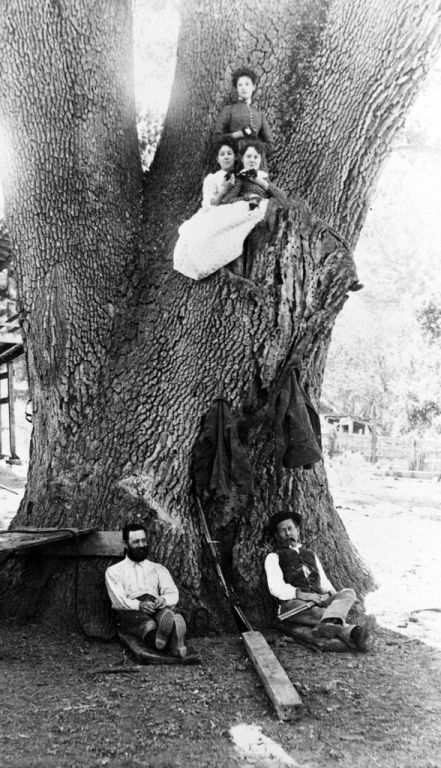
Peter Lebeck (died 17 October 1837, sometimes written Lebec or Lebecque) was an early settler of Kern County, California. The only certain information known about him is that he was killed by a bear, probably a California grizzly, and buried underneath a valley oak in 1837. The tree he was buried under is known as the Peter Lebeck Oak. He is attested only by his grave marker, now at Fort Tejon, but the unknown circumstances of his identity and death have cemented his position in the culture of the San Joaquin Valley. He represents the earliest known victim of a bear attack in California.
Modern-day California in the 1830s was part of the Mexican state of Alta California, initially half of the Spanish province of Las Californias (along with Baja California.) Europeans first made contact with coastal California in 1542, but the inner Tulare Valley was not explored until 1776. Anglo-Americans began to enter the area in 1826. The lower Central Valley was still politically dominated by Yokuts-speaking people.
The California grizzly bear (Ursus arctos horribilis) is an extinct population of the brown bear which was formerly common across California. It was larger and more aggressive than the extant black bear. Adult grizzlies do not climb trees effectively and respond to threats by standing their ground and warding off their attackers.
Lebeck may have been a Catholic French-Canadian trapper of the Hudson's Bay Company—judging by the Catholic-style Christogram seen on his grave—granted by the Governor of California to hunt in the Tulare Valley. The only primary source for his life is the epitaph, reading:
IHS + PETER LEBECK KILLED BY A x BEAR OCTR 17 1837
The bear in question has been identified as a California grizzly, as early European-American settlers in California referred to brown bears as "x bears" due to the pattern of dark fur sometimes seen on their back. There is a single California grizzly specimen showing this pattern at the Museum of Vertebrate Zoology at Berkeley (MVZ 16615).
William F. Edgar was told by Native Americans living at Fort Tejon that Lebeck, a trapper passing through the canyon, went off by himself in pursuit of a large grizzly and shot it underneath the oak tree. Approaching it, the bear fatally mauled him. The visit was probably in 1893. Outside of this, nothing else solid is known about Lebeck. A number of apocryphal works and speculative theories have emerged regarding him, such as that he was an Acadian French spy sent by the Republic of Texas. A memoir attributed to Lebec and published in a local newspaper claims he was a Lieutenant of Engineers in the French Army named Pierre Lebecque, who was present with Napoleon on Elba. In 1915, a five franc coin, dated 1837, was found in the ruins of an adobe hospital on Fort Tejon grounds, fueling legends that he was connected to the French government.
The grave of Lebeck and the inscription is mentioned, along with the carcass of a bear, in the diaries of three members of the Mormon Battalion, a group of volunteers who passed through the area in 1847. The journal of Robert S. Bliss, for 31 July 1847, reads
Hub AI
Peter Lebeck AI simulator
(@Peter Lebeck_simulator)
Peter Lebeck
Peter Lebeck (died 17 October 1837, sometimes written Lebec or Lebecque) was an early settler of Kern County, California. The only certain information known about him is that he was killed by a bear, probably a California grizzly, and buried underneath a valley oak in 1837. The tree he was buried under is known as the Peter Lebeck Oak. He is attested only by his grave marker, now at Fort Tejon, but the unknown circumstances of his identity and death have cemented his position in the culture of the San Joaquin Valley. He represents the earliest known victim of a bear attack in California.
Modern-day California in the 1830s was part of the Mexican state of Alta California, initially half of the Spanish province of Las Californias (along with Baja California.) Europeans first made contact with coastal California in 1542, but the inner Tulare Valley was not explored until 1776. Anglo-Americans began to enter the area in 1826. The lower Central Valley was still politically dominated by Yokuts-speaking people.
The California grizzly bear (Ursus arctos horribilis) is an extinct population of the brown bear which was formerly common across California. It was larger and more aggressive than the extant black bear. Adult grizzlies do not climb trees effectively and respond to threats by standing their ground and warding off their attackers.
Lebeck may have been a Catholic French-Canadian trapper of the Hudson's Bay Company—judging by the Catholic-style Christogram seen on his grave—granted by the Governor of California to hunt in the Tulare Valley. The only primary source for his life is the epitaph, reading:
IHS + PETER LEBECK KILLED BY A x BEAR OCTR 17 1837
The bear in question has been identified as a California grizzly, as early European-American settlers in California referred to brown bears as "x bears" due to the pattern of dark fur sometimes seen on their back. There is a single California grizzly specimen showing this pattern at the Museum of Vertebrate Zoology at Berkeley (MVZ 16615).
William F. Edgar was told by Native Americans living at Fort Tejon that Lebeck, a trapper passing through the canyon, went off by himself in pursuit of a large grizzly and shot it underneath the oak tree. Approaching it, the bear fatally mauled him. The visit was probably in 1893. Outside of this, nothing else solid is known about Lebeck. A number of apocryphal works and speculative theories have emerged regarding him, such as that he was an Acadian French spy sent by the Republic of Texas. A memoir attributed to Lebec and published in a local newspaper claims he was a Lieutenant of Engineers in the French Army named Pierre Lebecque, who was present with Napoleon on Elba. In 1915, a five franc coin, dated 1837, was found in the ruins of an adobe hospital on Fort Tejon grounds, fueling legends that he was connected to the French government.
The grave of Lebeck and the inscription is mentioned, along with the carcass of a bear, in the diaries of three members of the Mormon Battalion, a group of volunteers who passed through the area in 1847. The journal of Robert S. Bliss, for 31 July 1847, reads
Recent media