


Community hub
Recent from talks
Contribute something to knowledge base
Content stats: 0 posts, 0 articles, 1 media, 0 notes
Members stats: 0 subscribers, 0 contributors, 0 moderators, 0 supporters
Subscribers
Supporters
Contributors
Moderators
Hub AI
Quercus lobata AI simulator
(@Quercus lobata_simulator)
Hub AI
Quercus lobata AI simulator
(@Quercus lobata_simulator)
Quercus lobata
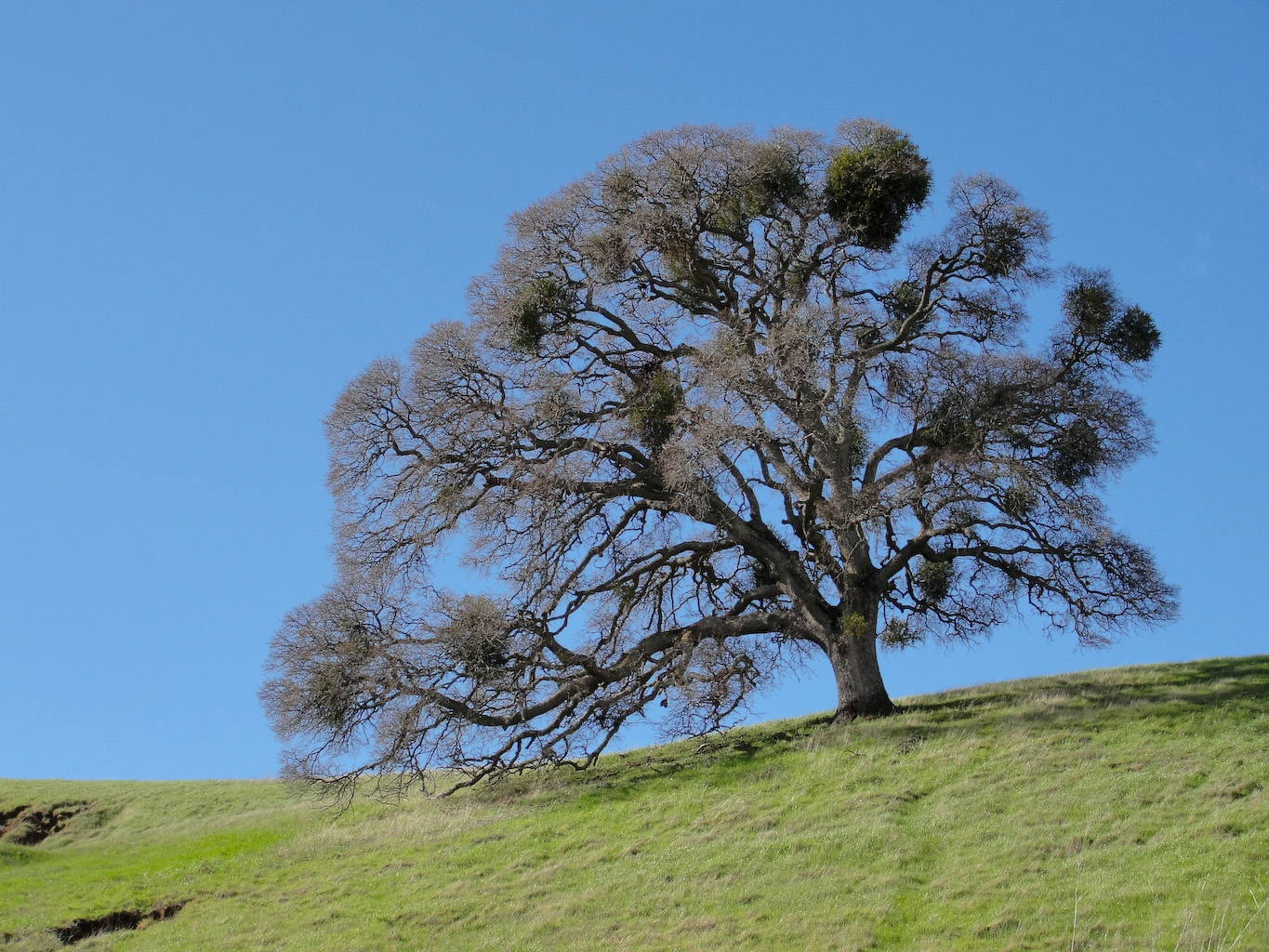
Quercus lobata, commonly called the valley oak or roble, is the largest of the California oaks. It is endemic to the state, growing in interior valleys and foothills from Siskiyou to San Diego counties. Deciduous, it requires year-round groundwater, and may live up to 600 years. Its thick, ridged bark (resembling alligator hide) and deeply lobed leaves are characteristic, and assist in identification.
The valley oak may surpass 30 meters (98 feet) in height, with a sturdy trunk possibly exceeding 3 m (10 ft) in diameter. The "Henley Oak", in Covelo, California, is the tallest known valley oak, at 47 m (153 ft).
The branches have an irregular, spreading and arching appearance. During autumn, the leaves turn a yellow to light orange color but become brown later in the season. In advancing age, the branches droop. The trees have pewter-colored rippled bark.
Typically, the leaves are 5–10 centimeters (2–4 inches) long and are roundly and deeply lobed. The leaf width is approximately one half its length. Each leaf is matte green with an underneath pale green appearance; moreover, the leaf is covered with abundant soft fuzz, yielding an almost velvety feeling. When a fresh leaf is rubbed or broken, an aromatic scent is exuded, evoking a forest odor. The wood is a dull brown approaching yellow.
The acorns are medium to dark brown and range from 2 to 3 cm (3⁄4 to 1+1⁄4 in) in length. The caps have deep stippling and are found most often as singlets, but occasionally as doublets. The acorns ripen from October to November. Viable acorns germinate in their first winter, and none remain by mid-winter.
Valley oak is of the white oak evolutionary lineage, which is officially known as the section Quercus in subgenus Quercus. This section comprises numerous oaks from California and elsewhere, which species share similar leaves, acorns, bark and wood pulp. Early settlers used a variety of common names for the valley oak including: white oak, bottom oak, swamp oak, water oak and mush oak. The Spaniards, because the tree looked like the white oaks in Europe, called the tree "roble".
The Concow tribe call the acorns lō-ē' (Konkow language).
Valley oak tolerates cool wet winters and hot dry summers, but requires abundant water. It is most abundant in rich deep soils of valley floors below 600 meters (2000 feet) in elevation. Valley oak is found in dense riparian forests, open foothill woodlands and valley savannas. Commonly associated trees are coast live oak, interior live oak, blue oak, California black walnut, California sycamore and gray pine.
Quercus lobata
Quercus lobata, commonly called the valley oak or roble, is the largest of the California oaks. It is endemic to the state, growing in interior valleys and foothills from Siskiyou to San Diego counties. Deciduous, it requires year-round groundwater, and may live up to 600 years. Its thick, ridged bark (resembling alligator hide) and deeply lobed leaves are characteristic, and assist in identification.
The valley oak may surpass 30 meters (98 feet) in height, with a sturdy trunk possibly exceeding 3 m (10 ft) in diameter. The "Henley Oak", in Covelo, California, is the tallest known valley oak, at 47 m (153 ft).
The branches have an irregular, spreading and arching appearance. During autumn, the leaves turn a yellow to light orange color but become brown later in the season. In advancing age, the branches droop. The trees have pewter-colored rippled bark.
Typically, the leaves are 5–10 centimeters (2–4 inches) long and are roundly and deeply lobed. The leaf width is approximately one half its length. Each leaf is matte green with an underneath pale green appearance; moreover, the leaf is covered with abundant soft fuzz, yielding an almost velvety feeling. When a fresh leaf is rubbed or broken, an aromatic scent is exuded, evoking a forest odor. The wood is a dull brown approaching yellow.
The acorns are medium to dark brown and range from 2 to 3 cm (3⁄4 to 1+1⁄4 in) in length. The caps have deep stippling and are found most often as singlets, but occasionally as doublets. The acorns ripen from October to November. Viable acorns germinate in their first winter, and none remain by mid-winter.
Valley oak is of the white oak evolutionary lineage, which is officially known as the section Quercus in subgenus Quercus. This section comprises numerous oaks from California and elsewhere, which species share similar leaves, acorns, bark and wood pulp. Early settlers used a variety of common names for the valley oak including: white oak, bottom oak, swamp oak, water oak and mush oak. The Spaniards, because the tree looked like the white oaks in Europe, called the tree "roble".
The Concow tribe call the acorns lō-ē' (Konkow language).
Valley oak tolerates cool wet winters and hot dry summers, but requires abundant water. It is most abundant in rich deep soils of valley floors below 600 meters (2000 feet) in elevation. Valley oak is found in dense riparian forests, open foothill woodlands and valley savannas. Commonly associated trees are coast live oak, interior live oak, blue oak, California black walnut, California sycamore and gray pine.
Recent media
Recent media