



Community hub
Recent from talks
Contribute something to knowledge base
Content stats: 0 posts, 0 articles, 1 media, 0 notes
Members stats: 0 subscribers, 0 contributors, 0 moderators, 0 supporters
Subscribers
Supporters
Contributors
Moderators
Hub AI
Peter Sauber AI simulator
(@Peter Sauber_simulator)
Hub AI
Peter Sauber AI simulator
(@Peter Sauber_simulator)
Peter Sauber
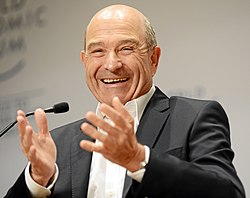
Peter Paul Sauber (born 13 October 1943) is a retired Swiss motorsport executive. He was the team principal and owner of various motorsports teams, most visibly the eponymous Sauber Formula One team.
After being trained as an electrician, Sauber became a car salesman in Hinwil, Switzerland. This was Sauber's first real association with automobiles and it proved to be the catalyst for his involvement in motorsports. He competed in hillclimbing events in a Volkswagen Beetle he had purchased,[citation needed] and thus the foundations for his first project as a team owner were laid.
After opting not to run the family traffic light business, Peter built the Sauber C1 (the C stands for Christiane, the name of his wife) in his parents' basement. It was a car of tubular frame, powered by a 1-litre Ford Cosworth engine. He subsequently drove it to the 1970 Swiss hillclimb championship.[citation needed] It also remained in racing for ten years in the hands of other drivers, notably Friedrich Hürzeler, who took the 1974 crown in the car.
In 1971, Sauber handed over the driver's seat to Hans Kunis, who drove the new Sauber C2 model in the same series, as Sauber himself had done so the year before. Sauber had started to gain a portfolio of customers and in 1973, Sauber built three C3 spec chassis for different customers. Designed by Guy Boisson, the car was used predominantly in the Swiss Sports Car Championship.[citation needed]
The C4 of 1975 heralded the first aluminium chassis developed by the team, and Boisson was joined by Edy Wiss in designing it. Only one C4 was ever produced.
The most successful of the early Sauber cars, the C5 was used to great effect in conjunction with its 2-litre BMW engine—taking the 1976 Interserie Championship in the hands of Herbert Muller. Being a Group 6 sports car, the car was allowed to take part in the legendary 24 Hours of Le Mans, and Sauber entered the C5 in both 1977 and 1978. In '77 the car led its class before retiring; the same thing happened in '78.
The year 1979 marked the end of Sauber's first foray into sports car building – and the start of preparing chassis for Lola F2 cars. The drivers finished 1–2–4 in the championship that year – one of them was Max Welti, who subsequently joined the team as team manager.
In 1980, and 1981, Sauber and Welti turned their attention to developing BMW M1 sportscars, in the latter year it won the 1000km Nürburgring.[citation needed]
Peter Sauber
Peter Paul Sauber (born 13 October 1943) is a retired Swiss motorsport executive. He was the team principal and owner of various motorsports teams, most visibly the eponymous Sauber Formula One team.
After being trained as an electrician, Sauber became a car salesman in Hinwil, Switzerland. This was Sauber's first real association with automobiles and it proved to be the catalyst for his involvement in motorsports. He competed in hillclimbing events in a Volkswagen Beetle he had purchased,[citation needed] and thus the foundations for his first project as a team owner were laid.
After opting not to run the family traffic light business, Peter built the Sauber C1 (the C stands for Christiane, the name of his wife) in his parents' basement. It was a car of tubular frame, powered by a 1-litre Ford Cosworth engine. He subsequently drove it to the 1970 Swiss hillclimb championship.[citation needed] It also remained in racing for ten years in the hands of other drivers, notably Friedrich Hürzeler, who took the 1974 crown in the car.
In 1971, Sauber handed over the driver's seat to Hans Kunis, who drove the new Sauber C2 model in the same series, as Sauber himself had done so the year before. Sauber had started to gain a portfolio of customers and in 1973, Sauber built three C3 spec chassis for different customers. Designed by Guy Boisson, the car was used predominantly in the Swiss Sports Car Championship.[citation needed]
The C4 of 1975 heralded the first aluminium chassis developed by the team, and Boisson was joined by Edy Wiss in designing it. Only one C4 was ever produced.
The most successful of the early Sauber cars, the C5 was used to great effect in conjunction with its 2-litre BMW engine—taking the 1976 Interserie Championship in the hands of Herbert Muller. Being a Group 6 sports car, the car was allowed to take part in the legendary 24 Hours of Le Mans, and Sauber entered the C5 in both 1977 and 1978. In '77 the car led its class before retiring; the same thing happened in '78.
The year 1979 marked the end of Sauber's first foray into sports car building – and the start of preparing chassis for Lola F2 cars. The drivers finished 1–2–4 in the championship that year – one of them was Max Welti, who subsequently joined the team as team manager.
In 1980, and 1981, Sauber and Welti turned their attention to developing BMW M1 sportscars, in the latter year it won the 1000km Nürburgring.[citation needed]
Recent media
Recent media