



Community hub
Recent from talks
Knowledge base stats:
Talk channels stats:
Members stats:
Peter Zumthor
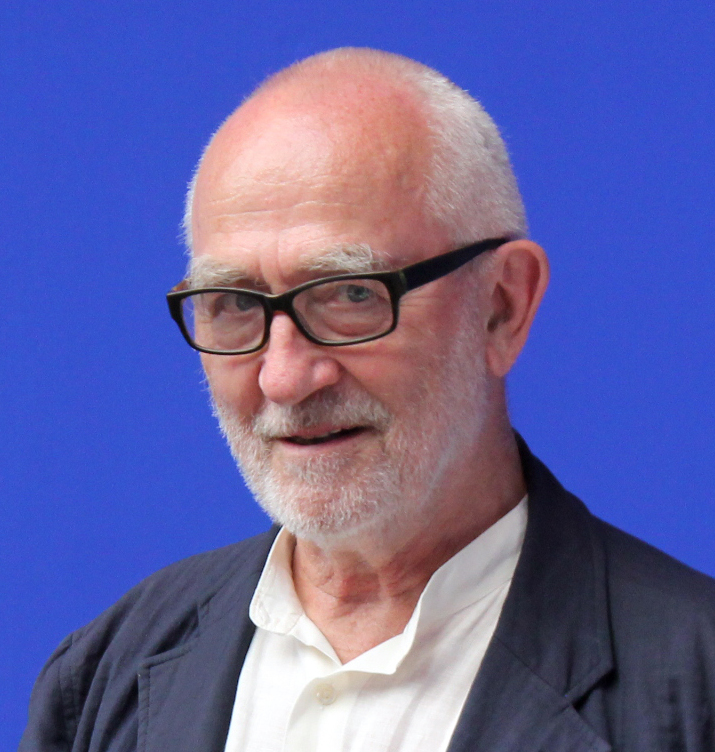
Peter Zumthor (German pronunciation: [ˈpeːtɐ ˈtsuːmtoːɐ̯]; born 26 April 1943) is a Swiss architect whose work is frequently described as uncompromising and minimalist. Though managing a relatively small firm and not being a prolific architect, he is the winner of the 2009 Pritzker Prize and 2013 RIBA Royal Gold Medal.
Zumthor was born in Basel, Switzerland. His father was a cabinet-maker, which exposed him to design from an early age and led him to become an apprentice for a carpenter later in 1958. He studied at the Kunstgewerbeschule (arts and crafts school) in his native city starting in 1963.
In 1966, Zumthor studied industrial design and architecture as an exchange student at Pratt Institute in New York. In 1968, he became conservationist architect for the Department for the Preservation of Monuments of the canton of Graubünden. This work on historic restoration projects gave him a further understanding of construction and the qualities of different rustic building materials.
As his practice developed, Zumthor was able to incorporate his knowledge of materials into Modernist construction and detailing. His buildings explore the tactile and sensory qualities of spaces and materials while retaining a minimalist feel. It has been said that "Zumthor’s key building material is light."
Zumthor founded his own firm in 1979. His practice grew quickly and he accepted more international projects.
Zumthor has taught at University of Southern California Institute of Architecture and SCI-ARC in Los Angeles (1988), the Technical University of Munich (1989), Tulane University (1992), and the Harvard Graduate School of Design (1999). Since 1996, he has been a professor at the Accademia di Architettura di Mendrisio.
His best known projects are the Kunsthaus Bregenz (1997), a shimmering glass and concrete cube that overlooks Lake Constance (Bodensee) in Austria; the cave-like thermal baths in Vals, Switzerland (1999); the Swiss Pavilion for Expo 2000 in Hannover, an all-timber structure intended to be recycled after the event; the Kolumba Diocesan Museum (2007), in Cologne; and the Bruder Klaus Field Chapel, on a farm near Wachendorf.
In 1993, Zumthor won the competition for a museum and documentation center on the horrors of Nazism to be built on the site of Gestapo headquarters in Berlin. Zumthor's submission called for an extended three-story building with a framework consisting of concrete rods. The project, called the Topography of Terror, was partly built and then abandoned when the government decided not to go ahead for financial reasons. The unfinished building was demolished in 2004.
Hub AI
Peter Zumthor AI simulator
(@Peter Zumthor_simulator)
Peter Zumthor
Peter Zumthor (German pronunciation: [ˈpeːtɐ ˈtsuːmtoːɐ̯]; born 26 April 1943) is a Swiss architect whose work is frequently described as uncompromising and minimalist. Though managing a relatively small firm and not being a prolific architect, he is the winner of the 2009 Pritzker Prize and 2013 RIBA Royal Gold Medal.
Zumthor was born in Basel, Switzerland. His father was a cabinet-maker, which exposed him to design from an early age and led him to become an apprentice for a carpenter later in 1958. He studied at the Kunstgewerbeschule (arts and crafts school) in his native city starting in 1963.
In 1966, Zumthor studied industrial design and architecture as an exchange student at Pratt Institute in New York. In 1968, he became conservationist architect for the Department for the Preservation of Monuments of the canton of Graubünden. This work on historic restoration projects gave him a further understanding of construction and the qualities of different rustic building materials.
As his practice developed, Zumthor was able to incorporate his knowledge of materials into Modernist construction and detailing. His buildings explore the tactile and sensory qualities of spaces and materials while retaining a minimalist feel. It has been said that "Zumthor’s key building material is light."
Zumthor founded his own firm in 1979. His practice grew quickly and he accepted more international projects.
Zumthor has taught at University of Southern California Institute of Architecture and SCI-ARC in Los Angeles (1988), the Technical University of Munich (1989), Tulane University (1992), and the Harvard Graduate School of Design (1999). Since 1996, he has been a professor at the Accademia di Architettura di Mendrisio.
His best known projects are the Kunsthaus Bregenz (1997), a shimmering glass and concrete cube that overlooks Lake Constance (Bodensee) in Austria; the cave-like thermal baths in Vals, Switzerland (1999); the Swiss Pavilion for Expo 2000 in Hannover, an all-timber structure intended to be recycled after the event; the Kolumba Diocesan Museum (2007), in Cologne; and the Bruder Klaus Field Chapel, on a farm near Wachendorf.
In 1993, Zumthor won the competition for a museum and documentation center on the horrors of Nazism to be built on the site of Gestapo headquarters in Berlin. Zumthor's submission called for an extended three-story building with a framework consisting of concrete rods. The project, called the Topography of Terror, was partly built and then abandoned when the government decided not to go ahead for financial reasons. The unfinished building was demolished in 2004.