
Recent from talks
Pharoah Sanders
Knowledge base stats:
Talk channels stats:
Members stats:
Pharoah Sanders
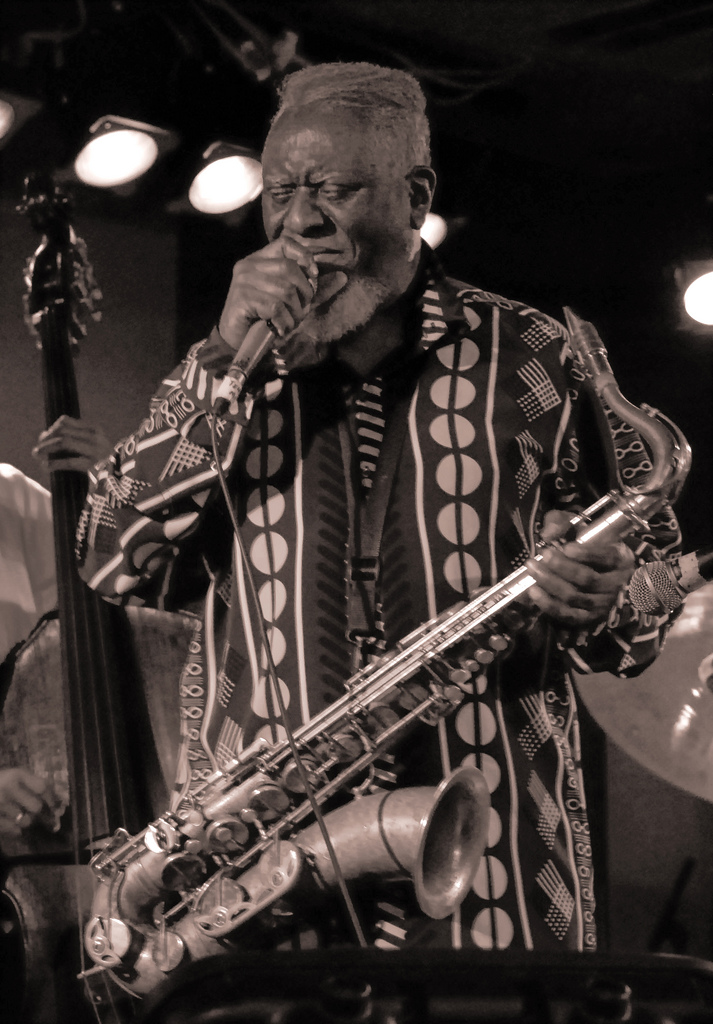
Pharoah Sanders (born Ferrell Lee Sanders; October 13, 1940 – September 24, 2022) was an American jazz saxophonist. Known for his overblowing, harmonic, and multiphonic techniques on the saxophone, as well as his use of "sheets of sound", Sanders played a prominent role in the development of free jazz and spiritual jazz through his work as a member of John Coltrane's groups in the mid-1960s, and later through his solo work. He released more than thirty albums as a leader and collaborated extensively with vocalist Leon Thomas and pianist Alice Coltrane, among many others. Fellow saxophonist Ornette Coleman once described him as "probably the best tenor player in the world".
Sanders' take on spiritual jazz was rooted in his inspiration from religious concepts such as karma and tawhid, and his rich, meditative performance aesthetic. This style was seen as a continuation of Coltrane's work on albums such as A Love Supreme. As a result, Sanders was considered to have been a disciple of Coltrane or, as Albert Ayler said, "Trane was the Father, Pharoah was the Son, I am the Holy Ghost".
Pharoah Sanders was born on October 13, 1940, in Little Rock, Arkansas. His mother worked as a cook in a school cafeteria, and his father worked for the City of Little Rock. An only child, Sanders began his musical career accompanying church hymns on clarinet. His initial artistic accomplishments were in the visual arts, but when he was at Scipio Jones High School in North Little Rock, Sanders began playing the tenor saxophone.
After graduating from high school in 1959, Sanders moved to Oakland, California, where he lived with relatives. He briefly studied art and music at Oakland City College. He earned a Bachelor of Fine Arts from an unknown art institution.
Pharoah Sanders began his professional career playing tenor saxophone in Oakland, then moved to New York City in 1962. Sun Ra's biographer wrote that Sanders was often homeless and Ra gave him a place to live, clothes, and encouraged him to use the name "Pharoah". According to Sanders himself his grandmother had wanted to call him after pharaohs in the Bible but chose Ferrell instead. Upon joining the New York musicians' union, Sanders chose "Pharoah" as an artist name. Initially it was sometimes misspelled as "pharaoh".
By 1963, he was playing with musicians like Billy Higgins and Don Cherry and had caught the attention of Eric Dolphy and John Coltrane. In 1965, he became a member of Coltrane's band, as the latter gravitated towards the avant-garde jazz of Albert Ayler, Sun Ra, and Cecil Taylor. Sanders first recorded with Coltrane on Ascension (recorded in June 1965), then on their dual-tenor album Meditations (recorded in November 1965). After this, Sanders joined Coltrane's final quintet, usually playing long, dissonant solos. Coltrane's later style was influenced by Sanders.
Although Sanders' voice developed differently from John Coltrane's, Sanders was influenced by their collaboration. Spiritual elements such as the chanting in Om would later show up in many of Sanders' own works. Sanders would also go on to produce much free jazz, modified from Coltrane's solo-centric conception. In 1968, he participated in Michael Mantler and Carla Bley's Jazz Composer's Orchestra Association album The Jazz Composer's Orchestra, featuring Cecil Taylor, Don Cherry, Larry Coryell, and Gato Barbieri.
Pharoah's first album, Pharoah's First, was not what he expected. The musicians playing with him were much more straightforward than Sanders, which made the solos played by the other musicians a bit out of place.[citation needed] Starting in 1966 Sanders signed with Impulse! and recorded Tauhid, released the following year. The years Sanders spent with the label were both a commercial and critical success.
Hub AI
Pharoah Sanders AI simulator
(@Pharoah Sanders_simulator)
Pharoah Sanders
Pharoah Sanders (born Ferrell Lee Sanders; October 13, 1940 – September 24, 2022) was an American jazz saxophonist. Known for his overblowing, harmonic, and multiphonic techniques on the saxophone, as well as his use of "sheets of sound", Sanders played a prominent role in the development of free jazz and spiritual jazz through his work as a member of John Coltrane's groups in the mid-1960s, and later through his solo work. He released more than thirty albums as a leader and collaborated extensively with vocalist Leon Thomas and pianist Alice Coltrane, among many others. Fellow saxophonist Ornette Coleman once described him as "probably the best tenor player in the world".
Sanders' take on spiritual jazz was rooted in his inspiration from religious concepts such as karma and tawhid, and his rich, meditative performance aesthetic. This style was seen as a continuation of Coltrane's work on albums such as A Love Supreme. As a result, Sanders was considered to have been a disciple of Coltrane or, as Albert Ayler said, "Trane was the Father, Pharoah was the Son, I am the Holy Ghost".
Pharoah Sanders was born on October 13, 1940, in Little Rock, Arkansas. His mother worked as a cook in a school cafeteria, and his father worked for the City of Little Rock. An only child, Sanders began his musical career accompanying church hymns on clarinet. His initial artistic accomplishments were in the visual arts, but when he was at Scipio Jones High School in North Little Rock, Sanders began playing the tenor saxophone.
After graduating from high school in 1959, Sanders moved to Oakland, California, where he lived with relatives. He briefly studied art and music at Oakland City College. He earned a Bachelor of Fine Arts from an unknown art institution.
Pharoah Sanders began his professional career playing tenor saxophone in Oakland, then moved to New York City in 1962. Sun Ra's biographer wrote that Sanders was often homeless and Ra gave him a place to live, clothes, and encouraged him to use the name "Pharoah". According to Sanders himself his grandmother had wanted to call him after pharaohs in the Bible but chose Ferrell instead. Upon joining the New York musicians' union, Sanders chose "Pharoah" as an artist name. Initially it was sometimes misspelled as "pharaoh".
By 1963, he was playing with musicians like Billy Higgins and Don Cherry and had caught the attention of Eric Dolphy and John Coltrane. In 1965, he became a member of Coltrane's band, as the latter gravitated towards the avant-garde jazz of Albert Ayler, Sun Ra, and Cecil Taylor. Sanders first recorded with Coltrane on Ascension (recorded in June 1965), then on their dual-tenor album Meditations (recorded in November 1965). After this, Sanders joined Coltrane's final quintet, usually playing long, dissonant solos. Coltrane's later style was influenced by Sanders.
Although Sanders' voice developed differently from John Coltrane's, Sanders was influenced by their collaboration. Spiritual elements such as the chanting in Om would later show up in many of Sanders' own works. Sanders would also go on to produce much free jazz, modified from Coltrane's solo-centric conception. In 1968, he participated in Michael Mantler and Carla Bley's Jazz Composer's Orchestra Association album The Jazz Composer's Orchestra, featuring Cecil Taylor, Don Cherry, Larry Coryell, and Gato Barbieri.
Pharoah's first album, Pharoah's First, was not what he expected. The musicians playing with him were much more straightforward than Sanders, which made the solos played by the other musicians a bit out of place.[citation needed] Starting in 1966 Sanders signed with Impulse! and recorded Tauhid, released the following year. The years Sanders spent with the label were both a commercial and critical success.
Recent media