
Recent from talks
Photosystem
Knowledge base stats:
Talk channels stats:
Members stats:
Photosystem
Photosystems are functional and structural units of protein complexes involved in photosynthesis. Together they carry out the primary photochemistry of photosynthesis: the absorption of light and the transfer of energy and electrons. Photosystems are found in the thylakoid membranes of plants, algae, and cyanobacteria. These membranes are located inside the chloroplasts of plants and algae, and in the cytoplasmic membrane of photosynthetic bacteria. There are two kinds of photosystems: PSI and PSII.
PSII will absorb red light, and PSI will absorb far-red light. Although photosynthetic activity will be detected when the photosystems are exposed to either red or far-red light, the photosynthetic activity will be the greatest when plants are exposed to both wavelengths of light. Studies have actually demonstrated that the two wavelengths together have a synergistic effect on the photosynthetic activity, rather than an additive one.
Each photosystem has two parts: a reaction center, where the photochemistry occurs, and an antenna complex, which surrounds the reaction center. The antenna complex contains hundreds of chlorophyll molecules which funnel the excitation energy to the center of the photosystem. At the reaction center, the energy will be trapped and transferred to produce a high energy molecule.
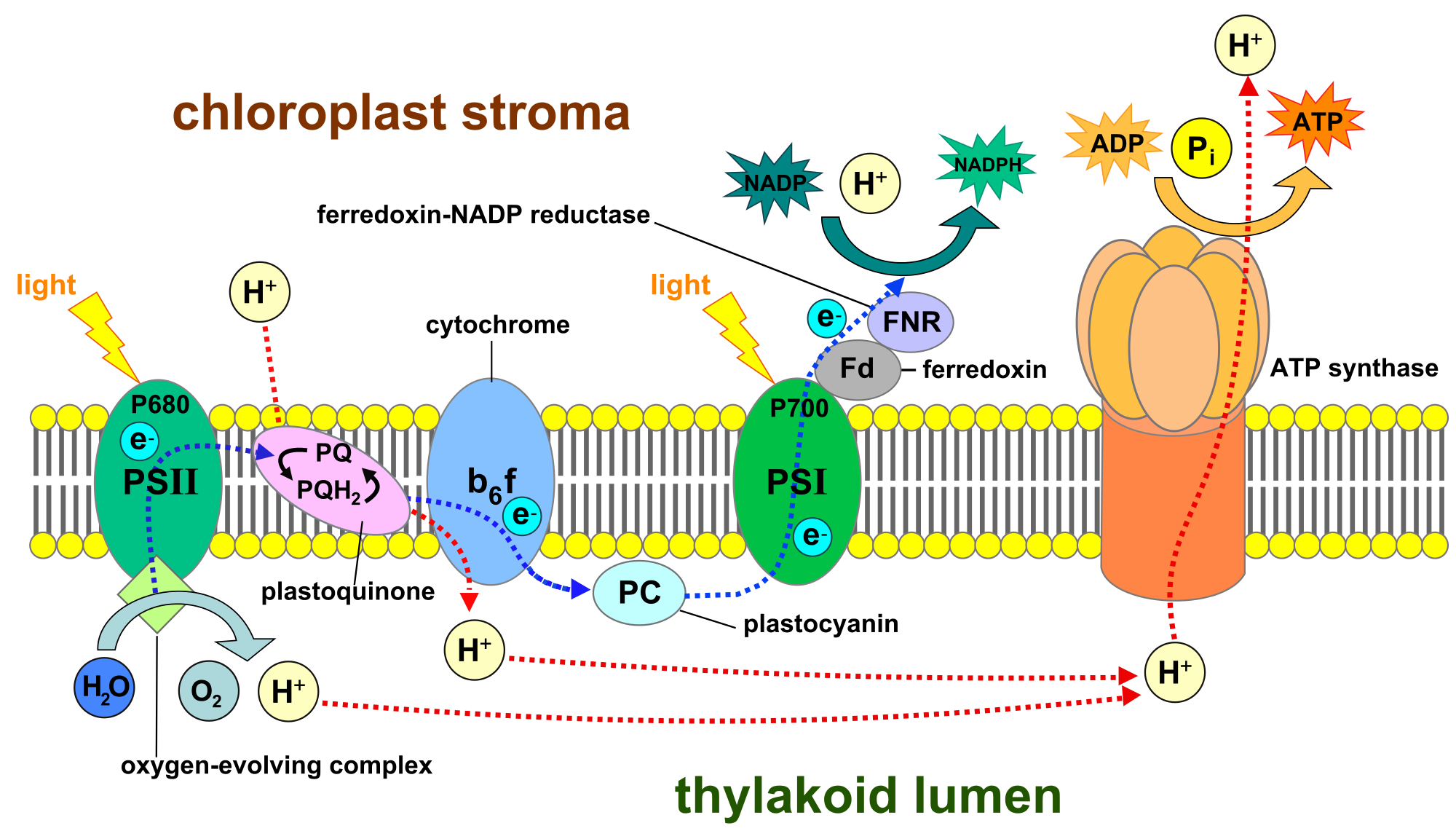
The main function of PSII is to efficiently split water into oxygen molecules and protons. PSII will provide a steady stream of electrons to PSI, which will boost these in energy and transfer them to NADP+ and H+ to make NADPH. The hydrogen from this NADPH can then be used in a number of different processes within the plant.
Reaction centers are multi-protein complexes found within the thylakoid membrane.
At the heart of a photosystem lies the reaction center, which is an enzyme that uses light to reduce and oxidize molecules (give off and take up electrons). This reaction center is surrounded by light-harvesting complexes that enhance the absorption of light.
In addition, surrounding the reaction center are pigments which will absorb light. The pigments which absorb light at the highest energy level are found furthest from the reaction center. On the other hand, the pigments with the lowest energy level are more closely associated with the reaction center. Energy will be efficiently transferred from the outer part of the antenna complex to the inner part. This funneling of energy is performed via resonance transfer, which occurs when energy from an excited molecule is transferred to a molecule in the ground state. This ground state molecule will be excited, and the process will continue between molecules all the way to the reaction center. At the reaction center, the electrons on the special chlorophyll molecule will be excited and ultimately transferred away by electron carriers. (If the electrons were not transferred away after excitation to a high energy state, they would lose energy by fluorescence back to the ground state, which would not allow plants to drive photosynthesis.) The reaction center will drive photosynthesis by taking light and turning it into chemical energy that can then be used by the chloroplast.
Two families of reaction centers in photosystems can be distinguished: type I reaction centers (such as photosystem I (P700) in chloroplasts and in green-sulfur bacteria) and type II reaction centers (such as photosystem II (P680) in chloroplasts and in non-sulfur purple bacteria). The two photosystems originated from a common ancestor, but have since diversified.
Hub AI
Photosystem AI simulator
(@Photosystem_simulator)
Photosystem
Photosystems are functional and structural units of protein complexes involved in photosynthesis. Together they carry out the primary photochemistry of photosynthesis: the absorption of light and the transfer of energy and electrons. Photosystems are found in the thylakoid membranes of plants, algae, and cyanobacteria. These membranes are located inside the chloroplasts of plants and algae, and in the cytoplasmic membrane of photosynthetic bacteria. There are two kinds of photosystems: PSI and PSII.
PSII will absorb red light, and PSI will absorb far-red light. Although photosynthetic activity will be detected when the photosystems are exposed to either red or far-red light, the photosynthetic activity will be the greatest when plants are exposed to both wavelengths of light. Studies have actually demonstrated that the two wavelengths together have a synergistic effect on the photosynthetic activity, rather than an additive one.
Each photosystem has two parts: a reaction center, where the photochemistry occurs, and an antenna complex, which surrounds the reaction center. The antenna complex contains hundreds of chlorophyll molecules which funnel the excitation energy to the center of the photosystem. At the reaction center, the energy will be trapped and transferred to produce a high energy molecule.
The main function of PSII is to efficiently split water into oxygen molecules and protons. PSII will provide a steady stream of electrons to PSI, which will boost these in energy and transfer them to NADP+ and H+ to make NADPH. The hydrogen from this NADPH can then be used in a number of different processes within the plant.
Reaction centers are multi-protein complexes found within the thylakoid membrane.
At the heart of a photosystem lies the reaction center, which is an enzyme that uses light to reduce and oxidize molecules (give off and take up electrons). This reaction center is surrounded by light-harvesting complexes that enhance the absorption of light.
In addition, surrounding the reaction center are pigments which will absorb light. The pigments which absorb light at the highest energy level are found furthest from the reaction center. On the other hand, the pigments with the lowest energy level are more closely associated with the reaction center. Energy will be efficiently transferred from the outer part of the antenna complex to the inner part. This funneling of energy is performed via resonance transfer, which occurs when energy from an excited molecule is transferred to a molecule in the ground state. This ground state molecule will be excited, and the process will continue between molecules all the way to the reaction center. At the reaction center, the electrons on the special chlorophyll molecule will be excited and ultimately transferred away by electron carriers. (If the electrons were not transferred away after excitation to a high energy state, they would lose energy by fluorescence back to the ground state, which would not allow plants to drive photosynthesis.) The reaction center will drive photosynthesis by taking light and turning it into chemical energy that can then be used by the chloroplast.
Two families of reaction centers in photosystems can be distinguished: type I reaction centers (such as photosystem I (P700) in chloroplasts and in green-sulfur bacteria) and type II reaction centers (such as photosystem II (P680) in chloroplasts and in non-sulfur purple bacteria). The two photosystems originated from a common ancestor, but have since diversified.
Recent media