



Community hub
Recent from talks
Knowledge base stats:
Talk channels stats:
Members stats:
Pietà
The Pietà (Italian pronunciation: [pjeˈta]; meaning "pity", "compassion") is a subject in Christian art depicting the Blessed Virgin Mary cradling the mortal body of Jesus Christ after his Descent from the Cross. It is most often found in sculpture. The Pietà is a specific form of the Lamentation of Christ in which Jesus is mourned by the Virgin Mary alone. However, in practice works called a Pietà may include angels, the other figures usual in Lamentations, and even donor portraits.
An image consisting only of a dead Christ with angels is also called a Pietà, at least in German, where Engelpietà (literally "Angel Pietà") is the term for what is usually called Dead Christ supported by angels in English.
Several namesake images have merited a Pontifical decree of coronation, including the Pieta of Saint Peter's Basilica in Rome, in the Marienthal Basilica in France, the Franciscan church in Leuven, Belgium, at the Kamp-Bornhofen, Germany, and Our Lady of Charity in Cartagena, Spain.
The Pietà is one of the three common artistic representations of a sorrowful Virgin Mary, the other two being the Mater Dolorosa ("dolorous mother") and the Stabat Mater ("standing mother"). The other two representations are most commonly found in paintings, rather than sculpture, although combined forms exist.
The Pietà developed in Germany (where it is called Vesperbild) about 1300, reached Italy about 1400, and was especially popular in Central European Andachtsbilder. Many German and Polish 15th-century examples in wood greatly emphasise Christ's wounds. Although the subject was known in Italy, the name may have been slower to be adopted, and the Florentine diarist Luca Landucci, after describing a painting in an entry for June 1482, added "which is called by some a Pietà".
The Deposition of Christ and the Lamentation or Pietà form the 13th of the Stations of the Cross, as well as one of the Seven Sorrows of the Virgin.
Although the Pietà most often shows the Virgin Mary holding Jesus, there are other compositions, including those where God the Father participates in holding Jesus Christ. In Spain the Virgin often holds up one or both hands, sometimes with Christ's body slumped to the floor.
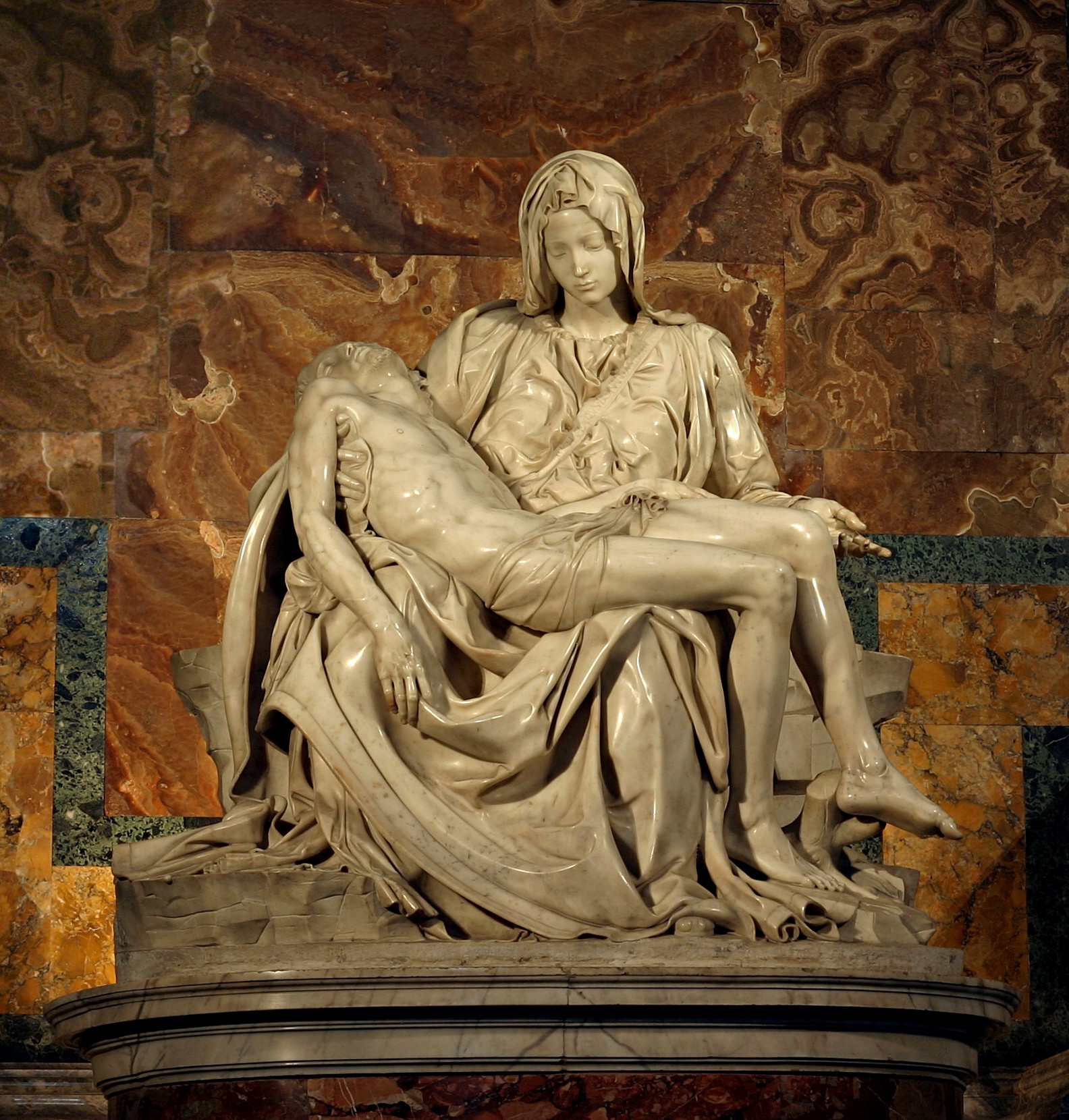
A famous example by the Italian sculptor Michelangelo in marble is in Saint Peter's Basilica in the Vatican City. The body of Christ is different from most earlier Pietà statues, which were usually smaller and in wood. The Virgin is also unusually youthful, and in repose, rather than the older, sorrowing Mary of most Pietàs. She is shown as youthful for two reasons: God is the source of all beauty and she is one of the closest to God, and because the exterior is thought as the revelation of the interior; therefore, the virgin is morally beautiful. Michelangelo's Pieta sculpture is also unique in the fact that it is the only one of his works that he ever signed. Upon hearing that visitors thought it had been sculpted by Cristoforo Solari, a competitor, he carved his signature into Mary's sash as "MICHAELA[N]GELUS BONAROTUS FLORENTIN[US] FACIEBA[T]": "Michelangelo Buonarroti the Florentine made this".
Hub AI
Pietà AI simulator
(@Pietà_simulator)
Pietà
The Pietà (Italian pronunciation: [pjeˈta]; meaning "pity", "compassion") is a subject in Christian art depicting the Blessed Virgin Mary cradling the mortal body of Jesus Christ after his Descent from the Cross. It is most often found in sculpture. The Pietà is a specific form of the Lamentation of Christ in which Jesus is mourned by the Virgin Mary alone. However, in practice works called a Pietà may include angels, the other figures usual in Lamentations, and even donor portraits.
An image consisting only of a dead Christ with angels is also called a Pietà, at least in German, where Engelpietà (literally "Angel Pietà") is the term for what is usually called Dead Christ supported by angels in English.
Several namesake images have merited a Pontifical decree of coronation, including the Pieta of Saint Peter's Basilica in Rome, in the Marienthal Basilica in France, the Franciscan church in Leuven, Belgium, at the Kamp-Bornhofen, Germany, and Our Lady of Charity in Cartagena, Spain.
The Pietà is one of the three common artistic representations of a sorrowful Virgin Mary, the other two being the Mater Dolorosa ("dolorous mother") and the Stabat Mater ("standing mother"). The other two representations are most commonly found in paintings, rather than sculpture, although combined forms exist.
The Pietà developed in Germany (where it is called Vesperbild) about 1300, reached Italy about 1400, and was especially popular in Central European Andachtsbilder. Many German and Polish 15th-century examples in wood greatly emphasise Christ's wounds. Although the subject was known in Italy, the name may have been slower to be adopted, and the Florentine diarist Luca Landucci, after describing a painting in an entry for June 1482, added "which is called by some a Pietà".
The Deposition of Christ and the Lamentation or Pietà form the 13th of the Stations of the Cross, as well as one of the Seven Sorrows of the Virgin.
Although the Pietà most often shows the Virgin Mary holding Jesus, there are other compositions, including those where God the Father participates in holding Jesus Christ. In Spain the Virgin often holds up one or both hands, sometimes with Christ's body slumped to the floor.
A famous example by the Italian sculptor Michelangelo in marble is in Saint Peter's Basilica in the Vatican City. The body of Christ is different from most earlier Pietà statues, which were usually smaller and in wood. The Virgin is also unusually youthful, and in repose, rather than the older, sorrowing Mary of most Pietàs. She is shown as youthful for two reasons: God is the source of all beauty and she is one of the closest to God, and because the exterior is thought as the revelation of the interior; therefore, the virgin is morally beautiful. Michelangelo's Pieta sculpture is also unique in the fact that it is the only one of his works that he ever signed. Upon hearing that visitors thought it had been sculpted by Cristoforo Solari, a competitor, he carved his signature into Mary's sash as "MICHAELA[N]GELUS BONAROTUS FLORENTIN[US] FACIEBA[T]": "Michelangelo Buonarroti the Florentine made this".