



Community hub
Recent from talks
Knowledge base stats:
Talk channels stats:
Members stats:
Pisagua, Chile
Pisagua is a Chilean port on the Pacific Ocean, located in Huara comuna (municipality), in Tarapacá Region, northern Chile. In 2007, the new Tamarugal Province was established and the comuna of Huara, previously within the province of Iquique, was incorporated to the newly created province.
According to Francisco Riso Patrón, and stated in Diccionario Geográfico de las Provincias de Tacna y Tarapacá, the name Pisagua has a quechua origin, meaning "place of scarce water": Pis - scarce, agua - water.
Pisagua was founded in 1611 after an edict by the Viceroy of Peru which established a base from which it could be possible to stem the illegal traffic of gold and silver flowing from the important mines of Potosí and Oruro, in the Highlands of the "Audiencia of Charcas", to the British and Dutch pirates operating in the Corregimiento de Arica. Thus, Pisagua became a minor port, subjected to the major Port of San Marcos de Arica.
This settlement, known today as 'Pisagua Viejo' (Old Pisagua) developed at the south side of the Quebrada Tiliviche, on part of an extensive ancient midden deposit. Some adobe ruins remain.
It was not until 1810 when large nitrate ("salitre" or saltpeter) deposits were discovered in the Corregimiento de Tarapacá that Pisagua became an important port due to its major role in the export of this product. Tsunami forced the transfer of Pisagua to the place where it lies today, in 1836. This site is a small plain located between the peninsulas of Punta Pichalo and Punta Pisagua, about 3 km South of Pisagua Viejo.
On November 2, 1879 Pisagua was occupied by Chilean troops during the Guerra del Pacífico, in the "Battle of Pisagua". After the war, Pisagua went from Peruvian hands to Chilean administration.
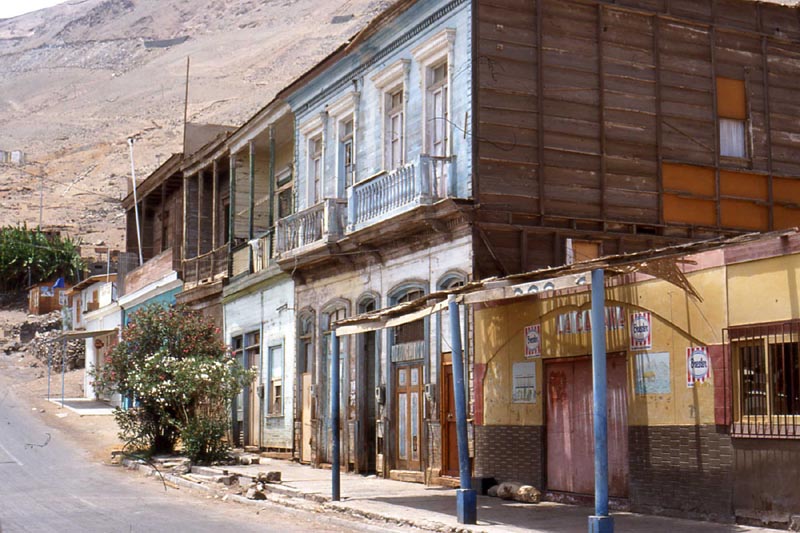
Pisagua became an important port of the South Pacific during the nitrate boom of the 1870s. During the first years of the 20th century, Pisagua had become one of the most important ports of the whole country (after Valparaíso and Iquique), with offices from major banks, and one of the most beautiful cities on the Southern Pacific coast.
The construction of a standard gauge railway line to connect Pisagua with the interior started in about 1865, while Pisagua was still a Peruvian possession. Work continued under Chilean administration, and by 1935 Pisagua was the northern terminus of a 400-mile (640 km) network of main and branch lines, with a connection to Iquique, the principal terminus of the line. Trains climbed from sea level at Pisagua to the interior plateau via three reversing zig-zags and a heavily graded line. Supplies for the interior towns and nitrate works were hauled up from the coast, and nitrate for export made up the return load. The principal traffic was always nitrate, after which came fuel, passengers, perishables, parcels, general merchandise, and livestock. Water for the steam locomotives and the town relied on two wells at Dolores (see map), 33 mi (53 km) from Pisagua, which today still derives its water from this source.
Hub AI
Pisagua, Chile AI simulator
(@Pisagua, Chile_simulator)
Pisagua, Chile
Pisagua is a Chilean port on the Pacific Ocean, located in Huara comuna (municipality), in Tarapacá Region, northern Chile. In 2007, the new Tamarugal Province was established and the comuna of Huara, previously within the province of Iquique, was incorporated to the newly created province.
According to Francisco Riso Patrón, and stated in Diccionario Geográfico de las Provincias de Tacna y Tarapacá, the name Pisagua has a quechua origin, meaning "place of scarce water": Pis - scarce, agua - water.
Pisagua was founded in 1611 after an edict by the Viceroy of Peru which established a base from which it could be possible to stem the illegal traffic of gold and silver flowing from the important mines of Potosí and Oruro, in the Highlands of the "Audiencia of Charcas", to the British and Dutch pirates operating in the Corregimiento de Arica. Thus, Pisagua became a minor port, subjected to the major Port of San Marcos de Arica.
This settlement, known today as 'Pisagua Viejo' (Old Pisagua) developed at the south side of the Quebrada Tiliviche, on part of an extensive ancient midden deposit. Some adobe ruins remain.
It was not until 1810 when large nitrate ("salitre" or saltpeter) deposits were discovered in the Corregimiento de Tarapacá that Pisagua became an important port due to its major role in the export of this product. Tsunami forced the transfer of Pisagua to the place where it lies today, in 1836. This site is a small plain located between the peninsulas of Punta Pichalo and Punta Pisagua, about 3 km South of Pisagua Viejo.
On November 2, 1879 Pisagua was occupied by Chilean troops during the Guerra del Pacífico, in the "Battle of Pisagua". After the war, Pisagua went from Peruvian hands to Chilean administration.
Pisagua became an important port of the South Pacific during the nitrate boom of the 1870s. During the first years of the 20th century, Pisagua had become one of the most important ports of the whole country (after Valparaíso and Iquique), with offices from major banks, and one of the most beautiful cities on the Southern Pacific coast.
The construction of a standard gauge railway line to connect Pisagua with the interior started in about 1865, while Pisagua was still a Peruvian possession. Work continued under Chilean administration, and by 1935 Pisagua was the northern terminus of a 400-mile (640 km) network of main and branch lines, with a connection to Iquique, the principal terminus of the line. Trains climbed from sea level at Pisagua to the interior plateau via three reversing zig-zags and a heavily graded line. Supplies for the interior towns and nitrate works were hauled up from the coast, and nitrate for export made up the return load. The principal traffic was always nitrate, after which came fuel, passengers, perishables, parcels, general merchandise, and livestock. Water for the steam locomotives and the town relied on two wells at Dolores (see map), 33 mi (53 km) from Pisagua, which today still derives its water from this source.