



Community hub
Recent from talks
Contribute something to knowledge base
Content stats: 0 posts, 0 articles, 1 media, 0 notes
Members stats: 0 subscribers, 0 contributors, 0 moderators, 0 supporters
Subscribers
Supporters
Contributors
Moderators
Hub AI
Pittock Mansion AI simulator
(@Pittock Mansion_simulator)
Hub AI
Pittock Mansion AI simulator
(@Pittock Mansion_simulator)
Pittock Mansion
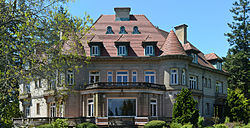
The Pittock Mansion is a French Renaissance-style château in the West Hills of Portland, Oregon, United States. It was built in 1914 as a private home for London-born Oregonian publisher Henry Pittock and his wife, Georgiana Burton Pittock. It is a 46-room estate built of Tenino sandstone situated on 46 acres (19 ha) that is now owned by the city's Bureau of Parks and Recreation and open for touring.
Modeled after Beaux Arts and French Renaissance architecture, the mansion is situated on an expanse in the West Hills that provides panoramic views of Downtown Portland. It was added to the National Register of Historic Places in 1974.
Pittock Mansion was constructed in 1909 by London-born publisher and business tycoon Henry Pittock as a private residence for himself and his wife, Georgiana. The house was designed by San Francisco architect Edward T. Foulkes. Construction began in 1909, though the house was not completed until 1914. Upon completion, the home featured such luxuries as a central vacuum system, intercoms, indirect lighting, an elevator, and a walk-in refrigerator. The interiors of the mansion were modeled on an eclectic collection of styles, including Jacobean, (the library) craftsman, (the dining room) Turkish, (the smoking room) and French Renaissance (the music room).
Georgiana Pittock was an avid gardener who was a founding member of the Portland Rose Society, hosted the first Portland Rose Show in 1889, and helped launch the Portland Rose Festival. Pittock Mansion is surrounded by formal gardens that reflect her passion for gardening. The lawn is hedged by heritage roses as a tribute to Georgiana's work.
The home was at the center of a political scandal in 1911 when a Portland City Council member, Will H. Daly, brought public attention to Pittock having arranged for a water line to the construction project entirely at city expense, despite it being located a half mile outside of the city limits at the time. The incident contributed to a longstanding feud between Pittock's paper and Daly which ultimately led to the end of the councilman's political career.
Georgiana died in 1918 at the age of 72, and Henry in 1919 at 84. The Pittock family remained in residence at the mansion until 1958 when Eric Ladd, who had stayed in the mansion for four years, and Peter Gantenbein, a Pittock grandson who had been born in the house, put the estate on the market and were unsuccessful in selling it. Extensive damage caused by the Columbus Day Storm in 1962 caused the owners to consider demolishing the building. The community raised $75,000 in three months in order to help the city purchase the property. Seeing this popular support, and agreeing that the house had tremendous value as a unique historic resource, the City of Portland purchased the estate in 1964 for $225,000.
Fifteen months were spent restoring the building. It opened to the public in 1965 and has been a community landmark ever since.[citation needed] Roughly 80,000 people visit the Pittock Mansion each year. Due to the location of the site 1,000 feet (300 m) above sea level, the mansion is one of the best places for birdwatching in Portland. The building was added to the National Register of Historic Places in 1974.
In 2006, the City of Portland estimated that $6–8 million worth of restorations were needed for the mansion.
Pittock Mansion
The Pittock Mansion is a French Renaissance-style château in the West Hills of Portland, Oregon, United States. It was built in 1914 as a private home for London-born Oregonian publisher Henry Pittock and his wife, Georgiana Burton Pittock. It is a 46-room estate built of Tenino sandstone situated on 46 acres (19 ha) that is now owned by the city's Bureau of Parks and Recreation and open for touring.
Modeled after Beaux Arts and French Renaissance architecture, the mansion is situated on an expanse in the West Hills that provides panoramic views of Downtown Portland. It was added to the National Register of Historic Places in 1974.
Pittock Mansion was constructed in 1909 by London-born publisher and business tycoon Henry Pittock as a private residence for himself and his wife, Georgiana. The house was designed by San Francisco architect Edward T. Foulkes. Construction began in 1909, though the house was not completed until 1914. Upon completion, the home featured such luxuries as a central vacuum system, intercoms, indirect lighting, an elevator, and a walk-in refrigerator. The interiors of the mansion were modeled on an eclectic collection of styles, including Jacobean, (the library) craftsman, (the dining room) Turkish, (the smoking room) and French Renaissance (the music room).
Georgiana Pittock was an avid gardener who was a founding member of the Portland Rose Society, hosted the first Portland Rose Show in 1889, and helped launch the Portland Rose Festival. Pittock Mansion is surrounded by formal gardens that reflect her passion for gardening. The lawn is hedged by heritage roses as a tribute to Georgiana's work.
The home was at the center of a political scandal in 1911 when a Portland City Council member, Will H. Daly, brought public attention to Pittock having arranged for a water line to the construction project entirely at city expense, despite it being located a half mile outside of the city limits at the time. The incident contributed to a longstanding feud between Pittock's paper and Daly which ultimately led to the end of the councilman's political career.
Georgiana died in 1918 at the age of 72, and Henry in 1919 at 84. The Pittock family remained in residence at the mansion until 1958 when Eric Ladd, who had stayed in the mansion for four years, and Peter Gantenbein, a Pittock grandson who had been born in the house, put the estate on the market and were unsuccessful in selling it. Extensive damage caused by the Columbus Day Storm in 1962 caused the owners to consider demolishing the building. The community raised $75,000 in three months in order to help the city purchase the property. Seeing this popular support, and agreeing that the house had tremendous value as a unique historic resource, the City of Portland purchased the estate in 1964 for $225,000.
Fifteen months were spent restoring the building. It opened to the public in 1965 and has been a community landmark ever since.[citation needed] Roughly 80,000 people visit the Pittock Mansion each year. Due to the location of the site 1,000 feet (300 m) above sea level, the mansion is one of the best places for birdwatching in Portland. The building was added to the National Register of Historic Places in 1974.
In 2006, the City of Portland estimated that $6–8 million worth of restorations were needed for the mansion.
Recent media
Recent media