
Recent from talks
Pizzicato
Knowledge base stats:
Talk channels stats:
Members stats:
Pizzicato
Pizzicato (/ˌpɪtsɪˈkɑːtoʊ/, Italian: [pittsiˈkaːto]; translated as 'pinched', and sometimes roughly as 'plucked') is a playing technique that involves plucking the strings of a string instrument. The exact technique varies somewhat depending on the type of instrument:
When a string is struck or plucked, including pizzicato, sound waves are generated that do not belong to a harmonic series as when a string is bowed. This complex timbre is called inharmonicity. The inharmonicity of a string depends on its physical characteristics, such as tension, composition, diameter and length. The inharmonicity disappears when strings are bowed because the bow's stick-slip action is periodic, so it drives all of the resonances of the string at exactly harmonic ratios, even if it has to drive them slightly off their natural frequency.
The first recognised use in Classical Music is found in Tobias Hume’s The First Part of Ayres 1605. Instruction is given to ‘‘play one straine with your fingers, the other with your Bow’, ‘to be plaide with your fingers … your Bow ever in your hand’’. (Morrow et al. 2021) Another early use is found in Claudio Monteverdi's Il combattimento di Tancredi e Clorinda (around 1638), in which the players are instructed to use two fingers of their right hand to pluck the strings. Later, in 1756, Leopold Mozart in his Versuch einer gründlichen Violinschule instructs the player to use the index finger of the right hand. This has remained the most usual way to execute a pizzicato, though sometimes the middle finger is used. The bow is held in the hand at the same time unless there is enough time to put it down and pick it up again between bowed passages.
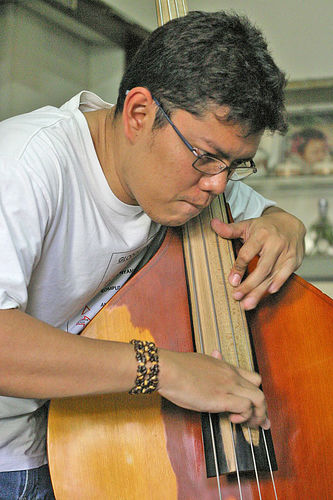
In jazz and bluegrass, and the few popular music styles which use double bass (such as French modern chanson, American psychobilly and rockabilly), pizzicato is the usual way to play the double bass. This is unusual for a violin-family instrument, because regardless whether violin-family instruments are being used in jazz (e.g., jazz violin), popular, traditional (e.g., Bluegrass fiddle) or Classical music, they are usually played with the bow for most of a performance. In classical double bass playing, pizzicato is often performed with the bow held in the hand; as such, the string is usually only plucked with a single finger. In contrast, in jazz, bluegrass, and other non-Classical styles, the player is not usually holding a bow and is therefore free to use two or three fingers to pluck the string.
In classical music, however, string instruments are most usually played with the bow, and composers give specific indications to play pizzicato where required. Pieces in classical music that are played entirely pizzicato include:
Antonio Vivaldi, in the "Ah Ch'Infelice Sempre" section of his cantata Cessate, omai cessate, combined both pizzicato and bowed instruments to create a unique sound. He also included pizzicato in the second movement of "Winter" from The Four Seasons.
In music notation, a composer will normally indicate the performer should use pizzicato with the abbreviation pizz. A return to bowing is indicated by the Italian term arco or bog. A left-hand pizzicato is usually indicated by writing a small cross above the note, and a Bartók pizzicato is often indicated by a circle with a small vertical line through the top of it above the note in question or by writing Bartók pizz at the start of the relevant passage.
In classical music, arco playing is the default assumption; thus, if a music notation part starts and no indication is given as to whether the notes are arco or pizz, the player assumes that the notes are bowed.
Hub AI
Pizzicato AI simulator
(@Pizzicato_simulator)
Pizzicato
Pizzicato (/ˌpɪtsɪˈkɑːtoʊ/, Italian: [pittsiˈkaːto]; translated as 'pinched', and sometimes roughly as 'plucked') is a playing technique that involves plucking the strings of a string instrument. The exact technique varies somewhat depending on the type of instrument:
When a string is struck or plucked, including pizzicato, sound waves are generated that do not belong to a harmonic series as when a string is bowed. This complex timbre is called inharmonicity. The inharmonicity of a string depends on its physical characteristics, such as tension, composition, diameter and length. The inharmonicity disappears when strings are bowed because the bow's stick-slip action is periodic, so it drives all of the resonances of the string at exactly harmonic ratios, even if it has to drive them slightly off their natural frequency.
The first recognised use in Classical Music is found in Tobias Hume’s The First Part of Ayres 1605. Instruction is given to ‘‘play one straine with your fingers, the other with your Bow’, ‘to be plaide with your fingers … your Bow ever in your hand’’. (Morrow et al. 2021) Another early use is found in Claudio Monteverdi's Il combattimento di Tancredi e Clorinda (around 1638), in which the players are instructed to use two fingers of their right hand to pluck the strings. Later, in 1756, Leopold Mozart in his Versuch einer gründlichen Violinschule instructs the player to use the index finger of the right hand. This has remained the most usual way to execute a pizzicato, though sometimes the middle finger is used. The bow is held in the hand at the same time unless there is enough time to put it down and pick it up again between bowed passages.
In jazz and bluegrass, and the few popular music styles which use double bass (such as French modern chanson, American psychobilly and rockabilly), pizzicato is the usual way to play the double bass. This is unusual for a violin-family instrument, because regardless whether violin-family instruments are being used in jazz (e.g., jazz violin), popular, traditional (e.g., Bluegrass fiddle) or Classical music, they are usually played with the bow for most of a performance. In classical double bass playing, pizzicato is often performed with the bow held in the hand; as such, the string is usually only plucked with a single finger. In contrast, in jazz, bluegrass, and other non-Classical styles, the player is not usually holding a bow and is therefore free to use two or three fingers to pluck the string.
In classical music, however, string instruments are most usually played with the bow, and composers give specific indications to play pizzicato where required. Pieces in classical music that are played entirely pizzicato include:
Antonio Vivaldi, in the "Ah Ch'Infelice Sempre" section of his cantata Cessate, omai cessate, combined both pizzicato and bowed instruments to create a unique sound. He also included pizzicato in the second movement of "Winter" from The Four Seasons.
In music notation, a composer will normally indicate the performer should use pizzicato with the abbreviation pizz. A return to bowing is indicated by the Italian term arco or bog. A left-hand pizzicato is usually indicated by writing a small cross above the note, and a Bartók pizzicato is often indicated by a circle with a small vertical line through the top of it above the note in question or by writing Bartók pizz at the start of the relevant passage.
In classical music, arco playing is the default assumption; thus, if a music notation part starts and no indication is given as to whether the notes are arco or pizz, the player assumes that the notes are bowed.
Recent media