
Recent from talks
Plain of Jars
Knowledge base stats:
Talk channels stats:
Members stats:
Plain of Jars
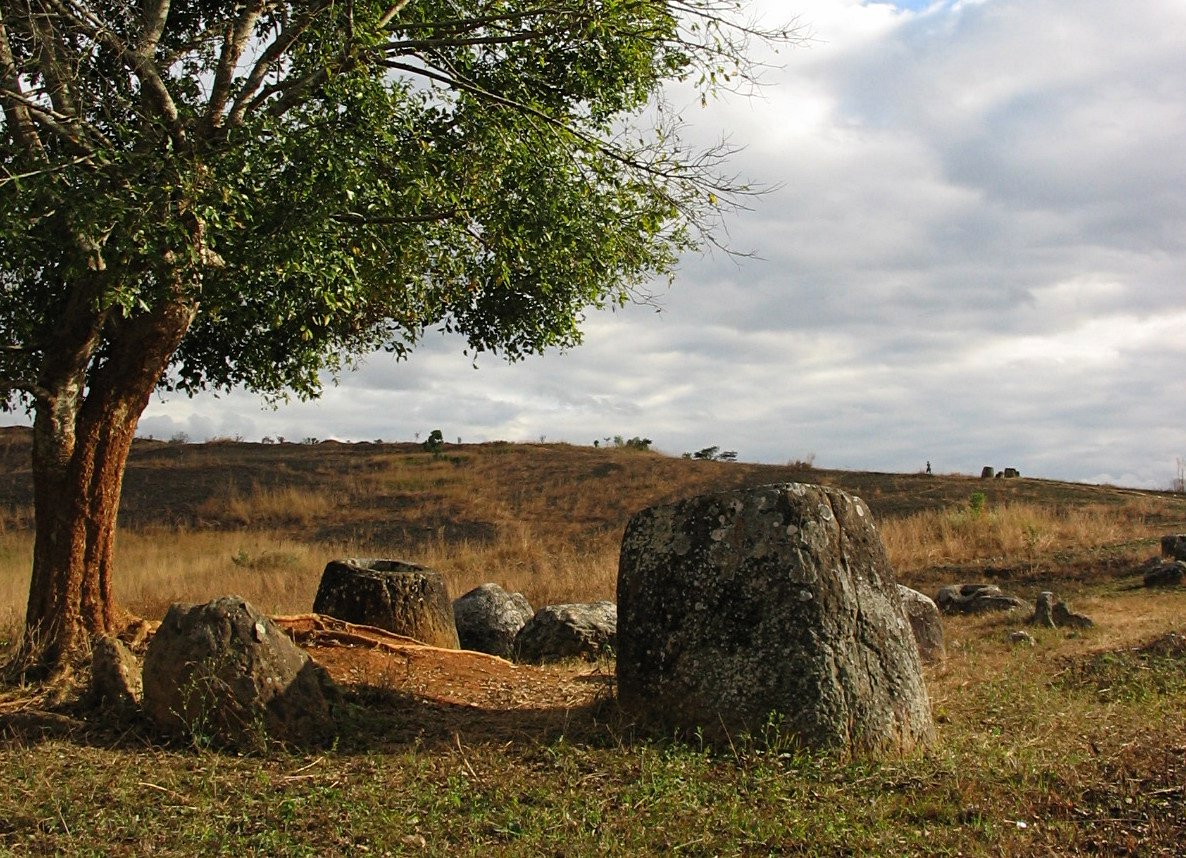
The Plain of Jars (Lao: ທົ່ງໄຫຫີນ Thong Hai Hin, [tʰōŋ hǎj hǐn]) is a megalithic archaeological landscape in Laos. It consists of thousands of stone jars scattered around the upland valleys and the lower foothills of the central plain of the Xiangkhoang Plateau. The jars are arranged in clusters ranging in number from one to several hundred.
The Xiangkhoang Plateau is at the northern end of the Annamese Cordillera, the principal mountain range of Indochina. French researcher Madeleine Colani concluded in 1930 that the jars were associated with burial practices. Excavation by Lao and Japanese archaeologists in the intervening years has supported this interpretation with the discovery of human remains, burial goods and ceramics around the jars. Researchers (using optically stimulated luminescence) determined that the jars were put in place as early as 1240 to 660 BC. The jars at Site 1 (using detrital zircon geochronology) were determined to have been transported to their current location from a presumed quarry eight kilometers away. The Plain of Jars is one of the most important prehistoric sites in Southeast Asia.
More than 120 jar sites have been identified in Xiangkhouang Province and surrounding areas, with 129 sites now confirmed by recent surveys. Today, UNESCO officially recognizes over 50 sites, but there are additional documented sites not officially recognized. Each site has between one and 400 stone jars. Documented sites now include over 2,100 jars. The jars vary in height and diameter between 1 m and 3 m and are all hewn from rock. Their shape is cylindrical, with the bottom always wider than the top.
Stone discs were also found. The discs differ from the lids, as they have at least one flat side. Previous theories that the discs could have been lids were disproved due to that none of the discs were found on top of a jar and none would fit on the tops of the jars. Fewer discs have been found than jars, totaling 200 discs. It is possible that the discs may have been used as burial markers, as the discs were found nearby jars or could have been placed on the ground to mark a burial pit. Some of the jars contained human remains. Evidence supporting that these discs were used as burial markers includes an extensive network of intentionally placed and largely unworked stones marking elaborate burial pits and chambers to the north of Xiangkhouang, known as the "standing stones of Huaphanh." These have been dated to the Bronze Age. Iconography is found on many of the discs. These images consist of both anthropomorphic and zoomorphic representations. The anthropomorphic, or human-like, figures are more uniform than the zoomorphic, or animal-like, images. The anthropomorphic figures are almost all "spread-eagle" with straight or bent legs. Zoomorphic figures include tigers, monkeys, and other animals. Of the jars, only one jar has been found with iconography carved into it. This jar from Site 1 has a human "frogman" bas-relief carved on the exterior. Parallels between the "frogman" and the rock painting at Huashan in Guangxi, China, have been drawn. The Chinese paintings, which depict large full-frontal images of humans with arms raised and knees bent, date to 500 BC–200 CE.
The most investigated and visited Jar site is close to the town of Phonsavan, and is known as Site 1. Seven jar sites have now been cleared of unexploded bombs and are open to visitors. These are currently sites 1, 2 and 3, and Site 16 near the old capital Xieng Khouang; Site 23, near the big hot spring in Muang Kham; Site 25 in the largely unvisited Phou Kout District; and Site 52, the largest known jar site to date with 392 jars near a traditional Hmong village only accessible by foot.
The earliest documented archaeological research began with Madeleine Colani in 1935, who documented 21 sites and gave them each names. Colani documented additional possible sites, but later research often had trouble locating these sites due to differences in metric degree systems. The most well-known of the sites that Colani identified is Site 1, also known as Ban Ang. In Colani's initial excavation around 20 jars, spindle whorls, ear discs, glass beads, and bronze and iron tools, knives, and jewelry were found. Human remains and glass beads were found in some of the jars.
Colani also recorded and excavated at twelve Plain of Jars sites and published two volumes with her findings in 1935. Colani concluded that the Plain of Jars was an Iron Age burial site. Inside the jars she found, embedded in black organic soil, coloured glass beads and burnt teeth and bone fragments, sometimes from more than one individual. Around the stone jars, she found human bones, pottery fragments, iron and bronze objects, glass and stone beads, ceramic weights and charcoal. The bone and teeth inside the jars show signs of cremation, while the burials surrounding the jars yield unburnt secondary burial bones.
More recent excavations, such as those by the joint Lao-Australian Plain of Jars Archaeological Project (PJARP) from 2016-2020, have confirmed that Site 1 was used for secondary burials dating from the 8th to 13th centuries CE. These later excavations revealed that multiple individuals were interred in shared mortuary contexts. In 2023, preliminary excavations at Site 75 unearthed uncremated human remains inside a stone jar, the first substantive instance of such a burial in Lao jar contexts.
Hub AI
Plain of Jars AI simulator
(@Plain of Jars_simulator)
Plain of Jars
The Plain of Jars (Lao: ທົ່ງໄຫຫີນ Thong Hai Hin, [tʰōŋ hǎj hǐn]) is a megalithic archaeological landscape in Laos. It consists of thousands of stone jars scattered around the upland valleys and the lower foothills of the central plain of the Xiangkhoang Plateau. The jars are arranged in clusters ranging in number from one to several hundred.
The Xiangkhoang Plateau is at the northern end of the Annamese Cordillera, the principal mountain range of Indochina. French researcher Madeleine Colani concluded in 1930 that the jars were associated with burial practices. Excavation by Lao and Japanese archaeologists in the intervening years has supported this interpretation with the discovery of human remains, burial goods and ceramics around the jars. Researchers (using optically stimulated luminescence) determined that the jars were put in place as early as 1240 to 660 BC. The jars at Site 1 (using detrital zircon geochronology) were determined to have been transported to their current location from a presumed quarry eight kilometers away. The Plain of Jars is one of the most important prehistoric sites in Southeast Asia.
More than 120 jar sites have been identified in Xiangkhouang Province and surrounding areas, with 129 sites now confirmed by recent surveys. Today, UNESCO officially recognizes over 50 sites, but there are additional documented sites not officially recognized. Each site has between one and 400 stone jars. Documented sites now include over 2,100 jars. The jars vary in height and diameter between 1 m and 3 m and are all hewn from rock. Their shape is cylindrical, with the bottom always wider than the top.
Stone discs were also found. The discs differ from the lids, as they have at least one flat side. Previous theories that the discs could have been lids were disproved due to that none of the discs were found on top of a jar and none would fit on the tops of the jars. Fewer discs have been found than jars, totaling 200 discs. It is possible that the discs may have been used as burial markers, as the discs were found nearby jars or could have been placed on the ground to mark a burial pit. Some of the jars contained human remains. Evidence supporting that these discs were used as burial markers includes an extensive network of intentionally placed and largely unworked stones marking elaborate burial pits and chambers to the north of Xiangkhouang, known as the "standing stones of Huaphanh." These have been dated to the Bronze Age. Iconography is found on many of the discs. These images consist of both anthropomorphic and zoomorphic representations. The anthropomorphic, or human-like, figures are more uniform than the zoomorphic, or animal-like, images. The anthropomorphic figures are almost all "spread-eagle" with straight or bent legs. Zoomorphic figures include tigers, monkeys, and other animals. Of the jars, only one jar has been found with iconography carved into it. This jar from Site 1 has a human "frogman" bas-relief carved on the exterior. Parallels between the "frogman" and the rock painting at Huashan in Guangxi, China, have been drawn. The Chinese paintings, which depict large full-frontal images of humans with arms raised and knees bent, date to 500 BC–200 CE.
The most investigated and visited Jar site is close to the town of Phonsavan, and is known as Site 1. Seven jar sites have now been cleared of unexploded bombs and are open to visitors. These are currently sites 1, 2 and 3, and Site 16 near the old capital Xieng Khouang; Site 23, near the big hot spring in Muang Kham; Site 25 in the largely unvisited Phou Kout District; and Site 52, the largest known jar site to date with 392 jars near a traditional Hmong village only accessible by foot.
The earliest documented archaeological research began with Madeleine Colani in 1935, who documented 21 sites and gave them each names. Colani documented additional possible sites, but later research often had trouble locating these sites due to differences in metric degree systems. The most well-known of the sites that Colani identified is Site 1, also known as Ban Ang. In Colani's initial excavation around 20 jars, spindle whorls, ear discs, glass beads, and bronze and iron tools, knives, and jewelry were found. Human remains and glass beads were found in some of the jars.
Colani also recorded and excavated at twelve Plain of Jars sites and published two volumes with her findings in 1935. Colani concluded that the Plain of Jars was an Iron Age burial site. Inside the jars she found, embedded in black organic soil, coloured glass beads and burnt teeth and bone fragments, sometimes from more than one individual. Around the stone jars, she found human bones, pottery fragments, iron and bronze objects, glass and stone beads, ceramic weights and charcoal. The bone and teeth inside the jars show signs of cremation, while the burials surrounding the jars yield unburnt secondary burial bones.
More recent excavations, such as those by the joint Lao-Australian Plain of Jars Archaeological Project (PJARP) from 2016-2020, have confirmed that Site 1 was used for secondary burials dating from the 8th to 13th centuries CE. These later excavations revealed that multiple individuals were interred in shared mortuary contexts. In 2023, preliminary excavations at Site 75 unearthed uncremated human remains inside a stone jar, the first substantive instance of such a burial in Lao jar contexts.
Recent media