




Community hub
Recent from talks
Contribute something to knowledge base
Content stats: 0 posts, 0 articles, 1 media, 0 notes
Members stats: 0 subscribers, 0 contributors, 0 moderators, 0 supporters
Subscribers
Supporters
Contributors
Moderators
Plains-wanderer
The plains-wanderer (Pedionomus torquatus) is an atypical species of wading bird, the only representative of family Pedionomidae and genus Pedionomus. It is endemic to Australia. Its historic range included much of eastern Australia, including Victoria, New South Wales, South Australia and the Northern Territory, but in recent years, it has become endangered with remaining known populations concentrated in the Riverina region of New South Wales and western Queensland.
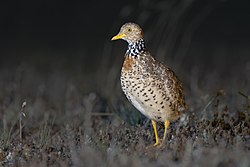
The plains-wanderer is a quail-like ground bird, measuring 15–19 cm. It is such an atypical bird that it is placed in an entire family of its own, Pedionomidae. The adult male is light brown above, with fawn-white underparts with black crescents. The adult female is substantially larger than the male, and has a distinctive, white-spotted black collar. They have excellent camouflage and will first hide at any disturbance. If approached too closely, they will run rather than fly, at which they are very poor. Females lay four eggs, which the male then incubates.
It was formerly believed to be related to the buttonquails and thus placed in the gamebird order Galliformes or with the cranes and rails in Gruiformes. DNA–DNA hybridization and RAG-1 sequence data places it as a wader related to the jacanas. It thus represents a remarkable case of morphological convergence, or perhaps it is simply extremely plesiomorphic in morphology (the buttonquails, meanwhile, having turned out to be a very basal offshoot of the wader radiation). In the latter case, this would mean that the jacanas, painted snipe and seedsnipes—all ecologically very different birds—all evolved from birds very similar to the living plains-wanderer.
Population decline has been caused by the conversion of native grasslands to cultivation and intensive predation by the introduced fox—the species' ground-nesting habits, poor flying ability, and tendency to run rather than fly from predators make it easy prey for the fox. Sites identified by BirdLife International as being important for plains-wanderer conservation are Boolcoomatta, Bindarrah and Kalkaroo Stations in north-eastern South Australia, Diamantina and Astrebla Grasslands in western Queensland, Patho Plains in northern Victoria and the Riverina Plains in New South Wales.
A crucial aspect of Plains-wanderer conservation is their habitat needs. They require grasslands with both open and denser vegetation for foraging and roosting, which is essential for their survival and recovery.
This bird is listed as Endangered on the 2022 IUCN Red List.
Plains-wanderers are listed as critically endangered under the Australian Environment Protection and Biodiversity Conservation Act 1999 (EPBC Act). Their conservation status varies from state to state within Australia:
A 2018 study ranked it sixth in a list of Australian birds most likely to go extinct.
Plains-wanderer
The plains-wanderer (Pedionomus torquatus) is an atypical species of wading bird, the only representative of family Pedionomidae and genus Pedionomus. It is endemic to Australia. Its historic range included much of eastern Australia, including Victoria, New South Wales, South Australia and the Northern Territory, but in recent years, it has become endangered with remaining known populations concentrated in the Riverina region of New South Wales and western Queensland.
The plains-wanderer is a quail-like ground bird, measuring 15–19 cm. It is such an atypical bird that it is placed in an entire family of its own, Pedionomidae. The adult male is light brown above, with fawn-white underparts with black crescents. The adult female is substantially larger than the male, and has a distinctive, white-spotted black collar. They have excellent camouflage and will first hide at any disturbance. If approached too closely, they will run rather than fly, at which they are very poor. Females lay four eggs, which the male then incubates.
It was formerly believed to be related to the buttonquails and thus placed in the gamebird order Galliformes or with the cranes and rails in Gruiformes. DNA–DNA hybridization and RAG-1 sequence data places it as a wader related to the jacanas. It thus represents a remarkable case of morphological convergence, or perhaps it is simply extremely plesiomorphic in morphology (the buttonquails, meanwhile, having turned out to be a very basal offshoot of the wader radiation). In the latter case, this would mean that the jacanas, painted snipe and seedsnipes—all ecologically very different birds—all evolved from birds very similar to the living plains-wanderer.
Population decline has been caused by the conversion of native grasslands to cultivation and intensive predation by the introduced fox—the species' ground-nesting habits, poor flying ability, and tendency to run rather than fly from predators make it easy prey for the fox. Sites identified by BirdLife International as being important for plains-wanderer conservation are Boolcoomatta, Bindarrah and Kalkaroo Stations in north-eastern South Australia, Diamantina and Astrebla Grasslands in western Queensland, Patho Plains in northern Victoria and the Riverina Plains in New South Wales.
A crucial aspect of Plains-wanderer conservation is their habitat needs. They require grasslands with both open and denser vegetation for foraging and roosting, which is essential for their survival and recovery.
This bird is listed as Endangered on the 2022 IUCN Red List.
Plains-wanderers are listed as critically endangered under the Australian Environment Protection and Biodiversity Conservation Act 1999 (EPBC Act). Their conservation status varies from state to state within Australia:
A 2018 study ranked it sixth in a list of Australian birds most likely to go extinct.
Recent media
Recent media