


Community hub
Recent from talks
Contribute something
Nothing was collected or created yet.
Galliformes
View on Wikipedia | This article includes a list of general references, but it lacks sufficient corresponding inline citations. (November 2015) |
| Galliformes Temporal range: Eocene-Recent, [1][full citation needed]
Possible earlier origin based on molecular clock[2] | |
|---|---|

| |
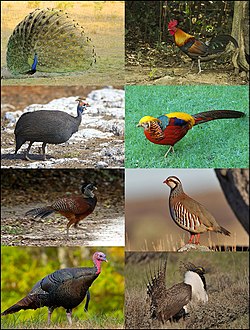
| Clockwise from top left: Indian peafowl (Pavo cristatus), red junglefowl (Gallus gallus), golden pheasant (Chrysolophus pictus), red-legged partridge (Alectoris rufa), Gunnison grouse (Centrocercus minimus), wild turkey (Meleagris gallopavo), great curassow (Crax rubra), helmeted guineafowl (Numida meleagris) | |
Scientific classification 
| |
| Kingdom: | Animalia |
| Phylum: | Chordata |
| Class: | Aves |
| Superorder: | Galloanserae |
| Clade: | Pangalliformes |
| Order: | Galliformes Temminck, 1820 |
| Extant families | |
| |
| Synonyms | |
|
Phasianiformes | |
Galliformes /ˌɡælɪˈfɔːrmiːz/ is an order of heavy-bodied ground-feeding birds that includes turkeys, chickens, quail, and other landfowl. Gallinaceous birds, as they are called, are important in their ecosystems as seed dispersers and predators, and are often reared by humans for their meat and eggs, or hunted as game birds.
The order contains about 290 species, inhabiting every continent except Antarctica, and divided into five families: Phasianidae (including chicken, quail, partridges, pheasants, turkeys, peafowl (peacocks) and grouse), Odontophoridae (New World quail), Numididae (guinea fowl), Cracidae (including chachalacas and curassows), and Megapodiidae (incubator birds like malleefowl and brush-turkeys). They have adapted to most environments, except for innermost deserts and perpetual ice.
Many gallinaceous species are skilled runners and escape predators by running rather than flying. Males of most species are more colorful than the females, with often elaborate courtship behaviors that include strutting, fluffing of tail or head feathers, and vocal sounds. They are mainly nonmigratory. Several species have been domesticated during their long and extensive relationships with humans.
The name galliformes derives from "gallus", Latin for "rooster". Common names are gamefowl or gamebirds, landfowl, gallinaceous birds, or galliforms. Galliforms and waterfowl (order Anseriformes) are collectively called fowl.
Systematics and evolution
[edit]
The living Galliformes were once divided into seven or more families. Despite their distinctive appearance, grouse and turkeys probably do not warrant separation as families due to their recent origin from partridge- or pheasant-like birds. The turkeys became larger after their ancestors colonized temperate and subtropical North America, where pheasant-sized competitors were absent. The ancestors of grouse, though, adapted to harsh climates and could thereby colonize subarctic regions. Consequently, the Phasianidae are expanded in current taxonomy to include the former Tetraonidae and Meleagrididae as subfamilies.[3]
The Anseriformes (waterfowl) and the Galliformes together make up the Galloanserae. They are basal among the living neognathous birds, and normally follow the Paleognathae (ratites and tinamous) in modern bird classification systems. This was first proposed in the Sibley-Ahlquist taxonomy and has been the one major change of that proposed scheme that was almost universally adopted. However, the Galliformes as they were traditionally delimited are called Gallomorphae in the Sibley-Ahlquist taxonomy, which splits the Cracidae and Megapodiidae as an order "Craciformes". This is not a natural group, however, but rather an erroneous result of the now-obsolete phenetic methodology employed in the Sibley-Ahlquist taxonomy.[4] Phenetic studies do not distinguish between plesiomorphic and apomorphic characters, which leads to basal lineages appearing as monophyletic groups.
Historically, the buttonquails (Turnicidae), mesites (Mesitornithidae) and the hoatzin (Opisthocomus hoazin) were placed in the Galliformes, too. The former are now known to be shorebirds adapted to an inland lifestyle, whereas the mesites are probably closely related to pigeons and doves. The relationships of the hoatzin are entirely obscure, and it is usually treated as a monotypic order Opisthocomiformes to signify this.
The fossil record for the Galliformes is incomplete.[5]
| |||||||||||||||||||||||||||||||||
| Phylogeny of the Galliformes based a study by De Chen and collaborators published in 2021.[6] The number of species are from the list maintained by Frank Gill, Pamela Rasmussen and David Donsker on behalf of the International Ornithologists' Union.[7][8] |
_(Aepypodius_bruijnii).jpg)


Evolution
[edit]Galloanserae-like birds were one of the main survivors of the K-T Event, that killed off the rest of the dinosaurs. The dominant birds of the dinosaur era were the enantiornithes, toothed birds that dominated the trees and skies. Unlike those enantiornithes, the ancestors of the galliformes were a niche group that were toothless and ground-dwelling. When the asteroid impact killed off all non-avian dinosaurs, and the dominant birds, it destroyed all creatures that lived in trees and on open ground. The enantiornithes were wiped out, but the ancestors of galliformes were small and lived in the ground (unlike water for Anseriformes) which protected them from the blast and destruction.[9]
Fossils of these galliform-like birds originate in the Late Cretaceous, most notably those of Austinornis lentus. Its partial left tarsometatarsus was found in the Austin Chalk near McKinney, Texas, dating to about 85 million years ago (Mya). This bird was quite certainly closely related to Galliformes, but whether it was a part of these or belongs elsewhere in the little-known galliform branch of Galloanserae is not clear. However, in 2004, Clarke classified it as a member of the larger group Pangalliformes, more closely related to chickens than to ducks, but not a member of the crown group that includes all modern galliformes.[10] Another specimen, PVPH 237, from the Late Cretaceous Portezuelo Formation (Turonian-Coniacian, about 90 Mya) in the Sierra de Portezuelo (Argentina) has also been suggested to be an early galliform relative. This is a partial coracoid of a neornithine bird, which in its general shape and particularly the wide and deep attachment for the muscle joining the coracoid and the humerus bone resembles the more basal lineages of galliforms.[11]
Additional galliform-like pangalliformes are represented by extinct families from the Paleogene, namely the Gallinuloididae, Paraortygidae and Quercymegapodiidae. In the early Cenozoic, some additional birds may or may not be early Galliformes, though even if they are, they are unlikely to belong to extant families:
- †Argillipes (London Clay Early Eocene of England)
- †Coturnipes (Early Eocene of England, and Virginia, USA?)
- †Palaeophasianus (Willwood Early Eocene of Bighorn County, USA)
- †Percolinus (London Clay Early Eocene of England)
- †Amitabha (Bridger middle Eocene of Forbidden City, USA) – phasianid?
- †"Palaeorallus" alienus (middle Oligocene of Tatal-Gol, Mongolia)
- †Anisolornis (Santa Cruz Middle Miocene of Karaihen, Argentina)
From the mid-Eocene onwards – about 45 Mya or so, true galliforms are known, and these completely replace their older relatives in the early Neogene. Since the earliest representatives of living galliform families apparently belong to the Phasianidae – the youngest family of galliforms, the other families of Galliformes must be at least of Early Eocene origin but might even be as old as the Late Cretaceous. The ichnotaxon Tristraguloolithus cracioides is based on fossil eggshell fragments from the Late Cretaceous Oldman Formation of southern Alberta, Canada, which are similar to chachalaca eggs,[12] but in the absence of bone material, their relationships cannot be determined except that they are apparently avian in origin.
Modern genera of phasianids start appearing around the Oligocene-Miocene boundary, roughly 25–20 Mya. It is not well known whether the living genera of the other, older, galliform families originated around the same time or earlier, though at least in the New World quail, pre-Neogene forms seem to belong to genera that became entirely extinct later on.
A number of Paleogene to mid-Neogene fossils are quite certainly Galliformes, but their exact relationships in the order cannot be determined:
- †Galliformes gen. et sp. indet. (Oligocene) – formerly in Gallinuloides; phasianid?[13]
- †Palaealectoris (Agate Fossil Beds Early Miocene of Sioux County, USA) – tetraonine?
List of major taxa
[edit]For a long time, the pheasants, partridges, and relatives were indiscriminately lumped in the Phasianidae, variously including or excluding turkeys, grouse, New World quail, and guineafowl, and divided into two subfamilies – the Phasianinae (pheasant-like forms) and the Perdicinae (partridge-like forms). This crude arrangement was long considered to be in serious need of revision, but even with modern DNA sequence analyses and cladistic methods, the phylogeny of the Phasianidae has resisted complete resolution.[14]

A tentative list of the higher-level galliform taxa, listed in evolutionary sequence, is:[14][15]
- †Archaeophasianus Lambrecht 1933 (Oligocene? – Late Miocene)
- †Argillipes Harrison & Walker 1977
- †Austinornis Clarke 2004 [Pedioecetes Baird 1858] (Austin Chalk Late Cretaceous of Fort McKinney, USA)
- †Chambiortyx Mourer-Chauviré et al. 2013
- †Coturnipes Harrison & Walker 1977
- †Cyrtonyx tedfordi (Barstow Late Miocene of Barstow, USA)
- †Linquornis Yeh 1980 (middle Miocene)
- †Namaortyx Mourer-Chauviré, Pickford & 2011
- †Palaeorallus alienus Kuročkin 1968 nomen dubium
- †Sobniogallus Tomek et al. 2014
- †Tristraguloolithus Zelenitsky, Hills & Curri 1996 [ootaxa- cracid?]
- †Procrax Tordoff & Macdonald 1957 (middle Eocene? – Early Oligocene)
- †Paleophasianus Wetmore 1940
- †Taoperdix Milne-Edwards 1869 (Late Oligocene)
- Family †Gastornithidae?[16] Fürbringer, 1888
- Gastornis Hébert, 1855 (vide Prévost, 1855) [Diatryma Cope, 1876] (Paleocene-Eocene)
- Family †Sylviornithidae?[16] Mourer-Chauviré & Balouet, 2005
- †Sylviornis Poplin, 1980 (Holocene)
- †Megavitiornis Worthy, 2000 (Holocene)
- Family †Paraortygidae Mourer-Chauviré 1992
- †Pirortyx Brodkorb 1964
- †Scopelortyx Mourer-Chauviré, Pickford & Senut 2015
- †Paraortyx Gaillard 1908 sensu Brodkorb 1964
- †Xorazmortyx Zelenkov & Panteleyev 2019
- Family †Quercymegapodiidae Mourer-Chauviré 1992
- †Taubacrex Alvarenga 1988
- †Ameripodius Alvarenga 1995
- †Quercymegapodius Mourer-Chauviré 1992
- Family Megapodiidae – mound-builders and scrubfowl, or megapodes
- †Mwalau Worthy et al. 2015 (Lini's megapode)
- †Ngawupodius & Ivison 1999
- Brushturkey group
- Talegalla Lesson 1828
- Leipoa Gould 1840 [Progura de Vis 1889; Chosornis de Vis 1889; Palaeopelargus de Vis 1892] (Malleefowl)
- Alectura Gray 1831 [Catheturus Swainson 1837] (Australian Brushturkeys)
- Aepypodius Oustalet 1880
- Scrubfowl group
- Macrocephalon Müller 1846 [Megacephalon Gray 1846; Megacephalon Gray 1844 nomen nudum; Galeocephala Mathews 1926] (Maleos)
- Eulipoa Ogilvie-Grant 1893 (Moluccan Megapodes)
- Megapodius Gaimard 1823 non (sic) Mathews 1913 [Megathelia Mathews 1914; Amelous Gloger 1841]
- Family Cracidae – chachalacas, guans and curassows
- †Archaealectrornis Crowe & Short 1992 (Oligocene)
- †Boreortalis Brodkorb 1954
- †Palaeonossax Wetmore 1956 (Brule Late Oligocene of South Dakota, USA)
- Penelopinae Bonaparte 1851 (Guans)
- Chamaepetes Wagler 1832 (black & sickle-winged guan)
- Penelopina Reichenbach 1861 (Highland Guans)
- Aburria Reichenbach 1853 [Opetioptila Sundevall 1873; Pipile Bonaparte 1856 non Pipilo Vieillot 1816; Cumana Coues 1900]
- Penelope Merrem 1786 [Penelopsis Bonaparte 1856]
- Cracinae Rafinesque 1815
- Ortalis Merrem 1786 [Ganix Rafinesque 1815] {Ortalidini Donegan 2012} (Chachalacas)
- Oreophasis Gray 1844 {Oreophasini Bonaparte 1853} (Horned Guans)
- Cracini Rafinesque 1815 (Curassows)
- Suborder Phasiani
- Family †Gallinuloididae – tentatively placed here
- †Gallinuloides Eastman 1900 [Palaeobonasa Shufeldt 1915]
- †Paraortygoides Mayr 2000
- Family Numididae – guineafowl
- Family Odontophoridae – New World quail
- †Miortyx Miller 1944
- †Nanortyx Weigel 1963
- †Neortyx Holman 1961
- Ptilopachinae Bowie, Coehn & Crowe 2013
- Ptilopachus Swainson 1837
- Odontophorinae Gould 1844
- Rhynchortyx Ogilvie-Grant 1893 (Tawny-faced Quail)
- Oreortyx Baird 1858 [Orortyx Coues 1882] (Mountain Quail)
- Dendrortyx Gould 1844 (Wood Partridges)
- Philortyx Gould 1846 non Des Murs 1854 (Banded Quail)
- Colinus Goldfuss 1820 [Eupsychortyx Gould 1844; Gnathodon Streubel 1842; Ortygia Boie 1826; Philortyx Des Murs 1854 non Gould 1846] (Bobwhites)
- Callipepla Wagler 1832 [Lophortyx Bonaparte 1838] ()
- Cyrtonyx Gould 1844 ()
- Dactylortyx Ogilvie-Grant 1893 (Singing Quail)
- Odontophorus Vieillot 1816 [Dentophorus Boie 1828] (Wood Quail)
- Family Phasianidae – pheasants, partridges and relatives
- †Alectoris" pliocaena Tugarinov 1940b
- †Bantamyx Kuročkin 1982
- †Centuriavis lioae Ksepka et al., 2022
- †Diangallus Hou 1985
- †"Gallus" beremendensis Jánossy 1976b
- †"Gallus" europaeus Harrison 1978
- †Lophogallus Zelenkov & Kuročkin 2010
- †Megalocoturnix Sánchez Marco 2009
- †Miophasianus Brodkorb 1952 [Miophasianus Lambrecht 1933 nomen nudum ; Miogallus Lambrecht 1933 ]
- †Palaeocryptonyx Depéret 1892 [Chauvireria Boev 1997; Pliogallus Tugarinov 1940b non Gaillard 1939; Lambrechtia Janossy 1974 ]
- †Palaeortyx Milne-Edwards 1869 [Palaeoperdix Milne-Edwards 1869]
- †Plioperdix Kretzoi 1955 [Pliogallus Tugarinov 1940 nec Gaillard 1939]
- †Rustaviornis Burchak-Abramovich & Meladze 1972
- †Schaubortyx Brodkorb 1964
- †Shandongornis Yeh 1997
- †Shanxiornis Wang et al. 2006
- †Tologuica Zelenkov & Kuročkin 2009
- Subfamily Rollulinae Bonaparte, 1850
- Subfamily Phasianinae
- Tribe Lerwini von Boetticher, 1939 – snow partridge
- Tribe Ithaginini Wolters 197 – blood pheasant
- Tribe Lophophorini Gray, 1841 – monals, monal-partridges, and tragopans
- Tribe Pucrasiini Wolters 1976 – koklass pheasant
- Tribe Meleagridini – turkey
- Tribe Tetraonini Leach 1820 – grouse
- Tribe Rhizotherini – long-billed partridges
- Tribe Phasianini Horsfield 1821 – true pheasants and partridges
- Subfamily Pavoninae
- Tribe Pavonini Rafinesque 1815 – peafowl, arguses, and Tropicoperdix partridges
- Tribe Polyprectronini Blyth 1852 – peacock-pheasants, Asian spurfowl, and crimson-headed partridge
- Tribe Gallini Brehm 1831 – junglefowl, bamboo partridges, and true francolins
- Tribe Coturnicini Reichenbach, 1848 - Old World quail, snowcocks, and allies
- Family †Gallinuloididae – tentatively placed here
The relationships of many pheasants and partridges were formerly very badly resolved and much confounded by adaptive radiation (in the former) and convergent evolution (in the latter).[17] Thus, the bulk of the Phasianidae was alternatively treated as a single subfamily Phasianinae. The grouse, turkeys, true pheasants, etc., would then become tribes of this subfamily, similar to how the Coturnicinae are commonly split into a quail and a spurfowl tribe.[18] In 2021, Kimball et al. found the family to comprise three distinct subfamilies, with two containing multiple genera; these results were followed by the International Ornithological Congress.[15][19][20]
The partridge of Europe is not closely related to other partridge-like Galliformes, as already indicated by its sexually dimorphic coloration and possession of more than 14 rectrices, traits it shares with the other advanced phasianids. However, among these its relationships are obscure; it is unclear whether it is closer to the turkeys or to certain short-tailed pheasants like Ithaginis, Lophophorus, Pucrasia, and Tragopan.[21] In 2021, Kimball et al. found it to belong to the subfamily Phasianini, alongside the true pheasants.[20]
Phylogeny
[edit]Living Galliformes based on the work by John Boyd.[22]
| Galliformes classification | ||||||||||||||||||||||||||||||||||||||||||||||||||||||||||||||||||||||||||||||||||||||||||||||||
|---|---|---|---|---|---|---|---|---|---|---|---|---|---|---|---|---|---|---|---|---|---|---|---|---|---|---|---|---|---|---|---|---|---|---|---|---|---|---|---|---|---|---|---|---|---|---|---|---|---|---|---|---|---|---|---|---|---|---|---|---|---|---|---|---|---|---|---|---|---|---|---|---|---|---|---|---|---|---|---|---|---|---|---|---|---|---|---|---|---|---|---|---|---|---|---|---|
|


.jpg)
.jpg)

.jpg)


_(white_background).jpg)


_(Colinus_virginianus).jpg)


_-_Meleagris_gallopavo_(white_background).jpg)
Description
[edit]
As their name suggests, they are chicken-like in appearance, with rounded bodies and blunt wings, and range in size from small at 15 cm (6 inches) to large at 120 cm (4 feet). They are mainly terrestrial birds, and their wings are short and rounded for short-distance flight. Galliforms are anisodactyl like passerines, but some of the adult males grow spurs that point backwards.
Gallinaceous birds are arboreal or terrestrial animals; many prefer not to fly, but instead walk and run for locomotion. They live 5–8 years in the wild and up to 30 years in captivity.[citation needed] They can be found worldwide and in a variety of habitats, including forests, deserts, and grasslands. They use visual displays and vocalizations for communication, courtship, fighting, territoriality, and brooding.
They have diverse mating strategies: some are monogamous, while others are polygamous or polygynandrous. Male courtship behavior includes elaborate visual displays of plumage. They breed seasonally in accordance with the climate and lay 3-16 eggs per year in nests built on the ground or in trees.
Gallinaceous birds feed on a variety of plant and animal material, which may include fruits, seeds, leaves, shoots, flowers, tubers, roots, insects, snails, worms, lizards, snakes, small rodents, and eggs.
These birds vary in size from the diminutive king quail (Coturnix chinensis) (5 in) long and weighing 28–40 g (1–1.4 oz) to the largest extant galliform species, the North American wild turkey (Meleagris gallopavo), which may weigh as much as 14 kg (30.5 lb) and may exceed 120 cm (47 in).
The galliform bird species with the largest wingspan and largest overall length (including a train of over 6 feet) is most likely the green peafowl (Pavo muticus). Most galliform genera are plump-bodied with thick necks, moderately long legs, and short, rounded wings. Grouse, pheasants, francolins, and partridges are typical in their outwardly corpulent silhouettes.
Adult males of many galliform birds have one to several sharp horny spurs on the back of each leg, which they use for fighting. Several lineages exhibit pronounced sexual dimorphism, and among each galliform clade, the more apomorphic ("advanced") lineages tend to be more sexually dimorphic.[citation needed]
Flightlessness
[edit]While most Galliformes are rather reluctant flyers, truly flightless forms are unknown among the extant members of the order. Though they are often mischaracterised as weak-flying, Galliformes are actually highly specialised for their particular flight style, bearing extremely powerful flight muscles, and some species are even migratory.[23] Adult snowcocks are, however, flightless, requiring gravity to launch, although juveniles can still fly relatively well.[24]
Nonetheless, a few birds outside the Galliformes crown-group did produce flightlessness.
The genus Sylviornis, a huge prehistorically extinct species of New Caledonia, was flightless, but as opposed to most other flightless birds like ratites or island rails which become flightless due to arrested development of their flight apparatus and subsequently evolve to larger size, Sylviornis seems to have become flightless simply due to its bulk, with the wing reduction following consequently, not being the reason for its flightlessness.
The gigantic Australian mihirungs, which may be closer to Galliformes than to Anseriformes as traditionally expected,[25] achieved flightlessness more traditionally, strongly reducing their wings and keel. They were massive herbivorous birds, among the largest avian dinosaurs of all time.
By contrast, the stem-galliform Scopelortyx appears to have been more aerial than modern fowl, with a flight style more suited for gliding and soaring.[26]
Behaviour and ecology
[edit] |
Most of the galliform birds are more or less resident, but some of the smaller temperate species (such as quail) do migrate over considerable distances. Altitudinal migration is evidently quite common amongst montane species, and a few species of subtropical and subarctic regions must reach their watering and/or foraging areas through sustained flight. Species known to make extensive flights include the ptarmigans, sage-grouse (Centrocercus), crested partridge, green peafowl, crested argus, mountain peacock-pheasant (Polyplectron inopinatum), koklass pheasant (Pucrasia macrolopha), Reeves's pheasant, and (Syrmaticus reevesii). Other species — most of the New World quail (also known as the 'toothed quail'), the enigmatic stone partridge (Ptilopachus petrosus) of Africa, guineafowl, and eared pheasants (Crossoptilon) — are all notable for their daily excursions on foot which may take them many miles in a given day.
Some Galliformes are adapted to grassland habitat, and these genera are remarkable for their long, thin necks, long legs, and large, wide wings. Fairly unrelated species like the crested fireback (Lophura ignita), vulturine guineafowl (Acryllium vulturinum), and malleefowl (Leipoa ocellata) are outwardly similar in their body types (see also convergent evolution).
Most species that show only limited sexual dimorphism are notable for the great amount of locomotion required to find food throughout the majority of the year. Those species that are highly sedentary but with marked ecological transformations over seasons exhibit marked distinct differences between the sexes in size and/or appearance. Eared-pheasants, guineafowl, toothed quail, and the snow partridge (Lerwa lerwa) are examples of limited sexual differences and requirements for traveling over wide terrain to forage.
Winter ecology
[edit]Gallinaceous birds are well adapted to regions with cold winters. Their larger size, increased plumage, and lower activity levels help them to withstand the cold and conserve energy. Under such conditions, they are able to change their feeding strategy to that of a ruminant. This allows them to feed on and extract energy and nutrients from coarse, fibrous plant material, such as buds, twigs, and conifer needles. This provides a virtually unlimited source of accessible food and requires little energy to harvest.
Food and feeding
[edit]
Herbivorous to slightly omnivorous galliforms, forming the majority of the group, are typically stoutly built and have short, thick bills primarily adapted for foraging on the ground for rootlets or the consumption of other plant material such as heather shoots. The young birds will also take insects.
Peafowl, junglefowl and most of the subtropical pheasant genera have very different nutritional requirements from typical Palearctic genera. The Himalayan monal (Lophophorus impejanus) has been observed digging in the rotting wood of deadfall in a similar manner to woodpeckers to extract invertebrates, even bracing itself with aid of its squared tail. The cheer pheasant (Catreus wallichi), crested argus (Rheinardia ocellata), the crested partridge (Rollulus roulroul) and the crested guineafowl (Guttera pucherani) are similar ecologically to the Himalayan monal in that they too forage in rotting wood for termites, ant and beetle larvae, molluscs, crustaceans and young rodents.
Typical peafowl (Pavo), most of the peacock-pheasants (Polyplectron), the Bulwer's pheasant (Lophura bulweri), the ruffed pheasants (Chrysolophus) and the hill partridges (Arborophila) have narrow, relatively delicate bills, poorly suited for digging. These galliform genera prefer instead to capture live invertebrates in leaf litter, in sand, or shallow pools or along stream banks. These genera are also outwardly similar in that they each have exceptionally long, delicate legs and toes and the tendency to frequent seasonally wet habitats to forage, especially during chick-rearing. The blue peafowl (Pavo cristatus) is famed in its native India for its appetite for snakes – even poisonous cobras – which it dispatches with its strong feet and sharp bill. The Lady Amherst's pheasant (Chrysolophus amherstiae), green peafowl (Pavo muticus), Bulwer's pheasant and the crestless fireback (Lophura erythrophthalma) are notable for their aptitude to forage for crustaceans such as crayfish and other aquatic small animals in shallow streams and amongst rushes in much the same manner as some members of the rail family (Rallidae). Similarly, although wild turkeys (Meleagris gallopavo) have a diet primarily of vegetation, they will eat insects, mice, lizards, and amphibians, wading in water to hunt for the latter. Domestic hens (Gallus domesticus) share this opportunistic behaviour and will eat insects, mice, worms, and amphibians.

The tragopans (Tragopan), mikado pheasant (Syrmaticus mikado), and several species of grouse and ptarmigan are exceptional in their largely vegetarian and arboreal foraging habitats; grouse are especially notable for being able to feed on plants rich in terpenes and quinones—such as sagebrush or conifers—which are often avoided by other herbivores. Many species of moderate altitudes—for example the long-tailed pheasants of the genus Syrmaticus—also find a great deal of their daily nutritional requirements in the tree canopies, especially during the snowy and rainy periods when foraging on the ground is dangerous and less than fruitful for a variety of reasons. Although members of the genus Syrmaticus are capable of subsisting almost entirely on vegetarian materials for months at a time, this is not true for many of the subtropical genera. For example, the great argus (Argusianus argus) and crested argus may do most of their foraging during rainy months in the canopy of the jungle, as well. There they are known to forage on slugs, snails, ants, and amphibians to the exclusion of plant material. How they forage in the forest canopy during the rainy months is unknown.
Reproduction
[edit]Most galliforms are very prolific, with clutches regularly exceeding 10 eggs in many species. In contrast to most birds which are – at least for a particular breeding season – monogamous, galliforms are often polygynous or polygamous. Such species can be recognized by their pronounced sexual dimorphism.
Galliform young are very precocious and roam with their mothers – or both parents in monogamous species – mere hours after hatching. The most extreme case are the Megapodiidae, where the adults do not brood, but leave incubation to mounds of rotting vegetation, volcanic ash, or hot sand. The young must dig out of the nest mounds after hatching, but they emerge from the eggs fully feathered, and upon leaving the mound, they are able to fly considerable distances.
Common species
[edit]Grouse and ptarmigans - Family Tetraonidae
Grouse, ptarmigans, and prairie chickens are all chicken-like birds with short, curved, strong bills, part of the family Tetraonidae. This group includes 25 species residing mostly in North America. They are mainly ground-dwellers and have short, rounded wings for brief flights. They are well adapted to winter by growing feather "snowshoes" on their feet and roosting beneath the snow. They range in size from the 13-inch (33 cm) white-tailed ptarmigan to the 28-inch (71 cm) sage grouse. Their plumage is dense and soft and is most commonly found in shades of red, brown, and gray to camouflage to the ground. They are polygamous and male courtship behavior includes strutting and dancing and aggressive fighting for possession of females. The typical clutch size is between seven and 12 eggs.
Turkeys - Family Meleagrididae
Turkeys are large, long-legged birds that can grow up to 4 feet (1.2 m) in height and weigh up to 30 pounds (14 kg) in the wild. They have a long, broad, rounded tail with 14–19 blunt feathers. They have a naked, wrinkled head and feathered body. The North American wild turkey – Meleagris gallopavo – has five distinct subspecies (Eastern, Rio Grande, Florida [Osceola], Merriam's, and Gould's). Hybrids also exist where the ranges of these subspecies overlap. All are native only to North America, though transplanted populations exist elsewhere. Their plumage differs slightly by subspecies, but is generally dark to black for males, with buff to cream highlights, and generally drab brown for females. The feathers are quite iridescent and can take on distinct reddish/copper hues in sunlight. Their feathers are well defined with broad, square ends, giving the bird the appearance of being covered in scales. Males have a "beard" of coarse black bristles hanging from the center of their upper breasts and tend to have more vibrantly colored plumage than do females. They breed in the spring and their typical clutch size is between 10 and 12 eggs. The ocellated turkey (Meleagris ocellata), a different species of turkey, currently exists only in a portion of the Yucatán peninsula. After the 19th and early 20th centuries, wild turkey populations dropped significantly because of hunting and habitat loss. However, populations now flourish again due to hunting management and transplanting. The ocellated turkey, not commonly hunted, is currently threatened due to ongoing habitat loss in the Yucutan.
Pheasants, quail, and partridges - Family Phasianidae
The family is divided into four groups: 30 species of new world quail, residing between Paraguay and Canada, 11 species of Old World quail in Africa, Australia, and Asia, 94 species of partridges, and 48 species of pheasants. This family includes a wide range of bird sizes from a 5+1⁄2 inches (14 cm) quail to pheasants up to almost 30 inches (76 cm). Pheasants and quail have heavy, round bodies and rounded wings. Though they have short legs, they are very fast runners when escaping predators.
Chachalacas - Family Cracidae
Chachalacas are found in the chaparral ecosystems from southern Texas through Mexico and Costa Rica. They are mainly arboreal and make their nests in trees 5 to 15 feet (1.5 to 4.6 m) above the ground. They are large, long-legged birds that can grow up to 26 inches (66 cm) long. They have long tails and are chicken-like in appearance. Their frail-looking yet sturdy nests are made of sticks and leaves. Their clutch size is three or four eggs. The males make a unique, loud, mating call that give them their name. Chachalacas feed mainly on berries, but also eat insects. They are a popular game bird, as their flesh is good to eat. They are also commonly domesticated as pets.
References
[edit]- ^ Mourer-Chauviré; et al. (2013). "A new taxon of stem group Galliformes and the earliest record for stem group Cuculidae from the Eocene of Djebel Chambi, Tunisia" (PDF). Proceed. 8th Inter Nat. Meeting Society of Avian Paleontology and Evolution. Archived from the original (PDF) on 20 October 2023.
- ^ Kuhl., H.; Frankl-Vilches, C.; Bakker, A.; Mayr, G.; Nikolaus, G.; Boerno, S. T.; Klages, S.; Timmermann, B.; Gahr, M. (2020). "An unbiased molecular approach using 3'UTRs resolves the avian family-level tree of life". Molecular Biology and Evolution. 38: 108–127. doi:10.1093/molbev/msaa191. PMC 7783168. PMID 32781465.
- ^ Kimball et al. (1999), Dyke et al. (2003), Smith et al. (2005), Crowe et al. (2006a,b)
- ^ Smith et al. (2005), Crowe et al. (2006a,b)
- ^ Jackson, Christine E. (2006). Peacock. Reaktion Books. pp. 15. ISBN 978-1-86189-293-5.
- ^ Chen, D.; Hosner, P.A.; Dittmann, D.L.; O'Neill, J.P.; Birks, S.M.; Braun, E.L.; Kimball, R.T. (2021). "Divergence time estimation of Galliformes based on the best gene shopping scheme of ultraconserved elements". BMC Ecology and Evolution. 21 (1): 209. doi:10.1186/s12862-021-01935-1. PMC 8609756. PMID 34809586.
- ^ Gill, Frank; Donsker, David; Rasmussen, Pamela, eds. (24 December 2023). "Megapodes, guans, guineafowl, New World quail". IOC World Bird List Version 14.1. International Ornithologists' Union. Retrieved 27 May 2024.
- ^ Gill, Frank; Donsker, David; Rasmussen, Pamela, eds. (24 December 2023). "Pheasants, partridges, francolins". IOC World Bird List Version 14.1. International Ornithologists' Union. Retrieved 27 May 2024.
- ^ Quaillike creatures were the only birds to survive the dinosaur-killing asteroid impact
- ^ Clarke (2004)
- ^ Agnolin et al. (2006)
- ^ Zelenitsky et al. (1996)
- ^ Specimen MCZ 342506. A proximal humerus of a bird larger than Gallinuloides: Mayr & Weidig (2004)
- ^ a b Kimball et al. (1999, 2001), Crowe et al. (2006a,b)
- ^ a b "Taxonomic Updates – IOC World Bird List". Retrieved 2021-08-01.
- ^ a b McInerney, Phoebe L.; Blokland, Jacob C.; Worthy, Trevor H. (2024-06-02). "Skull morphology of the enigmatic Genyornis newtoni Stirling and Zeitz, 1896 (Aves, Dromornithidae), with implications for functional morphology, ecology, and evolution in the context of Galloanserae". Historical Biology. 36 (6): 1093–1165. doi:10.1080/08912963.2024.2308212. ISSN 0891-2963.
- ^ Dyke et al. (2003)
- ^ See e.g. the phylogenies in Kimball et al. (2006) and Crowe et al. (2006a,b)
- ^ Kimball, Rebecca T.; Hosner, Peter A.; Braun, Edward L. (2021-05-01). "A phylogenomic supermatrix of Galliformes (Landfowl) reveals biased branch lengths". Molecular Phylogenetics and Evolution. 158 107091. Bibcode:2021MolPE.15807091K. doi:10.1016/j.ympev.2021.107091. ISSN 1055-7903. PMID 33545275. S2CID 231963063.
- ^ a b "Galliformes". bird-phylogeny (in German). Retrieved 2021-08-01.
- ^ Kimball et al. (1999, 2001), Smith et al. (2005), Crowe et al. (2006a,b)
- ^ John Boyd's website [1] Boyd, John (2007). "GALLIFORMES- Landfowl". Retrieved 30 December 2015.
- ^ Gary W. Kaiser, The Inner Bird: Anatomy and Evolution Paperback – 1 Feb 2008
- ^ Madge, Steve; McGowan, J. K.; Kirwan, Guy M. (2002). Pheasants, Partridges and Grouse: A Guide to the Pheasants, Partridges, Quail, Grouse, Guineafowl, Buttonquail and Sandgrouse of the World. A.C. Black. pp. 174–180. ISBN 9780713639667.
- ^ Worthy, T., Mitri, M., Handley, W., Lee, M., Anderson, A., Sand, C. 2016. Osteology supports a steam-galliform affinity for the giant extinct flightless birds Sylviornis neocaledoniae (Sylviornithidae, Galloanseres). PLOS ONE. doi: 10.1371/journal.pone.0150871
- ^ Mourer-Chauviré, C.; Pickford, M. (2015). "Stemp group galliform and stemp group psittaciform birds (Aves, Galliformes, Paraortygidae, and Psittaciformes, family incertae sedis) from the Middle Eocene of Namibia". Journal of Ornithology. 156 (1): 275–286. doi:10.1007/s10336-014-1124-y. S2CID 16336177.
Further reading
[edit]- Agnolin, Federico L.; Novas, Fernando E. & Lio, Gabriel (2006): Neornithine bird coracoid from the Upper Cretaceous of Patagonia. Ameghiniana 43(1): 245–248. HTML fulltext
- Clarke, Julia A (2004). "Morphology, Phylogenetic Taxonomy, and Systematics of Ichthyornis and Apatornis (Avialae: Ornithurae)" (PDF). Bulletin of the American Museum of Natural History. 286: 1–179. doi:10.1206/0003-0090(2004)286<0001:mptaso>2.0.co;2. S2CID 84035285.
- Crowe, Timothy M.; Bloomer, Paulette; Randi, Ettore; Lucchini, Vittorio; Kimball, Rebecca T.; Braun, Edward L. & Groth, Jeffrey G. (2006a): Supra-generic cladistics of landfowl (Order Galliformes). Acta Zoologica Sinica 52(Supplement): 358–361. PDF fulltext Archived 2010-06-23 at the Wayback Machine
- Crowe, Timothy M.; Bowie, Rauri C.K.; Bloomer, Paulette; Mandiwana, Tshifhiwa G.; Hedderson, Terry A.J.; Randi, Ettore; Pereira, Sergio L. & Wakeling, Julia (2006b): Phylogenetics, biogeography and classification of, and character evolution in, gamebirds (Aves: Galliformes): effects of character exclusion, data partitioning and missing data. Cladistics 22(6): 495–532. doi:10.1111/j.1096-0031.2006.00120.x PDF fulltext
- Dyke, Gareth J; Gulas, Bonnie E. & Crowe, Timothy M. (2003): Suprageneric relationships of galliform birds (Aves, Galliformes): a cladistic analysis of morphological characters. Zool. J. Linn. Soc. 137(2): 227–244. doi:10.1046/j.1096-3642.2003.00048.x PDF fulltext
- Kimball, Rebecca T.; Braun, Edward L.; Zwartjes, P.W.; Crowe, Timothy M. & Ligon, J. David (1999): A molecular phylogeny of the pheasants and partridges suggests that these lineages are not monophyletic. Mol. Phylogenet. Evol. 11(1): 38–54. doi:10.1006/mpev.1998.0562 PDF fulltext Archived 2011-04-28 at the Wayback Machine
- Kimball, Rebecca T.; Braun, Edward L.; Ligon, J. David; Lucchini, Vittorio & Randi, Ettore (2001): A molecular phylogeny of the peacock-pheasants (Galliformes: Polyplectron spp.) indicates loss and reduction of ornamental traits and display behaviours. Biol. J. Linn. Soc. 73(2): 187–198. doi:10.1006/bijl.2001.0536 PDF fulltext
- Kimball, Rebecca T.; Braun, Edward L.; Ligon, J. David; Randi, Ettore & Lucchini, Vittorio (2006): Using molecular phylogenetics to interpret evolutionary changes in morphology and behavior in the Phasianidae. Acta Zoologica Sinica 52(Supplement): 362–365. PDF fulltext
- Mandiwana-Neudani, T.G.; Little, R.M.; Crowe, T.M.; Bowie, R.C.K. (2019). "Taxonomy, phylogeny and biogeography of African spurfowl Galliformes, Phasianidae, Phasianinae, Coturnicini: Pternistis spp". Ostrich. 90 (2): 145–172. Bibcode:2019Ostri..90..145M. doi:10.2989/00306525.2019.1584925. S2CID 195417777.
- Mayr, Gerald; Weidig, Ilka (2004). "The Early Eocene bird Gallinuloides wyomingensis – a stem group representative of Galliformes". Acta Palaeontologica Polonica. 49 (2): 211–217.
- Smith, Edward J.; Shi, Li & Tu, Zhijian (2005): Gallus gallus aggrecan gene-based phylogenetic analysis of selected avian taxonomic groups. Genetica 124(1): 23–32. doi:10.1111/j.1095-8312.2001.tb01356.x (HTML abstract)
- Zelenitsky, Darla K.; Hills, L.V. & Currie, Philip J. (1996): Parataxonomic classification of ornithoid eggshell fragments from the Oldman Formation (Judith River Group; Upper Cretaceous), Southern Alberta. Canadian Journal of Earth Sciences 33(12): 1655–1667. PDF fulltext
- Bent, Arthur C. 1963. Life Histories of North American Gallinaceous Birds, New York: Dover Publications, Inc.
- Eaton, Stephen W. 1992. The Birds of North America: Wild Turkey No. 22. The Academy of Natural Sciences; Washington DC: The American Ornithologists' Union.
- Forbush, Edward H. 1929. Birds of Massachusetts and Other New England States, Norwood Massachusetts: Norwood press.
- Harrison, Kit and George. 1990. The Birds of Winter, New York: Random House.
- Pearson, T. Gilbert, et al. 1936. Birds of America, New York: Garden City Publishing Company, Inc.
- Peterson, M.J. 2000. The Birds of North America: Plain Chachalaca (Ortalis vetula), No. 550. The Birds of North America, Inc., Philadelphia, PA.
- Robbins, Chandler S. et al. 1966. A Guide to Field Identification: Birds of North America, New York: Golden Press.
External links
[edit]

- The World Pheasant Association – The ultimate authority on Galliformes
- Gamebird Journal – An Online Magazine Devoted To The Gamebird Enthusiast
- Galliformes – Conservation and aviculture Archived 2019-07-22 at the Wayback Machine
Genera of landfowl and their extinct allies | |||||||||||||||||||||||||||||||||||
|---|---|---|---|---|---|---|---|---|---|---|---|---|---|---|---|---|---|---|---|---|---|---|---|---|---|---|---|---|---|---|---|---|---|---|---|
| |||||||||||||||||||||||||||||||||||
| |||||||||||||||||||||||||||||||||||
| |||||||||||||||||||||||||||||||||||
| |||||||||||||||||||||||||||||||||||
| |||||||||||||||||||||||||||||||||||


Galliformes
View on GrokipediaTaxonomy and evolution
Classification
Galliformes constitutes an order within the class Aves and the subclass Neognathae, characterized by its position as one of the basal lineages among neognathous birds.[10] The current taxonomic framework recognizes five families within the order: Megapodiidae (megapodes), Cracidae (curassows, guans, and chachalacas), Numididae (guineafowl), Odontophoridae (New World quails), and Phasianidae (encompassing pheasants, partridges, chickens, turkeys, grouse, and Old World quails), totaling approximately 290 species distributed across these groups.[11][12] Historically, Galliformes were classified within or closely allied to the order Gruiformes in traditional schemes based on shared morphological features like terrestrial habits, but molecular phylogenetic analyses have delineated them as a distinct order within the superorder Galloanseres, separate from the revised Gruiformes (now primarily rails, cranes, and allies).[13] The inclusion of Megapodiidae, despite their atypical mound-building incubation, was affirmed by such molecular data, resolving earlier debates that sometimes treated them as a peripheral group.[14] Classification criteria integrate morphological traits—such as the compact, rounded body, short rounded wings suited for brief flights, robust legs, and strong feet adapted for scratching and perching—with molecular evidence from multi-locus DNA sequences that confirm the order's monophyly and interfamilial relationships.[15][16]Evolutionary history
The earliest known fossils attributed to stem-group Galliformes date to the early Eocene epoch, approximately 55 million years ago, from the London Clay Formation in England. Gallinuloides wyomingensis from the Green River Formation in Wyoming (~50 million years ago) serves as another key example of a stem-group representative. This small, plover-sized bird, preserved in exceptional detail, exhibits primitive galliform traits such as a rounded skull and short wings, suggesting it diverged early from other galliform-like lineages within the broader Galloanserae clade. These fossils indicate that the order had already begun to differentiate by the Eocene, following the Cretaceous-Paleogene extinction event that reshaped avian diversity. The London Clay fossils suggest early faunal connections between Europe and Asia.[17][18][19] Subsequent evolutionary milestones involved adaptations to increasingly terrestrial lifestyles, with ancestral galliforms likely originating from more arboreal forms common in early Galloanserae. This transition emphasized ground-foraging behaviors and reduced reliance on flight, evident in the development of robust legs and shorter wings in many lineages, allowing exploitation of forested understories and open habitats. The Miocene epoch (approximately 23-5 million years ago) marked a major radiation, during which galliform diversity expanded rapidly in response to cooling climates and the spread of grasslands, enabling colonization of new ecological niches across Eurasia and beyond.[20][21] Continental drift played a pivotal role in shaping galliform distribution, with the order's origins traced to Laurasia in the Paleogene; the breakup of Pangaea and subsequent formation of land bridges facilitated dispersal to North America, Africa, and Asia, while isolation events promoted regional diversification. Molecular clock analyses, calibrated against fossil records, estimate key divergences such as the crown Phasianidae (including pheasants, turkeys, and allies) around 30-40 million years ago, aligning with Eocene-Oligocene transitions and underscoring a post-Cretaceous burst in galliform evolution.[22][23][24]Phylogenetic relationships
The order Galliformes is monophyletic, as confirmed by extensive molecular analyses including mitochondrial and nuclear DNA sequences.[15] Whole-genome phylogenomic studies further support this, placing Galliformes as a well-resolved clade within Galloanseres, with diversification originating in the Cretaceous period.[25] Phylogenetic trees derived from these data depict a sequential branching pattern, with Megapodiidae (megapodes) occupying the most basal position, followed by Cracidae (guans, chachalacas, and curassows) as the sister group to the remaining families.[26] This core group then splits into Numididae (guineafowl) as the next branch, succeeded by Odontophoridae (New World quails) sister to Phasianidae, which forms the largest and most diverse clade encompassing over 150 species of pheasants, partridges, turkeys, and grouse.[27] Phasianidae itself divides into major subfamilies, notably Phasianinae (including pheasants, Old World quail, and jungle fowl) and Tetraoninae (grouse and ptarmigan), reflecting deep divergences supported by both mitochondrial genes like ND2 and nuclear introns.[15] The placement of Odontophoridae has been particularly debated, with early morphology-based hypotheses suggesting a more basal position or close affinity to Perdicinae partridges, while molecular evidence from eight nuclear loci and three mitochondrial regions consistently positions it as a distinct family sister to Phasianidae, contradicting prior tapestry phylogenies.[28] This resolution highlights the role of genomic data in clarifying longstanding uncertainties in galliform relationships.[29]Physical characteristics
Morphology
Galliformes exhibit a distinctive heavy, compact body structure that supports a primarily terrestrial lifestyle, featuring a rounded physique with short, rounded wings and robust legs equipped with powerful feet for scratching and running.[3] These birds typically have short to medium-length tails, though some species display elongated or elaborate tail feathers.[3] The skeletal system includes a well-developed keel on the sternum, providing attachment for flight muscles despite their limited aerial capabilities.[30] Plumage in Galliformes is dense and soft, serving functions such as insulation and camouflage, with variations ranging from cryptic browns and grays in ground-dwelling species to vibrant iridescent colors in others.[3] Sexual dimorphism is common, particularly in families like Phasianidae, where males often possess more colorful and ornate plumage compared to the subdued tones of females.[31] Many species also feature bare patches of skin on the face, neck, or head, including wattles, combs, or snoods, which can be brightly colored or textured.[32] The head of Galliformes is relatively small and robust, crowned by a short, stout bill adapted for foraging in soil and vegetation through pecking and scratching motions.[3] In some taxa, such as domestic chickens (Gallus gallus domesticus), the head includes prominent combs or caruncles, while males in various species may have spurs on the legs arising from bony cores covered in keratin.[32] Size within the order varies considerably, from diminutive species like the painted quail (Excalfactoria chinensis) at approximately 13 cm in length and 28–40 g in weight, to larger forms such as the wild turkey (Meleagris gallopavo) reaching up to 115 cm in length and 14 kg in weight.[2] Cracids, including curassows and guans, represent some of the larger New World galliforms, with body lengths up to 95 cm.[2]Locomotion and flight adaptations
Galliformes primarily utilize bipedal locomotion, relying on walking and running as their main modes of terrestrial movement across diverse habitats. Their legs are robust and muscular, enabling high-speed sprints and agile maneuvers on the ground.[33] This bipedal gait is characterized by striding patterns that scale with body mass, allowing efficient energy use during sustained activity.[34] The feet of Galliformes feature an anisodactyl configuration, with three digits directed forward and a single hallux reversed backward, positioned higher on the tarsometatarsus. This structure provides stability for running while facilitating scratching motions to uncover food or prepare nesting sites.[2] The toes are scaled and robust, enhancing traction and force during ground-based activities.[35] Flight in Galliformes is limited to short bursts, typically employed for predator evasion or accessing elevated roosts, rather than sustained aerial travel. Their short, rounded wings generate rapid wingbeats powered by strong pectoral muscles, but the heavy body mass relative to wing size results in high energetic demands that restrict flight duration.[2] These adaptations reflect a trade-off favoring terrestrial efficiency over aerial prowess.[36] While no extant Galliformes are fully flightless, certain lineages show reduced reliance on flight. In megapodes (Megapodiidae), powerful legs dominate locomotion, with wings used sparingly for roosting or short escapes, emphasizing ground-based mobility over aerial capabilities.[37] Variations exist across families: arboreal cracids (Cracidae), such as guans, exhibit enhanced climbing with elongated hind toes and moderate gliding flight suited to forested canopies, contrasting with the more cursorial phasianids (Phasianidae), like pheasants, which prioritize rapid running and minimal flight.[38][39]Distribution and habitats
Geographic range
Galliformes exhibit a broad global distribution, spanning nearly all continents except Antarctica, polar regions, and certain remote oceanic islands. The order is represented by five major families, each with distinct native ranges that reflect their evolutionary origins and dispersal patterns. Collectively, these birds achieve a near-cosmopolitan presence through both natural distributions and human-mediated introductions.[2] The Phasianidae family, encompassing pheasants, partridges, grouse, turkeys, and chickens, dominates in the Old World, with native ranges extending across Europe, Asia (including high-altitude regions like the Himalayas), and sub-Saharan Africa. In the New World, native Phasianidae are limited to North American species such as wild turkeys and various grouse, though the family has been introduced widely elsewhere. Endemism within Phasianidae is notable in biodiversity hotspots like the Himalayas, where species such as the blood pheasant (Ithaginis cruentus) and satyr tragopan (Tragopan satyra) are restricted to montane forests and alpine meadows.[40][41] Odontophoridae, the New World quails, are exclusively native to the Americas, ranging from southern Canada through Central America to northern South America, with highest diversity in Mexico and the Andes. Cracidae, including guans, chachalacas, and curassows, are also confined to the New World, primarily in tropical Central and South America from Mexico to Argentina, with significant endemism in the Amazon Basin where up to six species may co-occur in western Amazonian forests. Numididae, the guineafowl, are native solely to sub-Saharan Africa, inhabiting savannas and woodlands across the continent.[42][43][44] Megapodiidae, or megapodes, are native to the Australasian region, distributed from the Nicobar Islands and Indonesia eastward through New Guinea, Australia, and Pacific islands to Samoa, often in tropical forest edges. Human activities have expanded Galliformes ranges dramatically; the domestic chicken, derived from the red junglefowl (Gallus gallus) of Southeast Asia, is now ubiquitous worldwide due to domestication and farming. Similarly, the ring-necked pheasant (Phasianus colchicus), native to Eurasia, has been introduced to North America, Europe, and beyond for hunting and ornamental purposes, establishing feral populations in diverse regions.[37][45][2]Habitat preferences
Galliformes exhibit a broad range of habitat preferences, spanning diverse ecosystems such as woodlands, grasslands, scrublands, and forests, where ground-level vegetation provides essential cover for concealment and predator avoidance.[3] These birds favor environments with heterogeneous topography and complex vegetation structures, particularly in mountainous regions like the Hengduan Mountains and the eastern edge of the Qinghai-Tibet Plateau, which support high species richness due to varied ecological niches.[46] Primary forests, deserts, bamboo thickets, cultivated lands, and alpine meadows are also commonly utilized, with elevations reaching up to 5,000 meters or higher in some cases.[40] Habitat selection varies significantly across families. Grouse species exhibit varied preferences; for example, black grouse favor boreal forests, tundra, young mixed hardwoods, and heterogeneous open areas including natural grasslands and bogs, often avoiding dense forests, while ruffed grouse prefer forested habitats with dense understory cover.[47] Quail thrive in open fields, grasslands with tall shrubs for visual obstruction, and pine-oak woodlands. Certain species, such as Montezuma quail, prefer areas with diverse grass cover above 5,200 feet (1,585 m). Scaled quail and northern bobwhite favor lower-elevation arid and grassland habitats, favoring edges and small home ranges of about 20 acres that integrate multiple cover types.[48][49] Pheasants occupy open forests with clearings, native grasslands, and agricultural edges like crop stubble and forage fields with 8-12 inches of vegetation height.[50] In contrast, megapodes are adapted to tropical rainforests, including wet, dry, humid, swamp, and monsoon forest types in lowland and highland regions, with some species utilizing coastal scrub and gallery forests.[37] Microhabitat requirements emphasize understory vegetation and dense ground cover for nesting and roosting, such as leaf litter and perennial grasses that offer protection from predators.[51] Proximity to water sources is often preferred, particularly for nesting sites along field edges or in riparian zones, enhancing survival in otherwise arid or fragmented landscapes.[52] These preferences underscore the need for intact understory layers in primary or second-growth forests, where many species cannot tolerate extensive modification.[53] Adaptations to these habitats include plumage patterns that provide camouflage, such as mottled browns and grays matching leaf litter in woodlands or grasslands for pheasants and quail, and seasonal molts to white for ptarmigan in snowy tundra environments.[31] Chicks feature spotted and streaked down for blending into diverse ground covers, reducing visibility to predators across varied terrains.[54] These traits align closely with the structural complexity of preferred habitats, enhancing concealment in both forested understories and open scrublands.[55]Behavior and ecology
Diet and foraging
Galliformes exhibit an omnivorous diet, primarily consisting of plant matter such as seeds, fruits, leaves, shoots, tubers, and roots, supplemented by animal matter including insects, spiders, small vertebrates like lizards and frogs, and occasionally eggs or nestlings.[3] This varied intake allows them to exploit diverse ground-level resources in their habitats.[2] To aid digestion in their muscular gizzards, wild Galliformes routinely ingest grit, such as small pebbles or sand, which acts as a gastric mill to grind tough plant material and hard-shelled invertebrates like seeds and insects.[30][56] Foraging in Galliformes is predominantly ground-based, involving scratching the soil with strong feet to uncover buried items and pecking at exposed surfaces to capture seeds, insects, or greens.[57] These activities often occur at dawn and dusk, with individuals or small groups probing leaf litter and understory vegetation.[3] Dietary composition shifts seasonally, with increased consumption of protein-rich insects during the breeding season to support reproductive demands and chick growth.[58] This adjustment enhances nutritional intake when energy needs peak for egg production and offspring rearing. Variations exist across families; larger species like wild turkeys (Meleagris gallopavo) tilt toward herbivory, with approximately 90% of their diet comprising vegetation such as acorns, seeds, and greens, though they consume insects year-round and predominantly so in early poults.[59] In contrast, quail species, particularly in the Odontophoridae family, show a stronger insect emphasis in chicks, where small invertebrates form the bulk of intake for the first few weeks to meet high protein requirements for rapid development.[60][61]Social structure and reproduction
Galliformes display a range of social structures, typically involving solitary individuals or small family groups during the breeding season, transitioning to larger flocks in non-breeding periods for foraging and protection. This gregarious behavior outside breeding helps reduce predation risk through collective vigilance, though flock sizes rarely exceed a few dozen individuals in most species. For instance, many partridges and quails form loose coveys that enhance survival without forming complex hierarchies.[3] Mating systems in Galliformes are predominantly polygynous, with males often competing intensely for access to multiple females through elaborate visual and auditory displays that signal genetic quality and health. Sexual selection drives the evolution of prominent ornaments, such as the iridescent tail feathers in male Indian peafowl (Pavo cristatus), where females select mates based on display complexity and symmetry, leading to high variance in male reproductive success. Lekking occurs in several taxa, particularly within the Tetraonidae (grouse), where males aggregate in communal arenas to perform synchronized courtship routines, minimizing territorial defense while maximizing female observation opportunities; this system is evident in species like the greater sage-grouse (Centrocercus urophasianus), where dominant males secure most copulations. Monogamy prevails in some smaller-bodied groups, such as certain Odontophoridae quails, where pair bonds facilitate joint territory defense and resource sharing.[62][63] Reproduction in many Galliformes involves ground-nesting, with clutch sizes typically ranging from 5 to 15 eggs, though variations exist across families; for example, Cracidae often nest in trees with smaller clutches of 2-5 eggs, and Megapodiidae lay in mounds with 1-5 eggs per site. Notably, Megapodiidae represent an exception with no parental incubation or care, relying on mound heat for egg development and producing immediately independent young. In most Galliformes, incubation lasts 20 to 30 days, with females maintaining nest temperatures around 35–37°C, producing precocial young capable of following parents and foraging independently shortly after hatching. Parental care varies, but in many species including grouse (Tetraonidae, a subfamily of Phasianidae), females typically handle incubation and brooding alone, leading chicks to food sources while males provide little post-copulatory investment. Exceptions include some ptarmigan where males assist briefly.[64][65][66][3]Seasonal adaptations
Galliformes demonstrate a range of behavioral and physiological adaptations to cope with seasonal environmental challenges, particularly the harsh conditions of winter. In northern and montane species, such as ptarmigan (Lagopus spp.), burrowing into snow is a key strategy for thermal insulation and predator avoidance; individuals create tunnels up to a foot deep, where temperatures can remain near freezing even when air temperatures drop below -40°C, significantly reducing heat loss compared to exposed roosting.[67] Similarly, ruffed grouse (Bonasa umbellus) dive into snow drifts to form insulated roosts, spending up to 21 hours daily in these shelters during extreme cold, which lowers their metabolic rate to 3.2–3.5 times the basal level and conserves energy.[68] Reduced activity levels across many galliform species, including grouse, minimize energy expenditure during winter by limiting foraging and movement, allowing reliance on stored resources amid scarce food.[69] Fat storage plays a critical role in winter survival for several Galliformes, enabling them to endure periods of low food availability. Sage grouse (Centrocercus urophasianus) accumulate substantial fat reserves in autumn, comprising 85–93% of their energy stores and equaling 5.1–9.6 times their standard metabolic rate, which sustains them through cold months when they feed primarily on low-nutrient sagebrush.[70] Sharp-tailed grouse (Tympanuchus phasianellus) similarly build fat by consuming abundant but low-quality fruits like hawthorn in winter, maintaining body condition despite nutritional challenges.[71] These reserves are particularly vital in species with limited flight capabilities, as they buffer against fasting and support basic thermoregulation without excessive foraging. Many Galliformes undertake short-distance or altitudinal migrations to optimize seasonal conditions, rather than long migrations typical of other birds. Montane species like dusky grouse (Dendragapus obscurus) perform reverse altitudinal movements, ascending to higher elevations in coniferous forests during winter for snow cover and cover from predators, then descending to open breeding grounds in spring; these shifts can span several kilometers but are driven by snow depth and vegetation availability.[72] Greater sage-grouse exhibit similar patterns, migrating altitudinally in response to environmental cues like snowmelt and forage quality, with fall transitions often triggered by cooler temperatures and reduced summer resources.[73] Breeding in Galliformes is typically synchronized with spring to align with peak food availability for raising young, ensuring higher chick survival. In red grouse (Lagopus lagopus scotica), warmer springs advance laying dates by up to 0.5 days per year, matching the earlier emergence of nutritious heather shoots and insects essential for juveniles.[74] Ruffed grouse initiate breeding in April, coinciding with the flush of high-energy aspen catkins and forbs, which supports gonadal development and nesting demands.[75] Physiological adaptations, including molting and hormonal regulation, further facilitate seasonal transitions in Galliformes. Most species undergo an annual post-breeding molt to replace worn feathers, but ptarmigan complete three molts yearly—summer brown to autumn transitional, then white winter plumage for snow camouflage, and back to breeding colors—timed by photoperiod to maintain crypsis and insulation.[58] Hormonal shifts, particularly increases in thyroid hormones, drive reproductive readiness in spring; in Galliformes like domestic chickens (Gallus gallus domesticus), these elevate gonadal activity and protein metabolism in sync with lengthening days, while declining post-breeding to initiate molt and prepare for winter dormancy.[76]Human interactions and conservation
Domestication and economic importance
The domestication of Galliformes began with the chicken (Gallus gallus domesticus), derived from the red junglefowl (Gallus gallus) in Southeast Asia around 8,000 years ago, facilitated by early agricultural practices involving rice and millet that attracted wild populations to human settlements.[77] Archaeological evidence from northern China supports this timeline, with chicken remains dating to approximately 8,000 calibrated years before present, indicating initial husbandry in the region.[78] The turkey (Meleagris gallopavo) was independently domesticated in Mesoamerica by Indigenous peoples, with evidence from the Maya region suggesting management as early as 1,500 years ago, though the full process likely unfolded over millennia through selective breeding for traits like larger size and docility.[79] The helmeted guinea fowl (Numida meleagris) was domesticated in West Africa around 2,000 years ago, based on genomic analyses revealing selective sweeps for traits adapted to human environments.[80] The Japanese quail (Coturnix japonica) represents a more recent domestication, originating in Japan during the 12th to 15th centuries initially as a songbird before shifting to food production.[81] Among these, chickens dominate global poultry production, accounting for approximately 73% of worldwide poultry meat as of 2024, with over 103 million metric tons of chicken meat produced annually, primarily for meat and eggs from billions of birds slaughtered each year.[82][83] Turkeys contribute about 4% to this sector as of 2024, valued for holiday meat markets and reaching production scales of around 5.2 million metric tons globally, while their feathers have historically supported industries like bedding and fly-tying.[84][85] Guinea fowl and quail hold niche economic roles, particularly in Africa and Asia; guinea fowl provide low-maintenance meat and eggs that enhance rural food security and generate income for smallholders, with production emphasizing their pest-control benefits alongside protein yield.[86] Japanese quail farming offers high returns due to rapid maturation and egg output exceeding 250 per hen annually, making it a cost-effective alternative in diversified poultry systems with minimal feed requirements.[87] Culturally, Galliformes have symbolized strength and vigilance across societies; chickens, in particular, feature prominently in folklore as emblems of dawn and bravery, while historical cockfighting practices in regions like ancient Asia and Mesoamerica elevated roosters to status symbols in rituals and social events, though now largely restricted or banned.[88] Turkeys held ceremonial importance in Indigenous American traditions, used in rituals and as offerings, underscoring their role beyond mere sustenance in pre-colonial economies.[89]Threats and conservation status
Galliformes face multiple anthropogenic threats that have contributed to population declines across their global range. Habitat loss, primarily driven by deforestation and conversion to agriculture, is a predominant risk, fragmenting forests and grasslands essential for these ground-dwelling birds. [3] In addition, overhunting and trapping for food, sport, and trade have severely impacted many species, with these activities identified as the leading direct exploitation pressures. [90] Invasive species further exacerbate habitat degradation, particularly in grassland ecosystems where non-native plants alter foraging areas and increase competition. [91] Climate change poses an emerging threat by shifting suitable habitats through altered temperature and precipitation patterns, potentially reducing available ranges for vulnerable populations. [92] According to the IUCN Red List, approximately 30% of Galliformes species are threatened with extinction as of 2024, a proportion significantly higher than the 13% for all bird species globally. [7] Notable examples include the Attwater's prairie chicken (Tympanuchus cupido attwateri), classified as endangered with an estimated 200 individuals remaining in the wild as of 2023, due to historical habitat loss. [93] [94] These status assessments highlight the order's vulnerability, with tropical and subtropical species often bearing the brunt of combined pressures. Conservation efforts for Galliformes emphasize habitat protection, captive breeding, and population reintroductions to mitigate declines. Protected areas, such as the Attwater Prairie Chicken National Wildlife Refuge in Texas, safeguard critical grasslands and support recovery plans aimed at delisting the species. [95] Captive breeding programs have successfully bolstered numbers for endangered taxa, with releases of over 36 Attwater's prairie chickens into the wild in 2025 to augment remnant populations. [96] A prominent success story is the wild turkey (Meleagris gallopavo), which was reintroduced across 49 U.S. states through trap-and-transfer initiatives starting in the mid-20th century, leading to a population recovery from near extinction to millions today. [97] Despite these advances, significant gaps persist in understanding Galliformes conservation, particularly for understudied tropical species where data on population trends and specific threats remain limited. Enhanced research in these regions is crucial to inform targeted interventions and prevent further extinctions.Diversity of species
Major families and genera
The order Galliformes comprises five extant families, encompassing approximately 307 species (as of 2025) distributed across diverse habitats worldwide. The Phasianidae, the largest family with 187 species, dominates the order and includes a wide array of pheasants, partridges, grouse, turkeys, and Old World quails; representative genera include Gallus (junglefowl, 4 species), Phasianus (true pheasants, 2 species), Tetrao (capercaillies, 2 species), and Meleagris (turkeys, 2 species). This family accounts for over 60% of galliform diversity and features numerous endemic genera, and various partridge groups adapted to specific regions. The Odontophoridae, or New World quails, consists of 34 species primarily in the Americas, with key genera including Odontophorus (wood-quails, 15 species, endemic to the Neotropics) and Colinus (bobwhites, 6 species). These quail are distinguished by their New World distribution and often cryptic, ground-dwelling habits. The Cracidae, with 57 species of guans, chachalacas, and curassows, is another New World family; prominent genera are Ortalis (chachalacas, 16 species) and Penelope (typical guans, 16 species), many of which are arboreal and restricted to Central and South American forests. Numididae, the guineafowl family, includes 8 species confined to sub-Saharan Africa, with genera such as Numida (helmeted guineafowl, 1 species) and Guttera (forest guineafowl, 4 species). Finally, the Megapodiidae, or megapodes, comprises 21 species of mound-builders and scrubfowl mainly in Australasia and the Pacific, featuring genera like Megapodius (scrubfowl, 12 species) and Alectura (Australian brushturkey, 1 species), noted for their unique incubation behaviors. Recent taxonomic revisions, informed by genetic analyses, have refined galliform diversity; for instance, the crested bobwhite (Colinus cristatus) has been split into two species, the red grouse separated from the willow ptarmigan, and proposals exist to divide the helmeted guineafowl into four species, alongside adjustments in African francolins and spurfowls.[98]| Family | Common Name | Species Count | Key Genera (Examples) | Distribution Focus |
|---|---|---|---|---|
| Phasianidae | Pheasants, grouse, etc. | 187 | Gallus, Phasianus, Tetrao | Global, mostly Old World |
| Odontophoridae | New World quails | 34 | Odontophorus, Colinus | Americas |
| Cracidae | Guans, curassows | 57 | Ortalis, Penelope | Central/South America |
| Numididae | Guineafowl | 8 | Numida, Guttera | Sub-Saharan Africa |
| Megapodiidae | Megapodes | 21 | Megapodius, Alectura | Australasia/Pacific |