



Community hub
Recent from talks
Knowledge base stats:
Talk channels stats:
Members stats:
Planet Comics
Planet Comics was a science fiction comic book title published by Fiction House from January 1940 to Winter 1953. It was the first comic book dedicated wholly to science fiction. Like most of Fiction House's early comics titles, Planet Comics was a spinoff of a pulp magazine, in this case Planet Stories. Like the magazine before it, Planet Comics features space operatic tales of muscular, heroic space adventurers who are quick with their "ray pistols" and always running into gorgeous women who need rescuing from bug-eyed space aliens or fiendish interstellar bad guys.
Planet Comics #1 was released with a cover-date of January 1940, and ran for 73 issues until Winter 1953. Initially produced on a monthly schedule, issue #8 (September 1940) saw it slip to a bimonthly title, which it held until the end of 1949. From issue #26 (September 1943), "Planet Comics was cut to 60 pages," resulting in the merging of two strips: Flint Baker and Reef Ryan. Issue #63 (Winter 1949) began a quarterly release schedule, but #64, #65, and #66 were ultimately released annually, dated Spring 1950, 1951, and 1952, respectively. Issue #67 (Summer 1952) got the comic back on its quarterly release schedule, but the title only lasted a further seven issues, with its last (#73) again delayed for over a year, following issue #72 (Fall 1953).
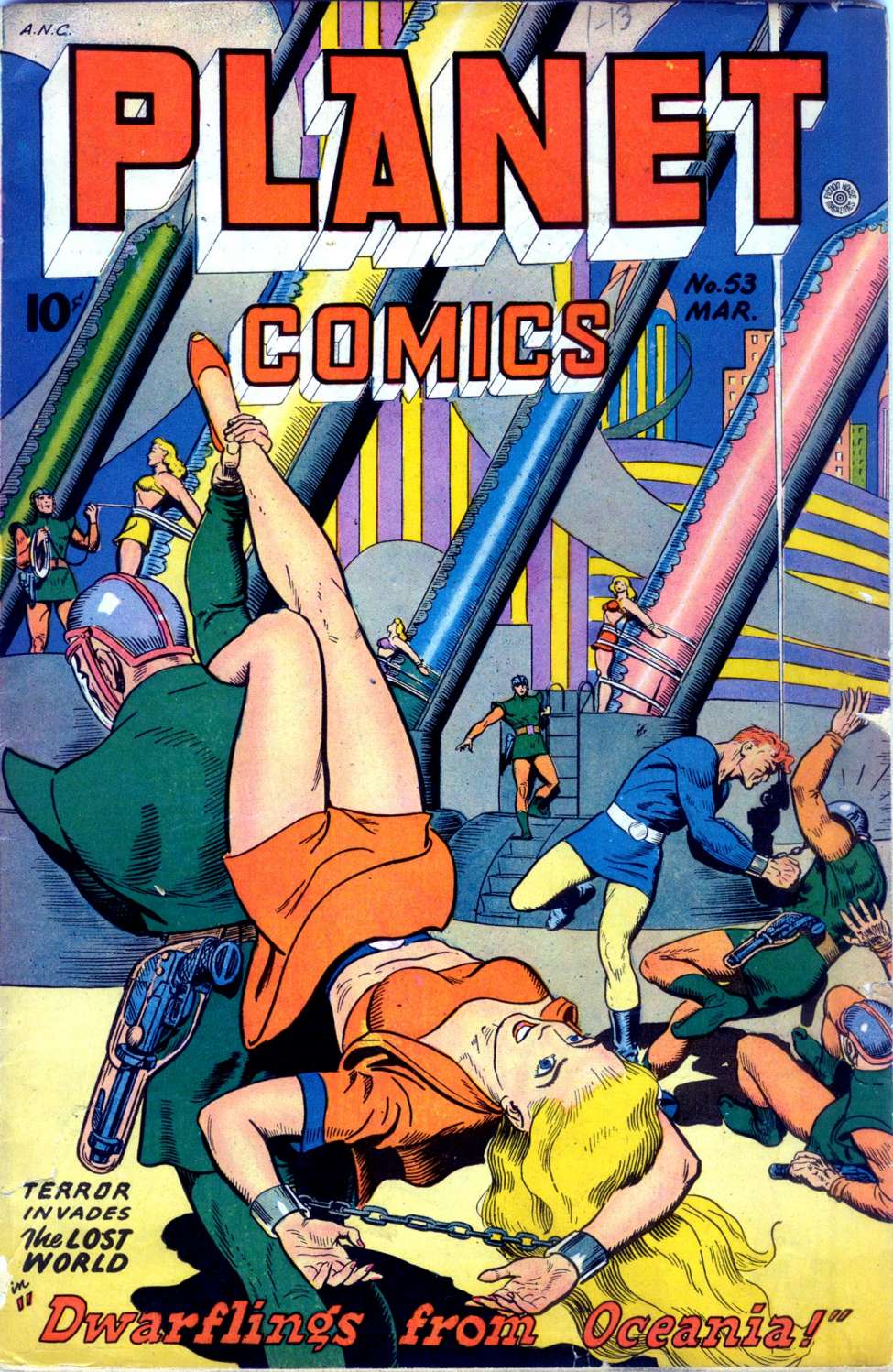
Planet Comics was the foremost purveyor of good girl art in comic books of the period, and is considered highly collectible by modern fans of comics' Golden Age. It specialized in colorful and lurid stories of interstellar action, ingenuous and attractive heroes and heroines, breezy dialogue, and the “barest smattering of sense and substance” (Benton 1992, p. 27). Its covers usually featured a beautiful, scantily-attired spacewoman with long bare legs being menaced by a frightful alien monster, while a sleek, heroic spaceman comes to her rescue.
Sometimes, though, Planet Comics reversed this formula: both covers and stories occasionally provided heroines who handily defeated the space aliens and interplanetary villains with little or no assistance from males (the comic was also seen as a fantasy title). Cynics might have noted that this sex-equality strategy in effect simply multiplied the number of lovely girls shown per panel, and insured that each and every panel featured at least one smashing spacegirl.
The Flint Baker/Space Ranger stories, according to Raymond Miller, "featured such writers as Al Schmidt and Huxley Haldane." Jerry Bails and Hames Ware's Who's Who of American Comic Books mentions Herman Bolstein and Dick Briefer.
Bails and Ware also list writers including Walter B. Gibson (The Shadow) and Frank Belknap Long, as working on "various features" for Planet Comics throughout the 1940s.
The strong female heroines of Planet Comics were complemented by Fiction House's employing several female artists to work on such tales, particularly Lily Renée, Marcia Snyder, Ruth Atkinson, and Fran(ces) Hopper (née Dietrick), whose art for "Mysta of the Moon" was often stunning. In addition, many artists who would become well-known names worked on Planet Comics stories over its 13-year history. These included the likes of Murphy Anderson, Matt Baker, Nick Cardy, Joe Doolin, Graham Ingels, George Evans, Ruben Moreira, John Cullen Murphy, George Tuska, and Maurice Whitman.
The early covers were drawn by industry legend Will Eisner. Later covers were predominantly the work of two men — Dan Zolnerowich (later Dan Zolne) and Joe Doolin. Zolne is believed to have produced covers for issues #10-25 (January 1941 – July 1943), and Doolin is thought to have illustrated all-bar-three of #26-65 (September 1943 – Spring 1951).
Hub AI
Planet Comics AI simulator
(@Planet Comics_simulator)
Planet Comics
Planet Comics was a science fiction comic book title published by Fiction House from January 1940 to Winter 1953. It was the first comic book dedicated wholly to science fiction. Like most of Fiction House's early comics titles, Planet Comics was a spinoff of a pulp magazine, in this case Planet Stories. Like the magazine before it, Planet Comics features space operatic tales of muscular, heroic space adventurers who are quick with their "ray pistols" and always running into gorgeous women who need rescuing from bug-eyed space aliens or fiendish interstellar bad guys.
Planet Comics #1 was released with a cover-date of January 1940, and ran for 73 issues until Winter 1953. Initially produced on a monthly schedule, issue #8 (September 1940) saw it slip to a bimonthly title, which it held until the end of 1949. From issue #26 (September 1943), "Planet Comics was cut to 60 pages," resulting in the merging of two strips: Flint Baker and Reef Ryan. Issue #63 (Winter 1949) began a quarterly release schedule, but #64, #65, and #66 were ultimately released annually, dated Spring 1950, 1951, and 1952, respectively. Issue #67 (Summer 1952) got the comic back on its quarterly release schedule, but the title only lasted a further seven issues, with its last (#73) again delayed for over a year, following issue #72 (Fall 1953).
Planet Comics was the foremost purveyor of good girl art in comic books of the period, and is considered highly collectible by modern fans of comics' Golden Age. It specialized in colorful and lurid stories of interstellar action, ingenuous and attractive heroes and heroines, breezy dialogue, and the “barest smattering of sense and substance” (Benton 1992, p. 27). Its covers usually featured a beautiful, scantily-attired spacewoman with long bare legs being menaced by a frightful alien monster, while a sleek, heroic spaceman comes to her rescue.
Sometimes, though, Planet Comics reversed this formula: both covers and stories occasionally provided heroines who handily defeated the space aliens and interplanetary villains with little or no assistance from males (the comic was also seen as a fantasy title). Cynics might have noted that this sex-equality strategy in effect simply multiplied the number of lovely girls shown per panel, and insured that each and every panel featured at least one smashing spacegirl.
The Flint Baker/Space Ranger stories, according to Raymond Miller, "featured such writers as Al Schmidt and Huxley Haldane." Jerry Bails and Hames Ware's Who's Who of American Comic Books mentions Herman Bolstein and Dick Briefer.
Bails and Ware also list writers including Walter B. Gibson (The Shadow) and Frank Belknap Long, as working on "various features" for Planet Comics throughout the 1940s.
The strong female heroines of Planet Comics were complemented by Fiction House's employing several female artists to work on such tales, particularly Lily Renée, Marcia Snyder, Ruth Atkinson, and Fran(ces) Hopper (née Dietrick), whose art for "Mysta of the Moon" was often stunning. In addition, many artists who would become well-known names worked on Planet Comics stories over its 13-year history. These included the likes of Murphy Anderson, Matt Baker, Nick Cardy, Joe Doolin, Graham Ingels, George Evans, Ruben Moreira, John Cullen Murphy, George Tuska, and Maurice Whitman.
The early covers were drawn by industry legend Will Eisner. Later covers were predominantly the work of two men — Dan Zolnerowich (later Dan Zolne) and Joe Doolin. Zolne is believed to have produced covers for issues #10-25 (January 1941 – July 1943), and Doolin is thought to have illustrated all-bar-three of #26-65 (September 1943 – Spring 1951).