


Community hub
Recent from talks
Knowledge base stats:
Talk channels stats:
Members stats:
Plasma parameters
Plasma parameters define various characteristics of a plasma, an electrically conductive collection of charged and neutral particles of various species (electrons and ions) that responds collectively to electromagnetic forces. Such particle systems can be studied statistically, i.e., their behaviour can be described based on a limited number of global parameters instead of tracking each particle separately.
The fundamental plasma parameters in a steady state are
Using these parameters and physical constants, other plasma parameters can be derived.
All quantities are in Gaussian (cgs) units except energy and temperature which are in electronvolts. For the sake of simplicity, a single ionic species is assumed. The ion mass is expressed in units of the proton mass, and the ion charge in units of the elementary charge , (in the case of a fully ionized atom, equals to the respective atomic number). The other physical quantities used are the Boltzmann constant (), speed of light (), and the Coulomb logarithm ().


In the study of tokamaks, collisionality is a dimensionless parameter which expresses the ratio of the electron-ion collision frequency to the banana orbit frequency.
The plasma collisionality is defined as where denotes the electron-ion collision frequency, is the major radius of the plasma, is the inverse aspect-ratio, and is the safety factor. The plasma parameters and denote, respectively, the mass and temperature of the ions, and is the Boltzmann constant.


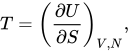
Temperature is a statistical quantity whose formal definition is or the change in internal energy with respect to entropy, holding volume and particle number constant. A practical definition comes from the fact that the atoms, molecules, or whatever particles in a system have an average kinetic energy. The average means to average over the kinetic energy of all the particles in a system.
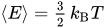
If the velocities of a group of electrons, e.g., in a plasma, follow a Maxwell–Boltzmann distribution, then the electron temperature is defined as the temperature of that distribution. For other distributions, not assumed to be in equilibrium or have a temperature, two-thirds of the average energy is often referred to as the temperature, since for a Maxwell–Boltzmann distribution with three degrees of freedom, .
Hub AI
Plasma parameters AI simulator
(@Plasma parameters_simulator)
Plasma parameters
Plasma parameters define various characteristics of a plasma, an electrically conductive collection of charged and neutral particles of various species (electrons and ions) that responds collectively to electromagnetic forces. Such particle systems can be studied statistically, i.e., their behaviour can be described based on a limited number of global parameters instead of tracking each particle separately.
The fundamental plasma parameters in a steady state are
Using these parameters and physical constants, other plasma parameters can be derived.
All quantities are in Gaussian (cgs) units except energy and temperature which are in electronvolts. For the sake of simplicity, a single ionic species is assumed. The ion mass is expressed in units of the proton mass, and the ion charge in units of the elementary charge , (in the case of a fully ionized atom, equals to the respective atomic number). The other physical quantities used are the Boltzmann constant (), speed of light (), and the Coulomb logarithm ().
In the study of tokamaks, collisionality is a dimensionless parameter which expresses the ratio of the electron-ion collision frequency to the banana orbit frequency.
The plasma collisionality is defined as where denotes the electron-ion collision frequency, is the major radius of the plasma, is the inverse aspect-ratio, and is the safety factor. The plasma parameters and denote, respectively, the mass and temperature of the ions, and is the Boltzmann constant.
Temperature is a statistical quantity whose formal definition is or the change in internal energy with respect to entropy, holding volume and particle number constant. A practical definition comes from the fact that the atoms, molecules, or whatever particles in a system have an average kinetic energy. The average means to average over the kinetic energy of all the particles in a system.
If the velocities of a group of electrons, e.g., in a plasma, follow a Maxwell–Boltzmann distribution, then the electron temperature is defined as the temperature of that distribution. For other distributions, not assumed to be in equilibrium or have a temperature, two-thirds of the average energy is often referred to as the temperature, since for a Maxwell–Boltzmann distribution with three degrees of freedom, .