Hubbry Logo
John Player & SonsJohn Player & SonsMain
Open search
John Player & Sons
Community hub
John Player & Sons
logo
8 pages, 0 posts
0 subscribers
Be the first to start a discussion here.
John Player & Sons
John Player & Sons
from Wikipedia

John Player & Sons, most often known simply as Player's, was a tobacco and cigarette manufacturer based in Nottingham, England. In 1901 the company merged with twelve other companies to become a branch of the Imperial Tobacco Company of Great Britain and Ireland.[2] The company pioneered the advertising with trading (cigarette) cards. As a branch, Player's continued this practice (see below), most notably with a series devoted to the association football in the 1930s.

Key Information

The brands currently sold, "Players" and "John Player Special" are owned and marketed by Imperial Brands and, especially in markets external to the UK, by British American Tobacco. In the UK, the JPS Players brand is the third-most popular cigarette brand (As of November 2025). Its Gold Leaf rolling tobacco is the fourth most-popular in the UK.[3]

History

[edit]

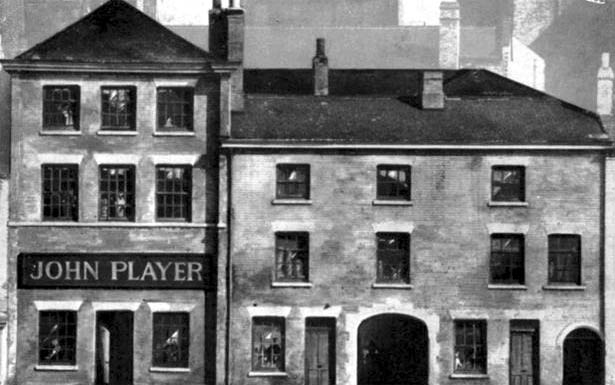
In March 1820, William Wright set up a small tobacco factory in Craigshill, Livingston, West Lothian. This business expanded and earned Wright a comfortable fortune. John Player bought the business in 1877. He had the Castle Tobacco Factories built in Radford, Nottingham, just west of the city centre.[4] He had three factories built, but initially only one was used to process and pack tobacco. The other two blocks were rented out to lace manufacturers until the business had expanded enough to use the additional space.[5]

John Player died in December 1884 and for the next nine years the business was run by a small group of family friends until his sons, William Goodacre Player and John Dane Player, took over management of the firm in 1893.[6] The business became a private limited company in 1895, with an issued share capital of £200,000.[2]

In 1901, in response to a serious competitive challenge from "Buck" Duke's American Tobacco Company, a defensive merger of thirteen British tobacco manufacturers saw Player's merged into the newly created Imperial Tobacco Company of Great Britain & Ireland. The largest constituent of Imperial Tobacco, and major driver of the amalgamation, was W. D. & H. O. Wills and the new company was run for eight years from a suite of offices located in the Wills' branch premises until a new Imperial Tobacco head office was built in Bedminster, Bristol.[2] As a constituent part of Imperial Tobacco, Player's was tightly controlled from Bedminster but as a manufacturer the branch retained its own identity, producing distinctive cigarette brands such as Navy Cut, No. 9, John Player Special, and Gold Leaf; loose tobacco brands such as No Name; and its distinctive logo of a smoking sailor in a navy-cut cap.

Workers and staff of John Player at a Christmas party in the 1920s

Player's Medium Navy Cut was the most popular by far of the three Navy Cut brands (there was also Mild and Gold Leaf, mild being today's rich flavour). In January 1937, Player's sold nearly 3.5 million cigarettes (which included 1.34 million in London).[7] The popularity of the brand was mostly amongst the middle class and in the South of England. It was smoked in the north but other brands were locally more popular.[7]

Production continued to grow until at its peak in the late 1950s, Player's was employing 11,000 workers (compared to 5,000 in 1926) and producing 15 brands of pipe tobacco and 11 brands of cigarettes.[2]

In the UK in 1968, in response to an increase in tobacco duty in the budget, Player's launched a new, cheaper brand, "Player's No.10". Priced at 3 s 2 d (16 p) for 20, it was the cheapest cigarette on the British market.[8]

Pack of Player's Extra Lights shown on a billboard in Toronto, Canada, c. 1980

A new factory (the 'Horizon' factory) was opened in the early 1970s on Nottingham's industrial outskirts, with better road access and more effective floor space, next to the headquarters of Boots the Chemists. On 15 April 2014, Imperial Tobacco announced that the Horizon factory would close in early 2016, bringing an end to cigarette and tobacco manufacture in Nottingham after over 130 years.

The old factories in Radford, especially the cavernous No. 1 Factory which occupied the whole area between Radford Boulevard and Alfreton Road, bordered by Player Street and Beckenham Road, were gradually run down. The No. 2 Factory, facing onto Radford Boulevard with its distinctive clock (now plinthed in the retail park on the site) and the No. 3 factory (which faced onto Churchfield lane) with its rooftop 'John Player & Sons' sign, were demolished in the late 1980s. The iron railings and gates onto Radford Boulevard from the present retail park are the ones that surrounded No. 2 Factory – the large gates (present vehicle access) were the entrance to the factory yard between No. 2 and No. 3 factories and the smaller gates were the pedestrian entrances to No. 2 factory itself.[9]

Manufacture

[edit]
Gold Leaf is the widely used cigarette brand in Pakistan

Player's still trades, but with a much-reduced workforce (down to about 700 employees due to increased efficiency) compared to the 20th century, when it was one of the Big Three employers associated with Nottingham, along with Boots the Chemists and the Raleigh Bicycle Company. Player's workforce peaked in the 1960s: subsequently the company's fortunes declined as awareness of the health effects of tobacco increased, and during the 1980s five of the firm's Nottingham factories closed with the loss of 3,000 jobs. Its current workforce is eclipsed by larger service sector employers in the city, such as Experian and Queen's Medical Centre[10] and the University of Nottingham.

As of 2020, the Player's Navy Cut, Players and John Player Special (JPS) brands are manufactured by Imperial Brands in the UK, whereas John Player Gold Leaf is manufactured by British American Tobacco for sale in markets external to the UK, and ranks as one of the best selling and most popular tobacco products in Pakistan. It is also marketed in Bangladesh, Sri Lanka, Malaysia, and Arab States of the Persian Gulf. In South Asia, it is one of the biggest brands in the High category brand list.

The JPS brand has also been re-positioned in the last several years and is now a UK mid-price cigarette brand.

United Kingdom

[edit]

As of 2020, John Player Special (JPS) sell the following cigarettes in the UK:

  • JPS Black King Size
  • JPS Real Blue King Size and Superkings
  • JPS Silver Stream King Size and Superkings
  • JPS Crushball King Size (discontinued as of 20 May 2020)
  • JPS Green Edge King Size and Superkings (discontinued as of 20 May 2020)
  • JPS Triple Flow King Size

They also sell a lower-cost product marketed under the JPS Players Brand:

  • JPS Players Real Red King Size and Superkings
  • JPS Players Bright Blue King Size and Superkings
  • JPS Players Crushball King Size and Superkings (discontinued as of 20 May 2020)
  • JPS Players Green Superkings (discontinued as of 20 May 2020)

As of November 2025, the Players cigarette brand holds 9.9% of the UK market and is the third-most popular cigarette brand in the country.[3]

Also the following rolling tobacco in 30g and 50g pouches:

  • JPS Hand Rolling Tobacco
  • JPS Players Tobacco
  • Gold Leaf JPS Quality Blend Tobacco

Canada

[edit]

In Canada, Player's is manufactured by Imperial Tobacco Canada and is available in the following varieties, in both regular and king size:

  • Player's Original Flavour
  • Player's Rich Flavour
  • Player's Smooth Flavour
  • Player's Plain
  • Player's Black & Red
  • Player's Black & Gold
  • Player's Black & Silver
  • John Player Smooth
  • John Player Special
  • John Player Standard Blue
  • John Player Standard Silver
  • John Player Choice (discontinued)
  • Player's Special Blend

Besides cigarettes, John Player & Sons also markets a line of rolling tobacco in Canada, the UK, and several European countries. The rolling tobacco is typically portioned into 12.5, 25, and 50-gram bags.

Rolling tobacco is available in the following varieties:

  • John Player Special Red
  • John Player Special Blue
  • John Player Special Silver
  • John Player Halfzware Shag
  • Player's Gold Leaf

Ireland

[edit]

In Ireland, Imperial Brands trade as John Player. The following John Player products are on the market in Ireland.

  • John Player Blue King Size
  • John Player Blue King Size 24s
  • John Player Blue King Size 27s
  • John Player Blue 100s
  • John Player Blue Compact
  • JPS Blue King Size
  • JPS Blue King Size 23s
  • JPS Blue King Size 28s
  • JPS Blue King Size 34s
  • JPS Blue 100s
  • JPS Red King Size
  • JPS Red King Size 23s
  • JPS Red 100s
  • JPS Silver Stream King Size
  • JPS Silvet Stream 100s
  • JPS Bright King Size
  • JPS Cool Green King Size (replaced JPS Crush Ball)
  • JPS Cool Green 100s (replaced JPS Green 100s)
  • Superkings Black
  • Superkings Bright (previously Blue)
  • Lambert & Butler Silver King Size
  • Regal King Size
  • Players Navy Cut
  • Drum The Original Tobacco
  • Drum Bright Blue
  • Golden Virginia Original
  • Golden Virginia Yellow
  • Riverstone Rolling Tobacco
  • John Player Blue Volume Tobacco
  • JPS Blue Volume Tobacco
  • JPS Silver Volume Tobacco

Sri Lanka

[edit]

In Sri Lanka, Player's is manufactured by Ceylon Tobacco Company and is available in the following varieties.[11]

  • John Player Gold Leaf
  • John Player Gold
  • John Player Navy Cut

Sponsorship and marketing

[edit]
1975 Ford Capri Mk II 2.0 JPS

John Player's brands are well known in motor racing from their long association with the Lotus Formula One team, the Forsythe Racing Champ Car team, and Norton motorcycle racing team.

Ford introduced the John Player Special limited edition Capri, (known as the JPS) in March 1975. Available only in black or white, the JPS featured yards of gold pinstriping to mimic the Formula 1 livery, gold-coloured wheels, and a bespoke upgraded interior of beige cloth and carpet trimmed with black.

Car racing

[edit]

John Player's sponsorship of Team Lotus began with the Lotus 49 in Gold Leaf colours in the 1968 Tasman Series. It continued with the Lotus 49 and Lotus 72 in Formula One, changed to the black and gold John Player Special colours in 1972, and ended in 1986 with the Lotus 98T, as the team switched to the Camel-sponsored yellow livery the following season.

In Australia, JPS Team BMW competed in the Australian Touring Car Championship between 1981 and 1987, with Jim Richards winning the series in 1985 and 1987. In 1981, BMW released a limited-edition road version of its 323i touring car in JPS colours to the Australian market and another in 1984.

North America

[edit]
Greg Moore in a 1996 IndyCar with Player's branding.

Imperial Tobacco Canada's Player's brands also sponsored Canadian auto racing for decades. After a blanket tobacco advertising ban was instituted in the Canadian Tobacco Act in 1988, Imperial created a new corporation, Player's Racing Ltd., that was strictly an auto racing promotion company. This took advantage of an exemption in the Act that allowed tobacco companies to sponsor "cultural events" using the company's proper name instead of a brand name. Player's Ltd. advertising looked nearly identical to Player's cigarette packs, and given that it was one of the few legal outlets for advertising, the company was extensively promoted both during race weekends and at other sporting events.

Player's Racing promoted a number of Canadian drivers, including 1995 Indianapolis 500 and IndyCar champion Jacques Villeneuve, whose Forsythe-Green Racing team carried a Player's Ltd livery. The team would later carry on in CART as Player's Forsythe Racing, which after the Tobacco Act was struck down as violating the Charter of Rights, was able to use Player's branding. The team was competitive and featured Canadian drivers Greg Moore, Patrick Carpentier, Alex Tagliani, and in 2003, Paul Tracy. Tracy would win the championship in 2003, just as a new Tobacco Act ban took full effect for auto racing in October 2003. The team would use a "GOODBYE, CANADA" theme for Tracy and Carpentier's final races and not have explicit Player's branding.

Motorcycle racing

[edit]

John Player began sponsoring Norton motorcycle racing in November 1971.[12] The racing was successful and Norton produced a version of the Norton Commando in John Player colours to exploit it. However, Norton's NVT parent company commercially declined and John Player withdrew sponsorship in 1974.[13]

In the 1980s, Norton Motorcycles was revived and in 1988 John Player resumed racing sponsorship.[14] The racing succeeded again and in 1990–91 Norton produced a road-going version of its RCW588 racer, the Norton F1.[15] In 1991 Norton again commercially declined and John Player withdrew sponsorship for a second time.

Other events

[edit]

The company also sponsored an influential series of celebrity lectures at the National Film Theatre between 1968 and 1973. Well over 100 international film stars took the stage to introduce screenings and discuss their career. The series was revived at the end of the 1970s as the Guardian Lectures.

In the 1970s Player's operated a steamboat, Hero, for promotional purposes.[16]

Player's sponsored the Canadian Open tennis championship in the 1980s.

From 1969 to 1987 John Player sponsored the John Player Sunday League for English county cricket clubs.

Cigarette cards

[edit]

Player's were one of the first UK tobacco companies to include sets of general interest cards in their packs of cigarettes. One of the first sets, produced in 1893, was Castles and Abbeys. These cards were generally produced in sets of 50 and have since become highly collectable. Other sets produced include Street Cries (cries of street vendors) in 1913 and 1916; Footballers (1926); Civil Aircraft (1935); Motor Cars (1936) and a Coronation Series in 1937. John Player & Sons issued more than 200 sets of cards and some were reprinted in the 1990s.[citation needed]

In sports, Player's released several cards series, mostly association football collections. One of them was the "Cup Winners" series, featuring FA Cup winning teams and the illustrated "Hints on association football" in 1934, where some football movements (kicks, passes, defensive tactics, etc.) were shown.[17] Player's also released a rugby union series in 1926,[18] and a cricket series in 1934.[19]

[edit]

Bibliography

[edit]

References

[edit]
[edit]
Revisions and contributorsEdit on WikipediaRead on Wikipedia
from Grokipedia

John Player & Sons was a British tobacco manufacturing company founded in Nottingham in 1877 by John Player, who acquired an existing tobacco business and established production facilities there. The firm became known for cigarette brands such as Player's Navy Cut, introduced around 1900, and later Player's No. 6 and John Player Special (JPS), with the latter achieving significant market success in the mid-20th century. In 1901, it merged with other British tobacco firms to form the Imperial Tobacco Company, continuing as a key brand within that conglomerate.
The company's marketing innovations included issuing collectible cigarette cards starting in 1893, which featured topics from sports to aviation and contributed to brand loyalty. John Player & Sons expanded its influence through sponsorships, particularly in motorsport, where the JPS brand backed Team Lotus in Formula One from 1972, introducing the iconic black-and-gold livery associated with drivers like Emerson Fittipaldi and Mario Andretti during a dominant era for the team. It also supported motorcycle racing with Norton and other events, leveraging these partnerships to promote its products amid growing regulatory scrutiny on tobacco advertising. Production at its Nottingham facilities, including the modern Horizon factory opened in 1972, continued until 2016, marking the end of an era for the brand's manufacturing legacy.

Origins and Historical Development

Founding and Early Expansion (1828–1901)

The origins of John Player & Sons trace to March 1828, when William Wright established a small tobacco factory in the Broadmarsh district of Nottingham, England. This enterprise grew steadily over the subsequent decades, producing pipe tobaccos and other products, which enabled Wright to amass sufficient wealth for a comfortable retirement by 1877. In that year, local businessman John Player, born in 1839 and previously engaged in retailing seeds, manure, and tobacco from a shop on Beastmarket Hill since around 1862, acquired the factory and its operations. Player's purchase marked the formal inception of John Player & Sons as a dedicated manufacturing concern, with an initial focus on expanding production capacity to meet rising demand for tobacco goods in Victorian Britain. Anticipating further growth in the burgeoning tobacco industry, Player promptly invested in new infrastructure, commissioning the construction of the Castle Tobacco Factories in the Radford area of Nottingham shortly after the acquisition. This complex consisted of three substantial factory blocks, though operations initially commenced in only one to facilitate a phased rollout of machinery and workforce integration. By 1884, the business had relocated fully to the Radford site, which offered superior space and efficiency compared to the original Broadmarsh premises, enabling increased output of hand-rolled cigarettes and cut tobaccos. That same year, Player succumbed to liver cancer at age 45, after which a cadre of family associates managed the firm for nearly a decade to stabilize its trajectory. In the early 1890s, Player's sons—William Goodacre Player and John Dane Player—assumed leadership, driving continued expansion through enhanced manufacturing techniques and broader distribution networks, including additional retail outlets such as those on Sheep Lane (later Market Street). Under their stewardship, the company solidified its reputation for quality products, positioning it among Britain's leading tobacco firms by 1901, when it amalgamated with other domestic manufacturers to form the Imperial Tobacco Company in response to intensifying competition from American rivals. This period of early development laid the groundwork for John Player & Sons' prominence, transforming a modest acquisition into a scaled industrial operation centered in Nottingham.

Integration into Imperial Tobacco and Growth (1901–1945)

In 1901, John Player & Sons joined twelve other British tobacco manufacturers to form the Imperial Tobacco Company, a cartel established to resist aggressive expansion by the American Tobacco Company into the UK market. This integration positioned John Player & Sons as a key subsidiary brand within Imperial, with the Player brothers serving on the new company's inaugural board of directors, while retaining operational autonomy in production and branding. The merger preserved domestic market shares through non-aggression agreements, allowing John Player & Sons to focus on expanding its cigarette lines amid rising demand for machine-rolled products. Following the merger, John Player & Sons experienced substantial growth, driven by the popularity of brands like Player's Medium Navy Cut, introduced in 1900 just prior to integration. Employee numbers at its Nottingham facilities rose from approximately 1,600 in 1906 to 2,500 by 1914, reflecting increased mechanization and output. By the interwar period, the workforce expanded further to 5,000 in 1928 and 7,500 in 1939, supported by factory extensions at the Radford site, including new buildings opened in 1932 and 1939, alongside a bonded warehouse. This period also saw Imperial establishing manufacturing plants in Ireland in 1923–1924, extending John Player's production footprint. During World War II, John Player & Sons contributed significantly to wartime supplies, with Imperial Tobacco shipping nearly 12 billion cigarettes and 1.75 million pounds of pipe tobacco to British troops by 1945, bolstering the subsidiary's role in sustaining domestic and military demand. The company's growth trajectory through this era underscored its adaptation to mass production techniques and brand loyalty, positioning it as one of Imperial's flagship operations despite broader industry consolidations.

Post-War Modernization and Global Reach (1945–1980s)

Following World War II, John Player & Sons resumed expansion within Imperial Tobacco's structure, capitalizing on recovering domestic demand for cigarettes. The company introduced innovative brands, including Player’s No. 6 in 1966, which achieved the status of Britain's best-selling cigarette by 1970 through its appeal to modern consumers seeking milder tobacco products. Employment at John Player & Sons grew significantly, reaching approximately 11,000 workers by the late 1950s, reflecting increased production capacity and market share in the UK. A pivotal modernization initiative occurred with the construction and opening of the Horizon factory in Nottingham's Lenton Industrial Estate on November 1, 1972, at a cost of £15 million. Designed by Arup Associates, this state-of-the-art facility incorporated advanced automation and efficient layouts, supplanting outdated sites such as the Radford complex and earning architectural accolades in 1973 for its innovative industrial design. Complementing broader Imperial Tobacco efforts, Horizon exemplified post-war investments in technology to enhance output efficiency, alongside the simultaneous development of Wills' Hartcliffe factory in Bristol, positioning both as among the world's most advanced tobacco production centers by the mid-1970s. By 1980, Imperial had streamlined its operations to three primary entities—W.D. & H.O. Wills, John Player & Sons, and Ogden’s—centralizing administrative functions to support these modernized units. John Player & Sons' global reach during this era remained predominantly tied to Imperial Tobacco's established export channels in the UK and Ireland, with limited direct international manufacturing; overseas sales constituted a minor portion of revenue until expansions in the 1990s. Brands like John Player Special began gaining traction in select foreign markets through distribution networks, particularly in Commonwealth countries, though primary growth focused domestically amid rising health regulations and EU-influenced tobacco taxation post-1973. Imperial Tobacco's workforce peaked at 100,000 employees group-wide by 1979, underscoring the scale of operations that indirectly bolstered Player’s brands abroad via consolidated supply chains.

Products and Brands

Core Cigarette Lines and Innovations

John Player & Sons developed several flagship cigarette brands, with Player's Navy Cut serving as a foundational line characterized by its use of a specific tobacco cut favored by sailors for durability at sea, achieving widespread popularity in Britain and exported markets by the early 20th century. Player's No. 6, launched in early 1966, rapidly became Britain's best-selling cigarette brand through the 1970s, available in both plain and filter-tipped versions with eye-catching packaging designed for mass appeal and affordability. John Player Special (JPS), introduced in the United Kingdom in 1970, offered king-size cigarettes blending premium tobacco at competitive prices, distinguished by its signature black packs and gold lettering that emphasized luxury positioning. Among innovations, the company pioneered pre-packaged tobacco sales in the late 19th century, departing from traditional loose-weight purchases to provide standardized portions and enhance convenience for consumers. This approach extended to pre-rolled cigarettes, where John Player & Sons advanced machine-rolling techniques for uniform production, contributing to the scalability of branded lines like Navy Cut. Filter-tipped variants, as seen in No. 6 and subsequent brands, reflected adaptations to evolving smoker preferences for reduced harshness, while bold, modern packaging innovations in the 1960s supported market dominance amid intensifying competition.

Tobacco Products Beyond Cigarettes

John Player & Sons initially produced loose tobacco sold from jars for pipe smoking and hand-rolling, as a means to supplement revenue in its early operations as a Nottingham-based tobacconist. This loose tobacco was offered in fine cut or rough varieties, weighed on shop scales for customers prior to the company's expansion into machine-rolled cigarettes. The firm developed dedicated pipe tobacco lines, including under the enduring Player's Navy Cut brand, which originated in 1883 and encompassed both cigarette and pipe variants known for their popularity among smokers. Specific formulations included Player's Navy Cut Flake, marketed as a premium pipe tobacco, and Medium Navy Cut, distributed in tins for loose pipe use. Additionally, blends such as Country Life Smoking Mixture were produced around 1900, reflecting the company's diversification into flavored or mixed tobaccos suited for pipes. By the late 19th and early 20th centuries, following the 1901 merger into Imperial Tobacco, John Player & Sons maintained production of pipe tobaccos alongside cigarettes, with records indicating ongoing manufacture of multiple tobacco types into the mid-20th century. These products catered to traditional smoking preferences, though cigarettes eventually dominated the company's output and branding efforts. No substantial evidence exists for significant production of cigars, snuff, or chewing tobacco under the John Player & Sons name, with the focus remaining on pipe and loose tobaccos as complements to their cigarette lines.

Manufacturing Operations

United Kingdom Facilities and Techniques

John Player & Sons established its initial manufacturing presence in Nottingham with the purchase of William Wright's tobacco factory in the Broadmarsh area in 1877, marking the company's shift from retail to large-scale production. This facility served as the core site for early operations, focusing on tobacco processing and initial cigarette assembly before expansions. By 1883, the company constructed the original Castle Tobacco Factory in Radford, Nottingham, encompassing approximately 43,948 square feet of superficial area, which facilitated increased output through dedicated production blocks. Subsequent developments included additional factories at the Radford site starting in 1884, with further buildings added in the 1920s and 1930s to accommodate growing demand for machine-made cigarettes. The Horizon Factory, located on a 45-acre site at Lenton Industrial Estate, represented a pinnacle of post-war modernization, featuring highly automated production lines capable of manufacturing over 52 billion cigarettes annually at its peak, employing up to 7,000 workers. These UK facilities centralized operations under Imperial Tobacco after the 1901 merger, emphasizing efficiency in tobacco blending and packaging. Production techniques evolved from hand-rolled cigarettes in the late 19th century to mechanized processes by 1900, exemplified by the launch of Player's Medium Navy Cut as a mass-produced product. Early methods involved manual cutting and rolling of fine-cut or rough tobacco, transitioning to automated slicing and pressing for pipe tobaccos like Navy Cut, which remained a staple technique. In advanced facilities like Horizon, high-speed machinery handled tobacco shredding, blending specific varietals, filter attachment, and wrapping, optimizing for consistency and volume while adhering to quality controls for moisture content and draw resistance inherent to cigarette manufacturing.

International Production Sites

In response to growing global demand following its integration into Imperial Tobacco in 1901, John Player & Sons expanded production capabilities beyond the United Kingdom through subsidiary operations and group facilities. A key site was the cigarette manufacturing plant in Dublin, Ireland, which produced Player's brands for the local and regional markets; this facility employed approximately 90 workers and operated until its announced closure on December 10, 2004, as part of Imperial's restructuring to consolidate operations amid declining European volumes. Earlier premises associated with Imperial Tobacco Company/John Player & Sons were established on Botanic Road in Glasnevin, Dublin, constructed in 1923 to support tobacco processing and distribution in Ireland. In Canada, Imperial Tobacco Canada Limited functioned as a successor entity to John Player & Sons, maintaining a dedicated division for Player's cigarette production; brands such as Player's Navy Cut were manufactured at facilities including the company's plant in Montreal, Quebec, serving North American markets with variants tailored to local preferences. This operation contributed to Player's establishing a strong foothold, with the brand ranking among Canada's most popular cigarettes for decades. By the 2010s, as UK-based manufacturing faced regulatory and economic pressures, Imperial relocated Player's production from the Nottingham Horizon factory—closed in May 2016—to continental European sites for cost efficiency and compliance with plain packaging laws. Specific transfers included facilities in Poland, such as Imperial's Ozorków plant, and Germany, including sites operated by subsidiary Reemtsma in Langenhagen and other locations, enabling continued output of John Player Special and related lines for export to over 18 countries. These moves reflected broader industry shifts toward centralized Eastern European production, though recent announcements indicate potential further adjustments, such as the planned cessation at Langenhagen in 2025.

Marketing Strategies and Sponsorships

Pre-Ban Advertising and Branding

![Player's cigarette pack on billboard advertising][float-right] John Player & Sons established its branding early through trademarks emphasizing local heritage and product quality, registering a depiction of Nottingham Castle in 1877 for pipe tobacco packaging and labels. For its flagship Player's Navy Cut cigarettes, introduced around 1900, the company adopted an iconic sailor emblem in 1883, portraying a figure toasting with a lifebuoy and "Hero" inscribed on his cap, which conveyed naval tradition and reliability across print advertisements and packaging. This branding persisted in early 20th-century press ads, such as a 1899 advertisement promoting Navy Cut tobacco and cigarettes for their fine quality. In the post-war era, advertising strategies evolved to target emerging youth markets, incorporating imagery of leisure and social enjoyment. By the 1950s, print campaigns featured scenarios like rural activities paired with smoking pleasure, reinforcing the longstanding "Players Please" slogan to evoke satisfaction and broad appeal. Market research informed a shift toward younger demographics, with advertisements from the 1950s and early 1960s regularly depicting teenagers and young adults to build brand loyalty among new consumers. The "People Love Player's" campaign, launched in 1961, exemplified this approach by using romantic couple imagery and themes of love and gender dynamics to position the product as integral to youthful social experiences, appearing in magazines and other print media. These efforts relied on point-of-sale materials like counter cards and show cards, alongside billboards, to maintain visibility in retail environments before television and comprehensive print restrictions took effect in the mid-1960s.

Sports and Event Sponsorships

John Player & Sons (JP&S) employed sports sponsorship as a key marketing strategy from the late 1960s onward, particularly to promote brands like Gold Leaf and John Player Special amid tightening tobacco advertising restrictions. The company targeted events offering high visibility and audience engagement, establishing "unique, distinctive and dominating" presence in selected sports. In motorsports, JP&S pioneered cigarette sponsorship in Formula One by backing Gold Leaf Team Lotus starting in 1968, marking the first full-season team sponsorship by a tobacco firm, with cars painted in red, white, and gold livery. This evolved into the iconic black-and-gold John Player Special scheme from 1972, adorning Lotus models such as the Type 72 and Type 77 through 1986, contributing to multiple constructors' and drivers' championships. The firm also supported Norton motorcycles in racing from November 1971, including works efforts with the Commando and rotary-engined RCW588 models. Additional motorsport involvements encompassed Formula 3, Trans-Am series, and powerboat racing. JP&S heavily invested in cricket, sponsoring the John Player League—a one-day county competition—from 1969 to 1986, which boosted the format's popularity and aligned with the company's Nottingham roots. This included partnerships with county teams and international tours, leveraging the sport's cultural significance in Britain to enhance brand recall. The company extended sponsorship to snooker, notably sponsoring professional tours and tournaments under the John Player banner from the 1970s, including events that supported players like John Spencer. Earlier efforts included rowing, with donations to Tideway Scullers in the 1960s for national team representation. These initiatives collectively amplified JP&S's visibility until regulatory pressures curtailed tobacco-linked promotions in the 1980s and beyond.

Circumvention of Advertising Restrictions

Following the imposition of restrictions on tobacco advertising, including the 1965 ban on television commercials in the United Kingdom, John Player & Sons increasingly relied on sports sponsorships to promote its brands, particularly John Player Special. These sponsorship deals enabled the prominent display of logos and liveries during televised events, providing indirect exposure that regulators initially permitted despite direct ad prohibitions. In cricket, a key area of focus, the company sponsored Nottinghamshire County Cricket Club starting in the late 1960s and backed national competitions, framing tobacco brands as supporters of traditional British leisure activities. This approach not only maintained visibility among audiences but also cultivated a philanthropic image, countering emerging health concerns by linking smoking to athleticism and community engagement. Similar tactics extended to snooker tournaments, such as the John Player-sponsored events in the 1970s, where branding appeared on cues, tables, and broadcasts. The most visible circumvention occurred in motorsports, where John Player Special entered a high-profile partnership with the Lotus Formula One team in 1972. The team's black-and-gold livery, emblazoned with the JPS logo, became iconic and was showcased worldwide via race telecasts, reaching millions in jurisdictions with ad bans. This sponsorship persisted through the 1970s, yielding multiple championships and embedding the brand in global pop culture, even as European restrictions tightened by the 1980s. Internationally, affiliates like Imperial Tobacco Canada utilized Player's brands in auto racing sponsorships post-1990s bans, adapting liveries to comply superficially while preserving recognition through familiar color schemes and subtle identifiers. Critics, including the World Health Organization, later highlighted these practices as deliberate loopholes undermining public health policies, though they remained legal until comprehensive sponsorship prohibitions in the early 2000s.

Collectibles and Cultural Artifacts

Cigarette Cards and Series

John Player & Sons began inserting collectible cigarette cards into their cigarette packets in 1893, positioning the company among the earliest British tobacco manufacturers to adopt this promotional tactic. These cards initially served a practical purpose by stiffening the soft paper packaging while doubling as advertising tools to foster brand loyalty through collecting incentives. By the early 20th century, the cards evolved into illustrated series on diverse educational and pictorial themes, encouraging consumers to purchase additional packs to complete sets. The company's output encompassed hundreds of series spanning topics from history and literature to sports and natural sciences, often produced in sets of 25 or 50 cards. Early examples included "Castles and Abbeys," military subjects, and characters from Charles Dickens' novels, reflecting Victorian interests in heritage and culture. Literary-themed sets continued with "Characters from Thackeray" in 1913, featuring 25 illustrations from William Makepeace Thackeray's works. Sports series gained prominence, such as the 1934 "Australian Cricket Team Tour of England" depicting players like Donald Bradman, and "Hints on Association Football" providing instructional diagrams on techniques like kicking. Aviation enthusiasts collected the 1935 "Civil Aircraft" series, which included 50 cards showcasing models like the de Havilland DH.88 Comet. Royal commemorations featured in the 1937 "Coronation Series," portraying figures such as the Archbishop of Canterbury and orders like the Order of the Indian Empire. Other notable issues addressed contemporary events and technology, including "British Naval Craft" with 25 large cards issued in 1939 amid rising geopolitical tensions, and "Fire Fighting Appliances" in 1930 detailing 50 pieces of equipment. National identity appeared in the 1936 "National Flags and Arms" set of 50, while natural history offerings like the 1930s "Sea Fishes" series provided colorful depictions of marine life. These cards not only marketed the brand but also disseminated factual information, contributing to public education on various subjects before widespread media alternatives.

Packaging and Memorabilia

John Player & Sons cigarette packaging prominently featured brand-specific iconography to distinguish products in competitive markets. Player's Navy Cut packs displayed a sailor emblem, often set against an ocean scene with the figure framed in a life belt, as seen in early 20th-century designs for 10-cigarette packets. This nautical motif emphasized the tobacco's "cut" quality, derived from manufacturing techniques, and appeared on both tins and paper cartons. Early packaging utilized metal tins for brands like Navy Cut, providing durable storage before shifting to cardboard with sliding trays in the mid-20th century to reduce costs and align with mass production. John Player Special (JPS) adopted premium aesthetics with black backgrounds and gold lettering, enhancing perceived luxury; a 1999 packet of 20 cigarettes exemplified this, manufactured in Nottingham using Virginia tobacco blends. Variations included filter-tipped and plain versions with bold, minimalist designs that persisted through the late 20th century. Memorabilia extends to preserved tins and promotional items, valued for historical packaging insights. Vintage Navy Cut tins, such as round or rectangular formats from the early 1900s, serve as collectibles due to their embossed labels and original paper wraps. Promotional ashtrays, often in glass, ceramic, or porcelain, bore brand logos; examples include square black glass pieces inscribed with "John Player Superkings" and centenary models marking 1877–1977 for employee distribution. These artifacts, alongside empty packs, highlight the company's integration of branding into everyday smoking accessories before advertising restrictions intensified.

Economic and Social Impact

Employment and Regional Development in Nottingham

John Player & Sons initiated tobacco manufacturing in Nottingham by acquiring a factory in the Broadmarsh area in 1877, establishing a foundation for local employment in the burgeoning cigarette industry. By 1906, the Castle Tobacco Factory alone employed approximately 1,600 workers, contributing to the city's commercial vitality through steady manufacturing jobs. Expansion continued into the early 20th century, with the Radford site reaching 2,500 employees by 1914 amid pre-World War I growth. The company's workforce expanded significantly post-war, peaking at around 9,000 employees in the 1960s across multiple Nottingham facilities, positioning John Player & Sons as one of the region's dominant employers from the 1930s through the 1970s. This scale of employment bolstered regional economic stability, offering opportunities in production, packaging, and administration, often spanning generations within families and embedding the firm deeply in Nottingham's social fabric. The 1972 opening of the Horizon Factory in Lenton, a £15 million investment in advanced machinery and infrastructure, sustained high employment levels while enhancing output efficiency for brands like No. 6 and Special. John Player & Sons' operations fostered regional development by concentrating skilled labor in Nottingham, supporting ancillary industries such as logistics and suppliers, and providing training in mechanized tobacco processing that influenced local manufacturing expertise. However, regulatory pressures and market consolidation under Imperial Tobacco led to facility rationalizations, including the 2014 closure of the remaining Nottingham plant, which employed hundreds and severed long-standing ties for thousands of families historically linked to the industry. This decline reflected broader shifts away from tobacco production, redirecting Nottingham's economy toward services and diminishing the sector's role in regional growth.

Contributions to Sports and Entertainment

John Player & Sons contributed to motorsports through extensive sponsorships, beginning with Formula 1 in 1968 when the company backed Team Lotus under its Gold Leaf brand, marking one of the earliest major tobacco sponsorships in the sport. This partnership evolved in 1972 with the introduction of the John Player Special livery, featuring distinctive black and gold colors that adorned Lotus cars during a dominant era, including drivers like Emerson Fittipaldi and Ronnie Peterson achieving multiple Grand Prix victories and constructors' titles. The sponsorship provided crucial funding that enabled technical innovations and competitive edge for Lotus, elevating the visibility of both the team and the brand on a global stage. In motorcycle racing, John Player & Sons sponsored Norton-Villiers from 1971 to 1974, supporting factory racers in Formula 750 events with riders such as Peter Williams securing wins, including the 1973 Daytona 200. This backing extended to production models like the 1974 Norton Commando John Player Special, a limited-edition street bike replicating the racing livery and contributing to Norton's commercial efforts amid financial challenges. The sponsorship highlighted the company's role in sustaining British manufacturing and racing heritage during a period of industry transition. Beyond motorsports, the company supported English county cricket by sponsoring the John Player Sunday League from 1969 to 1987, a limited-overs competition that introduced colored uniforms and floodlit matches to attract larger audiences and modernize the domestic game. This financial injection aided clubs in professionalizing operations and expanding fan engagement, though it drew scrutiny over tobacco promotion in family-oriented sports. Earlier involvement included donations to rowing clubs like Tideway Scullers in the 1960s, enabling international representation. These sponsorships, while boosting sports' commercial viability, primarily served marketing objectives amid growing regulatory pressures on tobacco advertising, yet they undeniably provided resources that enhanced competition and infrastructure in the sponsored disciplines.

Controversies and Criticisms

Health Risk Claims and Industry Responses

The link between cigarette smoking and serious health risks, including lung cancer, chronic obstructive pulmonary disease, and cardiovascular disease, was first robustly demonstrated in the United Kingdom through prospective cohort studies by Richard Doll and Austin Bradford Hill, published in 1950 and 1954, which showed smokers had 10- to 24-fold higher lung cancer mortality rates compared to non-smokers. Subsequent research, including randomized trials on passive smoking and biochemical markers of tobacco exposure like cotinine and carcinogens such as N-nitrosamines, confirmed causation via dose-response relationships and biological plausibility, with the Royal College of Physicians' 1962 report estimating smoking caused over 50,000 preventable UK deaths annually by the 1970s. These findings applied uniformly to brands produced by John Player & Sons, a subsidiary of Imperial Tobacco, as no evidence indicated differential risks from their formulations like John Player Special cigarettes beyond standard tobacco combustion products. John Player & Sons and Imperial Tobacco initially responded to these claims by aligning with broader industry efforts to dispute causation, emphasizing correlation versus proof and funding research to generate uncertainty; internal documents reveal British tobacco firms, including Imperial, acknowledged risks privately by the mid-1950s but publicly promoted "balanced" views through bodies like the Tobacco Research Council, established in 1959 to ostensibly conduct impartial studies while critiquing epidemiological methods. Imperial specifically destroyed scientific reviews and original research documents in the 1990s that contradicted denial strategies, including evidence from its own researchers on smoking's harms. As late as 1999, Imperial planned to contest the "proved link" between smoking and lung cancer in Scottish courts, arguing insufficient direct causation despite overwhelming epidemiological consensus. By the 1970s, amid mounting regulatory pressure, the industry shifted toward harm mitigation claims, introducing "low-tar" variants like certain John Player Special lines with ventilated filters, marketed as reduced-risk options; however, peer-reviewed analyses showed these did not lower actual disease incidence, as smokers compensated by inhaling deeper, maintaining exposure to tar and nicotine. John Player & Sons' marketing, including sports sponsorships, deflected health discussions by associating brands with athleticism, despite internal awareness of risks. Legally, Imperial and John Player & Sons faced ongoing suits; as of 2025, the firm contends with damages claims for smoking-related illnesses, contributing to profit declines amid market contraction. More recently, Imperial has pivoted to tobacco harm reduction advocacy, promoting non-combustible nicotine products as lower-risk alternatives while accepting smoking's dangers, though critics note persistent youth marketing concerns. By the 1980s, UK packs from John Player & Sons carried mandatory warnings like "Tobacco causes cancer," reflecting regulatory acknowledgment of verified risks.

Regulatory Battles and Policy Debates

John Player & Sons encountered regulatory challenges primarily through restrictions on tobacco advertising and sponsorships, which targeted the company's high-profile sports endorsements. Sponsorships such as the John Player Special backing of Team Lotus in Formula 1 from 1972 to 1986, featuring distinctive black and gold livery on cars like the Lotus 77, became focal points for debates on indirect promotion of smoking. These arrangements amplified brand visibility during televised events, prompting concerns over youth exposure despite industry claims of targeting adult consumers. In the United Kingdom, early disquiet over tobacco sport sponsorships led to voluntary industry codes in the 1970s, but legislative action culminated in the Tobacco Advertising and Promotion Act 2002, which prohibited tobacco sponsorship of domestic sporting events from December 2003. This followed years of policy contention, including 1983 parliamentary scrutiny where John Player was cited as the most frequently mentioned brand in sports broadcasts, underscoring the scale of exposure. The European Union's Tobacco Advertising Directive (2003/33/EC) extended similar bans across member states, effectively curtailing international motorsport sponsorships by 2006. In Ireland, John Player & Sons joined other manufacturers in legally contesting the Public Health (Tobacco) Acts of 2002 and 2004, which imposed point-of-sale display bans effective July 2009. The High Court case P.J. Carroll & Co Ltd & Ors v Minister for Health and Children challenged the measures as disproportionate restrictions on commercial speech, estimating annual smoking-related deaths at 7,000 while arguing limited efficacy in reducing consumption. The bans were upheld, with subsequent appeals reinforcing compliance despite industry assertions of increased illicit trade risks. As part of Imperial Brands, John Player has engaged in ongoing policy advocacy against escalating controls, including opposition to the UK's 2024 generational smoking ban proposal, which would prohibit sales to those born after 2009. Imperial warned of "significant disruption" to legal markets and potential black market growth, framing regulations as overlooking adult choice and harm reduction alternatives like vaping. Such positions reflect broader debates where industry data disputes causal links between advertising curbs and prevalence declines, prioritizing empirical critiques of regulatory overreach.

Alternative Viewpoints on Tobacco Use and Personal Liberty

Libertarians contend that competent adults possess the inherent right to engage in voluntary, informed tobacco use without coercive state interference, provided it does not directly infringe on others' rights, framing such consumption as a manifestation of personal autonomy and self-ownership. This perspective prioritizes negative liberty—the absence of external constraints—over utilitarian public health mandates, arguing that empirical evidence of health risks, while acknowledged, does not justify overriding individual agency for those aware of the dangers. Proponents assert that property rights should govern private spaces, allowing owners to permit smoking, as seen in pre-ban eras where bars and clubs operated without universal prohibitions, fostering market-driven accommodations like designated areas. Critics of expansive tobacco regulations invoke the "nanny state" critique, positing that measures like high sin taxes, advertising bans, and indoor smoking prohibitions represent paternalistic overreach that infantilizes citizens and distorts markets, akin to failed alcohol Prohibition which amplified crime and unsafe products. Economist Milton Friedman extended this logic to drug policy, advocating regulation of substances—including analogies to tobacco—under frameworks similar to alcohol and cigarettes, which are taxed and age-restricted but not eradicated, as outright bans foster black markets and undermine civil liberties without eliminating use. Data from the post-Prohibition era supports this, showing regulated alcohol consumption persisting at levels where voluntary abstinence prevails over coercion, with tobacco's addictive profile not warranting exceptional treatment absent direct aggression. Alternative viewpoints further challenge the aggregation of secondhand smoke risks as justification for blanket restrictions, emphasizing that verifiable non-smoker harms are context-specific and mitigable through voluntary contracts or ventilation rather than state edicts that erode associational freedoms. Longitudinal studies indicate that while active smoking elevates mortality risks—e.g., a 10-20 year reduction in life expectancy for heavy users—many moderate consumers experience attenuated effects, underscoring that probabilistic harms do not negate the ethical primacy of consent in a free society. This stance aligns with broader causal analyses rejecting conflation of correlation with coercion, positing that societal costs, including healthcare burdens, arise from collective risk-pooling systems rather than individual choices, which could be addressed via private insurance adjustments without curtailing liberty. In the context of companies like John Player & Sons, these perspectives defend historical marketing and sponsorships as extensions of consumer sovereignty, enabling access to lawful products amid cultural norms where tobacco facilitated social rituals and economic exchanges, unmarred by modern regulatory hindsight. Such views caution against retrospective moralizing, noting that pre-1960s epidemiological consensus tolerated tobacco's prevalence—e.g., over 40% adult male smoking rates in the UK by 1948—without apocalyptic outcomes, attributing shifts to institutional biases favoring alarmism over balanced risk assessment. Ultimately, advocates maintain that empowering individuals through education and market signals outperforms prohibitionist regimes, preserving the causal chain from choice to consequence as the bedrock of responsible adulthood.

Legacy and Current Status

Brand Endurance Under Imperial Brands

Following the 1901 merger of John Player & Sons with Imperial Tobacco Company (of Great Britain and Ireland), the Player's brands were integrated as a key division, retaining distinct identity and production capabilities in Nottingham while benefiting from Imperial's expanded distribution and resources. This structure allowed Player's products, including Navy Cut and subsequent variants, to maintain market relevance amid early 20th-century industry consolidation, with employment at John Player facilities growing from 2,500 in 1914 to 7,500 by the 1930s. The launch of John Player Special (JPS) in the United Kingdom in 1970 marked a pivotal evolution, positioning it as a premium yet affordable cigarette blend that has endured for over 50 years as a core offering under Imperial Brands (formerly Imperial Tobacco). JPS expanded internationally, becoming a staple in markets like Ireland and parts of Europe, where it adapted to plain packaging mandates through rebranded variants such as JPS Green to comply with flavor bans while preserving core appeal. Despite broader cigarette volume declines—such as a nearly 13% drop in Ireland's market in 2024—JPS contributed to Imperial's tobacco segment resilience, with the parent company's cigarette market share rising 15 basis points to 10.9% in key regions for the sixth consecutive year through pricing discipline and brand equity investments. Imperial's strategic shifts, including the 2016 closure of the Nottingham Horizon factory and relocation of production to lower-cost European sites, did not diminish JPS's viability; output continued seamlessly, supporting Imperial's position as the world's fourth-largest international cigarette manufacturer by volume. In parallel with next-generation products like heated tobacco and vapes driving 12-14% net revenue growth in 2025, combustible brands like JPS sustained profitability, exemplified by Irish operations reporting €16 million in pretax profits in 2023 despite volume pressures. This endurance reflects targeted sales force enhancements and loyalty among value-conscious smokers, countering regulatory headwinds without reliance on advertising.

Archival and Historical Preservation

The John Player Advertising Archive, held by the University of Nottingham in partnership with Nottingham City Museums & Galleries, comprises over 20,000 artifacts documenting the company's advertising history, including original show cards, counter displays, artwork, and promotional materials from its Nottingham operations. This collection originated from company depots and was transferred for public access following a museum-university collaboration initiated in the early 2000s, emphasizing the preservation of industrial heritage amid the tobacco industry's decline. Nottingham Museums maintains a dedicated Players Cigarette Advertising Archive at the Museum of Nottingham Life at Brewhouse Yard, featuring items such as internal publications like Navy Cuttings magazine issues from 1945 onward, which chronicle employee activities and factory life. The archive supports educational resources on smoking's health impacts using original materials, while safeguarding ephemera from John Player's founding in 1877 through its merger into Imperial Tobacco. Digital initiatives enhance accessibility, including the "People at Players" website launched in 2016 by University of Nottingham historian Laura King, which aggregates oral histories from former employees, photographs, and timelines of the Horizon Factory—John Player's primary Nottingham site operational until its 1986 closure and partial demolition. This platform preserves personal narratives alongside structural histories, countering the loss of physical records post-privatization. John Player's cigarette cards, issued from 1893 in sets depicting topics from aviation to sports, are preserved in institutional collections worldwide, such as the Victoria and Albert Museum's holdings of series like "Natural History" and "Cinema Stars," valued for their lithographic artistry and cultural insights despite originating as marketing incentives. The Science Museum Group catalogs these as early collectibles that evolved from protective inserts to standalone artifacts, with sets like "Cycling 1839-1939" exemplifying preserved documentation of technological progress.

References

Add your contribution
Related Hubs
User Avatar
No comments yet.