


Community hub
Recent from talks
Contribute something to knowledge base
Content stats: 0 posts, 0 articles, 1 media, 0 notes
Members stats: 0 subscribers, 0 contributors, 0 moderators, 0 supporters
Subscribers
Supporters
Contributors
Moderators
Hub AI
Structuralism (biology) AI simulator
(@Structuralism (biology)_simulator)
Hub AI
Structuralism (biology) AI simulator
(@Structuralism (biology)_simulator)
Structuralism (biology)
Biological or process structuralism is a school of biological thought that objects to an exclusively Darwinian or adaptationist explanation of natural selection such as is described in the 20th century's modern synthesis. It proposes instead that evolution is guided differently, by physical forces which shape the development of an animal's body, and sometimes implies that these forces supersede selection altogether.
Structuralists have proposed different mechanisms that might have guided the formation of body plans. Before Darwin, Étienne Geoffroy Saint-Hilaire argued that animals shared homologous parts, and that if one was enlarged, the others would be reduced in compensation. After Darwin, D'Arcy Thompson hinted at vitalism and offered geometric explanations in his classic 1917 book On Growth and Form. Adolf Seilacher suggested mechanical inflation for "pneu" structures in Ediacaran biota fossils such as Dickinsonia. Günter P. Wagner argued for developmental bias, structural constraints on embryonic development. Stuart Kauffman favoured self-organisation, the idea that complex structure emerges holistically and spontaneously from the dynamic interaction of all parts of an organism. Michael Denton argued for laws of form by which Platonic universals or "Types" are self-organised. Stephen J. Gould and Richard Lewontin proposed biological "spandrels", features created as a byproduct of the adaptation of nearby structures. Gerd B. Müller and Stuart A. Newman argued that the appearance in the fossil record of most of the phyla in the Cambrian explosion was "pre-Mendelian" evolution caused by physical factors. Brian Goodwin, described by Wagner as part of "a fringe movement in evolutionary biology", denies that biological complexity can be reduced to natural selection, and argues that pattern formation is driven by morphogenetic fields.
Darwinian biologists have criticised structuralism, emphasising that there is plentiful evidence both that natural selection is effective and, from deep homology, that genes have been involved in shaping organisms throughout evolutionary history. They accept that some structures such as the cell membrane self-assemble, but deny the ability of self-organisation to drive large-scale evolution.
In 1830, Étienne Geoffroy Saint-Hilaire argued a structuralist case against the functionalist (teleological) position of Georges Cuvier. Geoffroy believed that homologies of structure between animals indicated that they shared an ideal pattern; these did not imply evolution but a unity of plan, a law of nature. He further believed that if one part was more developed within a structure, the other parts would necessarily be reduced in compensation, as nature always used the same materials: if more of them were used for one feature, less was available for the others.
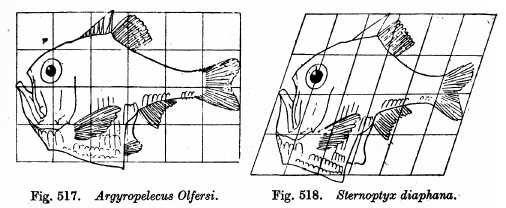
In his "eccentric, beautiful" 1917 book On Growth and Form, D'Arcy Wentworth Thompson revisited the old idea of "universal laws of form" to explain the observed forms of living organisms. The science writer Philip Ball states that Thompson "presents mathematical principles as a shaping agency that may supersede natural selection, showing how the structures of the living world often echo those in inorganic nature", and notes his "frustration at the 'Just So' explanations of morphology offered by Darwinians." Instead, Ball writes, Thompson elaborates on how not heredity but physical forces govern biological form. The philosopher of biology Michael Ruse similarly wrote that Thompson "had little time for natural selection", certainly preferring "mechanical explanations" and possibly straying into vitalism.
Like Thompson, the palaeontologist Adolf Seilacher emphasised fabricational constraints on form. He interpreted fossils such as Dickinsonia in the Ediacaran biota as "pneu" structures determined by mechanical inflation like a quilted air mattress, rather than having been driven by natural selection.
In his 2014 book Homology, Genes, and Evolutionary Innovation, the evolutionary biologist Günter P. Wagner argues for "the study of novelty as distinct from adaptation." He defines novelty as occurring when some part of the body develops an individual and quasi-independent existence, in other words as a distinct and recognisable structure, which he implies might occur before natural selection begins to adapt the structure for some function. He forms a structuralist picture of evolutionary developmental biology, using empirical evidence, arguing that homology and biological novelty are key aspects requiring explanation, and that developmental bias (i.e. structural constraints on embryonic development) is a key explanation for these.
The mathematical biologist Stuart Kauffman suggested in 1993 that self-organization may play a role alongside natural selection in three areas of evolutionary biology, namely population dynamics, molecular evolution, and morphogenesis. With respect to molecular biology, Kauffman has been criticised for ignoring the role of energy in driving biochemical reactions in cells, which can fairly be called self-catalysing but which do not simply self-organise.
Structuralism (biology)
Biological or process structuralism is a school of biological thought that objects to an exclusively Darwinian or adaptationist explanation of natural selection such as is described in the 20th century's modern synthesis. It proposes instead that evolution is guided differently, by physical forces which shape the development of an animal's body, and sometimes implies that these forces supersede selection altogether.
Structuralists have proposed different mechanisms that might have guided the formation of body plans. Before Darwin, Étienne Geoffroy Saint-Hilaire argued that animals shared homologous parts, and that if one was enlarged, the others would be reduced in compensation. After Darwin, D'Arcy Thompson hinted at vitalism and offered geometric explanations in his classic 1917 book On Growth and Form. Adolf Seilacher suggested mechanical inflation for "pneu" structures in Ediacaran biota fossils such as Dickinsonia. Günter P. Wagner argued for developmental bias, structural constraints on embryonic development. Stuart Kauffman favoured self-organisation, the idea that complex structure emerges holistically and spontaneously from the dynamic interaction of all parts of an organism. Michael Denton argued for laws of form by which Platonic universals or "Types" are self-organised. Stephen J. Gould and Richard Lewontin proposed biological "spandrels", features created as a byproduct of the adaptation of nearby structures. Gerd B. Müller and Stuart A. Newman argued that the appearance in the fossil record of most of the phyla in the Cambrian explosion was "pre-Mendelian" evolution caused by physical factors. Brian Goodwin, described by Wagner as part of "a fringe movement in evolutionary biology", denies that biological complexity can be reduced to natural selection, and argues that pattern formation is driven by morphogenetic fields.
Darwinian biologists have criticised structuralism, emphasising that there is plentiful evidence both that natural selection is effective and, from deep homology, that genes have been involved in shaping organisms throughout evolutionary history. They accept that some structures such as the cell membrane self-assemble, but deny the ability of self-organisation to drive large-scale evolution.
In 1830, Étienne Geoffroy Saint-Hilaire argued a structuralist case against the functionalist (teleological) position of Georges Cuvier. Geoffroy believed that homologies of structure between animals indicated that they shared an ideal pattern; these did not imply evolution but a unity of plan, a law of nature. He further believed that if one part was more developed within a structure, the other parts would necessarily be reduced in compensation, as nature always used the same materials: if more of them were used for one feature, less was available for the others.
In his "eccentric, beautiful" 1917 book On Growth and Form, D'Arcy Wentworth Thompson revisited the old idea of "universal laws of form" to explain the observed forms of living organisms. The science writer Philip Ball states that Thompson "presents mathematical principles as a shaping agency that may supersede natural selection, showing how the structures of the living world often echo those in inorganic nature", and notes his "frustration at the 'Just So' explanations of morphology offered by Darwinians." Instead, Ball writes, Thompson elaborates on how not heredity but physical forces govern biological form. The philosopher of biology Michael Ruse similarly wrote that Thompson "had little time for natural selection", certainly preferring "mechanical explanations" and possibly straying into vitalism.
Like Thompson, the palaeontologist Adolf Seilacher emphasised fabricational constraints on form. He interpreted fossils such as Dickinsonia in the Ediacaran biota as "pneu" structures determined by mechanical inflation like a quilted air mattress, rather than having been driven by natural selection.
In his 2014 book Homology, Genes, and Evolutionary Innovation, the evolutionary biologist Günter P. Wagner argues for "the study of novelty as distinct from adaptation." He defines novelty as occurring when some part of the body develops an individual and quasi-independent existence, in other words as a distinct and recognisable structure, which he implies might occur before natural selection begins to adapt the structure for some function. He forms a structuralist picture of evolutionary developmental biology, using empirical evidence, arguing that homology and biological novelty are key aspects requiring explanation, and that developmental bias (i.e. structural constraints on embryonic development) is a key explanation for these.
The mathematical biologist Stuart Kauffman suggested in 1993 that self-organization may play a role alongside natural selection in three areas of evolutionary biology, namely population dynamics, molecular evolution, and morphogenesis. With respect to molecular biology, Kauffman has been criticised for ignoring the role of energy in driving biochemical reactions in cells, which can fairly be called self-catalysing but which do not simply self-organise.
Recent media
Recent media