
Recent from talks
Ediacaran biota
Knowledge base stats:
Talk channels stats:
Members stats:
Ediacaran biota
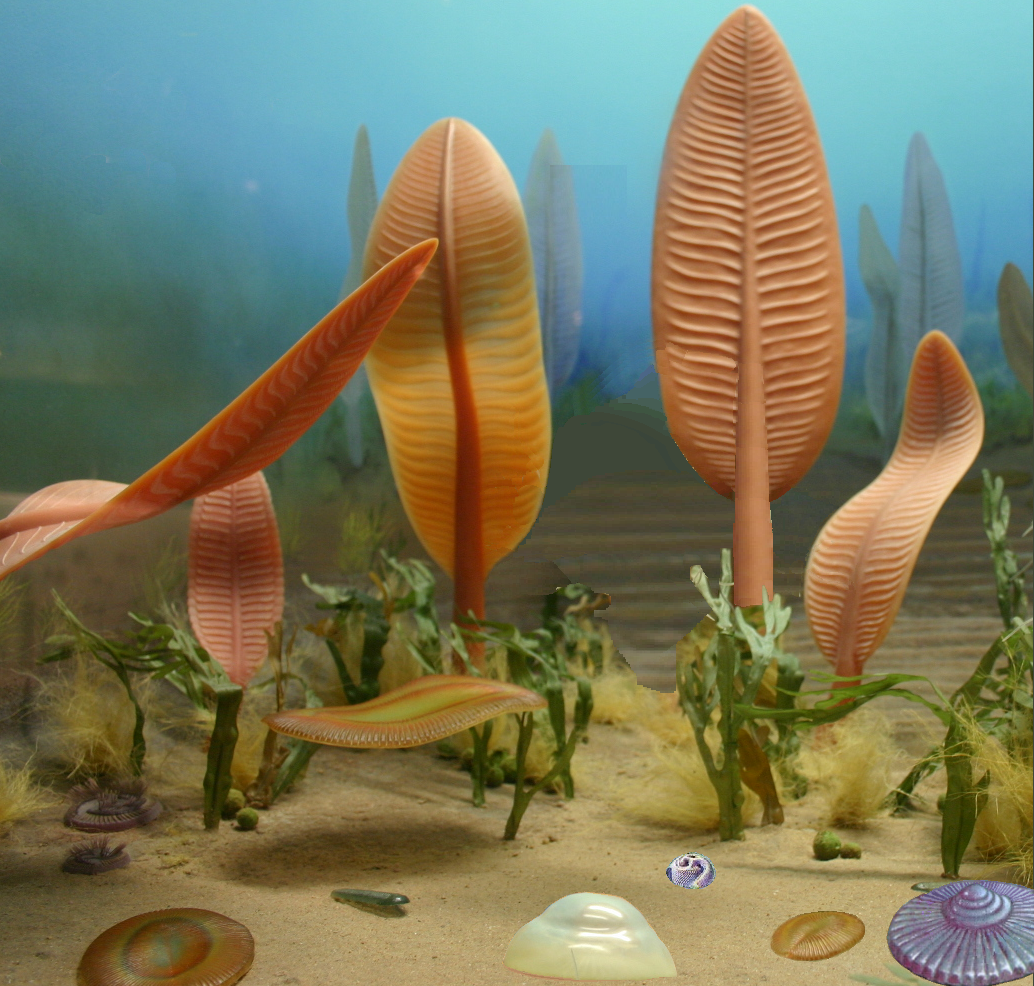
The Ediacaran (/ˌiːdiˈækərən/ EE-dee-ACK-ər-ən; formerly Vendian) biota is a taxonomic period classification that consists of all life forms that were present on Earth during the Ediacaran Period (c. 635–538.8 Mya). These were enigmatic tubular and frond-shaped, mostly sessile, organisms. Trace fossils of these organisms have been found worldwide, and represent the earliest known complex multicellular organisms. The term "Ediacara biota" has received criticism from some scientists due to its alleged inconsistency, arbitrary exclusion of certain fossils, and inability to be precisely defined.
The Ediacaran biota may have undergone evolutionary radiation in a proposed event called the Avalon explosion, 575 million years ago. This was after the Earth had thawed from the Cryogenian period's extensive glaciation. This biota largely disappeared with the rapid increase in biodiversity known as the Cambrian explosion. Most of the currently existing body plans of animals first appeared in the fossil record of the Cambrian rather than the Ediacaran. For macroorganisms, the Cambrian biota appears to have almost completely replaced the organisms that dominated the Ediacaran fossil record, although relationships are still a matter of debate.
The organisms of the Ediacaran Period first appeared around 600 million years ago and flourished until the cusp of the Cambrian 538.8 million years ago, when the characteristic communities of fossils vanished. A diverse Ediacaran community was discovered in 1995 in Sonora, Mexico, and is approximately 555 million years in age, roughly coeval with Ediacaran fossils of the Ediacara Hills in South Australia and the White Sea on the coast of Russia. While rare fossils that may represent survivors have been found as late as the Middle Cambrian (510–500 Mya), the earlier fossil communities disappear from the record at the end of the Ediacaran, leaving only curious fragments of once-thriving ecosystems. Multiple hypotheses exist to explain the disappearance of this biota, including preservation bias, a changing environment, the advent of predators and competition from other life-forms. A sampling, reported in 2018, of late Ediacaran strata across the scattered remnants of Baltica (< 560 Mya) suggests the flourishing of the organisms coincided with conditions of low overall productivity with a very high percentage produced by bacteria, which may have led to high concentrations of dissolved organic material in the oceans.
Determining where Ediacaran organisms fit in the tree of life has proven challenging; it is not even established that most of them were animals, with suggestions that they were lichens (fungus-alga symbionts), algae, protists known as foraminifera, fungi or microbial colonies, or hypothetical intermediates between plants and animals. The morphology and habit of some taxa (e.g. Funisia dorothea) suggest relationships to Porifera or Cnidaria (e.g. Auroralumina). Kimberella may show a similarity to molluscs, and other organisms have been thought to possess bilateral symmetry, although this is controversial. Most macroscopic fossils are morphologically distinct from later life-forms: they resemble discs, tubes, mud-filled bags or quilted mattresses. Due to the difficulty of deducing evolutionary relationships among these organisms, some palaeontologists have suggested that these represent completely extinct lineages that do not resemble any living organism. Palaeontologist Adolf Seilacher proposed a separate subkingdom level category Vendozoa (now renamed Vendobionta) in the Linnaean hierarchy for the Ediacaran biota. If these enigmatic organisms left no descendants, their strange forms might be seen as a "failed experiment" in multicellular life, with later multicellular life evolving independently from unrelated single-celled organisms. A 2018 study confirmed that one of the period's most-prominent and iconic fossils, Dickinsonia, included cholesterol, suggesting affinities to animals, fungi, or red algae.
The first Ediacaran fossils discovered were the disc-shaped Aspidella terranovica in 1868. Their discoverer, Scottish geologist Alexander Murray, found them useful aids for correlating the age of rocks around Newfoundland. However, since they lay below the "Primordial Strata" of the Cambrian that was then thought to contain the very first signs of animal life, a proposal four years after their discovery by Elkanah Billings that these simple forms represented fauna was dismissed by his peers. Instead, they were interpreted as gas escape structures or inorganic concretions. No similar structures elsewhere in the world were then known and the one-sided debate soon fell into obscurity. In 1933, Georg Gürich discovered specimens in Namibia but assigned them to the Cambrian Period. In 1946, Reg Sprigg noticed "jellyfishes" in the Ediacara Hills of Australia's Flinders Ranges, which were at the time believed to be Early Cambrian.
It was not until the British discovery of the iconic Charnia that the Precambrian was seriously considered as containing life. This frond-shaped fossil was found in England's Charnwood Forest first by a 15 year-old girl in 1956 (Tina Negus, who was not believed) and then the next year by a group of three schoolboys including 15 year-old Roger Mason. Due to the detailed geological mapping of the British Geological Survey, there was no doubt these fossils sat in Precambrian rocks. Palaeontologist Martin Glaessner finally, in 1959, made the connection between this and the earlier finds and with a combination of improved dating of existing specimens and an injection of vigour into the search, many more instances were recognised.
All specimens discovered until 1967 were in coarse-grained sandstone that prevented preservation of fine details, making interpretation difficult. S.B. Misra's discovery of fossiliferous ash-beds at the Mistaken Point assemblage in Newfoundland changed all this as the delicate detail preserved by the fine ash allowed the description of features that were previously undiscernible. It was also the first discovery of Ediacarans in deep water sediments.
Poor communication, combined with the difficulty in correlating globally distinct formations, led to a plethora of different names for the biota. In 1960 the French name "Ediacarien" – after the Ediacara Hills – was added to the competing terms "Sinian" and "Vendian" for terminal-Precambrian rocks, and these names were also applied to the life-forms. "Ediacaran" and "Ediacarian" were subsequently applied to the epoch or period of geological time and its corresponding rocks. In March 2004, the International Union of Geological Sciences ended the inconsistency by formally naming the terminal period of the Neoproterozoic after the Australian locality.
Hub AI
Ediacaran biota AI simulator
(@Ediacaran biota_simulator)
Ediacaran biota
The Ediacaran (/ˌiːdiˈækərən/ EE-dee-ACK-ər-ən; formerly Vendian) biota is a taxonomic period classification that consists of all life forms that were present on Earth during the Ediacaran Period (c. 635–538.8 Mya). These were enigmatic tubular and frond-shaped, mostly sessile, organisms. Trace fossils of these organisms have been found worldwide, and represent the earliest known complex multicellular organisms. The term "Ediacara biota" has received criticism from some scientists due to its alleged inconsistency, arbitrary exclusion of certain fossils, and inability to be precisely defined.
The Ediacaran biota may have undergone evolutionary radiation in a proposed event called the Avalon explosion, 575 million years ago. This was after the Earth had thawed from the Cryogenian period's extensive glaciation. This biota largely disappeared with the rapid increase in biodiversity known as the Cambrian explosion. Most of the currently existing body plans of animals first appeared in the fossil record of the Cambrian rather than the Ediacaran. For macroorganisms, the Cambrian biota appears to have almost completely replaced the organisms that dominated the Ediacaran fossil record, although relationships are still a matter of debate.
The organisms of the Ediacaran Period first appeared around 600 million years ago and flourished until the cusp of the Cambrian 538.8 million years ago, when the characteristic communities of fossils vanished. A diverse Ediacaran community was discovered in 1995 in Sonora, Mexico, and is approximately 555 million years in age, roughly coeval with Ediacaran fossils of the Ediacara Hills in South Australia and the White Sea on the coast of Russia. While rare fossils that may represent survivors have been found as late as the Middle Cambrian (510–500 Mya), the earlier fossil communities disappear from the record at the end of the Ediacaran, leaving only curious fragments of once-thriving ecosystems. Multiple hypotheses exist to explain the disappearance of this biota, including preservation bias, a changing environment, the advent of predators and competition from other life-forms. A sampling, reported in 2018, of late Ediacaran strata across the scattered remnants of Baltica (< 560 Mya) suggests the flourishing of the organisms coincided with conditions of low overall productivity with a very high percentage produced by bacteria, which may have led to high concentrations of dissolved organic material in the oceans.
Determining where Ediacaran organisms fit in the tree of life has proven challenging; it is not even established that most of them were animals, with suggestions that they were lichens (fungus-alga symbionts), algae, protists known as foraminifera, fungi or microbial colonies, or hypothetical intermediates between plants and animals. The morphology and habit of some taxa (e.g. Funisia dorothea) suggest relationships to Porifera or Cnidaria (e.g. Auroralumina). Kimberella may show a similarity to molluscs, and other organisms have been thought to possess bilateral symmetry, although this is controversial. Most macroscopic fossils are morphologically distinct from later life-forms: they resemble discs, tubes, mud-filled bags or quilted mattresses. Due to the difficulty of deducing evolutionary relationships among these organisms, some palaeontologists have suggested that these represent completely extinct lineages that do not resemble any living organism. Palaeontologist Adolf Seilacher proposed a separate subkingdom level category Vendozoa (now renamed Vendobionta) in the Linnaean hierarchy for the Ediacaran biota. If these enigmatic organisms left no descendants, their strange forms might be seen as a "failed experiment" in multicellular life, with later multicellular life evolving independently from unrelated single-celled organisms. A 2018 study confirmed that one of the period's most-prominent and iconic fossils, Dickinsonia, included cholesterol, suggesting affinities to animals, fungi, or red algae.
The first Ediacaran fossils discovered were the disc-shaped Aspidella terranovica in 1868. Their discoverer, Scottish geologist Alexander Murray, found them useful aids for correlating the age of rocks around Newfoundland. However, since they lay below the "Primordial Strata" of the Cambrian that was then thought to contain the very first signs of animal life, a proposal four years after their discovery by Elkanah Billings that these simple forms represented fauna was dismissed by his peers. Instead, they were interpreted as gas escape structures or inorganic concretions. No similar structures elsewhere in the world were then known and the one-sided debate soon fell into obscurity. In 1933, Georg Gürich discovered specimens in Namibia but assigned them to the Cambrian Period. In 1946, Reg Sprigg noticed "jellyfishes" in the Ediacara Hills of Australia's Flinders Ranges, which were at the time believed to be Early Cambrian.
It was not until the British discovery of the iconic Charnia that the Precambrian was seriously considered as containing life. This frond-shaped fossil was found in England's Charnwood Forest first by a 15 year-old girl in 1956 (Tina Negus, who was not believed) and then the next year by a group of three schoolboys including 15 year-old Roger Mason. Due to the detailed geological mapping of the British Geological Survey, there was no doubt these fossils sat in Precambrian rocks. Palaeontologist Martin Glaessner finally, in 1959, made the connection between this and the earlier finds and with a combination of improved dating of existing specimens and an injection of vigour into the search, many more instances were recognised.
All specimens discovered until 1967 were in coarse-grained sandstone that prevented preservation of fine details, making interpretation difficult. S.B. Misra's discovery of fossiliferous ash-beds at the Mistaken Point assemblage in Newfoundland changed all this as the delicate detail preserved by the fine ash allowed the description of features that were previously undiscernible. It was also the first discovery of Ediacarans in deep water sediments.
Poor communication, combined with the difficulty in correlating globally distinct formations, led to a plethora of different names for the biota. In 1960 the French name "Ediacarien" – after the Ediacara Hills – was added to the competing terms "Sinian" and "Vendian" for terminal-Precambrian rocks, and these names were also applied to the life-forms. "Ediacaran" and "Ediacarian" were subsequently applied to the epoch or period of geological time and its corresponding rocks. In March 2004, the International Union of Geological Sciences ended the inconsistency by formally naming the terminal period of the Neoproterozoic after the Australian locality.
Recent media