
Recent from talks
Poe Toaster
Knowledge base stats:
Talk channels stats:
Members stats:
Poe Toaster
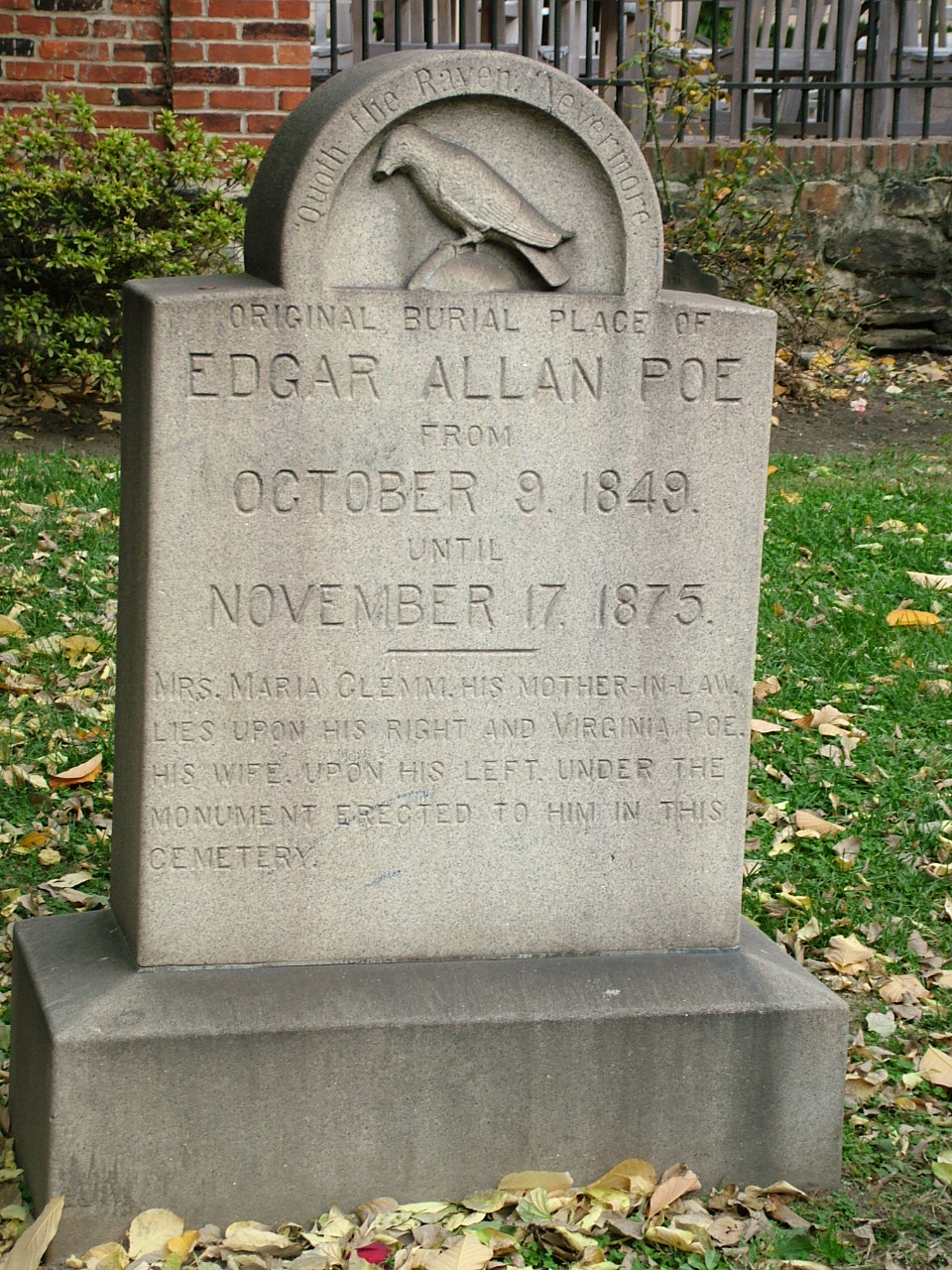
Poe Toaster is the media sobriquet used to refer to an unidentified person (or probably more than one person in succession) who, for several decades, paid an annual tribute to the American author Edgar Allan Poe by visiting the cenotaph marking his original grave in Baltimore, Maryland, in the early hours of January 19, Poe's birthday. The shadowy figure, dressed in black with a wide-brimmed hat and white scarf, would pour himself a glass of cognac (or cherry brandy, amontillado, or Scotch whisky) and raise a toast to Poe's memory, then vanish into the night, leaving three roses in a distinctive arrangement and the unfinished bottle of liquor. Onlookers gathered annually in hopes of glimpsing the elusive Toaster, who did not seek publicity and was rarely seen or photographed.
According to eyewitness reports and notes accompanying offerings in later years, the original Toaster made the annual visitation from sometime in the 1930s (though no report appeared in print until 1950) until his death in 1998, after which the tradition was passed to "a son". Controversial statements were made in some notes left by the post-1998 Toaster. In 2010, there was no visit by the Toaster, with absences in 2011 and 2012 signaling an end to the lengthy 75-year tradition. In 2016, the Maryland Historical Society selected a new "Toaster", marking the start of a new era for the tradition.
Edgar Allan Poe, an American author, died in Baltimore, Maryland, on October 7, 1849, under mysterious circumstances. The Poe Toaster tradition may have begun as early as the 1930s, according to witnesses, and continued annually until 2009.
Each year, in the early hours of the morning of January 19 (Poe's birthday), a black-clad figure carrying a silver-tipped cane, his face obscured by a scarf or hood, entered the Westminster Hall and Burying Ground in Baltimore. At the site of Poe's original grave—which is marked with a commemorative stone—he would pour a glass of Martell cognac and raise a toast. He then arranged three red roses on the monument in a distinctive configuration and departed, leaving the unfinished bottle of cognac.
The roses were believed to represent Poe, his wife Virginia Eliza Poe, and his mother-in-law Maria Clemm, all three of whom were originally interred at the site. The significance of the cognac is uncertain, as it does not feature in Poe’s works (as would, for example, amontillado); but a note left at the 2004 visitation suggested that the cognac may have represented a tradition of the Toaster's family rather than Poe's. Several of the cognac bottles are kept at the Edgar Allan Poe House and Museum.
A group of varying size composed of reporters and Poe enthusiasts observed the event each year. A photograph, reputedly of the Toaster, was published by Life Magazine in 1990.
On several occasions, the Toaster left a note along with the roses and cognac. Some notes were simple expressions of devotion, such as, "Edgar, I haven't forgotten you." In 1993, a cryptic message stated, "The torch will be passed." In 1999, a note announced that the original Toaster had died the previous year and had passed the tradition to "a son." Subsequent eyewitnesses noted that the post-1998 Toaster appeared to be a younger individual.
A note left at the 2001 visitation, which happened to occur a few days before Super Bowl XXXV between the Baltimore Ravens and the New York Giants, spurred controversy in Baltimore: "The New York Giants. Darkness and decay and the big blue hold dominion over all. The Baltimore Ravens. A thousand injuries they will suffer. Edgar Allan Poe evermore." Never before had the Toaster commented on sports or other current events, nor could anyone explain the negative reference to Baltimore's football team, whose nickname was inspired by Poe's poem "The Raven". The prophecy, a play on the last line of "The Masque of the Red Death" ("And Darkness and Decay and the Red Death held illimitable dominion over all") and on the Giants' nickname "The Big Blue," proved inaccurate, as Baltimore won the game 34–7.
Hub AI
Poe Toaster AI simulator
(@Poe Toaster_simulator)
Poe Toaster
Poe Toaster is the media sobriquet used to refer to an unidentified person (or probably more than one person in succession) who, for several decades, paid an annual tribute to the American author Edgar Allan Poe by visiting the cenotaph marking his original grave in Baltimore, Maryland, in the early hours of January 19, Poe's birthday. The shadowy figure, dressed in black with a wide-brimmed hat and white scarf, would pour himself a glass of cognac (or cherry brandy, amontillado, or Scotch whisky) and raise a toast to Poe's memory, then vanish into the night, leaving three roses in a distinctive arrangement and the unfinished bottle of liquor. Onlookers gathered annually in hopes of glimpsing the elusive Toaster, who did not seek publicity and was rarely seen or photographed.
According to eyewitness reports and notes accompanying offerings in later years, the original Toaster made the annual visitation from sometime in the 1930s (though no report appeared in print until 1950) until his death in 1998, after which the tradition was passed to "a son". Controversial statements were made in some notes left by the post-1998 Toaster. In 2010, there was no visit by the Toaster, with absences in 2011 and 2012 signaling an end to the lengthy 75-year tradition. In 2016, the Maryland Historical Society selected a new "Toaster", marking the start of a new era for the tradition.
Edgar Allan Poe, an American author, died in Baltimore, Maryland, on October 7, 1849, under mysterious circumstances. The Poe Toaster tradition may have begun as early as the 1930s, according to witnesses, and continued annually until 2009.
Each year, in the early hours of the morning of January 19 (Poe's birthday), a black-clad figure carrying a silver-tipped cane, his face obscured by a scarf or hood, entered the Westminster Hall and Burying Ground in Baltimore. At the site of Poe's original grave—which is marked with a commemorative stone—he would pour a glass of Martell cognac and raise a toast. He then arranged three red roses on the monument in a distinctive configuration and departed, leaving the unfinished bottle of cognac.
The roses were believed to represent Poe, his wife Virginia Eliza Poe, and his mother-in-law Maria Clemm, all three of whom were originally interred at the site. The significance of the cognac is uncertain, as it does not feature in Poe’s works (as would, for example, amontillado); but a note left at the 2004 visitation suggested that the cognac may have represented a tradition of the Toaster's family rather than Poe's. Several of the cognac bottles are kept at the Edgar Allan Poe House and Museum.
A group of varying size composed of reporters and Poe enthusiasts observed the event each year. A photograph, reputedly of the Toaster, was published by Life Magazine in 1990.
On several occasions, the Toaster left a note along with the roses and cognac. Some notes were simple expressions of devotion, such as, "Edgar, I haven't forgotten you." In 1993, a cryptic message stated, "The torch will be passed." In 1999, a note announced that the original Toaster had died the previous year and had passed the tradition to "a son." Subsequent eyewitnesses noted that the post-1998 Toaster appeared to be a younger individual.
A note left at the 2001 visitation, which happened to occur a few days before Super Bowl XXXV between the Baltimore Ravens and the New York Giants, spurred controversy in Baltimore: "The New York Giants. Darkness and decay and the big blue hold dominion over all. The Baltimore Ravens. A thousand injuries they will suffer. Edgar Allan Poe evermore." Never before had the Toaster commented on sports or other current events, nor could anyone explain the negative reference to Baltimore's football team, whose nickname was inspired by Poe's poem "The Raven". The prophecy, a play on the last line of "The Masque of the Red Death" ("And Darkness and Decay and the Red Death held illimitable dominion over all") and on the Giants' nickname "The Big Blue," proved inaccurate, as Baltimore won the game 34–7.
Recent media