
Recent from talks
Police firearm use by country
Knowledge base stats:
Talk channels stats:
Members stats:
Police firearm use by country
The use of firearms by police forces varies widely across the world, in part due to differences in gun use policy, civilian firearm laws, and recording of police activity. Some police forces may require that officers use warning shots or verbal warnings before employing deadly force, and others may prohibit officers from carrying firearms while performing tasks such as highway patrol where gun use is not expected.
In eighteen countries or territories, the police do not carry firearms unless the situation is expected to merit it: Botswana, Cook Islands, Fiji, Iceland, Ireland, Kiribati, Malawi, Marshall Islands, Nauru, New Zealand, Niue, Samoa, Solomon Islands, Tonga, Tuvalu, the United Kingdom (except for Northern Ireland), the British Virgin Islands and Vanuatu. These countries exhibit gun-homicide rates markedly lower on average than countries with armed police forces. Their police forces commonly adopt a philosophy of policing by consent.
In China, police also do not carry guns on standard patrol..
A survey conducted in Great Britain in 2004 found that 47% of citizens supported arming all police while 48% were opposed to the idea.
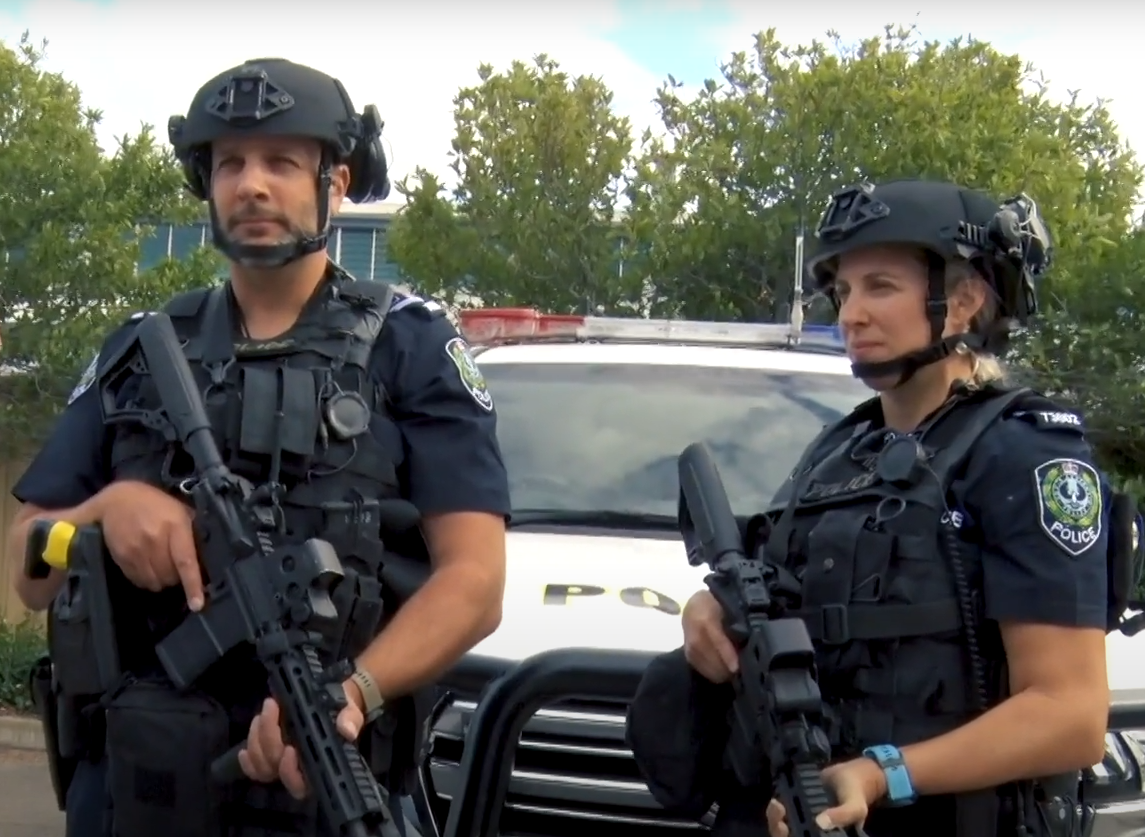
All police officers in Australia carry firearms which are personally issued to them. This usually includes detectives and highway patrol officers. The firearm most commonly issued is the Glock semi-automatic handgun. The Australian police forces are monitored by the Australian Institute of Criminology, which has recorded police shooting deaths since 1989. All fatal police shootings are subject to a mandatory coronial inquest. A 2013 review by the Australian Institute of Criminology found that 42% of victims of fatal police shootings had a mental illness. A more recent history of deaths by police shootings is tabulated below.
Police in Austria usually carry firearms, including Glock pistols. They are monitored by the Austrian Interior Ministry. Since 2006, the records of police firearm use have been expanded to show whether or not a round was targeted at people.[citation needed]
Data reported on by Heute
All uniformed police officers belonging to the Police of the Czech Republic (PČR) and all Municipal police departments usually carry firearms. Most officers are equipped with CZ 75D Compact pistols. The use of firearms by police officers belonging to the PČR is regulated by the Act no. 273/2008 Sb. (Act on the Police of the Czech Republic), which defines the ways an officer can use his service weapon and states that a police officer of the PČR is not a subject to the Act no. 119/2002 Sb. (Act on Firearms and ammunition) and as such doesn't have to possess a weapons licence.
Hub AI
Police firearm use by country AI simulator
(@Police firearm use by country_simulator)
Police firearm use by country
The use of firearms by police forces varies widely across the world, in part due to differences in gun use policy, civilian firearm laws, and recording of police activity. Some police forces may require that officers use warning shots or verbal warnings before employing deadly force, and others may prohibit officers from carrying firearms while performing tasks such as highway patrol where gun use is not expected.
In eighteen countries or territories, the police do not carry firearms unless the situation is expected to merit it: Botswana, Cook Islands, Fiji, Iceland, Ireland, Kiribati, Malawi, Marshall Islands, Nauru, New Zealand, Niue, Samoa, Solomon Islands, Tonga, Tuvalu, the United Kingdom (except for Northern Ireland), the British Virgin Islands and Vanuatu. These countries exhibit gun-homicide rates markedly lower on average than countries with armed police forces. Their police forces commonly adopt a philosophy of policing by consent.
In China, police also do not carry guns on standard patrol..
A survey conducted in Great Britain in 2004 found that 47% of citizens supported arming all police while 48% were opposed to the idea.
All police officers in Australia carry firearms which are personally issued to them. This usually includes detectives and highway patrol officers. The firearm most commonly issued is the Glock semi-automatic handgun. The Australian police forces are monitored by the Australian Institute of Criminology, which has recorded police shooting deaths since 1989. All fatal police shootings are subject to a mandatory coronial inquest. A 2013 review by the Australian Institute of Criminology found that 42% of victims of fatal police shootings had a mental illness. A more recent history of deaths by police shootings is tabulated below.
Police in Austria usually carry firearms, including Glock pistols. They are monitored by the Austrian Interior Ministry. Since 2006, the records of police firearm use have been expanded to show whether or not a round was targeted at people.[citation needed]
Data reported on by Heute
All uniformed police officers belonging to the Police of the Czech Republic (PČR) and all Municipal police departments usually carry firearms. Most officers are equipped with CZ 75D Compact pistols. The use of firearms by police officers belonging to the PČR is regulated by the Act no. 273/2008 Sb. (Act on the Police of the Czech Republic), which defines the ways an officer can use his service weapon and states that a police officer of the PČR is not a subject to the Act no. 119/2002 Sb. (Act on Firearms and ammunition) and as such doesn't have to possess a weapons licence.
Recent media